
 Worksheets
Elimination and Thermoregulation
Total questions: 135
Worksheet time: 1hrs 19mins
Secretion and excretion of physiological waste products by the kidneys and intestines
(a)
Two distinct methods of elimination include:
Emesis, diaphoresis
Diaphoresis, urination
Defecation, Emesis
Urination, defecation
(a) elimination works to control blood composition and concentration. Absorbs nutrients and rids of excess fluid and electrolytes to maintain homeostasis
Stretch receptors stimulated at ___-___, triggering the voiding reflex
250-400L
250-400mL
400-600mL
100-200mL
Factors affecting urination include:
Medications
Fluid/food intake
Muscle tone
Pathological conditions
Exercise
Normal urinary elimination should look like:
30mL/hr
void every 6 hours
void once per shift
100mL/hr
Production of abnormally large amounts of urine
Which chronic condition is mainly associated with polyuria and polydipsia?
Compulsive intake of excessive amounts of fluid
<100mL of urine a day, associated with patients on dialysis and with kidney failure
<400mL of urine a day
Which term describes voiding often at nighttime? Common in the elderly and pregnant
What is the definition of dysuria?
What is the definition of hesitancy?
Can't urinate but have the urge to
Painful urination
Urinate often
Voiding often at nighttime
A loss of voluntary control of urination can be related to a _____ _____ injury.
(a)
During a home visit, an older adult male client mentions that he has experienced an increase in the frequency of urination at night. Which condition should the nurse discuss as a possible factor related to increased urinary elimination at night? (Select all that apply.)
A) Infection
B) Oliguria
C) Recognition of bladder fullness
D) Nocturia
E) Residual urine
A
B
C
D
E
Which of the following are risk factors for alterations in urination?
Aging
Arteriosclerosis
Surgery
Acute/Chronic Conditions
Constipation
We palpate before auscultate.
True
False
What can be expected in a urinary physical examination?
Palpation of abdomen
Assessment of flank pain
Skin turgor
Percussion of abdomen
Your elderly patient is having issues with urination frequency. You and your collogues are concerned about residual urine issues. What is the most convenient diagnostic test can be used to assess if the patient is experiencing residual urine?
Urine Study
Bladder Scan
Cystoscopy
Kidney Biopsy
What is the most common diagnostic tool for health assessment often done individuals with urinary symptoms.
You are caring for a patient admitted with urination retention. What are some independent nursing interventions you can complete?
Monitoring input and output
Catheter care
Incontinence care
Urine specimen collection
Suggest surgery for a urostomy
This medication blocks receptors in the detrusor muscle of the bladder, preventing contractions and the urge to avoid
*used in patients who constantly urinate to slow things down
Cholinergic medication
This medication stimulates bladder contraction and assists with voiding via relaxation of trigone and sphincter muscles
*take on empty stomach
Solifenacin Medication
Tolterodine Medication
Anticholinergic Medication
Cholinergic Medication
Your patient presents with polyuria and urine incontinence. Which medication might they be prescribed to help this urinary issue?
Anticholinergics
Cholinergics
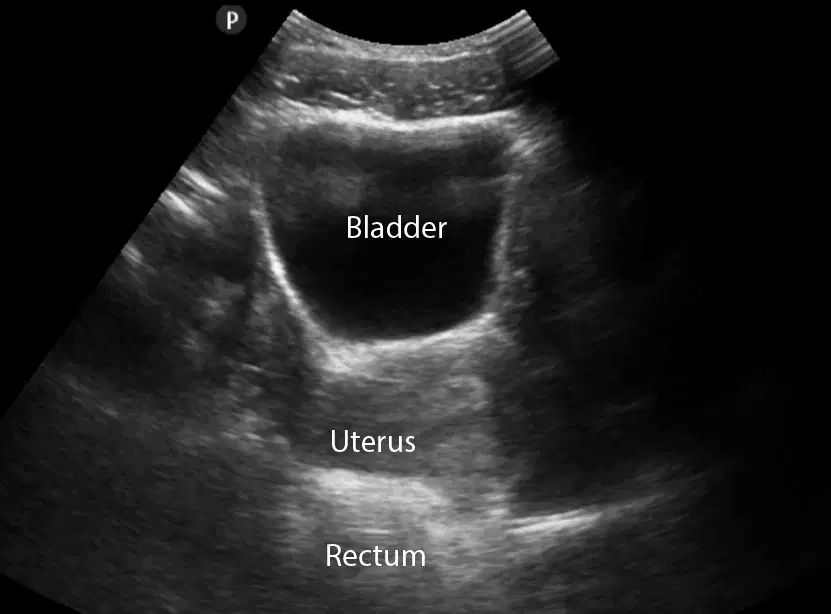
After completing a bladder scan of a patient, it is evident that they are experiencing urinary retention. What medication might be prescribed to help solve this issue?
Anticholinergics
Cholinergics
This treatment is used for kidney failure and is when a semipermeable membrane is used to filter blood by osmosis per patient schedule
(a)
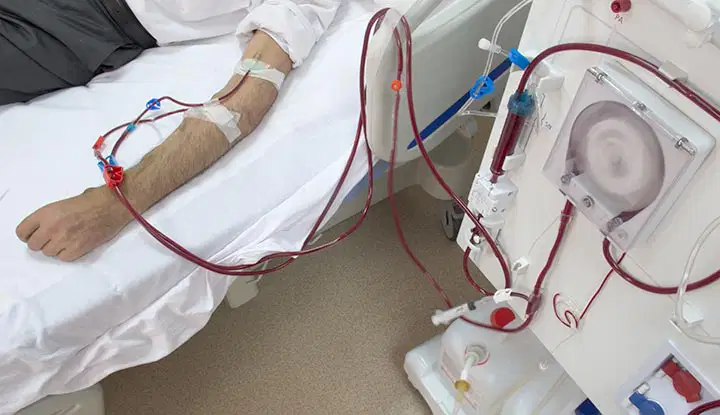
When blood flows through external machine
*when giving treatment to patient, be mindful of limb restriction
*NO BP in the arm that receives treatment!
Anticholinergic dialysis
Cholinergic Dialysis
Hemodialysis
Peritoneal dialysis
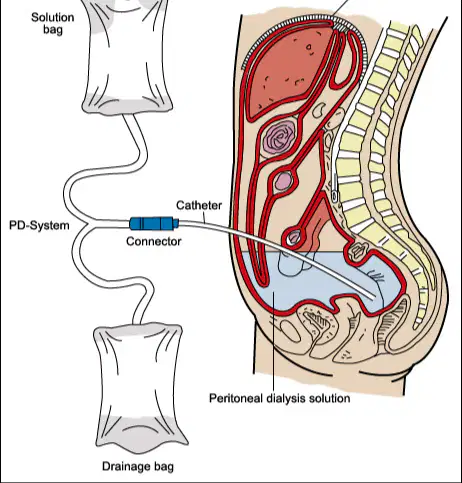
Solution is instilled into abdomen and rests there while molecules exchange and then it is drained
*typically used for temporary/acute kidney failure
Which structure stores urine before it is excreted from the body?
The average adult bladder can comfortably hold:
Upon completing a bladder scan after a patient has urinated, you find the bladder is still full of urine. This patient is most likely experiencing...
A nurse notes that a patient urinates frequently at night. This is called
Which of the following is a normal color and clarity of urine?
The nurse is teaching the patient about fluid intake. Which fluids are considered a diuretic and may increase urination?
Which nursing intervention can be completed to promote normal urinary elimination?
Providing privacy and adequate positioning
Which is not a function of the urinary system?
Filtration
Waste storage and removal
Homeostasis maintenance
Hormone production
Formation and expulsion of feces
-retrains nutrients and removes waste
-highly individualized
Urine elimination
Bowel elimination
Diarrhea elimination
Nutrients elimination
Peristalsis is defined as
Fiber that is good for colon health, and eases/prevents constipation
Insoluble fiber
Soluble fiber
Type of fiber that lowers blood cholesterol, improves blood sugars, help stay full longer
Insoluble fiber
Soluble fiber
Which of the following are factors affecting bowel elimination?
Diet
Irregular eating schedules
Spicy foods/foods high in sugar
Allergies
Which of the following are factors affecting bowel elimination and cause constipation?
Decreased Activity
Medication (Opioids)
Anesthesia Procedures
Increased whole grains in diet
During an office visit, a client reports infrequent and difficult bowel movements. Which teaching topic should the nurse include when developing the client's plan of care? (Select all that apply.)
A) The importance of staying active
B) The avoidance of raw fruit, vegetables, and meat when traveling abroad
C) The importance of cooking and storing food correctly
D) The use of laxatives or stool softeners
E) The importance of consuming adequate amounts of fluid and fiber
A
B
C
D
E
The passage of liquid feces with increased frequency
(a)
What are potential risks that are associated with diarrhea
Rapid passage of chyme and loss of fluid and electrolytes
Skin breakdown
Electrolyte imbalances
Edema
Presence of excess gas leading to inflation and stretching of intestines
Flatulence
Results from inflammation of the diverticula
*most patients with this are asymptomatic
-can compress arteries, obstruct the bowel, perforate, and cause bleeding
Hypertension
Diarrhea
Diverticular disease
Liver failure
occurs when the contents of the intestine are unable to move through the intestine
-can be mechanical or functional
Bowel obstruction
The daughter of a wheelchair-bound older adult client is concerned because her mother has been experiencing urinary incontinence. Which statement should the nurse use to explain the condition to the daughter?
A) "Renal blood flow and ability to concentrate urine decrease in older adults."
B) "Mobility issues may cause urinary incontinence."
C) "The frequency of voiding varies in older adults and may cause urinary incontinence."
"D) The kidneys reach maximum size at ages 35 to 40."
A
B
C
D
A surgically created opening that connects internal organ to the abdominal wall eliminating waste products
(a)
The nurse should anticipate conducting which assessment when preparing to provide care for a client experiencing alterations in bowel function? (Select all that apply.)
A) Abdominal assessment
B) Skin assessment
C) Client interview
D) Renal assessment
E) Inguinal area assessment
A
B
C
D
E
An inguinal hernia is defined as
The nurse is caring for a client who has a positive fecal test for occult blood. The nurse should anticipate which collaborative activity to further identify the cause of the client's problem?
Colonoscopy
Cystoscopy
Ultrasonic bladder scan
Direct rectal exam
Lowers surface tension of stool so that water can penetrate, soften, and allow for easier passing
*hold if patient has diarrhea
Stool Softeners
Stimulant Laxatives
Osmotic Laxatives
Bulk-Forming Laxatives
Stimulates intestinal peristalsis and increases the volume of water and electrolytes in intestine
*bowel movement should occur within 12 hours
Stimulant Laxatives
Stool Softeners
Osmotic Laxatives
Bulk-Forming Laxatives
Draws water into intestine to increase mass of stool and stretching of musculature
*causes peristalsis
Osmotic Laxatives
Stimulant Laxatives
Stool Softeners
Bulk-Forming Laxatives
Supplemental fiber to soften fecal mass and increase bulk
*take two hours before or after other meds
*take with at least 8oz of water
Bulk-Forming Laxatives
Osmotic Laxatives
Stimulant Laxatives
Stool Softeners
Augments acetylcholine, increasing upper GI motility and peristalsis
*don't use with bowel obstruction, perforation, or hemorrhage
Prokinetic Agents
Bulk-Forming Laxatives
Osmotic Laxatives
Stimulant Laxatives
Blocks opioid mu receptors in GI tract
Opioid Antagonists
Prokinetic Agents
Bulk-Forming Laxatives
Osmotic Laxatives
Blocks action of acetylcholine, slowing motility of the intestines
Antidiarrheal
Opioid Antagonists
Prokinetic Agents
Bulk-Forming Laxatives
What is meconium?
Which part of the GI tract is mainly responsible for water absorption and stool formation?
Stomach
Small intestine
Large intestine
Esophagus
Your patients stool SHOULD look...
Your patient is experiencing difficult, infrequent bowel movements. What is the medical term for what the patient is experiencing?
Your patient passes black, tarry stools (melena). This indicates:
What is the most common cause of constipation in hospitalized patients?
Increased activity
High-Fiber diets
Opioid pain medications
Stress
Which of the following foods would most help prevent constipation?
Whole grains
Bananas
White rice
Cheese
As a nurse, you know that a bowel training program is most useful for patients with:
Acute diarrhea
Normal bowel habits
Neurological conditions causing incontinence
Hemorrhoids
Which nursing intervention can best promote normal bowel elimination?
Restricting fluids to prevent incontinence
Encouraging privacy and regular toileting
Giving opioid medications
Discouraging ambulation after meals
Body's process of trying to balance heat production and loss
*controlled by hypothalamus
(a)
Our surface temperature remains stable, but our core temperature is always changing.
True
False
Normal body temperature range is 97-99 degrees F.
True
False
The temporal lobe responds when the core temp goes too high or low.
True
False
Ideal core temperature is 98.6 degrees.
True
False
Which of the following affect body temperature?
Fever-immune response
Basal Metabolic Rate
Muscle activity
Release of epinephrine, norepinephrine
Hunger
Temperature transfer that involves laying on a cold surface (ex. operating room table)
Temperature transfer that involves fluid motion of air or water (ex. fan, aquatics)
Temperature transfer that involves no physical contact (ex. the sun)
Temperature transfer that involves converting water into a vapor.
When the body becomes cold, it responds by...
Shivering
Sweating
Vasodilation
Vasoconstriction
Your patient is admitted with a traumatic brain injury. One of the healthcare providers concerns is the patients thermoregulation. Why is the healthcare provider concerned about the patient's ability to thermoregulate?
Factors that can affect thermoregulation include:
Age
Nutrition
Medications
Chronic Diseases
Infection
Without fever
Febrile-Pyrexia
Afebrile
T-Max
Hypothermia
Highest temperature recorded
Afebrile
Hottest
Hyperthermia
T-Max
Your patient has a temp of 94.9 degrees. They are considered hypothermic.
True
False
<95 degrees F
T-max
Febrile-Pyrexia
Hypothermia
Hyperthermia
>101.3 degrees F
Febrile-Pyrexia
Hyperthermia
Hypothermia
Afebrile
>104.0 degrees F
Hyperthermia
Hypothermia
Afebrile
T-Max
During your shift, you get vitals from a patient 3 times. The temperatures each time were:
103.4
103.9
102.4
What is the patient's T-max?
(a)
What is the most accurate way to take temperature?
Which age group is most at risk for impair thermoregulation?
What is an important nursing consideration in the thermoregulation of older adults?
May not have fever with illness
Can handle temps up to 105.8 degrees without difficulty
Increase of subcutaneous fat
Increased thermoregulation controls
A fever is a temperature of >101.3 degrees F.
True
False
Fever is a very serious symptom that should be treated immediately no matter the temperature.
True
False
Fever causes include:
Immune response
Stress
Inflammation
Autoimmune disease
Food allergy
Vasoconstriction occurs during fever.
True
False
Your patients fever alternates at regular intervals between periods of fever and periods of normal. They are most likely experiencing what type of fever?
constant fever
relapsing fever
remittent fever
Your patient is having flu-like symptoms. They have a fever that has a wide fluctuation in temperature over a 24 hour period. What type of fever is your patient most likely experiencing?
Remittent
Intermittent
Relapsing
Constant
Your patient is febrile for a few days, afebrile for a few days, then febrile for a few days. Which type of fever are they most likely experiencing?
Relapsing
Constant
Remittent
Intermittent
Your patient's fever fluctuates minimally, but is always above normal. Which type of fever are they experiencing?
Constant
Relapsing
Remittent
Fever spike
Your patient's fever fluctuates from normal to fever rapidly and returns to normal after a few hours
*risk for fever seizures
What kind of fever is your patient most likely experiencing?
Intermittent
Remittent
Relapsing
Fever Spike
Malaise is described as:
Your patient has a fever. What are some signs and symptoms of a fever that may be present in your patient?
Flushed/warm skin
Vomiting/diarrhea
Tachycardia/tachypnea
Hypotension
Body aches/fatigue
When completing a complete blood count, what are we looking for that would cause a fever?
Which of the following would help us find the cause of a fever?
Complete blood count
Urinalysis
Chest x-ray
Stool sample
Which fever pharmacological treatment is described:
-dose= 325mg-1g
-can be given as pill, liquid, IV, and suppository
-processed by liver
acetaminophen (Tylenol)
aspirin (NSAID)
ibuprofen (NSAID)
Which fever pharmacological treatment is described:
-dose= 325-650 mg
-increased risk for bleeding
-processed by kidney
Acetaminophen (Tylenol)
Ibuprofen (NSAID)
Aspirin (NSAID)
Which fever pharmacological treatment is described below:
-usual dose= 200-800mg
-motrin/aleve
-increase risk for bleeding
-processed by kidney
Acetaminophen (Tylenol)
Ibuprofen (NSAID)
Aspirin (NSAID)
What is the correct pathophysiology of hyperthermia?
cellular dysfunction occurs, heart becomes overwhelmed and cannot meet the demand, cardiac output diminishes
releases intracellular fluid into circulation, increase blood flow, heart works harder to pump the additional fluid, heart becomes overwhelmed and cannot meet the demand, cardiac output diminishes
cellular dysfunction occurs, releases intracellular fluid into circulation, increase blood flow, heart works harder to pump the additional fluid, heart becomes overwhelmed and cannot meet the demand, cardiac output diminishes
increase blood flow, heart works harder to pump the additional fluid, heart becomes overwhelmed and cannot meet the demand, cardiac output diminishes
If the ABC's are unaffected, the first thing you should do with a hyperthermic patient is...
COOL THEM DOWN!
HEAT THEM UP!
Remove clothing, and allow for body to naturally cool itself down
Remove clothing, and allow for body to naturally heat itself up
What are common in hyperthermic patients to get then cooled down ASAP?
Cooling blankets
Cool IV fluids
Cold Lavages
Heating pad
You need a doctor's order for the use of cooling blankets and cold lavages.
True
False
Which vital signs match a hyperthermic patient?
Respirations: 7
HR: 44
BP: 90/50
Respirations: 24
HR: 187
BP: 90/50
Respirations: 24
HR: 187
BP: 170/100
Respirations: 7
HR: 44
BP: 170/100
Loss of body fluid volume due to the loss of body fluid and salt
-Body is unable to compensate quickly enough
-Weakness, mental status change, possible loss of consciousness
(a)
Blood pressure skyrockets when you become heat exhausted.
True
False
Caused by high environmental temperatures and high humidity, dysfunction in thermoregulation, loss of ability to cool through sweat
-paleness, dizziness, vomiting, confusion, stupor, hypotension
(a)
Heat stroke can lead to vascular collapse, which is...
circulatory system fails to deliver enough blood to the body's organs
During heat stoke, permanent damage will be done to the body's organs after thirty minutes.
True
False
What are the three mechanisms of hypothermia?
Excessive heat loss
Inadequate heat production to counteract heat loss
Impaired hypothalamic thermoregulation
Impaired hyperthermic thermoregulation
Mild hypothermia
89.6--95 F
82.4-89.6 F
<82.4 F
Moderate hypothermia
89.6-95 F
82.4-89.6
<82.4
Severe hypothermia
<95 F
<82.4 F
82/4-89.6
What are the first signs of hypothermia?
Shivering
Pale, dry skin
Tachycardia, tachypnea
Bradycardia, bradypnea
What are signs of MODERATE hypothermia?
Depressed mental status
No shivering
Bradycardia, bradypnea
Pale/Cyanotic
Severe hypothermia...
Absence of pulse
Apnea
Coma
Tachycardia
What chronic disease puts someone at a thermoregulation risk?
Thyroid Disease
What are hypothermia causes and risk factors?
Endocrine disorders
Alcohol/drugs
Outdoor exposure
Wearing proper clothing
Newborns lose 4x the amount of heat than adults.
True
False
What are some risks for hypothermia in older adults?
Cognitive disorders
Chronic conditions
Decreased ability to maintain constant internal temp loss
Loss of hair
Injury of skin resulting from freezing~ no blood flow
(a)
Skin freezes when temperature drops below 32 degrees F.
True
False
The body vasoconstricts during hypothermia to conserve core temp, usually at the expense of the extremities.
Why does the body do this?
The body conserves core temp to protect the organs.
Necrosis happens in severe cases of frost bite and is defined as
the inflammation of body tissue due to infection. Results in green color
the formation of new blood vessels in response to injury. Results in blue color
the death of body tissue due to severe damage or lack of blood flow. Results in black color
What is infected necrosis?
Edema
Gangrene
Infection
Inflammation

