
 Worksheets
Foundation Chemistry Unit 1&2 Review
Total questions: 103
Worksheet time: 52mins
When a substance is heated, particles will
Move further apart
Get larger
Move closer together
Be unaffected
When heated, a substance expands and its density...
Increases
Stays the same
Decreases
Fluctuates
The process when a solid turns into a liquid
Evaporation
Sublimation
Freezing
Melting
The process when a gas turns into a liquid
Condensation
Sublimation
Freezing
Evaporation
The process when a liquid turns into a gas
Evaporation
Melting
Condensation
Deposition
The process when a solid turns into a gas
Sublimation
Deposition
Evaporation
Melting
The process when a gas turns into a solid
Deposition
Weathering and Erosion
Super freezing
Sublimation
What is the term given to the temperature at which a solid turns into a liquid?
Boiling point
Melting point
Freezing point
Heating point
What is the term given to the temperature at which a liquid changes to a solid?
Melting point
Boiling point
Sublimation point
Freezing point
True/False: When a substance changes state, its mass also changes.
FALSE
TRUE
True/False: When a substance changes state, its density remains the same.
FALSE
TRUE
True/False: Evaporation and condensation are opposite processes.
FALSE
TRUE
True/False: Melting and boiling are opposite processes.
FALSE
TRUE

Which of the following is a sign that a chemical reaction (or change) has occurred?
change in shape
melting
formation of a gas
dissolving

Is melting butter for popcorn a chemical or physical change?
chemical
physical

Which of the following is NOT an example of a physical change?
crumpled paper
dissolving sugar in water
freezing water
burning a marshmallow


Kool-aid dissolving in water
physical change
chemical change

A student calculated the density of a liquid and found it to be 1.36 g/ml. What is the liquid?
baby oil
water with food coloring
honey
dark maple syrup

What is happening to the molecules of water in the chemical change: electrolysis?
Molecules get closer together and more packed
Molecules break apart and form new molecules (H and O gas)
The atoms in the molecules get bigger
Nothing happens to the molecules


Which if the following is described as being pure substances?
elements
compounds
elements and compounds
mixtures
Which of the following describes a substance that has been physically combined and is NOT uniform throughout (you see the DIFFERENT parts that make it up)?
Homogeneous Mixture
Compound
Heterogeneous mixture
element
What is the smallest part of a compound that retains the properties of that compound
atom
element
Molecule
mixture
A student is observing a substance that contains multiple element that have been chemically combine C6H12O6(SUGAR). Which of the following best describes what the student is observing?
Heterogeneous Mixture
Homogeneous Mixture
Element
Compound
What is the smallest part of an element that retains the properties of the element?
atom
molecule
compound
subatomic particles

atom

atom

atom

This substance can be separated by physical means such as filtering, sifting, and evaporating.
Mixtures
Pure Substances
Elements
Compounds
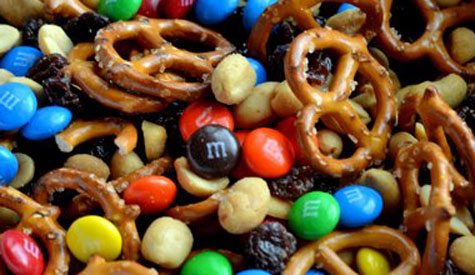

What kind of mixture is shown in the picture?
Homogeneous Mixture
Heterogeneous Mixture
When one or more substance is combined CHEMICALLY it is called __________________.
compound
element
mixture
solution

Which contains only elements?
A
B
C
D

Which contains a pure substance? (Choose all)
A
B
C
D
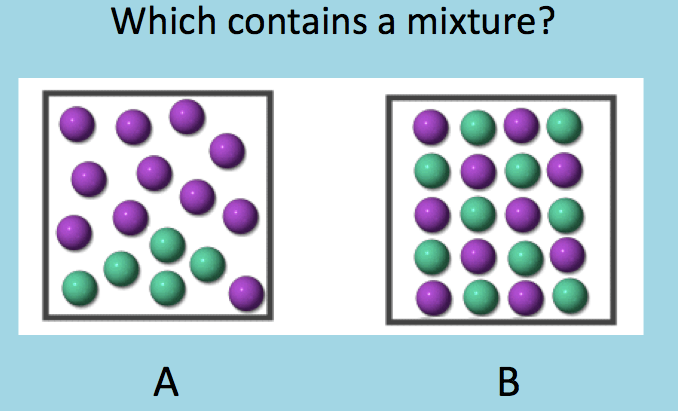
Which contains a mixture? (Choose all)
A
B

Which contains a solution? (Choose all)
A
B
None are solutions

Which contains a solid? (Choose all)
A
B
C
D

Which contains a pure substance? (Choose all)
A
B
C
D

What type of change is this?
Chemical
Melting
Evaporation
Condensation
Sublimation

Which contains only elements (no compounds)? (Choose all)
A
B
C

What type of change?
Chemical
Evaporation
Condensation
Sublimation
Melting

Which is a heterogeneous mixture? (Choose all)
1
2
3
4
Which of the following are found in the nucleus?
protons and electrons
protons ONLY
protons and neutrons
Electrons only
________________ have a positive charge, ___________________ have NO charge, and _____________________ have a negative charge.
Protons, Electrons, Neutrons
Neutrons, Electrons, Protons
Protons, Neutrons, Electrons
Electrons, Neutrons, Protons
Which of the following are found on the left side of the zig zag line on the periodic table?
Non-metals
metalloids
metals
compounds
_________________________ are the horizontal rows on the periodic table while _______________________ are the vertical columns.
periods/ groups(families)
groups(families)/periods
metals/non-metals
non-metals/metals

Which of the following elements is in (period 4 , group 2)
Carbon
Potassium
Calcium
Sodium

Which of the following has similar properties to potassium (K) because they are in the same group(family)
Sodium (Na)
Magnesium (Mg)
Calcium (Ca)
Gold (Au)
The element Zinc (Zn) has an atomic number of 30 and an atomic mass of 65 therefor each atom of zinc contains ___________protons, ______________neutrons, and _____________electrons.
30,30,35
30, 30, 25
30, 35, 30
35, 30, 30


number of electrons only
number of protons only
number of neutrons only
both electrons and protons in an atom


alphabetical order
number of neutrons
color
Which group does Aluminum belong to?
Group 3
Group 13
Group 6
Group 26
Which period is Oxygen found in?
Period 1
Period 2
Period 3
Group 16
Which element is found in Period 4, Group 8?
Iron
Oxygen
Nickel
Silver
What is the ATOMIC NUMBER of the element found in Period 4, Group 1?
41
4
1
19

Look at this picture of Argon off the periodic table. Which of the following is true for this element?
18 protons
40 protons
22 protons
21.9 protons

Look at this picture of Argon off the periodic table. Which of the following is true for this element when it is neutral?
18 electrons
40 electrons
22 electrons
21.9 electrons
When you two atoms with different masses, Carbon-12 and Carbon-13 for example, what type of atom do you have?
Neutral atom
Ion
Isotope
Which of the following is correct?
Protons are positive, electrons are negative, neutrons are neutral.
Protons are neutral, electrons are negative, neutrons are positive
Protons are negative, electrons are positive, neutrons are neutral
Protons are positive, electrons are neutral, neutrons are negative
Iodine-131
The -131 tells you the
number of protons.
mass number.
charge of the atom.
Which of the following elements is a metalloid?
Sulfur
Silicon
Iron
Copper

What is Group 18 referred as?
Halogens
Alkaline
Alkali
Noble Gases

How many protons are in this atom?
28
14
29
42

What element is represented in this Bohr Model?
Carbon
Hydrogen
Aluminum
Lithium


If an atom has an extra neutron, it is _____.
a positive ion
a neutral atom
an isotope
a negative ion

Can an atom of Helium have 3 neutrons?
Yes, because it can be an ion
No, because protons identify the atom
Yes, because it can be an isotope
No, because only neutral atom exist

Can an atom of Hydrogen have 2 protons?
Yes, because it can be an ion.
No, because protons identify the atom
Yes, because it can be an isotope
No, because only neutral atoms exist.
An atom has 12 protons and 13 neutrons in its nucleus. Which is the correct symbol?


Rubidium has two common isotopes, 85Rb and 87Rb. If the abundance of 85Rb is 72.2% and the abundance of 87Rb is 27.8%, what is the average atomic mass of rubidium?
85.468 amu
37 amu
85.6 amu
86.4 amu
There are two primary isotopes found in any sample of copper: copper-63 and copper-65. The isotope 65Cu composes 69.2% of the sample and 63Cu comprises the other 30.8%. Based on this data, what is the atomic mass of copper?
29 amu
63.546 amu
64.4 amu
63.6 amu
Isotopes of an element have a different number of...
Protons
Neutrons
Electrons
Mass

