wayground logo

Free Printable Worksheets

Font size

S
M
L
XL
Worksheets

High School Science ISASP Review

Total questions: 108

Worksheet time: 1hrs 16mins

Name
Class
Date
1.
Which of the following sequences of processes correctly reflects the central dogma?
a)
protein synthesis, transcription, translation
b)
protein synthesis, translation, transcription
c)
transcription, translation, protein synthesis
d)
translation, transcription, protein synthesis
2.
Any change in the sequence of DNA is...
a)
transgenic shift
b)
Single Genotype
c)
Monohybrid Trait
d)
Mutation
3.
DNA has a ______ strand; RNA has a ______ strand.
a)
double/double
b)
double/triple
c)
double/single
d)
single/single
4.

What is the goal of the central dogma?

a)

To create DNA

b)

To create RNA

c)

To create proteins

5.

What happens during transcription?

a)

DNA is replicated

b)

mRNA is created from a segment of DNA

c)

The amino acid chain is created

6.

Which are the four levels of biological organization from smallest to largest?

a)

organ system, organ, tissue, cell

b)

cell, organ, tissue, organ system

c)

cell, tissue, organ, organ system

d)

organ system, organ, cell, tissue

7.

Which system includes the kidneys which filter the blood of waste to make urine?

a)

excretory system

b)

reproductive system

c)

endocrine system

d)

circulatory system

8.

Which system connects to the bones to move them?

a)

digestive system

b)

circulatory system

c)

skeletal system

d)

muscular system

9.

Which system breaks down food and absorbs the nutrients?

a)

respiratory system

b)

endocrine system

c)

excretory system

d)

digestive system

10.

Which system is different between males and females and is needed to make babies?

a)

nervous system

b)

reproductive system

c)

immune system

d)

integumentary system

11.

Which system is blood a part of and is also responsible for pumping blood around the body?

a)

digestive system

b)

respiratory system

c)

circulatory system

d)

integumentary system

12.

Which system includes your skin, hair, and sweat glands?

a)

integumentary system

b)

circulatory system

c)

digestive system

d)

endocrine system

13.

Which system is responsible for thinking, emotions, and controlling movement?

a)

reproductive system

b)

muscular system

c)

nervous system

d)

integumentary system

14.

Which system has glands that produce hormones like testosterone, estrogen, and adrenaline (epinephrine)?

a)

digestive system

b)

excretory system

c)

endocrine system

d)

immune system

15.

Which system provides support for the body, protects vital organs like the brain and lungs, and is where new blood cells are made?

a)

nervous system

b)

respiratory system

c)

circulatory system

d)

skeletal system

16.

Which system protects the body from foreign pathogens (invaders) like viruses, bacteria, and fungi?

a)

immune system

b)

endocrine system

c)

nervous system

d)

skeletal system

17.

Which system brings in oxygen (O2) and takes out carbon dioxide (CO2) ?

a)

digestive system

b)

respiratory system

c)

nervous system

d)

immune system

18.
Homeostasis
a)
allows for a wildly fluctuating internal environment
b)
is impossible in vertebrates
c)
is the maintenance of a relatively stable internal environment and often incorporates a form of feedback regulation
d)
is the maintenance of a relatively stable external environment and often incorporates a form of feedback regulation
19.
Negative Feedback Loops:
a)
amplify processes
b)
prevent small changes from getting larger
c)
are initiated during childbirth
d)
are found only in plants
20.

Fruit fly body cells have 8 chromosomes. After mitosis, you would expect a resulting fruit fly daughter cell to have ...

a)

16 chromosomes.

b)

46 chromosomes.

c)

8 chromosomes.

d)

4 chromosomes.

21.
Name the phase:
a)
Anaphase
b)
Telophase
c)
Metaphase
d)
Prophase
22.
Identify the stage of mitosis.
a)
interphase
b)
prophase
c)
metaphase
d)
anaphase
23.
Identify the stage of mitosis. 
a)
interphase
b)
prophase
c)
anaphase
d)
cytokinesis
24.

A chromosome is packaged

a)

DNA

b)

Protein

c)

Carbohydrates

d)

Lipids

25.

What stage of mitosis is depicted here

a)

Prophase

b)

Anaphase

c)

Telophase

d)

Metaphase

26.

What stage of mitosis is depicted here

a)

Prophase

b)

Metaphase

c)

Anaphase

d)

Telophase

27.
Pigment in green plants that captures the energy in sunlight is called _______.
a)
Pigment
b)
Chlorophyll
c)
Stomata
d)
Green Thing
28.
Which of the following is the correct equation for PHOTOSYNTHESIS?
a)
CO+ light + H2O --> O+ Sugar
b)
CO+ sugar + H2O --> O+ light
c)
O2 + light + H2O --> CO+ Sugar
d)
CO+ O2 + H2O --> Light+ Sugar
29.

Which of these are limiting factors for photosynthesis? Choose 3 answers.

a)

Light intensity

b)

CO2 concentration

c)

Temperature

d)

Light

e)

CO2 levels

30.

Main products of the Calvin Cycle

a)

Oxygen, NADP+, ADP

b)

Glucose, CO2, ADP

c)

ADP, NADP+, Glucose

d)

ATP, NADPH, Oxygen

31.

The Calvin Cycle occurs in the

a)

Thylakoid

b)

Grana

c)

Inner membrane of chloroplast

d)

Stroma

32.

Choose the statement that best describes light reaction.

a)

It converts CO2 to sugar molecule

b)

It converts light energy to chemical energy of ATP and NADPH

c)

It takes place in the stroma

33.
Which carbon-based molecule contains the genetic information of the cell?
a)
carbohydrates
b)
lipids
c)
proteins
d)
nucleic acids
34.
Enzymes are made of which monomer?
a)
monosaccharides
b)
fatty acids and glycerol
c)
amino acids
d)
nucleotides
35.
This carbon-based molecule is at work in movement, eye sight, or digestion.
a)
carbohydrates
b)
lipids
c)
proteins
d)
nucleic acids
36.

This molecule provides quick energy for the cells.

a)

carbohydrates

b)

lipids

c)

proteins

d)

nucleic acids

37.
My monomer is amino acids.
a)
carbohydrates
b)
lipids
c)
protein
d)
nucleic acids
38.
My monomer is nucleotide.
a)
carbohydrates
b)
lipids
c)
proteins
d)
nucleic acids
39.
What main food group do we get most of our energy from?
a)
proteins
b)
carbs
c)
meats
d)
nucleic acids
40.
The purpose of cellular respiration is to produce ?
a)
energy
b)
oxygen
c)
sugar
d)
protein
41.
What is the energy molecule?
a)
DNA
b)
ATP
c)
RNA
d)
AAA
42.
The splitting of the glucose molecule is called?
a)
synthesis
b)
denaturalization
c)
glycolysis
d)
dissolving
43.
The two type of fermentation are alcohol and _____________ acid fermentation. 
a)
lactic
b)
sulfuric
c)
hydrochloric
d)
acetic 
44.
To get the most ATP molecules for energy in cellular respiration, you have to have lots of ?
a)
hydrogen
b)
oxygen
c)
carbon dioxide
d)
water
45.

The term aerobic means

a)

wine-making

b)

with carbon dioxide

c)

without carbon dioxide

d)

with oxygen

e)

without oxygen

46.

In the electron transport chain, electrons are passed from one electron transport molecule to another and are finally accepted by

a)

an oxygen molecule

b)

a molecule of carbon dioxide

c)

a molecule of water

d)

ADP

47.

The largest number of individuals that an environment can support long term is...

a)

carrying capacity

b)

emigration

c)

immigration

d)

population density

48.

What happens if a population grows past its carrying capacity?

a)

The population keeps growing

b)

The population starts to die off

c)

The entire species will go extinct

d)

The carrying capacity just increases

49.

Something that regulates the size of a population is called...

a)

a limiting measure

b)

a limiting factor

c)

carrying capacity

d)

biodiversity

50.
If a disease destroying barley plants in a field swept through an ecosystem, what would happen to the barley eating bird population in the the field ?
a)
The bird population would stay the same
b)
The bird population would infinitely increase
c)
The bird population would decrease
51.

Which of the following best describes the relationship between biodiversity

and stability of ecosystem?

a)

Increased biodiversity increases the stability of an ecosystem.

b)

As biodiversity increases, stability of the ecosystem decreases.

c)

A less diverse ecosystem keeps more resources in the ecosytem.

d)

An ecosystem with low biodiversity is better able to recover from natural disasters.

52.

Biodiversity, aka biological diversity, usually refers to

a)

the same species in a general location

b)

the number of different species in a given area

c)

the number of animal species in a given area

d)

the number of plant species in a given area
53.
Which is NOT a way to decrease your ecological footprint?
a)
Eating less meat and processed foods
b)
Walking or biking to school
c)
Turning off electricity and water when you're not using it. 
d)
Driving a large car around for fun.
54.
The variety of life in the world, a habitat, or an ecosystem
a)
biodiversity
b)
ecosystem
c)
mutations
d)
diversity
55.

An accurate definition of Sustainability is

a)

meeting population needs

b)

meeting the needs of the present without compromising the ability of future generations to survive

c)

meeting the needs of the future without worrying about todays

d)

meeting the food needs of animals

56.

Solar, wind, and geothermal energy are all examples of _____.

a)

renewable resources

b)

nonrenewable resources

57.

The bones of the forelimbs of the whale, the human and the bat are very similar. This indicates that they all may

a)

have descended from a common ancestor

b)

belong to the same species

c)

Have to range great distances to eat

58.

The variety of genes and alleles that exist in organisms

a)

independent assortment

b)

chromosomal abnormalities

c)

genetic diversity

d)

mutations

59.

This law describes how each member of a homologous pair is pulled randomly to one side or another in anaphase I

a)

Law of Segregation

b)

Law of Independent Assortment

c)

Law of Gravity

d)

Law of Mathematical Order

60.

Which of the following is NOT a source of genetic diversity?

a)

mutation

b)

segregation of homologs

c)

independent assortment of homologous pairs

d)

mitosis

61.

This law describes how each homologous pair separates independently of any other pairs during Anaphase I of meiosis

a)

Law of Segregation

b)

Law of Independent Assortment

c)

Law of Gravity

d)

Law of Mathematical Order

62.

The exchange of pieces of chromatin between homologous chromosomes during Prophase I of meiosis is called

a)

independent assortment

b)

mutation

c)

crossing over

d)

random fertilization

63.

Any change in the sequence of DNA is a

a)

recombination

b)

mutation

c)

chromatin

d)

independent assortment

64.

Which process is shown in the image?

a)

crossing over

b)

independent assortment

c)

segregation

d)

mutation

65.
Crossing over is important because....
a)
It prevents mutations from entering the gametes. 
b)
It allows for even distribution of chromosomes in the gametes.
c)
It allows for more genetic diversity of gametes.
d)
It allows for genetic uniformity of gametes. 
66.
Which of the following ideas is supported by Darwin’s observation of local variation among tortoises in the Galápagos Islands? 
a)
artificial selection
b)
adaptation
c)
acquired characteristics
d)
tendency towards perfection
67.
Which statement is part of Darwin’s theory of evolution by natural selection? 
a)
More offspring are produced than can possibly survive.
b)
The organisms that are the fittest are always largest and strongest. 
c)
The number of offspring is not related to fitness.
d)
Acquired characteristics that are inherited are the cause of evolution.
68.

A change in a DNA sequence that affects genetic information

a)

mutation

b)

fitness

c)

transformation

69.

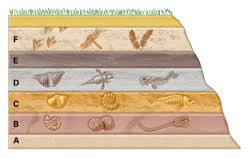
Which rock layer contains the newest fossils?

a)
F
b)
E
c)
B
d)
C
70.
Homozygous is when...
a)
the alleles are the same
b)
the alleles are different
c)
the alleles are absent
d)
the alleles are present
71.
T - tall and t = short
In the punnett square below, what belongs in the missing square
a)
tt
b)
Tt
c)
Bb
d)
TT
72.
B = brown fur  b = white fur
In the punnett square, what is the probability for white fur? 
a)
0%
b)
25%
c)
50%
d)
75%
73.
What genotype is missing from this Punnett Square?
a)
RrYy
b)
RRYY
c)
rryy
d)
RrYY
74.
What does heterozygous mean?
a)
An organism that has the same genes for a trait (TT or tt)
b)
An organism that has different genes for a trait (Tt)
c)
When neither gene is fully dominant; offspring is a mixture of both
d)
the different forms of a trait (hair color--> brown, blonde, red
75.
Cross Two Homozygous plants
(
RRYY x rryy)
R = round seeds, r  = wrinkled seeds Y = yellow seeds, y = green seeds
What percent will have Round and Yellow seeds? 
a)
0%
b)
25%
c)
50%
d)
100%
76.

Why are advantageous traits more likely to be passed onto offspring?

a)

Because they are more likely to survive and reproduce.

b)

Because they come from dominant alleles.

c)

Because they come from recessive alleles.

d)

Because the organism knew it needed that trait, survives, and passes it on.
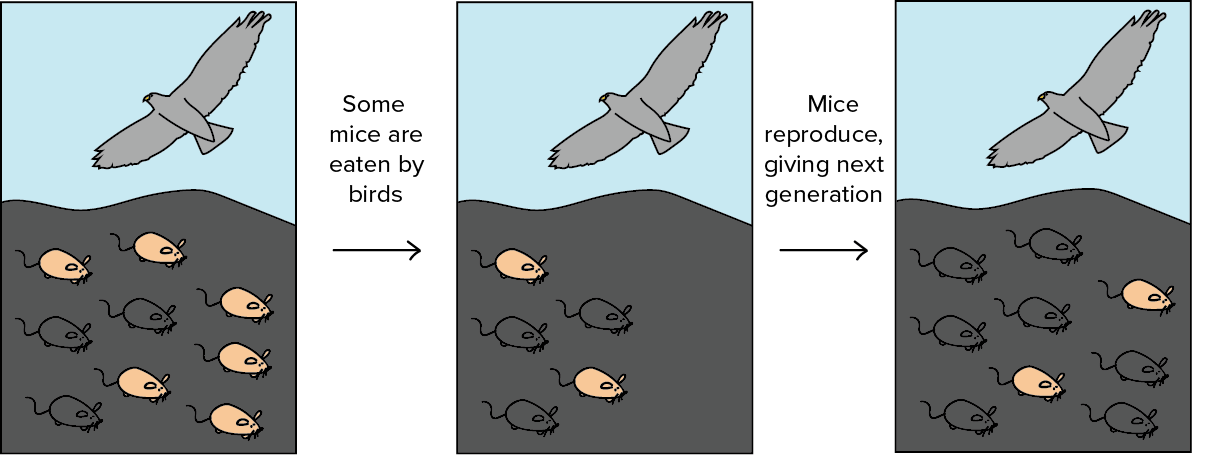
77.
The differences among a species, like different bird beaks, are called
a)
genes.
b)
variations.
c)
traits.
d)
theories.
78.
Why is the mouse population changing over time?
a)
The light mice can reproduce more successfully than the dark mice
b)
The hawks eat more dark mice than light mice because the dark mice taste better
c)
The hawks eat more light mice than dark mice because they can see the light mice more easily
d)
The hawks eat more dark mice than light mice because they can see the dark mice more easily
79.

Where do adaptations come from?

a)

The individual organism decides to adapt

b)

Mutations that give an organism an advantage in its environment

c)

Genetic recombination during meiosis

d)

Both mutations and genetic recombination are sources of adaptation

80.
Which fact provides the best evidence for the biological theory of evolution?
a)
Most fossils are found in sedimentary rock.
b)
Most species of life on Earth have become extinct.
c)
Characteristics of simpler life forms can be found in more complex life forms.
d)
Only a small percentage of living things have been preserved in fossils.
81.
What will most likely happen if a species can no longer produce offspring?
a)
It will become extinct.
b)
It will evolve into another species.
c)
It will move into a new environment and adapt.
d)
It will begin to mutate into another organism.
82.
Which part of Darwin's theory of evolution may be used to describe the results of when lions prey on antelope?
a)
natural selection
b)
survival of the fittest
c)
adaptation to environment
d)
variation in species
83.
Comparative embryonic development is the study and comparison of embryos of different species. The diagram shows the comparative embryonic development of a fish, reptile, bird, and human. Assume that the four embryos are at similar stages in their development. How can the study of comparative embryonic development be useful to biologists?
a)
It provides evidence that chordates evolved from different ancestors.
b)
It provides evidence that vestigial structures provide evidence of common ancestry.
c)
It provides evidence that some species with similar embryos have DNA that may be 99% similar.
d)
It provides evidence that no two species share exact DNA even though their embryos look similar.
84.

Which one of Newton's laws are displayed

a)

2nd law

b)

1st law

c)

3rd law

85.

Which of Newton's laws is shown

a)

1st law

b)

3rd law

c)

2nd law

86.

Which one of Newton's laws is shown

a)

3rd law

b)

2nd law

c)

1st law

87.

In referring to how much matter a body contains, we use the term:

a)

Volume

b)

Weight

c)

Mass

88.
At what position does the pendulum have the greatest gravitational potential energy?
a)
Position D
b)
Position C
c)
Position B
89.
At what position does the pendulum have the greatest kinetic energy?
a)
Position D
b)
Position C
c)
Position B
90.
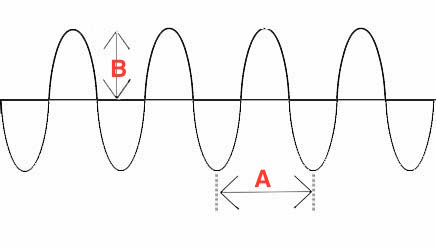
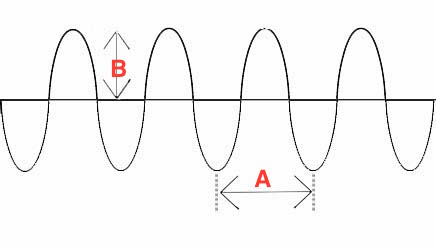
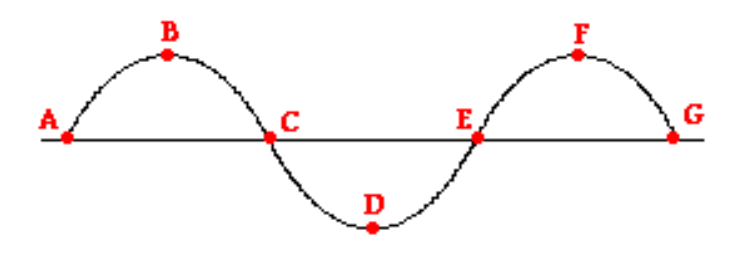
What property of this wave is represented by the letter "A"
a)
amplitude
b)
crest
c)
trough
d)
wavelength
91.
What property of the wave is represented by the letter "B"?
a)
amplitude
b)
crest
c)
trough
d)
wavelength
92.
The number of wavelengths that pass a point each per second is:
a)
frequency
b)
period
c)
longitudinal 
d)
transverse wave 
93.
The type of waves that require medium to pass:
a)
Mechanical Waves
b)
Electromagnetic Waves
94.
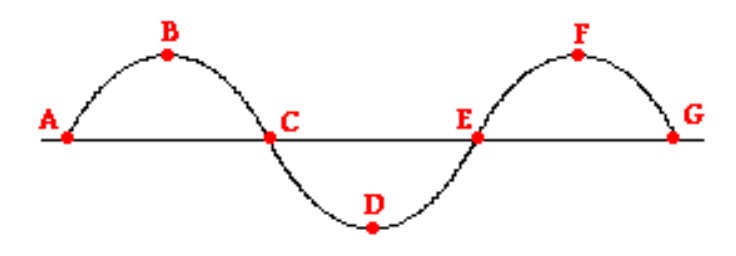
Which vocabulary term is used to identify the distance between points C & G?
a)
Amplitude
b)
Crest
c)
Frequency
d)
Wavelength
95.
When the frequency of a wave increases, what happens to the wavelength?
a)
The wavelength is not directly affected by the frequency of a wave.
b)
The wavelength increases.
c)
The wavelength decreases.
d)
More specific information is needed to form a conclusion about the wavelength.
96.
Which letter(s) represent the trough of the wave?
a)
A
b)
B & D
c)
D
d)
C & G
97.
Which letter(s) represent the crest of the wave?
a)
A
b)
B & D
c)
B & F
d)
F
98.
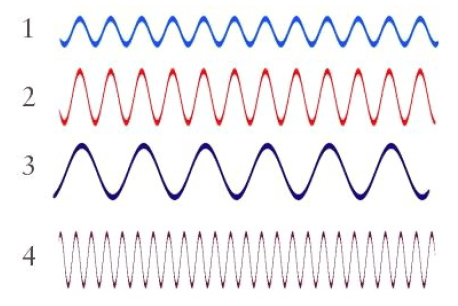
Which wave in the diagram has the greatest frequency?
a)
1
b)
2
c)
3
d)
4
99.

Matter is anything that has:

a)

mass

b)

volume

c)

mass and volume

d)

substance

100.

Mass is a measurement of:

a)

the amount of particles a substance has.

b)

the space an object occupies

101.
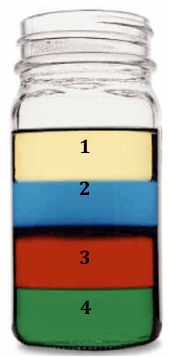
Put the liquids in order from most dense to least dense?
a)
4, 3, 2, 1
b)
1, 2, 3, 4
c)
3, 4, 2, 1, 
d)
4, 3, 1, 2
102.
What reaction type is characterized by the reactant breaking down as the reaction progresses?
a)
Synthesis
b)
Decomposition
c)
Combustion
d)
Double Replacement
103.
What two molecules are produced in a combustion reaction?
a)
CO+ NH4
b)
SiO2 + H2O
c)
H2O + CO2
d)
CO+ H2O2
104.
Which set of coefficients properly balances the reaction below?
_Cu + _H2→_ CuO3 + _H2
a)
1,3,1,5
b)
2,6,2,6
c)
1,3,1,3
d)
1,2,3,4
105.
Which of the following can be categorized as a synthesis reaction?
a)
Ba + NaCl →BaCl2 + Na
b)
KNO3→K+ + NO3-
c)
2Li + F→ 2LiF
d)
HCl + LiNO HNO3 + LiCl
106.
What type of reaction is displayed below?
HCl + NaOH → NaCl + H2O
a)
Neutralization
b)
Combustion
c)
Double Replacement
d)
Decomposition
107.
Is the reaction below exothermic or endothermic?
CH4 + 2O2 → CO2 + H2O + heat
a)
exothermic
b)
endothermic
108.
What makes something radioactive?
a)
elements with an atomic number above 81
b)
an unstable nucleus
c)
contaminated sewage
d)
It decays over time