
 Worksheets
WG: Unit 2 Review Game
Total questions: 45
Worksheet time: 24mins
Which of the following planets is classified as a terrestrial planet?
Jupiter
Saturn
Mercury
Neptune
Which of the following is a characteristic of gas giant planets?
Solid, rocky crusts
Gaseous
Inner planets
Terrestrial
Match the term to its definition: "It is at the center of the planet and is composed of iron and nickel under pressure."
Crust
Mantle
Core
Lithosphere
Which layer of the Earth is described as a thick layer of hot dense rock that sits below Earth's crust?
Crust
Mantle
Core
Lithosphere
Which is thicker: oceanic crust or continental crust?
Oceanic crust
Continental crust
Both are the same thickness
It depends on the location
Explain why continental crust is thicker than oceanic crust.
Continental crust is made of lighter materials
Continental crust can be as much as 62 miles thick, while oceanic crust can be as little as 2 miles thick
Oceanic crust is made of iron and nickel
All of the above
Which of the following is NOT a gas giant planet?
Jupiter
Saturn
Mars
Neptune
Which of the following best describes the Earth's crust?
A thick layer of hot dense rock below the surface
A hard, rocky shell forming the Earth's surface and part of the lithosphere
The center of the planet composed of iron and nickel
A gaseous layer surrounding the planet
What is the Hydrosphere, and what percent of Earth is made up of the Hydrosphere?
Includes oceans, lakes, rivers, underground water, and other bodies of water. 70%
The thin layer of gases extending above the planet’s surface. 50%
The layer of earth where all life exists. 10%
Includes the Earth’s crusts (30% of the surface).
What is the Lithosphere, and what percentage of Earth is made up of the Lithosphere?
The thin layer of gases extending above the planet’s surface. 10%
Includes the Earth’s crusts (30% of the surface).
The layer of earth where all life exists. 70%
Includes oceans, lakes, rivers, underground water, and other bodies of water. 50%
Define the Atmosphere.
The thin layer of gases extending above the planet’s surface.
The layer of earth where all life exists.
Includes the Earth’s crusts (30% of the surface).
Landforms are physical features of the Earth’s surface.
What is the Biosphere?
The layer of earth where all life exists.
The thin layer of gases extending above the planet’s surface.
Includes oceans, lakes, rivers, underground water, and other bodies of water.
Landforms are physical features of the Earth’s surface.
Which of the following best defines a Landform?
Landforms are physical features of the Earth’s surface. They are created by various geological processes, including erosion, sedimentation, volcanic activity, and tectonic movements. Examples include mountains, volcanoes, plateaus, etc.
The thin layer of gases extending above the planet’s surface.
The layer of earth where all life exists.
Includes oceans, lakes, rivers, underground water, and other bodies of water.
What does the Continental Drift Theory state?
Continents were once joined and slowly drifted apart.
The Earth’s crust is made up of several plates.
The atmosphere is made up of different layers.
Oceans cover 70% of the Earth’s surface.
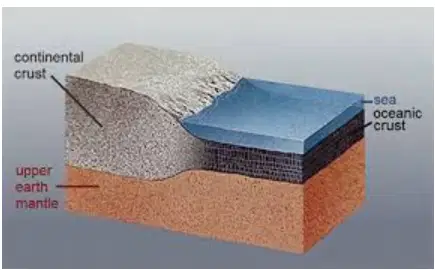
Based on the diagram, which layer is directly above the upper earth mantle?
Continental crust
Oceanic crust
Lithosphere
Hydrosphere
Which type of plate boundary is described as two plates sliding past each other in opposite directions, creating strong earthquakes?
Transform
Convergent
Divergent
Subduction
What is formed when two plates collide and form a mountain range, trench, or volcano?
Divergent boundary
Convergent boundary
Transform boundary
Hot spot
Which type of plate boundary is characterized by two plates separating and forming new crust through the rising of magma?
Convergent
Transform
Divergent
Subduction
What is subduction and what can it create?
The process where one tectonic plate moves under another and sinks into the mantle; it can create trenches and volcanoes.
The process where two plates slide past each other; it can create earthquakes.
The process where two plates move apart; it can create new crust.
The process where magma rises to the surface; it can create islands.
What is the definition of an earthquake?
The sudden shaking of the ground caused by the movement of tectonic plates.
The eruption of molten rock from a volcano.
The formation of a mountain range.
The process of subduction.
How were the Hawaiian Islands formed?
By the collision of two tectonic plates.
By the process of subduction.
Over a hot spot, where magma forcibly melts the crust and causes volcanic eruptions.
By the separation of two plates.
What type of plate boundary is located at the Mid-Atlantic Ridge?
Convergent boundary
Transform boundary
Divergent boundary
Subduction zone
Where do volcanoes occur?
Only at convergent plate boundaries
Only at divergent plate boundaries
Near convergent and divergent plate boundaries, and at hot spots
Only at transform boundaries
What can erupt from volcanoes?
Only water vapor
Only rocks
Molten rock, ash, and gasses
Only ash
If a volcano is not on a plate boundary, how can it occur?
Subduction
Hot spot
Earthquake
Divergent boundary
Which of the following are the directions in which tectonic plates can move?
Convergent (collide), divergent (separate), transform (slide past each other)
Upward, downward, sideways
Clockwise, counterclockwise, stationary
North, south, east, west
What landforms can be created by the movement of tectonic plates?
Mountains, volcanoes, and trenches
Deserts, forests, and lakes
Plateaus, valleys, and plains
Islands, rivers, and deltas
On average, how much do tectonic plates move in a year?
A couple of centimeters per year
Several meters per year
A few millimeters per decade
One meter per month
What is the process of breaking down or dissolving rocks and minerals on the Earth's surface called?
Weathering
Erosion
Deposition
Melting
Which of the following best describes physical weathering?
Rock is broken or weakened physically without a chemical change
Rock is dissolved by acid rain
Rock is melted by high temperatures
Rock is compressed by tectonic forces
Which is an example of chemical weathering?
Acid rain altering the minerals in rock
Frost wedging breaking rocks apart
Wind blowing sand against rocks
Water freezing in cracks
What is the movement of weathered rock and material by wind, glaciers, and moving water called?
Erosion
Deposition
Weathering
Melting
How do glaciers cause erosion?
By moving across the earth’s surface, carving out valleys, rivers, and wearing down mountaintops
By melting and forming lakes
By heating up rocks and causing them to crack
By blowing sand against rocks
What are moraines?
Debris left behind by melting glaciers
Large cracks in the earth’s surface
Volcanic ash deposits
Layers of sediment in riverbeds
What is wind erosion and how can it be prevented?
The movement of small particles of dust, sand, and soil from one place to another; plants can help protect from the soil eroding with wind.
The process of water turning into vapor; using fans can prevent it.
The breaking down of rocks by freezing and thawing; covering rocks with plastic can prevent it.
The movement of water underground; using dams can prevent it.
What is water erosion?
Occurs when rainwater and springwater flow downhill into streams, grinding away the surface of rocks along the stream's path.
The process of water turning into vapor and forming clouds.
The movement of wind over the surface of the ocean.
The freezing and thawing of water in cracks in rocks.
What source of energy drives the water cycle?
The sun
The moon
The wind
The Earth's core
Describe the water cycle, including evaporation, condensation, and precipitation.
The sun drives the water cycle by causing water to evaporate into the sky, then condense into clouds, and finally fall as precipitation.
Water is absorbed by plants and never returns to the atmosphere.
Water only moves underground and never enters the air.
The water cycle is driven by wind, which moves water from place to place.
Does the amount of water on Earth ever change? Why or why not?
No, it is constantly being recycled.
Yes, it decreases every year.
Yes, it increases due to rainfall.
No, because water is only found in the oceans.
What percentage of water on Earth is freshwater vs saltwater?
97% saltwater, 3% freshwater
50% saltwater, 50% freshwater
10% saltwater, 90% freshwater
80% saltwater, 20% freshwater
What is the purpose of desalination and why isn’t it an easy option?
To remove salt from ocean water; it is not easy because it is expensive and not environmentally friendly.
To add salt to freshwater; it is not easy because it requires special equipment.
To freeze water; it is not easy because it takes a long time.
To boil water; it is not easy because it uses too much energy.
Where can 2/3 of Earth's freshwater be found?
In glaciers and ice caps
In rivers and lakes
In underground wells
In the atmosphere
What are tributaries?
Small streams that flow into larger rivers.
Large rivers that flow into lakes.
Streams that flow into the ocean.
Rivers that flow underground.
Which of the following is NOT one of the five major oceans of the world?
Pacific
Atlantic
Indian
Mediterranean
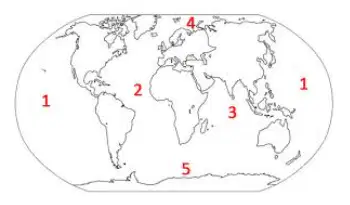
Match the following oceans to their correct numbers on the world map.
1-Pacific, 2-Atlantic, 3-Indian, 4-Arctic, 5-Southern
1-Atlantic, 2-Pacific, 3-Arctic, 4-Indian, 5-Southern
1-Indian, 2-Arctic, 3-Pacific, 4-Southern, 5-Atlantic
1-Southern, 2-Indian, 3-Atlantic, 4-Pacific, 5-Arctic

