
 Worksheets
ECON MIDTERM 1
Total questions: 82
Worksheet time: 1hrs 8mins
The change in consumption due to a change in price, holding purchasing power constant, is called the _____ _____
(a)
Two goods are (a) if an increase in the price of one good leads to a decrease in quantity demanded of the other.
The change in consumption due to a change in income, holding prices constant, is called the income effect.
True or false.
(a)
An Engel Curve shows combinations of
income and prices
two goods for different levels of prices
income and the quantity consumed of one good
two goods for different levels of income
An Engel curve
slopes upward for normal goods and downward for inferior goods.
slopes downward for both normal and inferior goods.
slopes upward for both normal and inferior goods.
slopes upward for inferior goods and downward for normal goods.
When the price of good X increases, the substitution effect leads consumers to buy
less of good X and less of substitute goods.
more of good X and more of substitute goods.
more of good X and less of substitute goods.
less of good X and more of substitute goods.
When the price of good X increases and all goods (including X) are normal goods, the income effect leads consumers to buy (a) of ALL goods
measures the percentage change in one variable in response to a one percent increase in another variable.
(a)
the percentage change in quantity demanded resulting from a 1 percent increase in income.
(a)
When the optimal point on an indifference curve and budget line diagram is a corner solution,
the budget line must have a kink in it.
the marginal rate of substitution usually does not equal the ratio of prices for the two goods.
the consumer does not spend her entire budget on the two goods.
ALL ANSWERS ARE CORRECT
At the optimal point on an indifference curve and budget line diagram (assuming an interior solution)
the marginal rate of substitution between the two goods equals the ratio of their prices.
the optimal indifference curve is tangent to the budget line.
the consumer spends his or her entire budget on the two goods.
ALL ANSWERS ARE CORRECT
The marginal utility associated with the additional consumption of X is given by
the partial derivative of the utility function with respect to good
X.
its equality to total utility.
the Lagrangian multiplier.
the second derivative of the utility function with respect to good
X.
Using calculus, we measure marginal utility as the utility change that results from a very (a) increase in consumption.
An individual (a) curve relates the quantity of a good that a single consumer will but to the price of that good, all else equal
All combinations of goods that provide a consumer with the same level of satisfaction is called an
(a)
The rate at which a consumer is willing to exchange one good for another and remain indifferent is called the
(a)
We make a number of assumptions on individual preferences. Preferences are (a) , which means that consumers are able to rank all possible baskets.
We make a number of assumptions on individual preferences. Preferences are (a) ,
which means that if bundle A is preferred to bundle B and bundle B is preferred to bundle C, then
bundle A is preferred to bundle C
.
Strict monotonicity implies more is always preferred to less. Consider an indifference map. Strict monotonicity implies that indifference curves further to the (a) provide greater utility.
The marginal rate of substitution is diminishing, where indifference curves are convex.
This assumption implies that consumers prefer a bundle of goods that is (a) .
Describe the indifference curves associated with two goods that are perfect substitutes.
The indifference curves for two goods that are perfect substitutes
Are downward-sloping straight lines
are shaped as right angles
Describe the indifference curves associated with two goods that are perfect complements.
The indifference curves for two goods that are perfect complements
Are downward-sloping straight lines
are shaped as right angles
What happens to the marginal rate of substitution as you move down along a convex indifference curve?
Along a convex indifference curve, the marginal rate of substitution (a)
What happens to the marginal rate of substitution as you move along a linear indifference curve?
Along a linear indifference curve, the marginal rate of substitution is (a)
Ordinal utility refers to
a ranking of market baskets in order of most to least preferred, while cardinal utility indicates how much one market basket is preferred to another.
a ranking of market baskets based on income, while cardinal utility is a ranking of market baskets based on consumption.
Explain why the assumption of cardinal utility is not needed in order to rank consumer choices.
Cardinal utility is not needed in order to rank consumer choices because economists
only need to understand the characteristics of collective market demand.
can instead use ordinal utility to show how consumers rank different baskets
A budget (a)
indicates all bundles (combinations of goods) for which the total amount of money spent is equal to income.
A budget (a)
is the set of all feasible bundles (all possible combinations of goods the consumer can afford).
Suppose you have drawn a consumer's budget line for food and clothing with food on the horizontal axis and clothing on the vertical axis. If the prices of food and clothing remain the same and the consumer's income increases,
the budget line becomes steeper.
the budget line shifts outward in a parallel fashion.
the budget line becomes flatter.
Suppose you have drawn a consumer's budget line for food and clothing with food on the horizontal axis and clothing on the vertical axis. If the price of food increases, the budget line becomes (a)
he theory of consumer behavior assumes that consumers often prefer
more balanced bundles. This assumption is called
convexity
rationality
completeness
transitivity
Suppose you have drawn a consumer’s budget line for food and clothing
with food on the horizontal axis and clothing on the vertical axis. If the price of
clothing decreases,
he budget line becomes flatter.
the budget line becomes steeper.
the budget line shifts inward in a
parallel fashion.
the budget line shifts outward in a
parallel fashion
Suppose we find good X has a cross-price elasticity of 2 with the price
of good Y. Which of the following can we conclude from this information?
They are complements
They are substitutes
What can you conclude about a good if the Engel curve is downward
sloping?
(a)
What do we call a product whose marginal utility is always negative?
(a)
I emphasized two (related) interpretations of a derivative. What are they?
The rate of change of a function at a given point
The slope of a line
tangent to f (x) at x.
The slope of a line
tangent to f (x) at y.
what does the partial derivative of U (x, y, z) with respect to x represent?
The partial derivative tells us how much U changes when x changes by a
small amount, holding y and z (a) .
True or false: When we take the partial derivative of U (x, y) with respect to x, we treat
y as a variable.
(a)
are candidates for local extrema (maxima or minima). They
include values of x where the derivative of f (x) is zero and the boundary points of a
function.
(a)
We take a first-order condition when we want to find the x which maximizes
or minimizes a function. That is the _ that corresponds to the largest or smallest value
a function takes.
(a)
How do we take first-order conditions?
Take the first derivative of a function and set it equal to (a) . Then solve for
the variable of interest.
represents all the combinations of x and y that have the same
value of f.
(a)
The min function takes as an input a set of numbers and outputs the (a)
element of that set.
A good is considered normal if:
∂x*/∂I < 0
∂x*/∂I > 0
The price of the good falls
The good has a positive cross-price elasticity
Which of the following is an example of an inferior good?
Organic fruit
Designer clothing
Ramen Noodles
Gym memberships
U(x,y) = x^(1/2)y^(1/2), if px=1, py=1, then the Engel curve for x is:
(a)
A good where the income effect dominates substitution effect, so demand rises when price rises
(a)
If cross-price elasticity between hamburgers and fries is negative, the goods are
(a)
If the income elasticity of hamburgers is -0.588, then hamburgers are:
(a)
The set of goods and services a person consumes
(a)
If a consumer strictly prefers bundle a to bundle b, we write:
(a)
The assumptions of preferences are:
Completeness
Utility
Transitivity
Elasticity
Indifference curves represent:
Bundles where the consumer is indifferent
Bundles where the consumer has the same income
If good Y is a bad, then indifference curves slope:
(a)
A neuter good is one where: The consumer is (a) to its amount
Utility is only (a) , representing rankings
More of a good is at least as good as less
(a)
(a) preferences imply: Indifference curves are bowed toward the origin
Cobb-Douglas utility U(x,y) = x^(1/2) y^(1/2) is
Strictly monotonic, strictly convex
Weakly monotonic, weakly convex
In (a) satiated preferences, the consumer: Has a bliss point where too much of either good lowers utility
The vertical intercept of a budget line, I/pY, represents:
The maximum x affordable
The slope of the budget line
The marginal rate of substitution
The maximum y affordable
The ratio pX/pY is best interpreted as:
The marginal utility of x
The consumer’s income
The slope of the indifference curve
The opportunity cost of x in terms of y
If income rises while prices remain constant, the budget line:
Rotates outward
Rotates inward
Shifts outward in parallel
Becomes flatter
If px rises while py and I remain constant, the budget line:
Rotates inward around the vertical intercept
Rotates outward around the vertical intercept
If py rises while px and I remain constant, the budget line
Rotates inward around the horizontal intercept
Rotates outward around the horizontal intercept
The demand function derived from utility maximization subject to a budget constraint
(a)
The optimal consumption bundle occurs where:
MRS = price ratio (px/py)
Income is maximized
Utility is minimized
In the Cobb-Douglas case, we assume the budget constraint can be written as an equality because:
Goods are inferior
Preferences are monotonic, so the consumer always spends all income
a ____ _____ occurs when the consumer only buys one of the goods
(a)
In linear utility, the consumer buys only the good with
The lowest price
The highest marginal utility
The lowest price per unit of utility
The highest budget share
If px > 1 in the Linear case, the consumer buys:
(a)
hich of the following properties does the utility function U (x, y) = min(x, y)
have:
Strict monotonicity
Weak monotonicity
Suppose you have drawn a consumer’s budget line for food and clothing with
food on the horizontal axis and clothing on the vertical axis. If income increases,
the budget line shifts outward in
a parallel fashion
he budget line shifts inward in a parallel fashion
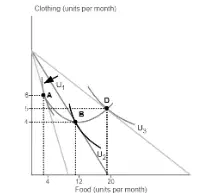
in the upward-sloping portion of the curve (i.e. between
points B and D) the two goods, food and clothing are
(a)
calculate the elasticity of demand for good x when the quantity demanded
decreases by 20% and price increases by 25%
(a)
Suppose that the demand for hamburgers is given by the demand function:
QDhamburgers = 100 − 5Phamburgers − 10Pf ries − .1I
where Phamburgers is the price of hamburgers, Pf ries is the price of fries, and I is income.
Are hamburgers and fries complements or substitutes?
A. Substitutes, the partial derivative with respect to fries is negative.
B. Substitutes, the partial derivative with respect to fries is positive.
C. Complements, the partial derivative with respect to fries is negative.
D. Complements, the partial derivative with respect to fries is positive.
(a)
how do we write that a consumer spends all their income on y? Your
answer should be in terms of the variables I, px, and py.
(a)
A (a) good has upward sloping demand
What can you conclude about a good if the Engel curve is downward sloping? The good is an _____ good. An Engel curve plots how demand
changes as income changes. If an Engel curve is downward sloping that means
that demand is declining in income, so the good is an ____ good
(a)
Suppose that the demand for hamburgers is given by the demand function: QDhamburgers = 100 − 5Phamburgers − 10Pf ries − .1I, where Phamburgers is the price of hamburgers, Pf ries is the price of fries, and I is income.
re hamburgers a normal or inferior good?
A. Normal, because the partial derivative with respect to hamburgers is neg-
ative.
B. Inferior, because the partial derivative with respect to hamburgers is neg-
ative.
C. Normal, because the partial derivative with respect to income is negative.
D. Inferior, because the partial derivative with respect to income
is negative.
(a)
A prisoner’s dilemma is when
A. each player is individually optimizing, but the overall outcome
is suboptimal
B. one player has a clear advantage over the other player, resulting in an
unfair game.
C. both players cooperate and work together to achieve a common goal.
D. one player can force the other player to choose a particular strategy, i.e.
the forced player is a prisoner to the other’s choices.
(a)
uppose that X and Y are goods and consumers have strictly monotonic
preferences. If there is no budget constraint, how much of good X and good Y will
a consumer purchase? The consumer will purchase (a) amounts of each good if there is
no budget constraint

