
 Worksheets
Atoms, Elements, Ions, Isotopes
Total questions: 94
Worksheet time: 1hrs 3mins

How many electrons do the alkali metals have in their outer shell?
1
2
8
7
What happens to the reactivity of the alkali metals as you move down the group?
increases
decreases
Which gas is released when the alkali metals react with water?
hydrogen
oxygen
hydroxide
carbon dioxide
What happens to the shielding affect as you go down the group?
increases
decreases

Which scientist described a positively charged core (“nucleus”) in the middle of a lot of empty space?
Chadwick
Thomson
Rutherford
Bohr
Ionic bonds are formed between...
Non - metals
A metal and a non-metal
Metals
Which of the below is an ionic compounds?
Ni
MgCl2
H2O
CH4
How is an ionic bond formed?
Sharing of electrons
Delocalised electrons
Transfer of electrons
An example of an ionic compound is Sodium Chloride, which is made from Na+ and Cl- ions. Why do these ions form an ionic bond?
They have like charges
They are from the same group
They are from the same period
They have opposite charges
Lead Chloride is an ionic compound, made up from Pb2+ ions and Cl- ions. Which is the correct formula for this compound?
PbCl3
PbCl
PbCl4
PbCl2
Which of the following is true for ionic bonding & ionic compounds? (3 correct statements)
They must be made of ions with like charges.
The negative ion must be written first.
Compounds must have an overall charge of zero.
They are made of metals and nonmetals.
The positive ion must be written first.

Which properties are all characteristics of ionic compounds?
solids with high melting and boiling points
soft solids which are highly malleable
when solid, the ions are held in place so the compounds cannot conduct electricity
conduct electricity when dissolved or molten
What properties does an ionic compound have?
A low boiling point and it conducts electricity when dissolved in water
A high melting point and it conducts electricity when molten or dissolved
A high boiling point and it conducts electricity when solid

Why do ionic compounds NOT conduct electricity when they are in their solid state?
Their ions are free to move.
Their ions are held in fixed positions.
Their electrons are free to move
Their electrons are held in a fixed state
Ionic compounds conduct electricity when dissolved in water. Which statement below best explains the property?
Ions are free to move.
Electrons are free to move.
Bonds are strong.
There are weak intermolecular forces of attraction.

Why do ionic compounds have high melting and boiling points?
Their ions are free to move.
Their ions are held in fixed positions.
They have many strong bonds which require a large amount of heat energy to overcome these strong bonds.
They have weak bonds which require a little amount of heat energy to overcome these weak bonds.
Which three of the following are features of ionic compounds? (click 3 boxes)
They have bonds between metals and non-metals.
They have bonds between two non-metals.
They form simple molecular structures.
They form giant ionic lattices.
They involve the transfer of electrons.
Be and F can combine to form BeF2, an ionic compound. Select ALL the true statements.
Each Be atom loses two electrons from the outer shell.
Each F atom gains two electrons from Be.
The force holding the ionic compound together is electrostatic attraction.
Each F ion has a charge of -1

Select all the true statements:
Each outer shell electron in Cl is represented by a cross.
In Na, the total charge is -2.
Na+ and Cl- are held together by electrostatic attraction.
Na+ has a full outer shell of electrons.
A single crystal of table salt (Sodium Chloride) is one giant ionic lattice, the Na+ and Cl- ions are held together in a (a) lattice.
Ionic bonds are formed between...
Non - metals
A metal and a non-metal
Metals
Which of the below is an ionic compounds?
Ni
MgCl2
H2O
CH4
How is an ionic bond formed?
Sharing of electrons
Delocalised electrons
Transfer of electrons
An example of an ionic compound is Sodium Chloride, which is made from Na+ and Cl- ions. Why do these ions form an ionic bond?
They have like charges
They are from the same group
They are from the same period
They have opposite charges
Sodium Oxide is Na2O. Meaning there are 2 Na present for every O in the ionic compound. As the Oxygen ion has a charge of -2, what charge does each Sodium ion have?
-1
-2
+2
+1
What is the correct formula for aluminium oxide? Aluminium is in group 3 and oxygen is in group 6.
Al₂O₃
AlO
AlO₄
Al₂O
Al₃O₂
Which Halogen has the lowest melting point?
Fluorine
Bromine
Iodine
Chlorine
In an atom, there are three types of subatomic particles. ______ are positively charged, ______ are negatively charged, and ______ are neutral.
Protons, Electrons, Neutrons
Electrons, Protons, Neutrons
Neutrons, Protons, Electrons
Electrons, Neutrons, Protons
The atomic number tells the number of ______ in an atom, which never changes.
Protons
Neutrons
Electrons
_______ is the average mass of all the isotopes of an element.
Atomic Mass
Atomic Number
Chemical Symbol
Element Name
An atom of an element with a different number of neutrons and therefore a different atomic mass
Isotope
Ion
Atom
Particle
Isotopes are atoms of the same element with different ____________.
Number of Neutrons & Mass Number
Number of Protons & Atomic Number
Number of Protons, Neutrons, and Electrons
Number of Electrons & Mass Number

What is the ATOMIC MASS of the isotope Carbon-14?
14
6
12
20

Carbon-14 has ____ protons, ____ electrons, and _____ neutrons.
6, 6, 8
6, 6, 6
6, 6, 14
6, 10, 14
Isotopes of the same element have the same number of ________ but a different number of _______.
protons, neutrons
neutrons, protons
protons, electrons
electrons, neutrons
An atom of phosphorus has an atomic number of 15 and a mass number of 31. How many neutrons does it contain?
15
16
31
46
The identity of a chemical element is always determined by which of the following?
the number of protons it has
the number of neutrons it has
the number of electrons it has

By studying the picture, you can determine that Carbon-13 has ____ protons.
6
13
12
14

Using the picture, you can determine that Carbon-13 has ____ neutrons.
13
6
12
7
Atomic Mass is...
protons + neutrons
neutrons + electrons
protons + electrons
An element's atomic number _______ changes.
always
sometimes
never
Isotopes of an element have a different number of...
Protons
Neutrons
Electrons
12 protons and 13 neutrons
Mg-12
Mg-13
Mg-25
Mg-24.305
9 protons and 9 neutrons
Fluorine-18
Fluorine-9
Fluorine-16
Fluorine-18.998
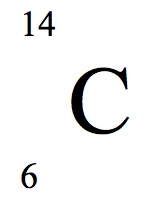

What is the atomic mass of the pictured isotope?
2
4
6

What is the name of the pictured isotope?
Chlorine-18
Chlorine-17
Chlorine-35

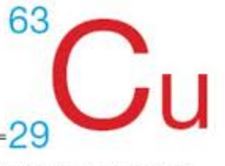
What is the name of the pictured isotope?
Copper-29
Copper-63
Copper-34

If a hydrogen atom has 1 proton, 1 electron, and 1 neutron, its mass number is ....
1
2
3
0
How many neutrons are in an atom of carbon-14?
6
8
10
14

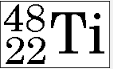
How many protons does this isotope of titanium have?
22
26
48
70
How many electrons are in an atom that has an atomic number of 34, an atomic mass of 74 and a charge of -2?
2
34
36
40
Write the hyphen notation for the isotope that has 39 protons and 50 neutrons.
Yttrium-11
Tin-39
Tin-89
Yttrium-89
Chromium has four naturally occurring isotopes (chromium-50, chromium-52, chromium-53, and chromium-54). What is the average atomic mass of Chromium?
4
51.996
52.25
Not enough information was given.
An element has three isotopes. Given the abundances and relative masses, calculate the average atomic mass and determine (from the periodic table) which element it is.
Abundances | Relative masses
0.005% | 234.04 amu
0.720% | 235.04 amu
99.275% | 238.05 amu
Uranium (#92, Atomic Mass: 238.03 amu)
Fluorine (#9, Atomic Mass: 19.00 amu)
Mercury (#89, Atomic Mass: 200.59 amu)
Polonium (#84 209 amu)
Rubidium has two naturally occurring isotopes, 85Rb (relative mass 84.9118 amu) and 87Rb (relative mass 86.9092 amu). The abundance of 87Rb is 27.8%, If rubidium has an average atomic mass of 85.47 amu, what is the % abundance of 85Rb (in percent)?
27.9%
72.1%
74.63%
34.29%

What element has the symbol K?
Potassium
Argon
Copper
Iron
What element has the symbol K?
Potassium
Argon
Copper
Iron
What element has the symbol Ca?
Cadmium
Carbon
Mg
Calcium
What element has the symbol Ti?
Helium
Boron
Aluminium
Titanium
What element has the symbol C?
Cadmium
Chromium
Carbon
Calcium
What element has the symbol Be?
Phosphorous
Tin
Boron
Beryllium
What element has the symbol N?
Sodium
Nitrogen
Silicon
Neon
What element has the symbol Na?
Nitrogen
Helium
Sodium
Beryillium
What symbol does Lithium?
Li
Na
Si
L
What symbol does Magnesium have?
Mg
Na
M
Mo
What symbol does hydrogen have?
H
He
Hy
Hi
What symbol does Silicon have?
S
Sy
Si
St
What symbol does sulfur have?
Si
S
Ti
D
What symbol does Argon have?
Ar
A
O
N
What symbol does Oxygen have?
O2
O
No
Ox
What symbol does Neon have?
N
No
Ne
Ni
If an atom has 22 protons and a mass number of 48, how may neutrons does it have?
70
22
48
26
If an element has a mass number of 24 and 12 neutrons, how many protons does it have?
24
36
12
6
If a stable atom has 10 protons, how many electrons does it have?
5
10
15
20
Calcium has 20 electrons, what is its electron configuration?
2, 8, 8, 2
4, 8, 8
2, 10, 8
2, 8, 10
Aluminium has 13 protons. What is its electron configuration?
2, 8, 2, 1
2, 10, 1
2, 8, 3
3, 10

