
 Worksheets
Unit 1-3 Rewind
Total questions: 80
Worksheet time: 3hrs 36mins
Categorize the following chemical formulas/Symbols.
H2O
CO2
O2
N2
CH4
C
Identify the number of atoms of each element in the chemical formula C6H12O6.
Carbon (a)
Hydrogen (b)
Oxygen (c)
Total Atoms (d)
1
2
3
Categorize the following as a physical or chemical change.
Fireworks
Melting ice
Chopping wood
Shredding paper
Burning wood
Baking a cake
Frying an egg
Boiling water
What is the solvent in a saltwater solution?
Water
Salt
Both water and salt
Neither water nor salt
Compare and contrast elements and compounds in terms of their chemical symbols and formulas.
Elements have one type of atom and a single chemical symbol, while compounds have two or more types of atoms and a chemical formula.
Elements have two or more types of atoms and a chemical formula, while compounds have one type of atom and a single chemical symbol.
Both elements and compounds have the same type of atoms and chemical symbols.
Elements and compounds cannot be distinguished by their chemical symbols and formulas.
Select all points that represent the solute in the solution.
There are (a) total atoms in the chemical formula Fe2(SO4)3.
Explain why burning wood is considered a chemical change.
Because it changes the state of matter from solid to gas.
Because it produces new substances with different properties.
Because it can be reversed by cooling.
Because it only changes the appearance of the wood.
If you were to make lemonade and, after tasting it, realized it was too sweet. What do you do next?
Dilute the solution by adding more solute
Raise the concentration by adding more solvent
Dilute the solution by adding more solvent.
Raise the concentration by adding more solute.
Identify the number of hydrogen and oxygen atoms in the chemical formula H2O2 and explain their significance.
1 hydrogen atom and 2 oxygen atoms; it is a simple molecule.
2 hydrogen atoms and 2 oxygen atoms; it is a compound with equal numbers of hydrogen and oxygen atoms.
2 hydrogen atoms and 1 oxygen atom; it is a compound with more hydrogen than oxygen.
1 hydrogen atom and 1 oxygen atom; it is a simple molecule.
Analyze the differences between physical and chemical changes by providing examples and reasoning.
Physical changes, like melting ice, do not produce new substances, while chemical changes, like rusting iron, produce new substances with different properties.
Physical changes, like burning wood, produce new substances, while chemical changes, like melting ice, do not produce new substances.
Both physical and chemical changes produce new substances with different properties.
Neither physical nor chemical changes produce new substances.

The amount of solute dissolved in an aqueous solution is a measurement of that solution's
concentration.
solubility.
solvency.
solute.
If more solvent is added the solution is (a)
If more solute is added the solution is (b)
If too much solute is added the solution becomes (c)
Which solution is more concentrated?
Solution 1:
500 mL of water
100 g of salt
Solution 2:
500 mL of water
90 g of salt
Solution 1
Solution 2
They have the same concentration
I have no idea
How many TOTAL atoms are in:
H2SO4
6
5
7
3
Grace is conducting an experiment in her science class. She observes different processes. Which of the following is a chemical change?
Dissolving
Bubbles formed
Evaporation
Melting

solute
solvent
In the chemical formula C6H12O6, how many carbon atoms are present?
6
12
18
3
What type of change occurs when ice melts into water?
Chemical Change
Physical Change
In the chemical formula NaCl, how many total atoms are present?
3
4
2
1
What happens to the concentration of a solution when more solute is added?
It increases.
It becomes saturated.
It remains the same.
It decreases.

How many hydrogen atoms are there?
1
4
5
6

How many nitrogen atoms are there?
4
8
10
20

How many atoms of carbon are there?
0
1
2
3
How many different elements are used to make Salt (NaCl)
1
2
3
4
Which of the following chemical formulas represents a molecule made of 1 potassium, 1 nitrogen, and 3 oxygen atoms?
KNO3
PNO3
PNo3
KNo3
(rust) made up of?
3 oxygen


In Michael's science experiment with salt water, NaCl (salt) would be considered the ______.
Solution
Solute
Solvent
Solvation
The smaller the particle size the faster the rate of dissolution (rate of dissolving).
True
False
True or False
The rate of dissolving of a solute in a solvent is faster when the solute and solvent are stirred.
True
False
Jackson is making dinner and is trying to dissolve salt into a pot of water. The salt is dissolving slowly. What should Jackson do to speed up the rate of dissolving?
He should put larger salt particles in the water.
He should heat the water to a higher temperature.
He should completely stop stirring the pot of water.
He should slow down the speed he is stirring the pot.
What combination would dissolve a solid solute the fastest?
high temperature, no stirring
no heat, no stirring
sugar cube, no heat
high temperature, stirring
H2SO4
H2O
Au
O2S(OH)2
Oxygen
_____ is a measure of the distance an object travels in a unit of time.
speed
acceleration
displacement
velocity
_____ speed is the total distance traveled divided by the total time taken to travel that distance.
constant
instantaneous
average
variable
A(n) _____ line on a distance-time graph shows a faster speed.
steeper
level
longer
shorter

The object represented on this distance-time graph is _____.
not moving
speeding up
slowing down
changing direction
The _____ of a moving object includes its speed and direction.
velocity
position
acceleration
displacement
The _____ of an object in motion can be shown on a distance-time graph.
speed
velocity
direction
displacement

If two objects moving at constant speed are represented on a distance-time graph, which object is moving faster?
the object represented by the steepest line
the object represented by the longest line
the object represented by the shortest line
the object with a horizontal line
Which choice represents a speed?
5 hours per mile
5 kilometers per hour
5 meters squared per second
5 meters

What are the axes on a distance-time graph?
the x-axis is time and the y-axis is distance
the x-axis is distance and the y-axis is time
the x-axis is time and the y-axis is speed
the x-axis is speed and the y-axis is time

What does a straight, sloped line on a distance-time graph represent?
constant speed
instantaneous speed
changing speed
zero speed
The following graph shows the motion of three swimmers. At which point on the graph is a swimmer shown to be at rest?
A race car travels 400 m in 4 seconds. Its average speed is _____
100 meters per second
1600 meters per second
100 seconds per meter
1600 seconds per meter

Which statement is true based on the graph?
the horse travels 1.0 kilometers in 60 seconds
the horse travels 60 kilometers in 1.0 second
the horse has stopped moving between 80 and 100 seconds
the horse is traveling northeast

Based on the image, which of the following is true about the basketball?
Its speed is constant.
Its velocity is constant.
Its velocity is changing.
Its speed increases as it travels upward

Based on the image, which is true?
The skateboarder is moving about twice as fast as the walker.
The skateboarder travels about twice as far as the walker.
The walker stops moving halfway across the park.
The skateboarder is heading northeast and the walker is heading north.

This graph shows an object that is -
Increasing speed
At a constant speed
Decreasing speed
Stationary


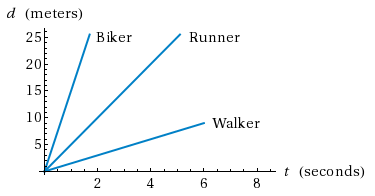
Which person moved the fastest in 3 seconds?
biker
runner
walker
they are all moving equally

