
 Worksheets
1st Hour Road to Revolution Test
Total questions: 39
Worksheet time: 20mins
Name
Class
Date
1.
Which was a conflict between Great Britain and the colonies?
a)
American Civil War
b)
English Civil War
c)
French and Indian War
d)
American Revolution
2.
How did mercantilist policies create tension between Great Britain and the colonies?
a)
By introducing indentured servitude to the middle colonies
b)
By requiring colonists to enlist in the military
c)
By limiting the amount of farmland each colonist could have
d)
By preventing colonists from trading with most other foreign countries
3.
A major consequence of the French and Indian War was that the:
a)
Colonists decision to side with France led Britain to retaliate against the Americans
b)
Expense of fighting the war led Britain to tax the colonies directly for the first time
c)
Loyalty of the colonists to the British side led to new freedoms and self government for the Americans
d)
Elimination of the French threat in North America led Britain to concentrate on conquering all of the remaining Spanish colonies
4.
How did the Proclamation of 1763 increase the tension between the American colonies and Great Britain?
a)
The British government reduced its military protection in the colonies.
b)
British commanders encouraged Native Americans to attack colonists.
c)
The British king prohibited settlement west of the Appalachian Mountains.
d)
British troops collected taxes to pay the war debt of Great Britain.
5.
Which of the following best explains why the British Parliament passed the Sugar Act, Stamp Act, and Townshend Acts?
a)
To punish the colonists for the Boston Tea Party
b)
To reduce colonial dependence on expensive paper products
c)
To pay for the French and Indian War
d)
To make British tax policies more fair
6.
What was the tax law requiring colonists to purchase special stamped paper for printed items?
a)
Sugar Act
b)
Townshend Acts
c)
Stamp Act
d)
Declaratory Act
7.
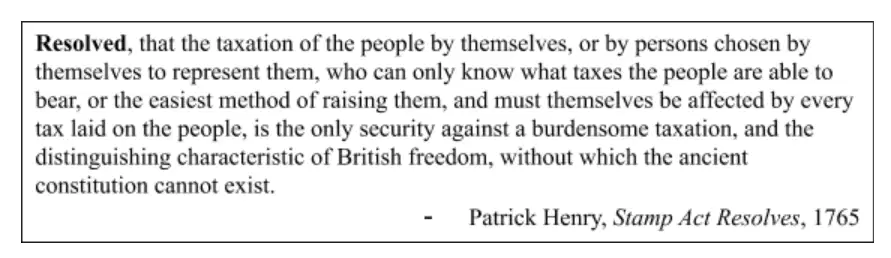
According to the passage below who should have the power to tax the colonists?
a)
The British Parliament
b)
King George III
c)
The Colonists
d)
The Sons of Liberty
8.
What was the act that gave parliament the power to make laws for the colonies "in all cases whatsoever"?
a)
Declaratory Act
b)
Sugar Act
c)
Townshend Acts
d)
Stamp Act
9.
Colonists formed Committees of Correspondence in order to:
a)
Protest to Parliament in writing
b)
Write to the King of England asking him to intervene on their behalf
c)
Write new laws giving Americans more freedom
d)
Establish communication chains among colonial town about resistance efforts
10.
Why was the phrase “taxation without representation” so important to the revolutionary cause?
a)
Great Britain would have ended taxation if colonists had kept the peace
b)
Colonists did not believe Parliament could tax them without their consent
c)
Colonists believed that Great Britain should only tax certain items
d)
Great Britain only taxed the colonists to force them into war
11.
What made British enactment of new laws intolerable to many American colonists?
a)
Colonists felt no need for foreign military protection.
b)
The British king could veto the laws passed by Parliament.
c)
The French government influenced lawmakers in Britain.
d)
American colonists had no representation in Parliament.
12.
How did colonists respond to direct taxation due to the Stamp Act?
a)
By boycotting the taxed products
b)
By selling more of the taxed products
c)
No reaction because they were loyal to the crown
d)
Throwing tax collectors in jail
13.
Which act of Parliament required colonists to house British soldiers?
a)
Tea Act
b)
Quartering Act
c)
Stamp Act
d)
Declaratory Act
14.
What was the cause of the Boston Massacre?
a)
Increased tensions between the British soldiers and the Native Americans
b)
Increased tensions between the colonists and the British soldiers
c)
Taxes due to the debt from the French and Indian War
d)
Continued boycotts by the colonists
15.
How did the British respond to the Boston Tea Party?
a)
They punished the colonists through the Intolerable Acts.
b)
They repealed the Tea Act.
c)
They praised the colonists for their dress up skills.
d)
They closed the Charleston Port to all trade.
16.
How did the Sons of Liberty respond to the Tea Act of 1773?
a)
Tarred and feathered the tax collectors.
b)
Continued to boycott tea.
c)
Wrote a letter to King George III.
d)
Organized the destruction of the tea.
17.
Which action was a Colonial response to the Intolerable Acts of 1774?
a)
The First Continental Congress was called into session in Philadelphia.
b)
The Declaration of Independence was written in Philadelphia.
c)
The Albany Plan was issued to unite the colonies.
d)
The Sons of Liberty was formed to resist tyranny.
18.
The Battles of Lexington and Concord marked the:
a)
Passage of the Intolerable Acts
b)
End of the French and Indian War
c)
Beginning of the Revolutionary War
d)
Beginning of the Civil War
19.
On the night of April 18th, 1775, a force of 700 British soldiers left Boston in search of a major colonial weapons storehouse rumored to be located where?
a)
Cambridge
b)
Bunker Hill
c)
Lexington
d)
Concord
20.
All of the following are an accomplishment of the Second Continental Congress EXCEPT:
a)
Formation of the Continental Army
b)
Sent the Olive Branch Petition
c)
Selected a committee to draft the Declaration of Independence
d)
Elected George Washington as the President of the United States
e)
Choose George Washington as commander of the Continental Army
21.
Who would have said, "no taxation without representation"?
a)
Patriot
b)
Loyalist
c)
King Of England
d)
Tax Collector
22.

Who uttered these famous words, below, in support of the Patriot cause?
a)
Thomas Paine
b)
John Locke
c)
Patrick Henry
d)
Thomas Jefferson
23.
Because it was meant to stir up colonial passions against the British, Paul Revere’s famous color print titled “The Bloody Massacre Perpetrated in King Street” can be best described as:
a)
Journalism
b)
Literature
c)
Propaganda
d)
Entertainment
24.
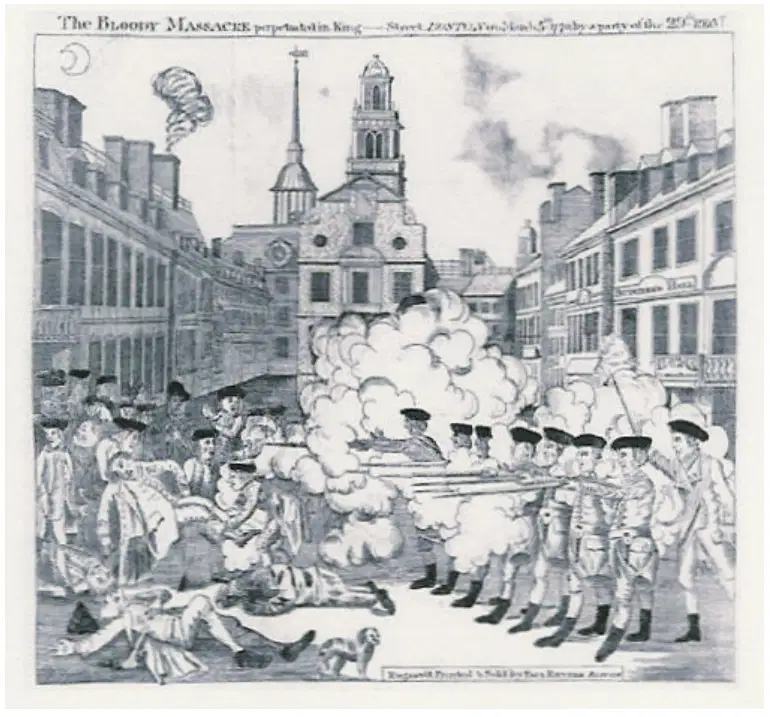
Why did Paul Revere make and distribute this engraving of the Boston Massacre?
a)
He wanted to make money selling the prints.
b)
He wanted to turn public opinion against the British.
c)
He wanted to convince the colonists to stop the rebellion.
d)
He wanted to show the exact details of what happened that day.
25.
Why was the Declaration of Independence written?
a)
To declare war against Great Britain
b)
To declare independence from Great Britain
c)
To declare the colonists unity with Great Britain
d)
To declare peace with Great Britain
26.
Each of the following is a central idea of the Declaration of Independence EXCEPT:
a)
The colonies have the right to break away from Great Britain
b)
Monarchy is the only acceptable form of government
c)
King George III has violated the colonists’ rights by taxing them without their consent
d)
All people possess unalienable rights, including the rights of “life, liberty, and the pursuit of happiness”
e)
Great Britain broke its social contract with the colonies and lost the consent of the people
27.
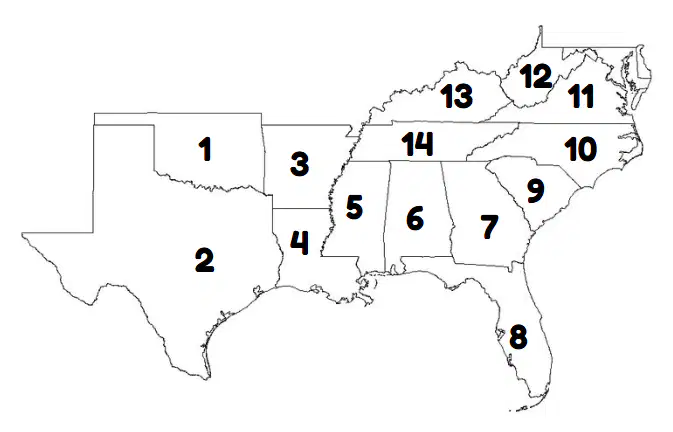
According to the map, what state is marked with #1?
a)
Oklahoma
b)
Texas
c)
Arkansas
d)
Louisiana
e)
Mississippi
28.
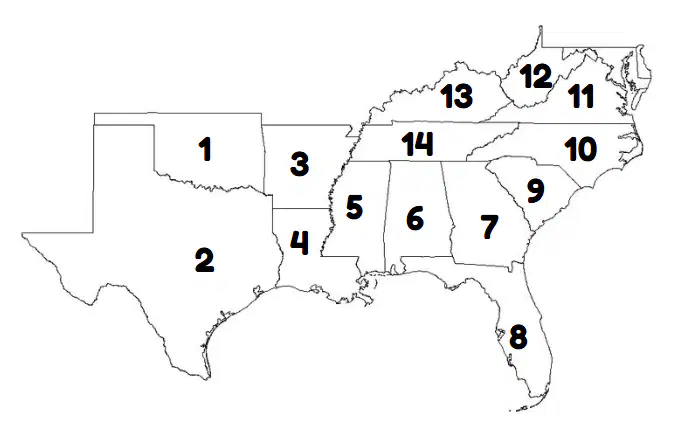
According to the map, what state is marked with #2?
a)
Oklahoma
b)
Texas
c)
Arkansas
d)
Louisiana
e)
Mississippi
29.
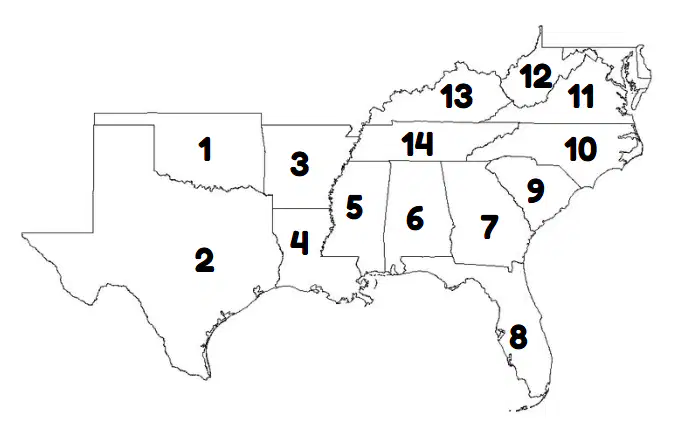
According to the map, what state is marked with #3?
a)
Oklahoma
b)
Texas
c)
Arkansas
d)
Louisiana
e)
Mississippi
30.
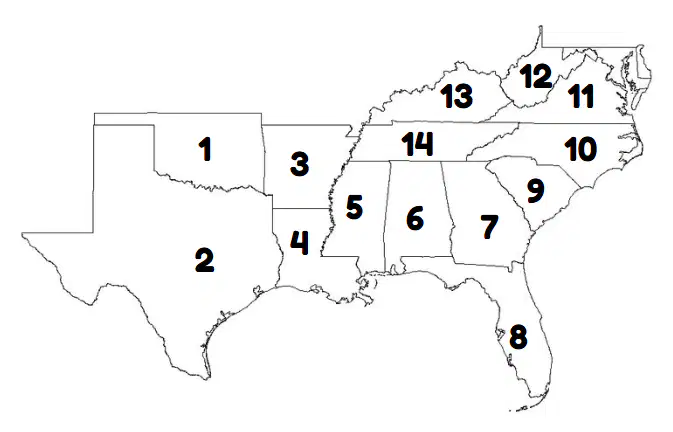
According to the map, what state is marked with #4?
a)
Oklahoma
b)
Texas
c)
Arkansas
d)
Louisiana
e)
Mississippi
31.
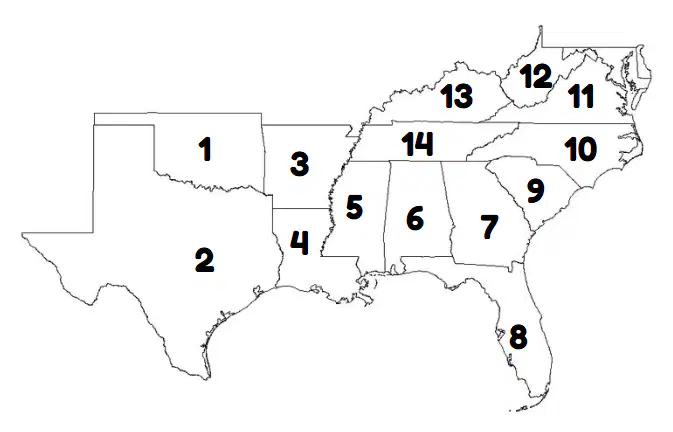
According to the map, what state is marked with #5?
a)
Oklahoma
b)
Texas
c)
Arkansas
d)
Louisiana
e)
Mississippi
32.
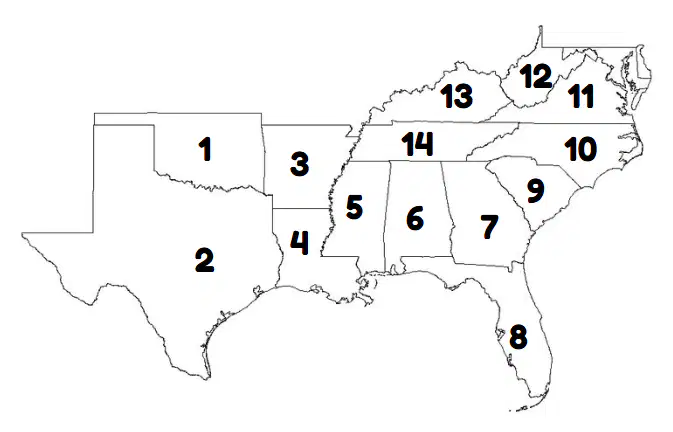
According to the map, what state is marked with #6?
a)
Alabama
b)
Georgia
c)
Florida
d)
South Carolina
e)
North Carolina
33.
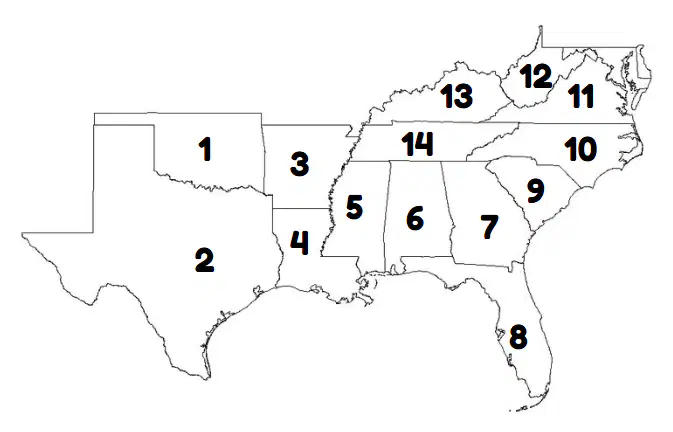
According to the map, what state is marked with #8?
a)
Alabama
b)
Georgia
c)
Florida
d)
South Carolina
e)
North Carolina
34.
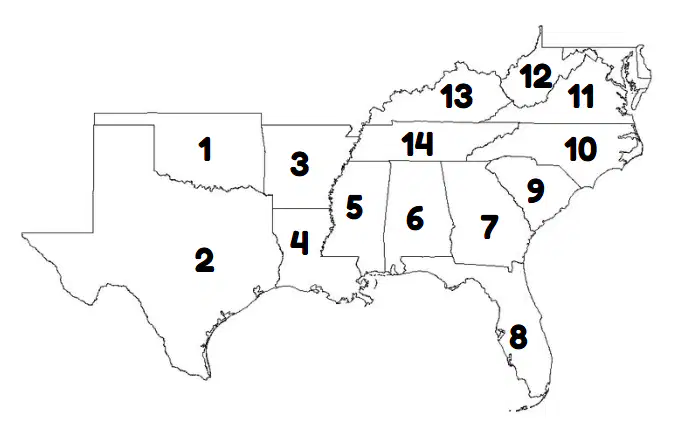
According to the map, what state is marked with #9?
a)
Alabama
b)
Georgia
c)
Florida
d)
South Carolina
e)
North Carolina
35.
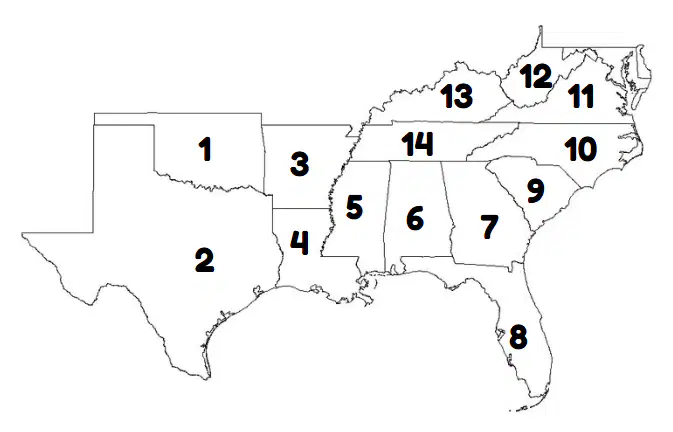
According to the map, what state is marked with #10?
a)
Alabama
b)
Georgia
c)
Florida
d)
South Carolina
e)
North Carolina
36.
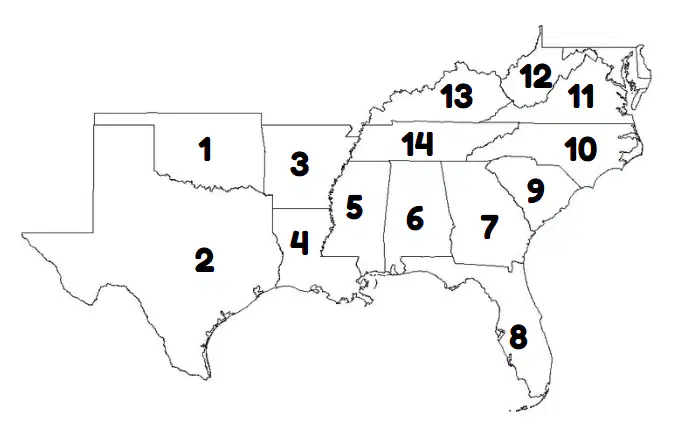
According to the map, what state is marked with #11?
a)
Virginia
b)
West Virginia
c)
Kentucky
d)
Tennessee
37.
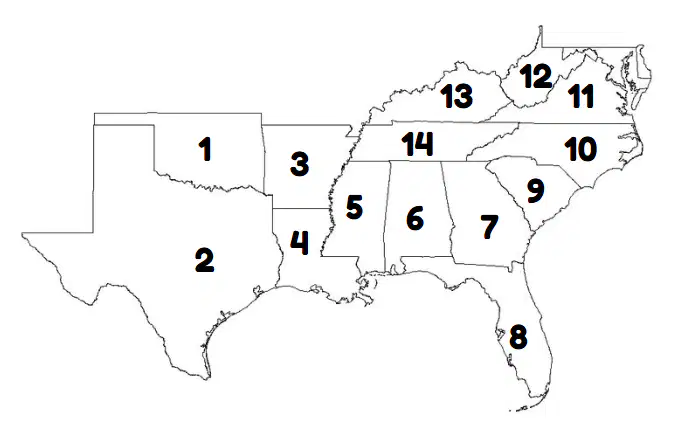
According to the map, what state is marked with #12?
a)
Virginia
b)
West Virginia
c)
Kentucky
d)
Tennessee
38.
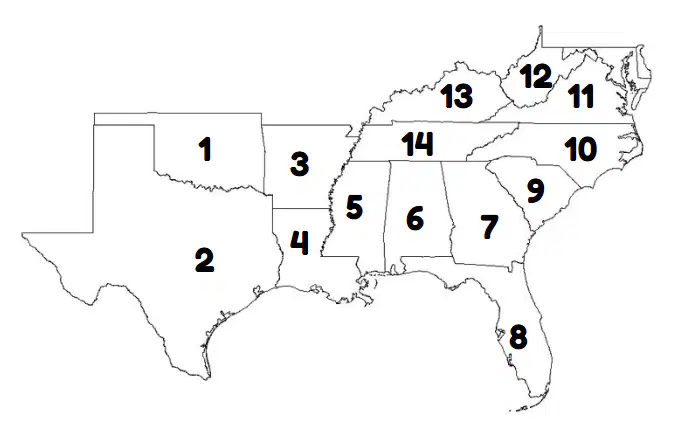
According to the map, what state is marked with #13?
a)
Virginia
b)
West Virginia
c)
Kentucky
d)
Tennessee
39.
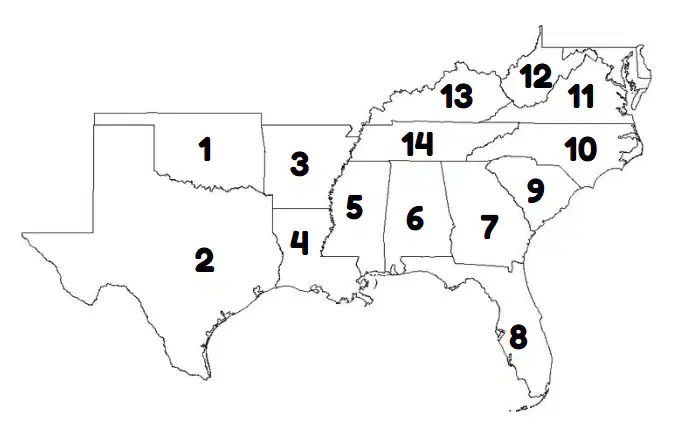
According to the map, what state is marked with #14?
a)
Virginia
b)
West Virginia
c)
Kentucky
d)
Tennessee
100 %

