Wayground logo

Free Printable Worksheets

Font size

S
M
L
XL
Worksheets

Grade 8 CCEC Revision

Total questions: 100

Worksheet time: 1hrs 26mins

Name
Class
Date
1.
all matter is made of what 
a)
energy 
b)
atoms 
c)
electrons 
d)
compounds 
2.
The smallest part of an element is known as the 
a)
Periodic Table
b)
Atom
c)
Group
d)
Period
3.
Something that takes up space and has mass.
a)
volume
b)
matter
c)
mass
d)
density
4.
What cannot be broken down into other substances?
a)
Compound
b)
Mixture
c)
Solids
d)
Element
5.

Two or more atoms joined together for a(n)...

a)

Element

b)

Compound

c)

Molecule

d)

Mixture

6.
An element is made up of only one kind of _____.
a)
isotope
b)
plastic
c)
atom
d)
metal
7.
Most of the mass in an atom is made up of _____________________?
a)
protons and electrons
b)
protons and neutrons
c)
neutrons and electrons
d)
electrons and quarks
8.
In order for an atom to be neutral what has to be true?
a)
The atom has more protons than neutrons
b)
The atom has more neutrons than protons
c)
The atom has the same number of protons and neutrons
d)
The atom has the same number of protons and electrons
9.

What does the 6 represent?

a)

Atomic mass

b)

atomic number

c)

chemical symbol

d)

element name

10.
How is the number of neutrons in the nucleus of an atom calculated?
a)
Add the number of e- and p+ together
b)
Subtract the number of e- from p+
c)
Subtract the number of p+ from the mass number
d)
Add the mass number to the number of e-
11.
What subatomic particles would you find in the nucleus of an atom?
a)
Protons only
b)
Protons and Neutrons
c)
Neutrons and Electrons
d)
Protons and Electrons 
12.

An atom has 10 protons, 15 neutrons and 10 electrons what is its mass number.

a)

20

b)

10

c)

35

d)

25

13.

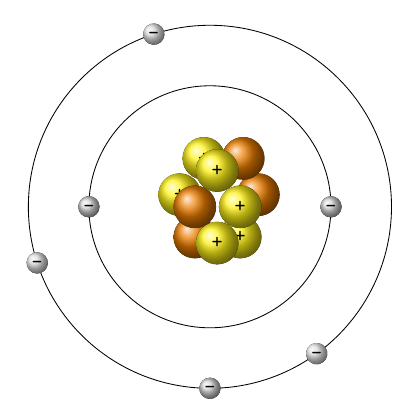
How many electrons does this atom have?

a)

2

b)

4

c)

6

d)

10

14.
An element with a mass number of 11 and an atomic number of 5 has how many neutrons?
a)
11
b)
5
c)
6
d)
16
15.
Where is most of the mass in an atom located?
a)
in the nucleus
b)
in the protons
c)
in the neutrons
d)
in the electrons
16.
What is the atomic number of the atom pictured? 
a)
9
b)
10
c)
18
d)
19
17.

Which of the following determines the identity of an element?

a)

number of protons

b)

atomic mass

c)

number of neutrons

d)

number of shells

18.

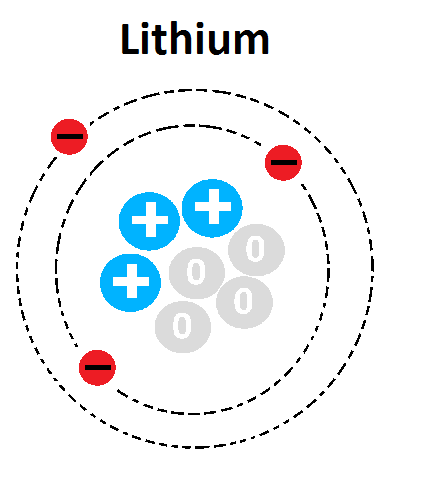
What is the atomic number of this atom?

a)

1

b)

3

c)

4

d)

7

19.

What is the mass number of this atom?

a)

1

b)

3

c)

4

d)

7

20.
The positive particles of an atom are 
a)
electrons 
b)
positrons 
c)
neutrons 
d)
protons 
21.
electrons have this type of charge?
a)
negative
b)
positive
c)
neutral
22.
How does the size of a proton compare to the size of a neutron?
a)
larger
b)
smaller
c)
equal
23.
These particles orbit around the nucleus of an atom.  What are they called?
a)
electrons
b)
protons
c)
neutrons
d)
photons
24.

These are the SMALLEST subatomic particles

a)

Proton

b)

Neutron

c)

Electron

25.
From the diagram, which particles are indicated with the arrow?
a)
electrons and protons
b)
protons and neutrons
c)
electrons and neutrons
d)
photons and nucleons
26.
Element or Compound?
H2O
a)
Element
b)
Compound
27.
Element or Compound?
Au
a)
Element
b)
Compound
28.
Element or Compound?
CF3CO2H
a)
Element
b)
Compound
29.
Element or Compound?
Salt (NaCl)
a)
Element
b)
Compound
30.

What is made up two or more DIFFERENT elements that are chemically combined?

a)

Element

b)

Mixture

c)

Compound

d)

Solids

31.
This picture represents which of the following?
a)
element
b)
compound
c)
mixture
32.
This picture represents which of the following?
a)
element
b)
compound
c)
mixture
33.

How many different elements are in this compound?

a)

1

b)

2

c)

3

d)

4

34.
Which of the following is not a compound?
a)
HCl
b)
Cl
c)
NaCl
d)
CO2
35.
Contains only one kind of atom.
a)
Element
b)
Compund
c)
Mixture
36.

All of the following are compounds EXCEPT:

a)

hydrogen

b)

sodium chloride

c)

water

d)

carbon dioxide

37.
H is the chemical symbol for which element?
a)
Helium
b)
Hydrogen
c)
Mercury
38.
Na is the chemical symbol for which element? 
a)
Sodium
b)
Nitrogen
c)
Neon
39.
K is the chemical symbol for which element? 
a)
Krypton
b)
Potassium
c)
Knox
40.
Ca is the chemical symbol for which element? 
a)
Carbon
b)
Chlorine
c)
Calcium
41.
Fe is the chemical symbol for which element? 
a)
Freon
b)
Iron
c)
Flourine
42.
C is the chemical symbol for which element? 
a)
Calcium
b)
Chlorine
c)
Carbon
43.
N is the chemical symbol for which element? 
a)
Sodium
b)
Nitrogen
c)
Nickel
44.
O is the chemical symbol for which element? 
a)
Osmium
b)
Odell
c)
Oxygen
45.
Si is the chemical symbol for which element? 
a)
Silicon
b)
Sodium
c)
Sulfur
46.
The chemical symbol for sodium is
a)
S
b)
So
c)
Na
47.
The chemical symbol for potassium is
a)
Po
b)
K
c)
Ko
48.
The chemical symbol for iron is
a)
I
b)
Fi
c)
Fe
49.

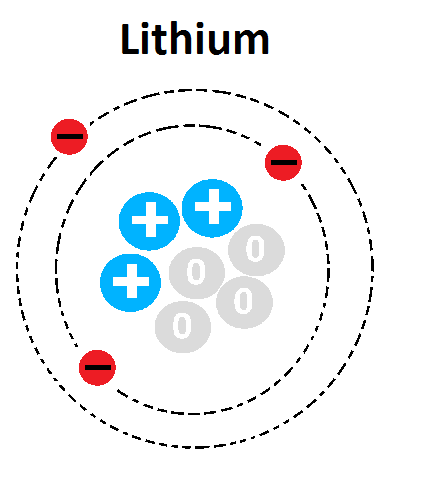
Lithium

(a)  

50.

Zn

a)

Magnesium

b)

Silver

c)

Zerconium

d)

Zinc

51.

Copper

a)

Cu

b)

C

c)

Cr

d)

Co

52.

Helium

a)

H

b)

He

c)

Ne

d)

Kr

53.

Sulfur

a)

S

b)

Sr

c)

Sb

d)

Sf

54.

Lead

a)

Pb

b)

Ld

c)

Bi

d)

At

55.

Silver

a)

Sv

b)

Sl

c)

Zn

d)

Ag

56.

Gold

a)

Gl

b)

Gd

c)

Ag

d)

Au

57.

P

(a)  

58.

Mg

(a)  

59.

F

(a)  

60.

Be

(a)  

61.

Li

(a)  

62.

What does a chemical symbol consist of?

a)

Only one letter

b)

two numbers

c)

one or two letters

d)

four letters

63.

The first letter of the chemical symbol is always a.......

a)

Capital

b)

Number

c)

Lower case

d)

subscript

64.

The second letter of a chemical symbol is always a ........

a)

Upper case

b)

Lower case

c)

subscript

d)

superscript

65.

What is the shorthand way of representing elements?

a)

Chemical names

b)

Chemical symbols

c)

Chemical numbers

d)

Chemical strucutre

66.
  • There are also some elements that have symbols that are not linked to their names.

Pb Au

What are the elements indicated by these letters?

a)

Lithium

Gold

b)

Potasium

Amber

c)

Lead

Gold

d)

Argon

Iron

67.

Who invented the Periodic Table?

a)

Mendeleev

b)

Bohr

c)

Lewis

d)

Democritus

68.

As you move left to right on a row or period what happens?

a)

Atomic number increases by 1

b)

Electrons decrease

c)

Number of shells decrease

d)

Nothing

69.

What happens to the number of shells as you move down a group?

a)

They decrease by 1

b)

They increase by 1

c)

Nothing

70.

The first energy shell can hold ______ electrons.

a)

2

b)

8

c)

18

71.

All elements in the same row have the same number of shells.

a)

True

b)

False

c)

Sometimes

72.

Valence means......

a)

inside

b)

outside

c)

full

73.

Elements in the same group or column have the same ...

a)

# of valence electrons

b)

# of shells

c)

# of protons

d)

Mass Number

74.

Rows on the periodic table are called ___________.

a)

Periods

b)

Sentences

c)

Fences

75.

Elements in the same group have __________

a)

Similar Properties

b)

Same number of shells

c)

Similar Mass

76.

What do all elements in the same period have?

a)

same number of shells

b)

same number of electrons

c)

belong in the same family

77.
What does the atomic number tell you?
a)
Number of Protons
b)
Number of Neutrons
c)
Sum of protons and neutrons
78.
The modern periodic table of elements is arranged by 
a)
Number of neutrons
b)
State of matter
c)
Atomic number
d)
Atomic Mass
79.
What subatomic particle is found outside of the nucleus?
a)
Isotope
b)
Electron
c)
Neutron
d)
Mass
80.

Use your periodic table to find which element has 5 protons.

a)

Lithium

b)

Calcium

c)

Boron

d)

Neon

81.
What is the family name of this group of elements? 
a)
Alkali metals 
b)
Halogens 
c)
Noble Gases 
d)
Alkali Earth Metals 
82.
Which element has 2 valence electrons? 
a)
cesium (Cs) 
b)
magnesium (Mg)
c)
boron (B)
d)
argon (Ar) 
83.
An atom is made up of protons, neutrons, and electrons.  Which is the smallest subatomic particle?
a)
Proton
b)
Neutron
c)
Electron
d)
Idontknowatron
84.
The atomic number tells you what?
a)
number of electrons
b)
number of protons
c)
number of neutrons
d)
both electrons and protons in an atom.
85.
Which group of the periodic table is composed of inert (not reactive)  gases?
a)
alkali metals
b)
alkaline earth metals
c)
halogens
d)
noble gases
86.
Which is an alkali metal?
a)
Magnesium
b)
Iron
c)
Sodium
d)
Europium
87.
How many protons are in this element?
a)
79
b)
196
c)
117
d)
Cannot be determined
88.
How many electrons does potassium K contain? (click to see image)
a)
19
b)
39
c)
20
d)
40
89.

Which color on the image of the periodic table corresponds with the noble gases?

a)

Black

b)

Red

c)

Blue

d)

Orange

90.

Which color on the image of the periodic table corresponds with the transition metals?

a)

Red

b)

Blue

c)

Black

d)

Orange

e)

Yellow

91.
Name group 1 on the periodic table.
a)
alkali metals
b)
alkaline earth metals
c)
noble gases
noble gases
d)
halogens
92.
Name group 2 on the periodic table.
a)
alkali metals
b)
alkaline earth metals
c)
noble gases
d)
transition metals
93.
Where are the nonmetals located on the periodic table?
a)
top left corner
b)
bottom left corner
c)
top right corner
d)
bottom left corner
94.
The majority of elements on the periodic table are
a)
man made.
b)
nonmetals.
c)
metals.
d)
gases.
95.
POTASSIUM
a)
P
b)
Ka
c)
K
d)
Pt
96.
SODIUM
a)
S
b)
So
c)
N
d)
Na
97.
SILICON
a)
S
b)
Si
c)
Su
d)
Sc
98.
SILVER
a)
Au
b)
Ag
c)
Al
d)
Ar
99.
SULFUR
a)
Su
b)
S
c)
Sf
d)
Si
100.
COPPER
a)
C
b)
Ca
c)
Cu
d)
Cl