
 Worksheets
Economics exam 1
Total questions: 94
Worksheet time: 47mins
Which one of the following can the principles of economics explain?
how to get rich by investing in the stock market
how to prepare a company's financial statements
why some people prefer Coke and other people prefer Pepsi
why people choose whether to work full-time or go to college full-time
Alan could apply the principles of economic decision making in all of the following situations except
deciding whether to debit or credit a specific business transaction in the company’s general journal.
deciding how to spend his paycheck.
deciding whom to marry.
deciding how many children to have.
Which one of the following questions would a macroeconomist most likely try to answer?
What stage of the business cycle is our economy currently in?
Why do Broadway musicals and airlines have different price discrimination strategies?
How much would marijuana consumption change if the market became legal?
Should IZZE increase its distribution from national to international?
The assumption of rational behavior
offers a perfect framework for how people actually behave.
helps economists explain how people behave in a way that will best achieve their goals.
explains why people voluntarily engage in decisions for which costs exceed benefits.
is best applied to psychology and should not be used in the science of economics.
Which one of the following statements about rationality is true?
Engaging in a behavior for which the marginal costs exceed the marginal benefits is irrational.
Economists wish to prove that all individuals are rational.
As long as the marginal benefit of an action is positive, the action is rational.
Individuals are hardly ever rational.
Which one of the following is not a direct result of scarcity?
A) Buildings in New York City are taller than buildings in Greenville, SC, due to fewer acres of land per person.
B) Due to high gas prices, Shana decides to trade her Chevy Tahoe for a Honda Accord.
C) A college student misses a test review in order to get a few more hours of sleep.
D) The energy industry is searching for a way to store the extra power generated by renewable energy.
The problems created by scarcity
could be solved if more people worked overtime.
are of no concern to the top income earners.
concern individuals but are not a concern on the macro level.
apply to everyone because resources are limited in general.
How should we best approach the issue of scarcity?
We should desire only things that we are capable of consuming and producing.
We should make changes to fiscal policy until the situation of scarcity is eliminated.
We should make decisions that allow us to arrange our resources rationally.
We should adopt economic policies that will lead to unlimited resources.
Suppose Hassan wants to rent a house near the lake over a holiday weekend, but the only house available is out of his price range. This example illustrates the concept of:
a resource constraint.
rising marginal benefits.
changing incentives.
sunk costs.
Which statement contradicts the basic assumption of rational behavior?
Jose moves money from his savings account into a certificate of deposit because the CD pays a much higher interest rate.
Amy stores her savings in a hidden box in her closet so that the money will be safe.
Fatima decides to work 10 hours of overtime because she will earn time and a half for those 10 hours.
Tyler sells a book for less than he paid for it because he knows he will never read that book again.
Scarcity exists because:
we assume that people make rational choices.
Earth cannot produce enough food to feed the human population.
we want more than we can get with available resources.
companies restrict the supply of essential goods during pandemics such as COVID-19.
Mimi gets a job twenty miles from her house and purchases a new car to commute. As a result of this new expense, Mimi decides to sell her season tickets to the local football stadium. Mimi's situation can be described as:
ignoring sunk costs.
a trade-off.
irrational decision making.
Economists assume that people choose to do something when they believe:
the benefits outweigh the costs of the decision.
it will make society better off.
their decision cannot be questioned by anyone else.
it won't harm anyone and will better themselves.
If Johnny weren't in economics class this morning, he'd be sleeping. The value Johnny places on sleeping is his:
marginal benefit.
incentives.
sunk cost.
opportunity cost.
A gas station that does not offer pay-at-the-pump service decides to require drivers to prepay for gas to decrease the amount of drive-offs. Which one of the following could be an opportunity cost of this decision?
the value of the gas that is no longer stolen by people who drove off
the time saved from not having to look for people waiting for you to turn on the pump
lost revenue from people who underestimate how much their gas tank can hold so they don't end up overpaying
a loss of snack sales due to people paying for gas before pumping rather than after pumping
A local fast-food restaurant mails coupons for a free fried chicken sandwich to every home in the community. Natasha, who is trying to stick to a diet of fresh produce and whole foods, receives one of the coupons. Which one of the following is an opportunity cost of redeeming the sandwich coupon for Natasha?
lost wages due to spending time going out to eat rather than eating the pre-prepared meal she brought to work
the benefit she would receive from sticking to her fresh produce and whole foods diet plan
the benefit she would receive from eating a fried chicken sandwich, one of her favorite fast-food options
There is no opportunity cost of redeeming the coupon because the sandwich is free.
Making a decision "on the margin" involves comparing
additional benefits against additional costs.
total benefits against total costs, including benefits and costs from past decisions.
sunk costs against opportunity costs.
all of the benefits you could expect to get, without considering costs.
Jasmin purchases a coffee cup from her local gas station for 5.00thatcanberefilledatanytimefor 0.50. The marginal cost of her 10th cup of coffee is
$0.50.
$5.00.
$10.00.
$5.50.
Aria purchases a coffee cup from her local gas station for 5.00thatcanberefilledatanytimefor 0.50. Economists would say that the $5.00 she spent on the cup is
an opportunity cost.
a sunk cost.
a marginal cost.
an average cost.
Many theaters sell empty seats at a deep discount just before show time. What economic concept is displayed by this behavior?
consumer demand
sunk costs
price optimization
thinking at the margin
The deadline for your research paper is tomorrow and you anticipate you'll need a full day's worth of writing to complete the paper. Unfortunately, you are scheduled to work all day in the cafeteria. You can turn the paper in one day late for a 10 percent penalty or take the day off of work and turn the paper in by the deadline. Losing a day of wages will cost you $90. The marginal cost of turning the paper in on time is
the 10 percent penalty on your final score.
$90 in forgone wages.
respect from your professor.
the 10 percent penalty on your score and $90 in forgone wages.
An Italian restaurant decreases the price of pizza relative to the price of spaghetti, so customers buy more pizza. This is an example of responding to
marginal science.
incentives.
A university posts a notice that anyone who registers for classes after the deadline will be charged an additional $30 fee. This fee is an example of
a trade-off.
a disincentive.
marginal cost.
group responsibility.
Which one of the following is an example of a positive incentive?
Discover offers zero percent balance transfer rates to anyone who opens a new credit card.
McDonald's decides to add a white chocolate mocha to its menu.
A teacher who has taught for 30 years decides to retire and focus on gardening.
A business decides to leave the industry after facing stiff competition.
Suppose you have an idea that you believe offers substantial opportunity, but no one has ever implemented this idea before. What conclusion might you accurately draw?
People are irrational.
You are being irrational.
You have come up with a new, innovative idea.
Nobody will fund your idea.
For which reason might you incorrectly conclude that an idea no other person has implemented is highly profitable?
You've accurately judged people's wants and constraints.
You've correctly calculated the trade-offs people face.
You've misunderstood how people will respond to incentives.
If you generate a new idea that has not yet been implemented by others, and the idea offers a more profitable use of some resource, it is likely an example of:
innovation.
market failure.
intervention.
a goal other than profit.
When toilet paper sales increase, quarterly economic growth rates tend to rise. This is an example of:
two variables that are negatively correlated.
the presence of ceteris paribus.
correlation without causation.
causation with no correlation.
When the unemployment rate rises, college enrollment increases as workers seek to expand training. This is an example of:
correlation and causation.
a negative correlation.
normative economics.
government failure.
As monthly rain levels rise, golf course revenue falls because casual golfers prefer to stay dry. This is an example of:
scarcity.
macroeconomics.
correlation and causation
When speed boat sales rise, the city of Las Vegas takes in more revenue. The omitted common variable between these outcomes is likely to be:
life jacket sales.
prices of flights to Las Vegas.
real estate prices in Las Vegas.
increased disposable income.
The classic conundrum, "Which came first, the chicken or the egg?" seeks to address the common fallacy of ________ in the context of correlation and causation.
A. reverse causality
B. omitted variables
C. linear relationships
D. comparative analysis
Suppose researchers are interested in the health effects of diet soda. It has been observed that individuals who consume diet soda are more likely to be overweight. Which one of the following describes how reverse causation could explain this correlation?
Overweight individuals have a genetic predisposition to seek out sweet foods and beverages.
Individuals who wish to lose weight choose to drink diet soda.
Diet soda advertises to people who wish to lose weight.
Diet soda has hidden calories that are not reported by the soda companies.
Households are vital to the circular flow model in which two ways?
They supply factors of production and purchase goods and services.
They export and import goods and services.
The sentence "Economies that adopt more open trade policies have often historically enjoyed faster economic growth rates as a result" is an example of a _________ statement.
marginal
normative
positive
biased
The sentence "The United States should adopt more open trade policies because they historically have caused increased economic growth" is an example of a(n) _________ statement.
unequivocally true
normative
positive
unequivocally false
A positive statement
can actually be false.
must always be true.
provides an opinion with a positive outlook.
is the same as a normative statement.
Which one of the following is an example of a positive statement?
The state government should allocate more funds toward education.
Teachers should be paid higher salaries
Individuals with a a bachelor's degree earn higher average incomes than those with only a high school diploma.
Which one of the following is an example of a normative statement?
Tom is a college student.
Immigration into the United States should be encouraged.
The cost of basic health insurance rose from the previous year.
The federal minimum wage is $7.25.
The idea that a country can experience gains from trade means that it can:
consume at a point outside its production possibilities frontier.
increase its exports.
increase the efficiency of its production.
experience a bowed-out production possibilities frontier.
Which points on the production possibilities frontier are efficient and attainable with existing resources?
Points on the curve
Points inside the curve
Points outside the curve
Points not shown on the graph
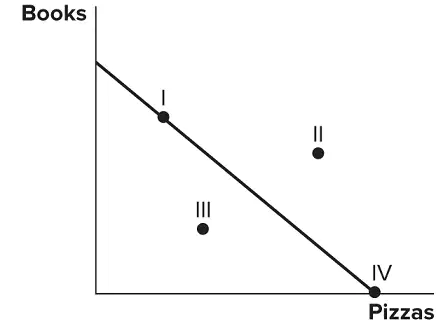
Refer to the production possibilities frontier for books and pizzas shown in the figure. Which of the following points are on the production possibilities frontier?
only point II
only point I
points I and IV
points I, III, and IV
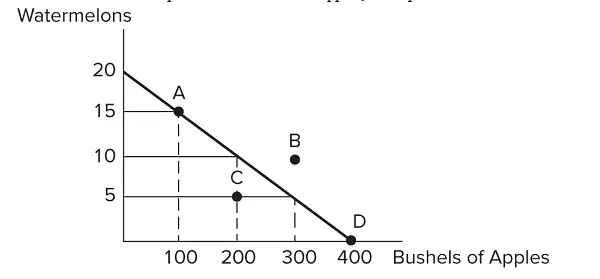
Consider the production possibilities frontier displayed in the figure shown. If a society with this frontier chooses to produce 200 bushels of apples, it can produce no more than ____ watermelons.
10 watermelons
20 watermelons
5 watermelons
15 watermelons
If we consider the reality that each worker has different skills, then the production possibilities frontier
should display a constant opportunity cost of a good, as more of that good is produced.
should display a decreasing opportunity cost of a good, as more of that good is produced.
should display an increasing opportunity cost of a good as more of that good is produced.
cannot be drawn, as too many variables would need to be taken into consideration.

Consider the production possibilities frontier in the figure shown. As more and more cars are produced, the opportunity cost of producing more cars
decreases.
stays the same.
increases.
Choosing to produce at any point within (inside, not on) a production possibilities frontier is
inefficient, meaning the society would not be using all its available resources in their best possible uses.
efficient, meaning the society would be using all its available resources in their best possible uses.
unobtainable, meaning the society cannot produce that combination of goods.
efficient, but not attainable.
If society experiences an increase in its available resources, its production possibilities frontier will
shift outward.
shift inward.
not move.
become convex.
An increase in productivity as a result of a new technology will cause the production possibilities frontier to
shift inward.
shift outward.
remain the same.
shift inward, then shift outward.
When nations trade,
only the strongest nation benefits.
only the weakest nation benefits.
all nations involved can benefit.
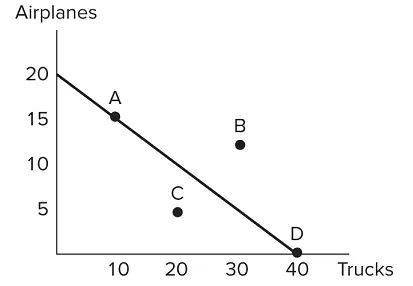
Suppose the figure shown represents the production possibilities frontier for Country A. Which one of the following combinations of goods could Country A consume in the absence of trade?
(15 airplanes, 15 trucks)
(20 airplanes, 40 trucks)
(10 airplanes, 30 trucks)
(5 airplanes, 30 trucks)
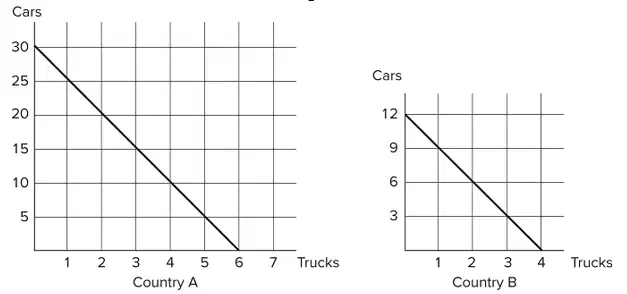
Refer to the figure shown, which represents the production possibilities frontiers for Countries A and B. Which one of the following statements is true?
Country A has a comparative advantage at producing cars
Country B can produce more of both goods than Country A.
Both countries have identical opportunity costs.
Neither country can benefit from trade.
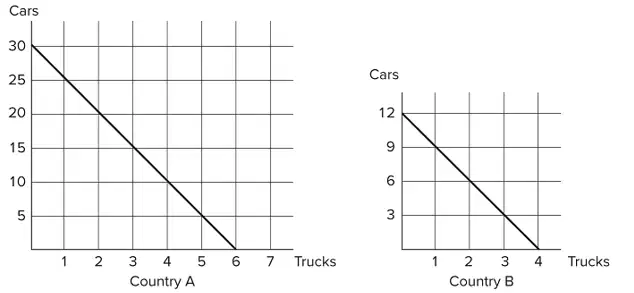
Refer to the figure shown, which represents the production possibilities frontiers for Countries A and B. Assuming both countries have the same amount of resources available to them, which one of the following statements is true?
Country A has an absolute advantage at producing cars, and Country B has an absolute advantage at producing trucks.
A) Country A has an absolute advantage at producing trucks, and Country B has an absolute advantage at producing cars
Country A has a comparative advantage at producing both cars and trucks.
Country B has a comparative advantage at producing both cars and trucks.
Suppose that a worker in Country A can produce either 25 bananas or 5 tomatoes each year. Country A has 200 workers. Suppose a worker in Country B can produce either 18 bananas or 6 tomatoes each year. Country B has 400 workers. For a worker in Country B, the trade-off to producing one tomato is
2 bananas.
3 bananas.
4 bananas.
5 bananas.
Suppose that, given the same number of workers, the United States can produce five times as many computers or ten times as many airplanes as Mexico. Which one of the following statements is true?
The United States has an absolute advantage in both computers and airplanes.
Mexico has an absolute advantage in both computers and airplanes.
The United States has a comparative advantage in both goods.
Mexico can produce more airplanes than the United States.
Suppose an American worker can make 20 pairs of shoes or grow 100 apples per day. Meanwhile, a Canadian worker can produce 10 pairs of shoes or grow 20 apples per day. When trade opens up, the United States should produce ________ because it has a(n) ________ and should ________.
both goods; absolute advantage in both goods; not trade
only shoes; comparative advantage at producing shoes; trade for apples
only apples; comparative advantage at producing apples; not trade
only apples; comparative advantage at producing apples; trade for shoes
Suppose an American worker can make 20 pairs of shoes or grow 100 apples per day. Meanwhile, a Canadian worker can produce 10 pairs of shoes or grow 20 apples per day. The opportunity cost of a pair of shoes is ________ for the United States than Canada, so Canada has a(n) ________ advantage at producing shoes.
higher; comparative
lower; comparative
higher; absolute
lower; absolute
Suppose an American worker can make 20 pairs of shoes or grow 100 apples per day. Meanwhile, a Canadian worker can produce 10 pairs of shoes or grow 20 apples per day. Canada's opportunity cost of producing a pair of shoes is ________ than the United States, so Canada should specialize in ________ production.
lower; apple
higher; apple
lower; shoe
Suppose an American worker can make 50 pairs of gloves or grow 300 radishes per day. Meanwhile, a Bangladeshi worker can produce 100 pairs of gloves or grow 200 radishes per day. Which one of the following statements is true?
The U.S. has a comparative advantage at producing both gloves and radishes.
The U.S. does not have a comparative advantage at producing either gloves or radishes.
The U.S. has a comparative advantage at producing gloves only.
The U.S. has a comparative advantage at producing radishes only.
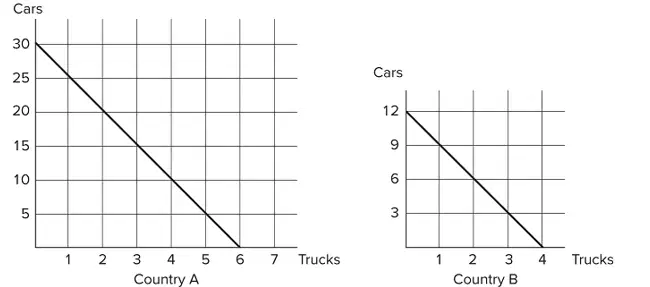
Refer to the figure shown, which represents the production possibilities frontiers for Countries A and B. After examining each country's production possibilities frontier, it is clear that
neither country will benefit from trade.
both countries can benefit from trade because an absolute advantage exists.
both countries could benefit from trade because a comparative advantage exists.
only Country A will benefit from trade.
Economic theory states that losing a comparative advantage at producing one good means creating a comparative advantage at producing another. As an economy transitions from producing one good to producing another good, those who must transition from the production of one good to the production of another good may find the transition difficult in the short run.
the transition can be seen as a success in the short run.
outsourcing will always be good for every member of a society.
no one will complain in the short run, but in the long run people may not like the transition.
What limits the terms of trade that a country would find acceptable?
the country’s opportunity costs of production
whether the country has an absolute advantage at producing a good
how much the country values the good for which it is trading
when the country has a comparative advantage at producing both goods
What happens to the demand curve when a nonprice determinant of demand changes?
The demand curve shifts to the left or to the right.
There is a movement along the demand curve.
The consumer moves to a different price point.
The demand curve does not change when a nonprice determinant of demand changes.
Suppose the price of dog collars has decreased and all other variables have remained constant. This change can be shown graphically as a
shift in the demand curve to the right.
shift in the demand curve to the left.
movement along the demand curve to the right.
movement along the demand curve to the left.
Which one of the following is one possible reason the supply of cell phones has increased?
More cell phone towers have been built.
Better technology allows cell phones to be produced for less money.
Consumer preference for cell phones has increased.
Consumers expect that land lines will cease to exist in the near future.
Suppose a recent epidemic of mad cow disease causes the government to mandate that thousands of cows be put down. What is the effect on the market for leather shoes?
The demand for leather shoes will increase.
The supply of leather shoes will decrease.
The demand for and supply of leather shoes will increase.
This scenario will not affect the market for leather shoes.
Suppose the price of chocolate chips increases. The producers of chocolate chip cookies will now supply ________ at each price because ________.
more; some of their competitors will drop out of the market
less; the price of a main input has gone up
more; the price of a main input has gone up
more; more competitors will enter the market
Suppose that advances in computer technology have decreased the productivity of a mill that produces paper. The result will likely be ________ the supply curve for paper.
a rightward shift of
a leftward shift of
a shift straight up of
a movement along
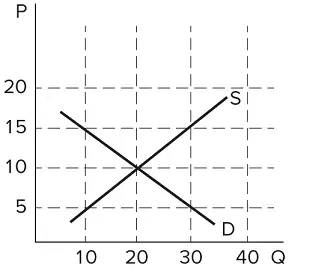
The graph shown depicts the market for a good. At a price of $5, there is
a shortage (excess demand) of 10 units.
a shortage (excess demand) of 20 units.
a shortage (excess demand) of 30 units.
a surplus (excess supply) of 20 units.
Suppose a tornado levels hundreds of homes. As rebuilding begins, how might you analyze the effect on the market for lumber?
The demand for lumber will increase, increasing both the equilibrium price and quantity.
The supply of lumber will increase, decreasing the equilibrium price and increasing the equilibrium quantity.
The demand for lumber will increase, decreasing the equilibrium price and increasing the equilibrium quantity.
The supply of lumber will decrease, increasing the equilibrium price and decreasing the equilibrium quantity.
Suppose the price of gasoline has recently increased. How will the market for hybrid cars be affected?
The demand for hybrid cars will increase.
The demand for hybrid cars will decrease.
The supply of hybrid cars will decrease.
The price of hybrid cars will fall.
Suppose the price of oil has recently increased, making it more expensive to manufacture ride-on lawn mowers. This oil price increase also makes it more expensive to run a ride-on mower. What factors of demand and/or supply are affected by the changing price of oil?
price of related good, expectations of future prices
price of related good, price of input
price of input, income
price of input, number of buyers
Suppose the price of oil has recently increased, making it more expensive to manufacture ride-on lawn mowers. This oil price increase also makes it more expensive to run a ride-on mower. What is likely to happen to the market for ride-on lawn mowers as a result of the changing price of oil?
Supply and demand will increase, increasing equilibrium quantity and having an indeterminate effect on price.
Supply and demand will decrease, decreasing equilibrium quantity and having an indeterminate effect on price.
Supply and demand will increase, increasing equilibrium price and having an indeterminate effect on quantity.
Supply and demand will decrease, increasing equilibrium price and having an indeterminate effect on quantity.
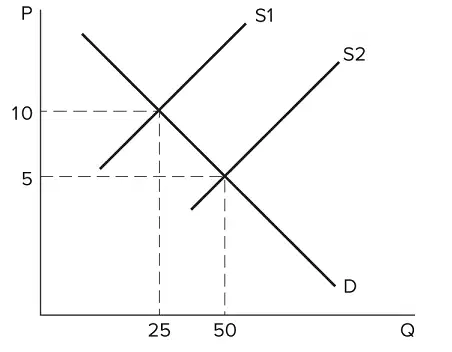
The graph shown depicts the market for a good. Assume the market was originally in equilibrium where the demand curve (D) and supply curve (S2) intersect. Something changes in the market, and the supply curve shifts to S1. What could have caused this shift?
The price of pizza sauce increased.
The price of pizza decreased.
The price of labor for pizza shops decreased.
Consumers no longer prefer to eat pizza.
Consider the market for pecans, which is currently in equilibrium. Now, suppose a hurricane destroys a large number of pecan trees. How will the market for pecans change as a result of the hurricane?
The equilibrium price will decrease, and the equilibrium quantity will increase due to an increase in supply.
The equilibrium price will increase, and the equilibrium quantity will decrease due to a decrease in supply.
The equilibrium price and quantity will fall due to a decrease in supply and demand.
The equilibrium price will increase, and the equilibrium quantity will decrease due to a decrease in supply and an increase in demand.
Consider the market for burritos, which is currently in equilibrium. Now, suppose that two events happen simultaneously: 1. the price of tortillas, used in the production of burritos, increases, and 2. a new advertising campaign increases the popularity of burritos among consumers. What effect might these events have on the market for burritos?
There will be no change in equilibrium price and quantity.
The equilibrium price will increase.
Demand will decrease.
Demand will increase.
Consider the market for potato chips, which is currently in equilibrium. Now, suppose that two events happen simultaneously: 1. a new technology is invented that allows potato chip makers to produce potato chips at a lower cost, and 2. the price of pretzels (a substitute in consumption) rises. What effect might these events have on the market for potato chips and pretzels?
The supply of potato chips will shift to the left.
The demand for potato chips will shift to the right.
The equilibrium quantity of potato chips will decrease.
The demand for pretzels will shift to the left.
Consider the market for potato chips, which is currently in equilibrium. Now, suppose that two events happen simultaneously: 1. a new technology is invented that allows potato chip makers to produce potato chips at a lower cost, and 2. the price of pretzels (a substitute in consumption) rises. Which one of the following statements is true about the market for potato chips?
The change in equilibrium quantity of potato chips cannot be determined.
The equilibrium quantity of potato chips will decrease.
The equilibrium price of potato chips will increase.
Suppose that a deep freeze across the southern United States destroys the citrus crop. What is the effect on the market for oranges, lemons, limes, and grapefruits?
The demand for citrus fruits will increase.
The supply of citrus fruits will decrease.
The demand for and supply of citrus fruits will increase.
The deep freeze will not affect the market for citrus fruits.
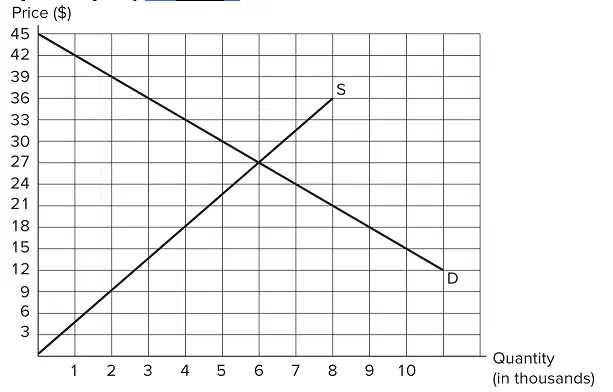
The graph shown depicts the market for a good. The equilibrium price is _________, and the equilibrium quantity is _________.
$27; 6
$45; 0
$27; 6,000
$18; 4,000
Suppose the price of a movie ticket is 7.50andthequantitydemandedis550.Whenthepriceincreasesto 8.50, the quantity demanded drops to 450. Using the mid-point method, what is the price elasticity of demand for movie tickets?
0.625
-0.625
-1.6
1.6
Suppose the price of a can of soup is 1.30andthequantitydemandedis9.Whenthepriceincreasesto 1.50, the quantity demanded drops to 7. Using the mid-point method, what is the price elasticity of demand?
-1.75
-0.57
0.57
1.75
Suppose the price of mascara is 12andthequantitydemandedis450.Whenthepricedropsto 8, the quantity demanded increases to 550. Using the mid-point method, what is the price elasticity of demand?
-0.5
-2.0
-55
-180
If the price of a good increases by 10 percent and its quantity demanded drops by 50 percent, then the price elasticity of demand is
1.0.
0.2.
-5.0
If the price of a cup of coffee increases by 50 percent and the quantity of cups demanded decreases by 50 percent, then the price elasticity of demand is:
elastic
inelastic
unit elastic
zero
If the price of hairbrushes decreases by 20 percent and the quantity of hairbrushes demanded increases by 2 percent, then the price elasticity of demand is ________ and is ________.
-0.1; elastic
10; elastic
-0.1; inelastic
10; inelastic
If the price of a DVD decreases by 50 percent and the quantity of DVDs demanded increases by 75 percent, then the price elasticity of demand is ________ and is ________.
-1.5; inelastic
-1.5; elastic
-0.67; elastic
-0.67; inelastic
Suppose the price of science textbooks increases by 50 percent. Suppose that the price of mystery novels also increases by 50 percent. The price of other books remains unchanged. The demand for science textbooks is ________ price elastic than the demand for mystery novels because science textbooks have ________ available substitutes.
less; fewer
more; more
more; fewer
less; more
How does the amount of time consumers have to adjust to a price change affect elasticity?
The more time consumers have to adjust, the less elastic their demand will be.
The time consumers have to adjust does not affect the elasticity of their response unless the good is a luxury good.
The more time consumers have to adjust, the more elastic their demand will be.
The time consumers have to adjust will not affect the elasticity of their response unless the good is a necessity.
If the price of subway rides increases, quantity demanded will be
more elastic in six weeks than in six months.
more elastic in six months than in six weeks.
the same over any time period.
unpredictable without more information.
Suppose gas prices have steadily increased over the last decade. We therefore expect the price elasticity of demand for gas, when measured over the last decade, to
be more elastic than it has been in the last six months.
be less elastic than it has been in the last six months.
be relatively the same as the last six months.
no longer be an issue because consumers are used to higher gas prices.
Suppose that the price of a good is 10andquantitydemandedis50units.Whenpriceincreasesto 12, quantity demanded decreases to 40 units. What happened to total revenue and what does this indicate?
Total revenue decreased, indicating demand is elastic.
Total revenue increased, indicating demand is inelastic.
Total revenue stayed the same, indicating unit elastic demand.
Total revenue increased, indicating demand is elastic.
Suppose when the price of shoelaces goes from 1to 2 per pair, production increases from 95 million pairs to 105 million pairs per year. Using the mid-point method, what is the price elasticity of supply?
6.28
0.66
0.11
0.15
Suppose when the price of pizza goes from 8to 12 per pie, production increases from 2,500 pies to 4,000 pies per month. Using the mid-point method, what is the percentage change in price?
40 percent
46 percent
50 percent
33 percent
Suppose when the price of novels goes from 15to 20 per book, production increases from 760 million books to 840 million books per year. Using the mid-point method, what is the price elasticity of supply?
0.77
2.85
2.0
0.35

