
 Worksheets
Civics and Government NOTES Quiz
Total questions: 55
Worksheet time: 33mins
1- How does studying civics help citizens participate in government?
Studying civics makes citizens better at making decisions in government.
Studying civics helps citizens understand politics and history
Studying civics helps citizens understand voting patterns
2- Explain Hobbes’s view of life without government and contrast it with Locke’s justification for government.
Hobbes argues for minimal government to ensure freedom, whereas Locke supports absolute monarchy or strong republicanism
Hobbes believes life without government is orderly and just, while Locke sees it as chaotic. This is because of the parts of the english civil war each man lived through
List the four functions of government and provide one concrete example of each.
1) Maintaining order: creating regulations; 2) Providing public services: voting; 3) Ensuring national security: teachers; 4) Guiding the Community: immigration control
1) Collecting taxes: Income tax;
2) maintaining infrastructure; roads
3) restricting rights; Jimmy Kimmel cancellation
4) investigating wrongdoing; police
1) Maintaining order: Police force; 2) Providing public services: Public schools; 3) Ensuring national security: Military; 4) Guiding the Community: Creating laws and regulations
1) Collecting taxes: tariffs;
2) maintaining infrastructure; water mains
3) restricting rights; for crime
4) Issuing currency: Minting coins;
explain why federal law has supremacy over state and local laws.
Federal, State and Local
State laws always override federal laws.
Federal, State and Local
Federal law has supremacy over state and local laws due to the Supremacy Clause in the U.S. Constitution.
Executive, Judicial, and Legislative
Local laws are more powerful than federal laws.
Executive, Judicial, and Legislative
The Constitution does not mention federal supremacy.
Match each type of government with a historical or modern example.
Representative democracy
The USA
Direct democracy
Ancient Athens
Dictatorship
North Korea
Theocracy
Saudi Arabia
Constitutional Monarchy
The UK
Define “anarchy.” What real-world example illustrates the dangers of anarchy?
Anarchy is a state of society without government or authority; The situation in Canada during the 1980s illustrates anarchy.
Anarchy is a form of government with strict laws. Like modern day North Korea
Anarchy promotes a strong central authority to maintain order. Like the empire in star wars
Explain the principle of popular sovereignty and how it is reflected in the U.S. Constitution.
Popular sovereignty is the idea that only the educated should vote. You can find it in the preamble
Popular sovereignty means the government can only act with the people's consent. You can find it in the declaration of independence
Popular sovereignty is the principle that government authority comes from the people, reflected in the U.S. Constitution through the Preamble and the establishment of a representative democracy.
Describe the two main ways a person can become a U.S. citizen
Naturalization and Visa process
Naturalization and Employment in the U.S.
Marriage to a U.S. citizen and Birthright
List the three ways a person can lose U.S. citizenship.
Voluntary renunciation
Committing treason
Fraud during the naturalization process
Identify one principle from Enlightenment thinkers that is reflected in each of the following documents:
Declaration of Independence
Natural Rights
U.S. Constitution Preamble
Social Contract
Bill of Rights
Individual Liberties
what is the difference between civic duties and civic responsibilities
match the list of duties and responsibilities
Civic Duties
Obeying the law
Civic Responsibilities
Voting
Civic Rights
Freedom of speech
Give three examples of ways individuals can participate in civic life beyond voting.
Watch a documentary on the Obamas.
Participate in advocacy groups.
Volunteer for community service projects.
Attend town hall meetings.
What are the major historical immigration waves to the U.S., and which groups were involved?
1800-1900s Great Wave: Irish, German, Italian;
Post-1965: Latin American, Asian immigrants.
What is the purpose of the U.S. Census, and how does it impact representation?
How have education levels and workforce participation changed in recent decades?
How does birthright citizenship work for children of non-U.S. citizens born in the United States?
What limitations do legal aliens face in the U.S.?
Legal aliens can vote in federal elections but not state ones.
Legal aliens have the same access to government benefits as citizens. But they can't vote.
What challenges do undocumented immigrants face in the U.S.?
Undocumented immigrants face challenges such as lack of access to healthcare,
Undocumented immigrants face challenges such as fear of deportation
Undocumented immigrants face challenges such limited job opportunities, and social isolation.
Undocumented immigrants struggle to understand the myriad of benefits they receive upon entering the US
Reorder the following: the five steps of the naturalization process.
Declare intent (N-300)
File application (N-400)
Fingerprinting and Background check
Citizenship Test
Oath of Allegiance Ceremony
In historical societies, who were typically allowed to be citizens?
Only male property owners
All adults
Only females
Anyone born in the country
How is modern citizenship different from historical citizenship regarding property ownership?
It is still tied to property ownership
It is not tied to property ownership
Only females can be citizens
Only property owners can vote
What is an example of a government action that reflects the consent of the governed?
Ignoring public opinion
Implementing policies based on public demand
Enforcing laws without public input
Making decisions without elections

What happens to society without a government?
It becomes more organized
It falls into anarchy
It becomes peaceful
It gains more structure
What historical event influenced Hobbes's belief that life without government is "nasty, brutish, and short"?
The French Revolution
The American Revolution
The English Civil War
The Industrial Revolution
According to Hobbes, what would humans compete for in the absence of government?
Education and culture
Territory, resources, and power
Art and literature
Technology and innovation

What is the "Divine Right of Kings"?
The belief that kings are chosen by the people.
The belief that kings are chosen by God.
The belief that kings are chosen by their ancestors.
The belief that kings are chosen by their military power.
What did Locke reject in his treatises?
The concept of natural rights
The Divine Right of Kings
The right to property
The need for government
According to Locke's Second Treatise, what are the natural rights everyone is born with?
Freedom, Justice, Equality
Life, Liberty, Property
Happiness, Wealth, Power
Security, Peace, Order
What does Locke's First Treatise argue about government?
Government should be based on divine-right theory
No legitimate government under divine-right theory
Government should be absolute
Government should be democratic
What is the function of government that involves making and enforcing rules to prevent chaos?
Provide Services
Keep Order
Provide Security
Guide the Community
Which function of government is responsible for offering public goods that no one person or private sector can provide?
Keep Order
Provide Security
Provide Services
Guide the Community
What does the government do to protect citizens from internal and external threats?
Provide Services
Keep Order
Guide the Community
Provide Security
Setting policy agendas to achieve community goals is an example of which government function?
Provide Security
Guide the Community
Keep Order
Provide Services
At what age must students attend school until, according to compulsory education laws?
14
16
18
20

What is the highest level of government in the United States?
State
Local
Federal
Municipal
What is federalism?
A system where the national government holds all the power
Sharing of powers between national, state, and local governments
A system where state governments have more power than the national government
A form of government where local governments are independent
Which type of government is characterized by rule by a king or queen?
Democracy
Monarchy
Dictatorship
Oligarchy
In which type of government does the leader have exclusive power and limit freedoms?
Democracy
Authoritarian
Anarchy
Theocracy
How does the system of Checks and Balances work in the U.S. government?
By allowing one branch to control all others
By enabling each branch to limit the powers of the others
By removing all power from the branches
By giving all power to the President
How have population changes shaped American society?
By increasing technological advancements
By shaping cultural diversity
By reducing economic growth
By limiting educational opportunities
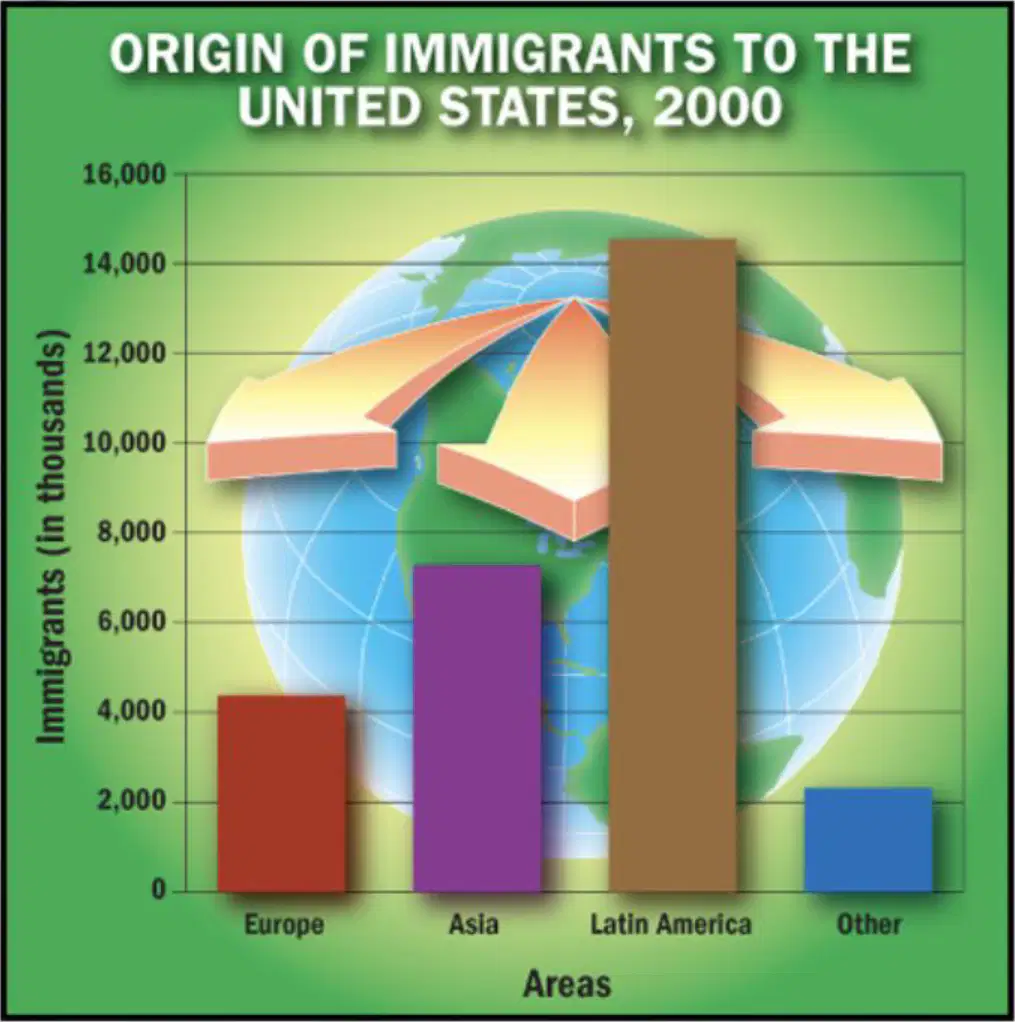
Which area is the birthplace of the highest percentage of immigrants in the United States according to the bar graph?
Europe
Asia
Latin America
Other

How often is the census conducted in the U.S.?
Every 5 years
Every 10 years
Every 15 years
Every 20 years

What is the definition of an immigrant?
A person who visits another country for a short time
A person who moves to another country to live permanently
A person who travels for business purposes
A person who studies abroad temporarily
Who is considered a citizen today?
Only those born in the country
Only those who own property
Native-born or naturalized individuals
Only those who serve in the military
What is the term used for citizenship by birth on a country's soil?
Jus sanguinis
Jus soli
Naturalization
Expatriation
What is the final step in the naturalization process?
Fingerprinting & background check
English & civics exam
Oath of Allegiance ceremony
Declare intent
What does "jus sanguinis" refer to in terms of citizenship?
Citizenship by soil
Citizenship by blood
Citizenship by marriage
Citizenship by naturalization
Which foundational document includes the phrase "Life, Liberty, and the pursuit of Happiness"?
U.S. Constitution
Bill of Rights
Declaration of Independence
Articles of Confederation
What concept is reflected by the phrase "We the People" in the U.S. Constitution Preamble?
Federalism
Popular sovereignty
Judicial review
Separation of powers
Which document contains the first ten amendments protecting individual liberties?
Declaration of Independence
U.S. Constitution
Bill of Rights
Federalist Papers
What is the validity period of a Green Card?
5 years
10 years
15 years
20 years
What is a document or stamp in a passport that gives permission to enter, stay, or work in a country for a certain period of time?
Expatriation
Visa
Denaturalization
Treason
Who are considered Refugees?
People who travel for work.
People who have been forced to leave their home country because of war, violence, or persecution.
People who are studying abroad.
People who are on vacation in another country.
How does the principle of majority rule and minority rights protect minorities?
By allowing minorities to make all decisions
By ensuring the rights of minorities are protected while the majority guides policy
By ignoring the will of the majority
By giving minorities more power than the majority

