

wayground logo

Free Printable Worksheets

Font size

S
M
L
XL
Worksheets

Agri 3100- Exam 2

Total questions: 153

Worksheet time: 1hrs 17mins

Name
Class
Date
1.

What is the relationship between the myelin sheath and the nodes of Ranvier?

a)
The myelin sheath slows down signal transmission, while the nodes of Ranvier enhance it.
b)
The myelin sheath insulates nerve fibers, while the nodes of Ranvier are gaps that enable faster signal transmission through saltatory conduction.
c)
The myelin sheath is a type of neuron, while the nodes of Ranvier are specialized cells.
d)
The myelin sheath and nodes of Ranvier are both found in the brain only.
2.

Name the parts of a typical neuron

a)
axon hillock, neurotransmitter, synaptic cleft
b)
dendritic spine, glial cells, soma
c)
soma, synapse, neurotransmitter
d)

Cell body, dendrites, axon, nodes of ranvier, nucleus, schwann cell, myelin sheath

3.

What are the anatomic differences between the CNS and PNS?

a)
The CNS includes the peripheral nerves and is not encased in bone.
b)
The PNS is protected by bone and includes the brain and spinal cord.
c)
The CNS consists of nerves outside the brain and spinal cord.
d)
The CNS is encased in bone and includes the brain and spinal cord, while the PNS consists of nerves outside the CNS and is not protected by bone.
4.

What does the autonomic system do?

a)
The autonomic system regulates voluntary muscle movements.
b)

The autonomic system controls involuntary bodily functions. (breathing)

c)
The autonomic system is responsible for conscious thought processes.
d)
The autonomic system manages sensory perception and interpretation.
5.

What does the somatic system do?

a)
The somatic system regulates involuntary functions like heartbeat.
b)
The somatic system is responsible for hormone production.
c)
The somatic system manages digestive processes.
d)

The somatic system controls voluntary movements and processes sensory information. (moving a limb)

6.

What is a sensory function?

a)
A sensory function refers to the act of moving muscles.
b)
A sensory function is the ability to think critically.
c)
A sensory function is the process of receiving and interpreting sensory information from the environment.
d)
A sensory function is the process of breathing and circulation.
7.

What is a motor function?

a)
Motor function is the ability to think critically.
b)
Motor function refers to the process of breathing.
c)
Motor function is the capacity to feel emotions.
d)
Motor function is the ability to perform movements through the coordination of muscles and the nervous system.
8.

What normally maintains the resting membrane potential of a neuron during the resting state?

a)
Calcium influx through voltage-gated channels.
b)
Chloride ion accumulation inside the neuron.
c)
The sodium-potassium pump and selective ion permeability.
d)
Increased potassium concentration outside the cell.
9.

What is the functional relationship between a neurotransmitter and a receptor?

a)
A neurotransmitter binds to a receptor to transmit signals between neurons.
b)
Neurotransmitters and receptors have no interaction in the nervous system.
c)
Receptors produce neurotransmitters to enhance signal strength.
d)
A neurotransmitter destroys the receptor to prevent signal transmission.
10.

Will any neurotransmitter stimulate any receptor?

a)
No, not every neurotransmitter can stimulate any receptor.
b)
Only specific neurotransmitters can stimulate specific receptors.
c)
Some neurotransmitters can stimulate multiple receptors.
d)
Yes, all neurotransmitters can stimulate any receptor.
11.

Which part of the brain controls many autonomic functions related to cardiovascular, respiratory, and gastrointestinal functions?

a)
Cerebellum
b)
Thalamus
c)

Medulla oblongata (brainstem)

d)
Hippocampus
12.


What are the 12 cranial nerves?

a)

Optic Chiasm, Optic, Oculomotor, Trochlear, Trigeminal, Abducens , Facial , Vestibulocochlear, Glossopharyngeal, Vagus, Accessory , Hypoglossal

b)

Spinal Accessory, Olfactory, Optic, Oculomotor, Trochlear, Trigeminal, Abducens , Facial , Vestibulocochlear, Glossopharyngeal, Vagus, Accessory ,

c)

Cerebellum, adductor, optic, olfactory, trigeminal, facial, vagus, hypoglossal, oculomotor, trochlear, accessory, glossopharyngeal

d)

Olfactory, Optic, Oculomotor, Trochlear, Trigeminal, Abducens , Facial , Vestibulocochlear, Glossopharyngeal, Vagus, Accessory , Hypoglossal

13.

Which of these cranial nerves are sensory?

a)

Hypoglossal, vagus, trigeminal

b)

Facial, oculomotor, trochlear

c)

Trigeminal, glossopharyngeal, trigeminal, abducens

d)

Olfactory, Optic, Vestibulocochlear

14.

Which of these cranial nerves are motor?

a)

Vagus, optic, olfactory, trigeminal

b)

Olfactory, optic

c)

Optic, facial, glossopharyngeal, vagus

d)

Oculomotor, Trochlear, Abducens, Accessory, Hypoglossal

15.

Which of these cranial nerves are both?

a)

Optic, olfactory, oculomotor, trochlear

b)

Olfactory, optic, abducens, vestibulocochlear

c)

Accessory, vagus, vestibulocochlear

d)

Trigeminal, Facial, Glossopharyngeal, Vagus

16.

Which part of the autonomic nervous system is responsible for the flight-or-flight response?

a)
Sympathetic nervous system
b)
Parasympathetic nervous system
c)
Central nervous system
d)
Somatic nervous system
17.

Which part of the autonomic nervous system is responsible for the rest-and-restore system?

a)
Parasympathetic nervous system
b)
Somatic nervous system
c)
Central nervous system
d)
Sympathetic nervous system
18.

If trauma occurs in the segment of the spinal cored through which a particular reflex arc passes, will the reflex arc be hyperreflexive or hyporeflexive?

a)

Hyper-reflexive

b)

Hypo-reflexive

19.

What is the palpebral reflex? 

a)
The palpebral reflex is an involuntary blink response to stimulation of the eyelids or cornea.
b)
A response that involves closing the eyes when hearing a loud sound.
c)
A reflex that causes the eyes to water when exposed to wind.
d)
A voluntary eye movement in response to light.
20.

What is the result of a normal PLR?

a)
Pupils dilate in response to light.
b)
Pupils constrict in darkness.
c)
Pupils constrict in response to light.
d)
Pupils remain unchanged regardless of light exposure.
21.

With which branch of the autonomic nervous system are muscarinic and nicotinic receptors associated?

a)
Sympathetic nervous system only
b)
Central nervous system
c)

Parasympathetic nervous system

d)
Both branches of the autonomic nervous system
22.

The average muscle fiber contraction cycle lasts about

a)

0.1 second

b)

0.5 second

c)

0.01 second

d)

0.05 second

23.

When the sternocephalicus muscle contracts what happens in the animal’s body?

a)

The rear leg is pulled backward.

b)

The front leg is pulled forward.

c)

The head and neck are lowered.

d)

The head and neck are raised.

24.

What is action potential?

a)
A method of muscle contraction without electrical signals.
b)
An action potential is a rapid change in electrical potential across a cell membrane that enables signal transmission.
c)
A slow change in temperature within a cell.
d)
A type of hormone released by neurons.
25.

What is depolarization?

a)
Depolarization is the increase of the membrane potential difference, making the inside of the cell more negative.
b)
Depolarization refers to the process of hyperpolarizing the cell membrane, leading to a more negative interior.
c)
Depolarization is the stabilization of the membrane potential, keeping the inside of the cell neutral.
d)
Depolarization is the reduction of the membrane potential difference, making the inside of the cell more positive.
26.

What does the dendrite do?

a)
Dendrites produce neurotransmitters.
b)

Dendrites carry signals toward the cell body.

c)
Dendrites transmit signals to muscles.
d)
Dendrites protect the neuron from damage.
27.

What does the axon do?

a)
The axon protects the neuron from damage.
b)

The axon transmits electrical signals away from the cell body.

c)
The axon stores neurotransmitters for later use.
d)
The axon receives signals from other neurons.
28.

What are the junctions between neurons called?

a)
Dendrites
b)
Synapses
c)
Axons
d)
Neurotransmitters
29.

What are support cells in the nervous system called?

a)
Dendrites
b)
Synapses
c)
Neurons
d)

Glia cells

30.

What are the two main parts of the nervous system?

a)
Brain and heart
b)
Central nervous system and peripheral nervous system
c)
Cerebral cortex and spinal cord
d)
Autonomic nervous system and somatic nervous system
31.

What is the functional cell of the nervous system?

a)
Axon
b)
Synapse
c)
Neuron
d)
Glial cell
32.

What is the most common type of synapse?

a)
Electrical synapse
b)
Gap junctions
c)
Neurotransmitter receptors
d)
Chemical synapse
33.

What are neurotransmitters?

a)
Neurotransmitters are hormones that regulate mood.
b)

Neurotransmitters are chemical messengers that transmit signals between neurons. (chemical released at synapses)

c)
Neurotransmitters are proteins that build cell structures.
d)
Neurotransmitters are electrical impulses that travel through the body.
34.

What are excitatory neurotransmitters?

a)
Hormones that regulate mood
b)
Proteins that transport neurotransmitters
c)
Chemicals that inhibit neuron firing
d)

increase sodium permeability and depolarize the postsynaptic cell.

35.

What are inhibitory neurotransmitters?

a)
Inhibitory neurotransmitters increase neuronal excitability.
b)
Inhibitory neurotransmitters only function in the digestive system.
c)

increase potassium or chloride permeability and hyper-polarize postsynaptic cell

d)
Inhibitory neurotransmitters are responsible for pain signaling.
36.

What is a reflex?

a)
A reflex is a type of muscle that contracts voluntarily.
b)
A reflex is a conscious decision made by the brain.
c)
A reflex is an automatic response to a stimulus.
d)
A reflex is a learned behavior over time.
37.

What does the ANS control?

a)
The immune system manages bodily infections.
b)
The endocrine system regulates emotional responses.
c)
The central nervous system controls voluntary movements.
d)

controls smooth & cardiac muscle and glands

38.

What does the PNS consist of?

a)
The PNS consists of the brain and spinal cord.
b)
The PNS is made up of only the cranial nerves.
c)
The PNS includes the central nervous system components.
d)
The PNS consists of nerves and ganglia outside the brain and spinal cord.
39.

What does the brachial plexus supply?

a)
The head and neck
b)
The upper limb (shoulder, arm, forearm, and hand)
c)
The lower limb (thigh, leg, and foot)
d)
The torso and abdomen
40.

What does the lumbosacral plexus supply?
a)
The upper limbs and neck.
b)
The abdominal organs and chest.
c)
The head and shoulders.
d)
The lower limbs and parts of the pelvis.
41.

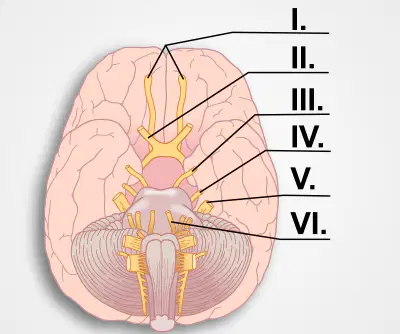
What are these nerves?

a)

I. olfactory nerve, II. optic, III. oculomotor, IV. trochlear, V. trigemenial, VI. abducens

b)

I. optic, II. trochlear, III. abducens, IV. olfactory nerve, V. hypoglossal, VI. accessory

c)

I. accessory, II. vagus, III. abducens, IV. optic, V. hypoglossal, VI. oculomotor

d)

I. olfactory nerve, II. optic, III. accessory, IV. hypoglossal, V oculomotor, VI. vagus

42.

Why are visceral sensations important to the survival of an animal?

a)
Visceral sensations are only important for reproduction.
b)
They help animals communicate with each other.
c)
Visceral sensations are irrelevant to an animal's behavior.
d)
Visceral sensations are important for survival as they inform the animal about its internal state and needs, enabling appropriate responses to maintain homeostasis and avoid threats.
43.

Why does moderate pain not appear to affect mood/behavior of domestic animals?

a)
Domestic animals are unaware of their pain levels.
b)
Moderate pain leads to increased aggression in domestic animals.
c)

Animals hide their pain to avoid looking vulnerable to predators.

d)
Moderate pain causes domestic animals to isolate themselves from others.
44.

Why is the proprioceptive sense important to balance and posture?

a)
Proprioception is solely about visual input.
b)

it informs the brain about body position and movement, enabling effective coordination and stability.

c)
It is not related to coordination or stability.
d)
Proprioception only affects muscle strength.
45.

How are your senses of taste and smell similar?

a)

they both detect chemical substances

b)
Smell is only used for detecting sweet flavors, while taste detects all others.
c)
Taste relies solely on temperature, while smell does not.
d)
Taste and smell are both primarily visual senses.
46.

How would rupture of the eardrum affect hearing?

a)
Rupture of the eardrum can cause hearing loss.
b)
Rupture of the eardrum only causes pain, not hearing loss.
c)
Rupture of the eardrum has no effect on hearing.
d)
Rupture of the eardrum improves hearing.
47.

What are ossicles?

a)

tiny muscles in the ear that control hearing.

b)

fluid-filled sacs in the inner ear responsible for balance.

c)

hair-like structures in the cochlea that detect sound waves.

d)

three small bones in the middle ear that help transmit sound vibrations.

48.

What are otoliths?

a)

large bones in the skull that protect the brain.

b)

fluid-filled sacs in the stomach that aid digestion.

c)

tiny hair-like structures in the lungs that filter air.

d)

small calcium carbonate structures in the inner ear that help with balance.

49.

What is the basic cause of motion sickness?

a)
Lack of sleep before travel
b)
Eating spicy food before a trip
c)

conflict between visual, vestibular, and proprioceptive signals.

d)
High altitude exposure during flight
50.

What do the rods in the retina perceive?

a)

perceive color and brightness.

b)

perceive sound and motion.

c)

perceive temperature and texture.

d)

perceive light intensity.

51.

What do the cones in the retina perceive?

a)
Shape and texture
b)
Sound and temperature
c)
Movement and depth
d)

Color and detail.

52.

Can an animal intentionally cover its eye with its third eyelid?

a)

No, the third eyelid is involuntary.

b)
Animals can cover their eyes with the third eyelid for protection.
c)
Some animals use their third eyelid to blink intentionally.
d)
Yes, animals can control their third eyelid at will.
53.

What is the function of the iris?

a)

protects the eye from foreign objects.

b)

responsible for color perception.

c)

regulate the amount of light entering the eye by adjusting the size of the pupil.

d)

helps in focusing light onto the retina.

54.

What is an ear hematoma?

a)
An infection in the inner ear.
b)
An ear hematoma is a collection of blood between the cartilage and skin of the outer ear.
c)
A buildup of wax in the ear canal.
d)
A type of hearing loss caused by aging.
55.

What are 4 causes of cataracts?

a)

genetics, trauma, infection and diabetes millitus

b)

trauma, genetics, infection, and blood

c)

infection, genetics, trauma and tonometer

d)

genetics, infection, diabetes mellitus and opoids

56.

What is glaucoma?

a)
Glaucoma is an infection of the eye caused by bacteria.
b)
Glaucoma is a group of eye conditions that damage the optic nerve, often associated with increased eye pressure.
c)
Glaucoma is a type of cataract that affects vision.
d)
Glaucoma is a condition that only affects children.
57.

What are the 4 characteristics of muscle?

a)
Flexibility, stability, strength, coordination
b)
Resistance, endurance, mobility, balance
c)
Agility, speed, power, recovery
d)
Excitability, contractility, extensibility, elasticity
58.

What are the primary functions of muscle?

a)
Breathing, digestion, and blood circulation
b)
Memory storage, sensory perception, and hormone production
c)
Vision, hearing, and taste sensation
d)

movement, posture maintenance, and heat production.

59.

What is skeletal muscle also known as?

a)
Cardiac muscle
b)
Voluntary muscle
c)
Smooth muscle
d)

Voluntary striated muscle

60.

Function of tendons?

a)
To protect muscles from injury.
b)
To connect bones to bones.
c)
To store energy for muscle contraction.
d)

To connect muscles to bones.

61.

What are aponeuroses?

a)

flat, sheet-like fibrous tissues. (ex: linea alba)

b)

round, muscle-like structures that store energy.

c)

bony structures that protect organs.

d)

fluid-filled sacs that cushion joints.

62.

What is the orgin?

a)

more stable site, little movement

b)
A historical event that occurred.
c)
A type of fruit.
d)

less stable site, lots of movement

63.

What is insertion?

a)

Site of greatest movement when muscle contracts

b)

The process of sorting elements in a data structure.

c)

Removal of an element from a data structure.

d)

The act of searching for an element in a data structure.

64.

What does an agonist do?

a)

Inhibits a receptor to block a biological response.

b)

Neutralizes the effects of a receptor.

c)

Deactivates a receptor to prevent a biological response.

d)

Directly produces movement (prime mover)

65.

What does an antagonist do?

a)

The main character in a story.

b)

Opposes the action of the agonist.

c)

Follows the action of the agonist

d)
An antagonist helps the protagonist succeed.
66.

What does a synergist do?

a)

Contracts at the same time as agonist to assist.

b)

Type of muscle that only relaxes.

c)

Opposes the action of another muscle.

d)

Contracts independently during movement.

67.

What does a fixator do?

a)

Increases joint flexibility.

b)

Promotes muscle growth.

c)

Stabilizes joints to allow other movements

d)

Enhances muscle strength.

68.

Characteristics of a skeletal muscle cell?

a)

Long & thin, multinucleated, composed of myofibrils, has contractile units called myofibril.

b)

Cells are primarily found in the heart, short and cubed, composed of myosin

c)
Skeletal muscle cells have a single nucleus and are non-striated.
d)
Skeletal muscle cells are smooth and involuntary.
69.

What are facicles

a)

Bundles of muscle fibers.

b)

Connective tissue around each bundle.

c)

A type of musical instrument.

d)

Types of plants found in tropical regions.

70.

What is the perimysium?

a)

Layer of fat surrounding muscles.

b)

Connective tissue that surrounds each bundle

c)

A type of nerve tissue.

d)

A type of muscle fiber.

71.

What is the endomysium?

a)
The endomysium is a connective tissue that surrounds individual muscle fibers.
b)
A type of blood vessel
c)

Bundles of muscle fibers

d)
A type of muscle fiber
72.

What is a myofibril?

a)

A type of muscle fiber that stores energy.

b)

A nerve cell that transmits signals.

c)

A protein that helps in digestion.

d)

Microscopic structure composed of actin and myosin

73.

Characteristics of a sarcomere?

a)
A structure that stores calcium ions in muscle cells.
b)
A type of connective tissue found in joints.
c)

Thick, dark myosin filaments & thin, light actin filaments

d)

Long, thin, multinucluated with actin filaments

74.

What is the neuromuscular junction?

a)
The neuromuscular junction is a type of muscle fiber.
b)
The neuromuscular junction is the connection between two muscle fibers.
c)

Part of the brain that controls movement; myofibril is released.

d)

Site where motor nerve connects muscle fiber; acetylcholine is released.

75.

Small motor units = what?

a)

used for heavy lifting.

b)

many movements

c)

responsible for endurance activities.

d)

few movements

76.

Large motor units = what?

a)

fine motor control.

b)

more movements

c)

endurance activities.

d)

few movements

77.

Steps of muscle relaxation?

a)
Calcium release from the sarcoplasmic reticulum
b)

sarcoplasmic reticulum pumps K+ back in; contraction starts

c)
Increased calcium binding to actin
d)

sarcoplasmic reticulum pumps Ca+ back in; contraction stops

78.

Do actin and myosin filaments overlap slightly at rest?

a)

Yes

b)

No

79.

In muscle contraction do the cross-bridges rachet back and forth, pulling muscle filaments toward the center?

a)

no

b)

yes

80.

What happens when the sarcomere shortens?

a)
The sarcomere expands, resulting in muscle fatigue.
b)
The sarcomere lengthens, causing muscle relaxation.
c)
The sarcomere remains unchanged, leading to no movement.
d)
The sarcomere shortens, causing muscle contraction.
81.

Characteristics of contraction?

a)

requires no energy and generates no tension.

b)

occurs only in smooth muscle fibers.

c)

fiber contracts completely or not at all

d)

leads to muscle fiber elongation and relaxation.

82.

What is aerobic metabolism?

a)

requires oxygen; efficient

b)

process of producing energy in cells using carbon dioxide.

c)

is the breakdown of glucose without oxygen.

d)

occurs without oxygen.

83.

What is anaerobic metabolism?

a)

no oxygen; produces lactic acid

b)

requires oxygen to function; efficent

c)

process of photosynthesis.

d)

occurs only in plants.

84.

Does muscle contraction generate heat?

a)
Heat is only generated during aerobic exercise.
b)
Muscle contraction does not produce any heat.
c)
Yes, muscle contraction generates heat.
d)

No, muscle contraction cools the body down.

85.

What is the cerebrum?

a)

controls the heartbeat and breathing functions.

b)

center of learning and intelligence.

c)

small part of the brain responsible for vision.

d)

the outer layer of the spinal cord.

86.

The surface of the cerebrum contains...

a)
the cerebellum
b)
the brainstem
c)

the thalamus & hypothalamus

d)

folds (gyri) & grooves (sulci)

87.

What are fissures?

a)

types of plants found in forests.

b)

large solid structures.

c)

deep underwater trenches.

d)

large, deep grooves

88.

What does the grey and white matter contain?

a)
Grey matter contains myelinated axons; white matter contains neuronal cell bodies.
b)

Grey matter contains neuronal cell bodies; white matter contains gilal & axons.

c)
Grey matter contains sensory neurons; white matter contains motor neurons.
d)
Grey matter contains blood vessels; white matter contains glial cells.
89.

What is the cerebellum responsible for?

a)

Controlling heart rate, blood pressure, visual information

b)

responsible for balance, movement, posture and complex reflexes.

c)

Regulating emotions, memory, balance, reflexes

d)

Processing visual information, movement, posture

90.

What is hypermetria?

a)
Hypermetria refers to a lack of coordination in movements.
b)
Hypermetria is the slowing down of motor responses.
c)

Hypermetria is the exaggerated/jerky movements.

d)
Hypermetria is the inability to move limbs.
91.

What does the diecephalon connect?

a)

The medulla oblongata to the pons.

b)

The cerebellum to the spinal cord.

c)

The cerebellum to the cerebrum.

d)

The thalamus to the hypothalamus

92.

Which part is the relay for sensory inputs?

a)
Thalamus
b)
Medulla oblongata
c)
Hippocampus
d)
Cerebellum
93.

What does the brainstem do?

a)

responsible for processing visual information.

b)

controls voluntary muscle movements.

c)

stores long-term memories.

d)

connects the brain to the spinal cord.

94.

What does the hypothalamus regulate?

a)

Temperature regulation only

b)

temp, hunger, thirst, rage

c)

Digestive system control, temp, rage

d)
Respiratory rate adjustment
95.

What are the parts of the brainstem?

a)
midbrain, pons, medulla oblongata
b)
cerebellum
c)
thalamus
d)
hippocampus
96.

What are the functions of the brainstem?

a)

responsible for memory storage, pictures.

b)

controls voluntary muscle movements.

c)

main site for sensory perception.

d)

respiration, swallowing, vomiting and the heart.

97.

Into what part are local anesthetics administered?

a)

periosteum

b)

brainstem

c)

cerebellum

d)

spinal cord

98.

Inner? Outer?

a)

Inner- dura; outer- pia mater

b)

Inner- pia mater; outer- dura

c)

Inner- gilal; outer- axons

d)

Inner- sulci; outer- myofibril

99.

What does the ventromedial motor system control?

a)
It controls breathing and heart rate.
b)
It regulates visual processing and memory.
c)

coordinated muscles during support phase of gait

d)

flexor muscles during swing phase of gait

100.

What are the four types of stimuli?

a)
Olfactory, Tactile, Temporal, Chemical
b)

mechanical, thermal, electromagnetic, chemical

c)
Visual, Auditory, Spatial, Emotional
d)
Gustatory, Kinesthetic, Thermal, Magnetic
101.

Types of visceral sensations

a)
happiness
b)
excitement
c)

relaxation (interior); chemical (exterior)

d)

miscellaneous (inferior body sensations); vague (hunger)

102.

What do touch/pressure receptors produce?

a)

Light contact, deep pressure, vibration, hair movement

b)
Sensations of taste and smell.
c)

Reactions to temperature changes, light contact, vibration

d)
Responses to light stimuli.
103.

What are the two types of temperature receptors?

a)
Taste receptors and smell receptors
b)

Superficial (detect skin temp); central (monitor blood temp)

c)

Pressure receptors (inside) and sound receptors (outside)

d)
Heat receptors and light receptors
104.

Which is the pain receptor?

a)
Photoreceptor
b)
Nociceptor
c)
Thermoreceptor
d)
Mechanoreceptor
105.

What is the function of a nociceptor?

a)
To detect and transmit temperature signals.
b)
To regulate blood pressure in the body.
c)

To facilitate muscle contraction during movement; in brain; complex

d)

protect body; widely distributed; not in brain

106.

What are the different processes of pain receptors?

a)
Identification, classification, treatment, and healing
b)
Detection, analysis, response, and feedback
c)

Transduction, transmission, modulation, and perception.

d)
Inflammation, relaxation, adaptation, and recovery
107.

What are the different classifications of pain receptors?

a)

Superficial, deep, visceral, acute, chronic

b)
Emotional, Cognitive, Spiritual
c)
Static, Dynamic, Kinetic
d)
Visual, Auditory, Olfactory
108.

What is proprioception?

a)
Proprioception is the sense of body position and movement.
b)
Proprioception is the awareness of external sounds.
c)
Proprioception refers to the sense of taste.
d)
Proprioception is the ability to see in the dark.
109.

What is taste?

a)

Gustatory sense

b)

Olfactory sense

c)

Auditory sense

d)

Proprioception

110.

What is smell?

a)

Proprioception

b)

Auditory sense

c)

Olfactory sense

d)

Gustatory sense

111.

What is hearing ?

a)

Auditory sense

b)

Gustatory sense

c)

Olfactory sense

d)

Proprioception

112.

Mechanical function of Hearing?

a)
The mechanical function of hearing involves the production of sound waves in the vocal cords.
b)
The mechanical function of hearing is the amplification of sound waves by the outer ear.
c)
The mechanical function of hearing is the absorption of sound waves by the brain.
d)

The mechanical function of hearing is the conversion of air molecules into nerve impulses.

113.

What is the tympanic membrane?

a)

The eardrum

b)

The brain

c)

The inner ear

d)

The middle ear

114.

Characteristics of the tympanic membrane?

a)

Paper-thin connective tissue; vibrated by sound waves

b)

Thick, solid structure that does not vibrate.

c)

Rigid barrier that connects the inner ear to the outer ear.

d)

Flat, opaque membrane that absorbs sound without vibrating.

115.

Characteristics of the middle ear?

a)
The middle ear contains the cochlea.
b)

The middle ear contains the ossicles, is air-filled.

c)
The middle ear is filled with fluid.
d)
The middle ear connects directly to the brain.
116.

What are the 3 ossicles of the middle ear?

a)
malleus, incus, stapes
b)

oval window, tympanic, stapes

c)

cochlea, stapes, papillae

d)

tympanic membrane, stapes, oval window

117.

What does the inner ear cause?

a)
The inner ear causes vision and taste.
b)
The inner ear causes smell and touch.
c)

The inner ear decreases vibrations but amplifies them in force.

d)
The inner ear causes digestion and circulation.
118.

Characteristics of the external ear?

a)
The external ear consists only of the eardrum.
b)

The external ear includes the pinna and external L-shaped auditory canal.

c)
The external ear does not play a role in sound collection.
d)
The external ear is primarily made of bone.
119.

What is the malleus?

a)
A part of the brain responsible for memory.
b)

The malleus is the outermost bone; attached to tympanic

c)
A muscle in the human arm.
d)
A type of fish found in the ocean.
120.

What is the incus?

a)
A type of fish found in the ocean.
b)
A muscle in the human arm.
c)

The incus is the middle bone.

d)
A part of the brain responsible for memory.
121.

What is the stapes?

a)
The stapes is a type of fish found in the ocean.
b)
The stapes is a muscle in the arm that aids in movement.
c)
The stapes is a gland that produces hormones in the body.
d)

The stapes is the oval window of cochlea.

122.

What is the eustachian tube?

a)
A structure that connects the inner ear to the outer ear.
b)

The auditory tube.

c)
A gland that produces earwax.
d)
A muscle that helps in hearing sounds.
123.

What does the eustachian tube do?

a)
The eustachian tube produces earwax.
b)
The eustachian tube amplifies sound waves.
c)

The eustachian tube connects middle ear to pharynx; equalizes air pressure; slit opens (swallowing)

d)
The eustachian tube connects the throat to the inner ear.
124.

Functions of the inner ear?

a)
The inner ear functions in digestion and metabolism.
b)
The inner ear is responsible for taste and smell.
c)
The inner ear regulates blood pressure and heart rate.
d)

The inner ear functions in hearing and balance.

125.

What happens during hearing?

a)
Hearing is the process of interpreting visual signals.
b)

Hearing involves the perilymph vibrating; cochlear duct moving, nerve impulse generates.

c)
Hearing is solely dependent on the movement of the jaw.
d)
Hearing involves the production of sound waves by the vocal cords.
126.

What happens during equilibrium?

a)
The system experiences constant fluctuations.
b)

Maintains balance; info from eyes.

c)
The system is in a state of chaos and disorder.
d)
The system reaches a point of maximum change.
127.

Where is the vestibule located?

a)
In the outer ear, near the eardrum.
b)
In the throat, connecting to the nasal cavity.
c)
In the inner ear, between the cochlea and semicircular canals.
d)
In the brain, responsible for balance.
128.

What is the macula?

a)

The macula is the utricle and saccule (hair cells)

b)
The macula is a muscle in the eye.
c)
The macula is a type of eye disease.
d)
The macula is responsible for peripheral vision.
129.

What are the 3 parts of the eyeball?

a)
Optic nerve, Ciliary body, Macula
b)
Cornea, Lens, Iris
c)
Pupil, Aqueous humor, Vitreous body
d)

Sclera, cornea, limbus

130.

What is the function of the cornea?

a)
The cornea is responsible for color vision.
b)

The cornea refracts light.

c)
The cornea regulates the pressure inside the eye.
d)
The cornea produces tears for lubrication.
131.

What is the sclera?

a)
The sclera is the transparent layer covering the front of the eye.
b)
The sclera is the inner layer of the eyeball.
c)
The sclera is the colored part of the eye.
d)
The sclera is the white outer layer of the eyeball.
132.

What is the limbus?

a)
The limbus is a muscle that controls eye movement.
b)
The limbus is the border between the cornea and the sclera in the eye.
c)
The limbus is a type of eye disease.
d)
The limbus is the colored part of the eye.
133.

What is the middle vascular layer called?

a)
Retina
b)

Uvea

c)
Sclera
d)
Cornea
134.

What is the choroid?

a)
The choroid is a layer of skin that protects the eye.
b)
The choroid is a type of muscle that controls eye movement.
c)
The choroid is a part of the ear that helps with balance.
d)

The choroid is between sclera and retina; pigment and blood vessels; tapetum

135.

What is the iris?

a)
The iris is a type of flower.
b)
The iris is the outer layer of the skin.
c)
The iris is a muscle that controls breathing.
d)

The iris is the muscular diaphragm; controls amount of light entering

136.

Where is the retina?

a)
Inside the cornea.
b)
Above the lens.
c)
In the front of the eye.
d)

At the back of the eye; contains rods and cones.

137.

What are the two compartments of the eyeball?

a)
Iris compartment and scleral compartment
b)
Vitreous compartment and choroidal compartment
c)
Corneal compartment and retinal compartment
d)

Aqueous (front of lens) ; vitreous (clear, geltinous fluid)

138.

Characteristics of the lens?

a)
Color, size, weight, and shape.
b)
Brightness, contrast, resolution, and texture.
c)
Thickness, transparency, shape, and density.
d)

Soft fiber, elastic & biconvex; helps focus a clear image

139.

Parts of the retina?

a)

Lens + cornea

b)

Iris + retina

c)

Optic disc + photoreceptor

d)

Cornea + optic disc

140.

Characteristics of the optic disc?

a)

The optic disc is the "blind spot" ; nerve fibers converge and leave the eye

b)
The optic disc is a transparent region on the retina that enhances vision by focusing light.
c)
The optic disc is a dark, oval area on the retina where the optic nerve enters, rich in photoreceptors.
d)
The optic disc is located in the cornea and contains many photoreceptors.
141.

Characteristics of the photoreceptor?

a)
Photoreceptors are found only in the brain and not in the retina.
b)
Photoreceptors are responsible for sound detection in the ear.
c)
Photoreceptors are exclusively used for detecting temperature changes.
d)

Photoreceptors are neurons w/ dendrites; rods (light sensitive); cones (color + detail)

142.

What is the conjunctiva membrane?

a)
A layer of muscle that controls eye movement.
b)
A type of tear-producing gland in the eye.
c)
The outermost layer of the eyeball.
d)

The conjunctiva membrane is a thin, protective membrane covering the eye and lining the eyelids.

143.

What is the conjunctival sac?

a)

The conjunctival sac is the space between the bulbar & palpebral.

b)
The conjunctival sac is a type of eye infection.
c)
The conjunctival sac is the outer layer of the eyeball.
d)
The conjunctival sac is a fluid-filled cavity behind the eye.
144.

What are tarsal glands?

a)
Tarsal glands are located in the ears and produce wax.
b)
Tarsal glands are responsible for tear production in the eyes.
c)
Tarsal glands are found in the skin and secrete sweat.
d)

Tarsal glands are tiny openings in the eyelids that produce a waxy substance.

145.

What is the third eyelid?

a)
A type of contact lens used for vision correction.
b)

The third eyelid is a nictiting membrane (T- shaped cartilage)

c)
A surgical procedure to enhance eyesight.
d)
A cosmetic product for eye makeup.
146.

What is the lacrimal apparatus?

a)
A device used for eye surgery.
b)
A type of eye drop solution.
c)
A part of the ear anatomy.
d)
The lacrimal apparatus is the system that produces and drains tears.
147.

What is the lacrimal gland?

a)
A gland that produces saliva.
b)
A gland that regulates hormones.
c)
A gland that filters blood.
d)

The lacrimal gland is a the primary source of tears.

148.

What are the parts of the tear drainage system?

a)
Tear ducts, eyelids, conjunctiva, cornea
b)
Puncta, sclera, retina, iris
c)

Lacrimal puncta, sacs & nasolacrimal duct

d)
Lacrimal gland, eyelash, cornea, pupil
149.

What are the functions of tears?

a)

Tears lubricate the eyes, protect surface of eyes.

b)
Tears help in regulating body temperature.
c)
Tears are a source of energy for the body.
d)
Tears are primarily used for digestion.
150.

What are the three main layers of the tears?

a)

Inner mucous, middle tear layer, outer oily layer

b)
Ciliary Body, Macula, Fovea
c)
Iris, Pupil, Vitreous Body
d)
Cornea, Lens, Aqueous Humor
151.

What is the inner mucous?

a)
A layer of skin that protects the outer body.
b)
A type of digestive enzyme found in the stomach.
c)

The cells in conjunctiva (antibacterial substances)

d)
A type of bacteria that aids in digestion.
152.

What is the middle tear layer?

a)

Lacrimal glands (keeps cornea moist)

b)
Cornea
c)
Sclera
d)
Retina
153.

What is the outer oily layer?

a)

Tarsal gland (reduces evaporation of tear layer)

b)

Nucleic acid sheath (protein sheath)

c)

Carbohydrate coating (for protective/communicati-ve purposes)

d)
Protein layer