
Font size
 Worksheets
Revision ideas that influenced Darwin
Total questions: 80
Worksheet time: 1hrs 11mins
In the 1800s Jean-Baptiste Lamarck offered a hypothesis about evolution called the inheritance of acquired characteristics. Which of the following is an example of how Lamarck thought animals evolved?
Fish mutated the genes necessary to develop lungs and were able to eventually survive on land.
Giraffes once had short necks and stretched them reaching for leaves on trees, later passing the longer neck trait to their offspring.
Dark moths, once outnumbered by light moths, began to survive longer and reproduce more after the industrial revolution turned the trees black.
The earth has been here so long that animals have had plenty of time to adapt to their environment through natural selection.
Charles Lyell wrote a book called the Principles of Geology which Charles Darwin read during his famous voyage around the world. Lyell’s book contributed to Darwin’s Theory of Evolution by convincing Darwin that
natural selection was responsible for the acquisition of new traits within a population when there was competition between species.
giraffes had short necks until they stretched them while reaching for the higher leaves on trees and then passed these traits to their offspring.
the earth was old and formed by slow-acting processes which Darwin applied to the evolution of living things.
homologous structures, the fossil record, and vestigial structures were the best evidence for the evolution of species.
Which of the following best describes Jean-Baptiste Lamarck's contribution to the theory of evolution?
He published a book that convinced others that the earth is old and formed by slow-acting processes.
He suggested that organisms changed gradually in response to their environment, and passed on acquired characteristics.
His work convinced Darwin that organisms overpopulate and compete for resources.
He developed a theory of evolution very similar to Darwin's theory at about the same time.
Which of the following best describes Charles Lyell’s contribution to the theory of evolution?
He believed giraffe necks grew longer with each generation as they kept reaching for higher leaves.
He published a book that convinced others the earth is old and formed by slow-acting processes.
He developed a theory of evolution very similar to Darwin’s theory at about the same time.
His work convinced Darwin that organisms overpopulate and compete for resources.

Populations are controlled by war, disease & famine.
Malthus
Hutton
Lyell
Lamarck
Wallace

Wrote "Principles of Geology". Geologic events that occurred in the past will continue to occur in the future.
Malthus
Hutton
Lyell
Lamarck
Wallace

One of the first theories of evolution. Organisms can acquire traits over their lifetime.
Malthus
Hutton
Lyell
Lamarck
Wallace

Stated earth is millions of years old.
Malthus
Hutton
Lyell
Lamarck
Wallace
Does the idea belong to Lamark or Darwin:
"Acquired Characteristics "
Darwin
Lamark
What scientist does this idea go with?
"Earth is ancient and still changing/Earth is much older than a few thousand years."
James Hutton/Charles Lyell
Jean-Baptiste Lamarck
Charles Darwin
Which observation caused Thomas Malthus to form his theory about population growth?
Human birth rate was higher than the death rate.
War caused the death of thousands of people.
The offspring of most species survived into adulthood.
The process where nature provides the variations, and humans select the variations they find useful.
Natural Selection
Artificial Selection
Environmental Selection
Hutton and Lyell's research suggested that Earth
is only a few thousand years old.
changes slowly over long periods of time.
now has geological processes that are different than from those in the past.
has not changed much over time.
Darwin noticed that many organisms seemed well suited to what?
being preserved as fossils.
providing humans with food.
surviving the environments in which they lived.
Swimming from South America to the Galapagos Islands.
Biologists in Darwin's time had already begun to understand that living things change over time. How did Darwin contribute to these ideas?
He found many fossils that showed that these changes could not possibly happen on islands.
He figured out and explained how these changes happened and supported his ideas with evidence.
He made guesses about how these changes happened, and wrote experiments that could be used to test these guesses.
He was the first person to truly believe that these changes happened, and he worked very hard to convince others.
Charles Darwin's observation that finches of different species on the Galapagos Islands have many similar physical characteristics supports the hypothesis that these finches
have the ability to interbreed.
acquired traits through use and disuse.
all eat the same type of food.
descended from a common ancestor.
Which of the following ideas is supported by Darwin's observation of local variation among tortoises in the Galapagos Islands?
artificial selection
adaptation
acquired characteristics
tendency towards perfection
Darwin first began to formulate his concept of evolution by natural selection after
experimenting with animals.
observing patterns among the geographical location of certain species.
reading the writings of Wallace.
agreeing with Lamarck about the driving force behind evolution.
One scientist who attempted to explain how rock formations, such as rock layers, form and change over time was
Thomas Malthus
James Hutton
Charles Darwin
Jean-Baptiste Lamarck
James Hutton's and Charles Lyell's work was important to Darwin because these scientists
explained volcanoes and earthquakes.
explained all geological events on Earth.
suggested that Earth was old enough for evolution to have occurred.
refuted the work of Lamarck, which was based on misunderstandings.
These species on the Golapogos Island helped Darwin shape his theory of natural selection. (Pick all that apply)
tortoise
armadillo
finches
alligator
blue birds

Who am I? I wrote about human populations. Darwin disagreed with me and came up with the idea of natural selection.
John Hutton
Charles Lyell
Alfred Russel Wallace
John Baptiste LaMarck
Thomas Malthus
The process by which evolution occurs; natural__________.
Evoltuion
Inheritance
Artificial
Selection
What did Darwin initially think about the little brown birds he observed?
They were all the same species of finch.
They were wrens, warblers, and blackbirds.
They were unique to South America.
They were a type of mockingbird.
What did James Hutton propose about forces beneath Earth's surface?
They create new oceans
They can push rock layers upward, tilting and twisting them
They cause earthquakes
They form new continents
What did Charles Lyell argue about the laws of nature?
They change frequently over time.
They are constant over time.
They are unpredictable.
They are irrelevant to past events.
What is the concept called that states geological processes we see today are the same as those that shaped Earth millions of years ago?
Catastrophism
Evolution
Uniformitarianism
Natural Selection
How did Lyell's books help Darwin during his voyage?
They provided maps of South America.
They helped him understand geological changes.
They taught him about marine biology.
They explained the history of human evolution.
According to Lamarck, what could happen to a water bird that begins to wade in deeper water looking for food?
It could develop a longer beak
It could acquire long legs
It could grow larger wings
It could develop webbed feet
What did Lamarck believe about the traits acquired by individuals during their lifetimes?
They could not be passed on to offspring
They could be passed on to offspring
They would disappear in future generations
They would remain unchanged in future generations
Who noted that humans were being born faster than people were dying, causing overcrowding?
Charles Darwin
Thomas Malthus
Albert Einstein
Isaac Newton
According to Malthus, what forces work against population growth?
Education, technology, and innovation
War, famine, and disease
Peace, prosperity, and health
Trade, travel, and communication
What did Thomas Malthus reason would happen if the human population grew unchecked?
There would be more jobs for everyone
There would be enough food for everyone
There would not be enough living space and food for everyone
There would be less pollution

During drought years on the Galapagos, small, easily eaten seeds become rare, leaving mostly large, hard-cased seeds that only birds with large beaks can eat. If a drought persists for several years, what should one expect to result from natural selection?
Small birds gaining larger beaks by exercising their mouth parts.
Small birds mutating their beak genes with the result that later-generation offspring have larger beaks.
Small birds anticipating the long drought and eating more to gain weight and, consequently, growing larger beaks.
More small-beaked birds dying than larger-beaked birds. The offspring produced in subsequent generations have a higher percentage of birds with large beaks.
Larger birds eating less so smaller birds can survive.
Natural selection is based on all of the following except
genetic variation exists within populations.
the best-adapted individuals tend to leave the most offspring.
individuals who survive longer tend to leave more offspring than those who die young.
populations tend to produce more individuals than the environment can support.
individuals adapt to their environments and, thereby, evolve.
When we say that an individual organism has a greater fitness than another individual, we specifically mean that the organism
lives longer than others of its species.
competes for resources more successfully than others of its species.
mates more frequently than others of its species.
utilizes resources more efficiently than other species occupying similar niches.
leaves more viable offspring than others of its species.
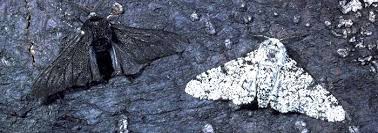
Predict which moth would increase in population:
light
dark

Which term refers to the process by which individuals that are better suited to the environment survive and reproduce, therefore passing down their genes to their offspring?
Evolution
Variation
Adaptation
Natural Selection

The white feathers of a snowy owl allow it to blend in with its environment during the winter months. This is an example of a(n) ________________.
species
environmental change
adaptation
variation

What is the advantage of having different shaped beaks?
To look different from other species.
To be able to eat the food readily available in the environment.
To protect itself against predators.
To protect itself against prey.

Individuals that are well adapted to their environment will survive and produce:
Fewer mutations
Stronger genes
More offspring
Better traits

Remains of ancient organisms are called:
Extinctions
Fossils
Mutations
Variations
Natural Selection
Genetic Variation
Homologous Structures
Struggle for Existence

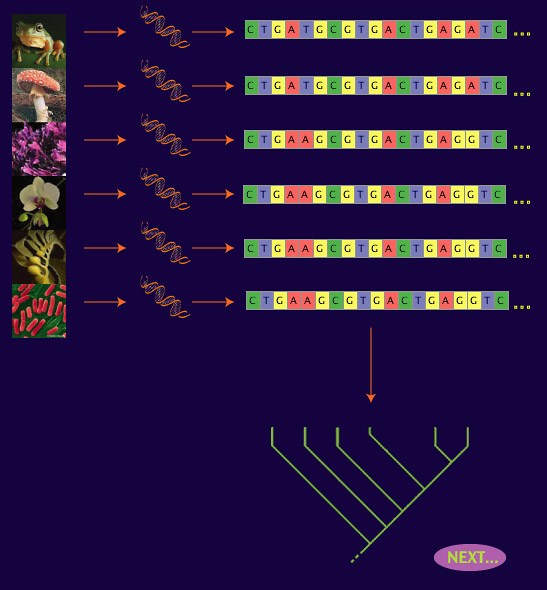
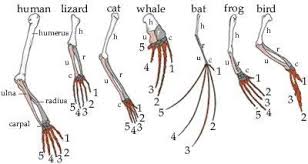
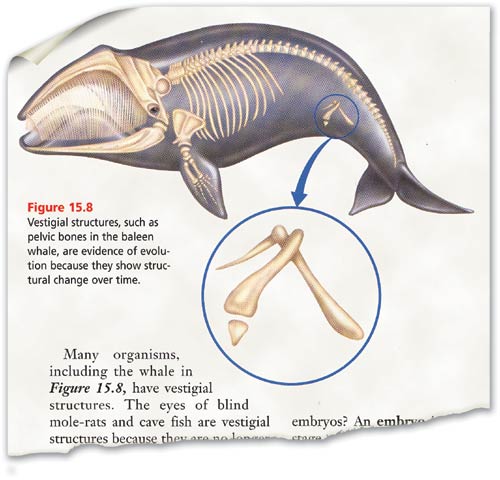
Which of the following is an example of a vestigial structure?
the wings of a red-tailed hawk
the tail of a house cat
the fins of sharks
the wings of a penguin
Why is genetic variation important in helping a species survive?
The more varied a population, the less likely the environment is to change.
If the environment changes, some members of the species will probably have adaptations that enable them to survive and reproduce.
Disease rarely affects a population that has a lot of genetic variety.
If the environment stays the same, a species with genetic variety will probably evolve rapidly.

