wayground logo

Free Printable Worksheets

Font size

S
M
L
XL
Worksheets

Unit 6 Review 2022

Total questions: 77

Worksheet time: 55mins

Name
Class
Date
1.
What do experts say is the most common form of Down Syndrome?
a)
Trisomy 47
b)
Trisomy 46
c)
Trisomy 21
d)
Trisomy 23
2.
What is it called when a sperm and egg meet?
a)
meiosis
b)
fertilization
c)
cell division
d)
mitosis
3.
What causes genetic variation in meiosis?
a)
chromosomes lining up
b)
crossing over of chromosomes
c)
separation of chromosomes
d)
chromosomes pulling apart
4.
Diploid Cells are represented by
a)
2n
b)
n
c)
4n
d)
1/2 n
5.
Which process and type of resulting cells are represented?
a)
mitosis, gametes
b)
mitosis, body cells
c)
meiosis, gametes
d)
meiosis, body cells
6.
The chromosomes that pair up during meiosis, are called __________ chromosomes.  
a)
homozygous 
b)
asexual
c)
homologous
d)
genes
7.
Crossing over helps promote 
a)
male genotype
b)
genetic variation
c)
DNA replication
d)
mitosis
8.
A male shark has 40 chromosomes in each of its sex cells. How many would be present in its body cells?
a)
20
b)
40
c)
80
d)
160
9.
Chromosomes exchange genetic material during 
a)
crossing over
b)
replication
c)
synthesis
d)
translation
10.
A human zygote should have _____ chromosomes inside.
a)
46
b)
23
c)
92
d)
64
11.
What is one of the advantages, why is it better to reproduce sexually versus asexually?
a)
survival of the fittest
b)
overproduction
c)
genetic variation
d)
cloning
12.
A human being has a somatic cell that has 46 chromosomes.  What is the haploid number found in a gamete?
a)
23
b)
46
c)
69
d)
92
13.
Which letter(s) in the diagram correspond to cells that are haploid? 
a)
A
b)
B
c)
C
d)
A and B
14.
Compared to the number of chromosomes contained in a body cell, how many chromosomes would normally be contained in a gamete?
a)
The same number
b)
One-fourth as many
c)
Twice as many
d)
Half as many
15.
What is this?
a)
Trisomy 13
b)
Monosomy 21
c)
47, XXY
d)
Trisomy 21
16.
Females have ____ and males have _____ chromosomes.
a)
XX, XY
b)
XY, XX
c)
XX, XX
d)
XY, XY
17.
a)

INCREASES GENETIC VARIATION

b)

TAKES PLACE IN PROPHASE I

c)

CROSSING OVER

d)

ALL ARE TRUE

18.

CROSSING OVER INCREASES

a)

LIFE SPAN

b)

GENETIC VARIATION

c)

THE NUMBER OF OFF-SPRING

d)

ALL ARE TRUE

19.

CROSSING OVER TAKES PLACE DURING

a)

PROPHASE II

b)

PROPHASE I

c)

INTERPHASE

d)

METAPHASE I

20.

MEIOSIS PRODUCES 4 CELLS-THE CHROMOSOME NUMBER IS ...

a)

DIPLOID

b)

HAPLOID

21.

MEIOSIS PRODUCES 4 CELLS, THEY ARE

a)

N

b)

2N

c)

3N

22.

1N AND N MEAN THE SAME THING (LIKE MATH)

a)

TRUE

b)

FALSE

23.
What phase is  shown in the picture?
a)
anaphase 1
b)
anaphase 2
c)
metaphase 1
d)
telophase 1
24.
What phase is  shown in the picture?
a)
anaphase 1
b)
anaphase 2
c)
metaphase 1
d)
telophase 1
25.
The correct order of the phases of mitosis and meiosis could be abbreviated as:
a)
MAPT
b)
PAMT
c)
TPAM
d)
PMAT
26.
The nuclear membrane dissolves during
a)
Prophase
b)
Metaphase
c)
Anaphase
d)
Telophase
27.
What phase is shown here?
a)
Prophase II
b)
Metaphase I
c)
Metaphase II
d)
Anaphase I
28.
What phase is shown here?
a)
Anaphase II
b)
Metaphase I
c)
Anaphase I
d)
Telophase II
29.
What phase is shown here?
a)
Metaphase II
b)
Telophase I
c)
Telophase II
d)
Metaphase I
30.
What phases is shown here?
a)
Prophase II
b)
Prophase I
c)
Anaphase II
d)
Interphase I
31.
What phase is shown here?
a)
Telophase I
b)
Metaphase II
c)
Telophase II
d)
Anaphase I
32.
Which process and type of resulting cells are represented?
a)
mitosis, gametes
b)
mitosis, body cells
c)
meiosis, gametes
d)
meiosis, body cells
33.
The haploid number of chromosomes for humans is ____.
a)
46
b)
43
c)
23
d)
26
34.
A single cross such as flower color.
a)
mono hybrid
b)
dihybrid
c)
crossing over
d)
homozygous
35.
What type of "square" helps us solve genetic problems?
a)
carpenter square
b)
Mendel square
c)
Punnett square
d)
genetic square
36.
TT,tt,PP,pp,SS,ss are examples of alleles that are?
a)
homozygous
b)
heterozygous
c)
different
d)
homologous 
37.
The exact genetic makeup of an organism, such as RR, Tt, PP is its?
a)
phenotype
b)
dominance
c)
genotype
d)
trait
38.
Y for yellow body is dominant over y for blue body.  What alleles would produce yellow bodies?
a)
YY,yy
b)
Yy,yy
c)
YY only
d)
YY,Yy
39.
"The Great White Shark was 20 feet in length.  Phenotype or Genotype?
a)
phenotype
b)
genotype
40.
Females-XX; MalesXY.  A couple has 4 girls.  What is the chance the next child will be a boy?
a)
75%
b)
100%
c)
25%
d)
50%
41.
If "T" is the allele for tall and "t" is the allele for short, then Tt would produce?
a)
tall
b)
short
c)
medium
d)
not enough info
42.

Which of the following alleles is homozygous (purebred) recessive?

a)

TT

b)

Tt

c)

tt

d)

ts

43.

Red (R) is dominant over white (r). How can a flower be white?

a)

It can have RR and be white.

b)

It has to have rr.

c)

It has to have rR

d)

There is no way it can be white until the third generation.

44.

Which of the following is an inheritable genetic trait?

a)

language

b)

type of music you like

c)

eye color

d)

slow growth due to insufficient nutrition.

45.

Alternant or different genes that code for the same trait are called?

a)

chromosomes

b)

segments

c)

alleles.

d)

homozygous.

46.
An offspring will receive how many alleles from each parent to determine a specific trait?
a)
one
b)
two
c)
three
d)
five
47.
having two of the same genes for the trait (sometimes called purebred).
a)
homozygous
b)
hetrozygous
c)
protein
d)
chromosome
48.
Incomplete dominance means that the traits are
a)
expressed equally
b)
dominant
c)
recessive
d)
blended
49.
One form of a gene is called_______________
a)
a DNA
b)
a Phenotype
c)
a trait
d)
an allele
50.
A heterozygous long-tusked elephant is crossed with a homozygous recessive short-tusked elephant. What is the probability of the offspring having short tusks?
a)
0%
b)
25%
c)
50%
d)
75%
51.

Which of the following genotypes is homozygous dominant?

a)

Yy

b)

yY

c)

yy

d)

YY

52.

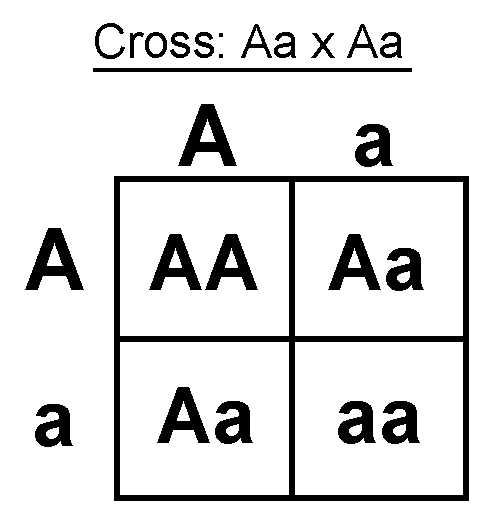
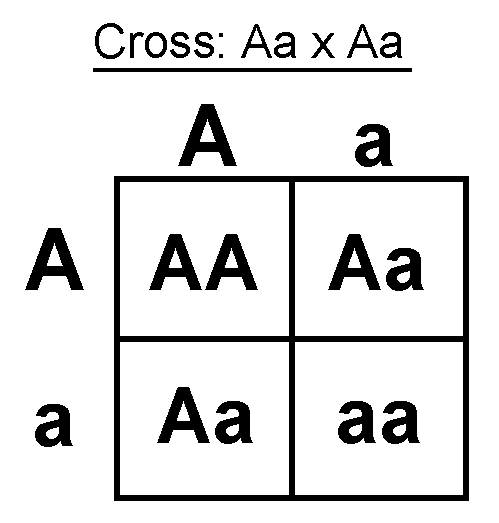
What is the genotypic ratio of the offspring?

a)

3:1

b)

1:3

c)

1:2:1

d)

2:2

53.

What are the phenotype percentages of the offspring?

(A-Brown fur color; a-white fur color)

a)

50 % Brown fur and 50% White fur

b)

25 % Brown fur and 75% White fur

c)

75 % Brown fur and 25% White fur

d)

0% Brown fur and 100% White fur

54.
What are the possible genotypes for this cross?
(Click the picture to see it without the text)
a)
TT = 25% Tt= 50% tt=25%
b)
all tall
c)
TT= 75% tt = 25%
d)
Tt = 100%
55.
This punnett square shows a cross between
a)
A hybrid Parent and a Homozygous parent
b)
A heterozygous parent and a heterozygous parent
c)
Two homozygous parents
d)
Two Hybrid Parents
56.
This is an example of
a)
Complete dominance
b)
Mendelian Genetics
c)
Codominance
d)
Incomplete Dominance
57.
What do we use pedigrees for?
a)
To look at families
b)
To make determinations about the offspring
c)
To track traits in families
d)
Nothing
58.

On a pedigree, this symbol represents a ---

a)

not affected female.

b)

not affected male.

c)

affected male.

d)

affected female.

59.

On a pedigree, this symbol represents a ----

a)

not affected male.

b)

not affected female.

c)

affected male.

d)

affected female.

60.

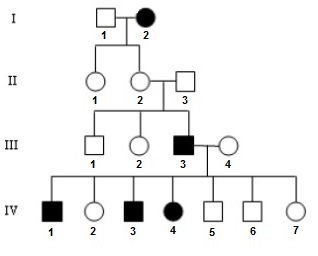
How many individuals are there in the 3rd generation?

a)

1

b)

2

c)

4

d)

6

61.

How are individuals III-2 and II-4 related?

a)

Brother and sister

b)

Dad and daughter

c)

Uncle and niece

d)

Grandfather and granddaughter

62.

The trait this pedigree traces is recessive because it skips a generation and individuals can be carriers. What is the most likely genotype for person III-3?

a)

GG

b)

Gg

c)

gg

63.
If this pedigree shows an autosomal recessive disorder, what MUST the genotype of individual II-3 be?
a)
HH
b)
Hh
c)
hh
d)
None of the above
64.

If this pedigree shows a recessive disorder, what MUST the genotype of individual 4 be?

a)

HH

b)

Hh

c)

hh

65.
How many kids did the mother and father from the first generation have?
a)
2
b)
4
c)
5
d)
6
66.
This pedigree represents the inheritance of hemophilia in this family. How many of the females have the hemophilia trait?
a)
8
b)
5
c)
2
d)
3
67.
Huntington's Disease is a dominant trait.
What is the correct genotype for individual I-2?
a)
HH
b)
Hh
c)
hh
d)
H_
68.
Does this pedigree show a dominant or recessive trait?
a)
Dominant
b)
Recessive
69.

What is the mode of inheritance shown here?

a)

Sex Linked Recessive

b)

Autosomal Dominant

c)

Autosomal Recessive

70.

Which of the following is a autosomal dominant disorder?

a)

Huntington's

b)

Cystic fibrosis

c)

Hemophilia

d)

Sickle cell anemia

71.

Which of the following is a sex-linked disorder?

a)

Hemophilia

b)

Sickle cell anemia

c)

Cystic fibrosis

d)

Huntington's

72.

Identify the substitution mutation that results in an abnormally shaped protein and that causes a reduced ability to bind and transport oxygen.

a)

Cystic fibrosis

b)

Sickle cell anemia

c)

Huntington's

d)

Hemophilia

73.

What do the half shaded symbols in a pedigree represent?

a)

Someone who doesn't have the trait

b)

Someone who does have the trait

c)

Someone who is a carrier of the trait

74.

What are the symptoms of this disease?

a)

Damage of the brain

b)

Mucous in the lungs

c)

Death by age 4

d)

Sinus and lung infections

75.

Which of the following diseases effects Jewish and Amish families the most?

a)

Tay Sachs

b)

PKU

c)

Huntington's

d)

Cystic Fibrosis

76.

Which genetic disease requires a special diet to prevent brain damage?

a)

Cystic Fibrosis

b)

Huntington's

c)

PKU

d)

Tay Sachs

77.

Which genetic disease is the most common among white Americans?

a)

Huntington's

b)

Cystic Fibrosis

c)

PKU

d)

Tay Sachs