Wayground logo

Free Printable Worksheets

Font size

S
M
L
XL
Worksheets

ACA Term 1 Exam Review

Total questions: 68

Worksheet time: 1hrs 8mins

Name
Class
Date
1.
A student wants to test the hypothesis of "If salt is added to water then the boiling point of water will decrease." What is the dependent variable?
a)
amount of salt
b)
boiling point
c)
same amount of water
2.
The higher the temperature in an oven, the faster a cake will bake.
What is the independent variable?
a)
Cake flavor
b)
Temperature
c)
Time
d)
Type of oven
3.

An observation that has a number is called a _________ observation?

a)

quantitative

b)

qualitative

c)

inference

d)

observation

4.

An observation that uses words without numbers or amounts is called a _________ observation?

a)

quantitative

b)

qualitative

c)

observation

d)

inference

5.

The pH scale measures the acidity or the basicity of a solution. Solutions that have a pH below 7 are acids. Solutions that have a low pH are more acidic than solutions that have a higher pH. The graph below shows the pH of four common fruit juices.

A student studying acidity of juices did a taste test and determined that the orange juice was the sweetest juice and the lemon and lime juices were the sourest. Based on this information, and the data shown in the bar graphs, which is the best inference the student could make about acidity?

a)

Juices with more sugar content have a lower pH.

b)

Higher acidity causes juices to taste more sour.

c)

Juice that tastes sour has a lower pH than juice that tastes sweet.

d)

Grapefruit juice tastes more sour than lime juice.

6.

According to this graph, for every 24 hours, about how many hours are spent watching TV?

a)

0 hours

b)

5 hours

c)

13 hours

d)

3 hours

7.

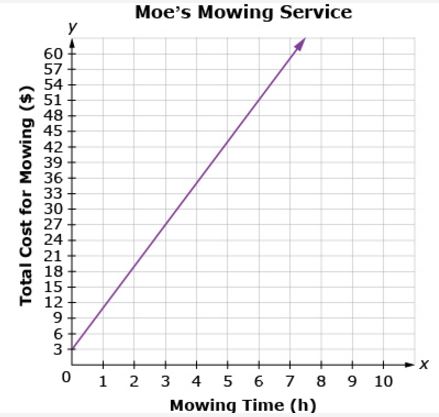
How much does it cost to have your lawn mowed for 2 hours?

a)

$16

b)

$17

c)

$18

d)

$19

8.

Determine which bar graph matches the table

a)
b)
c)
9.
a)

The cooler the temperature, the louder the crickets chirp.

b)

The crickets cannot chirp at temperatures lower than 10 degrees C.

c)

The warmer the temperature, the more often crickets chirp.

d)

The temperature and the chirping of crickets are not related.

10.
Which biomolecule is responsible for insulation and energy storage?
a)
Protein
b)
Nucleic Acid
c)
Lipid
d)
Carbohydrate
11.
Which biomolecule is made of amino acids?
a)
Nucleic Acid
b)
Carbohydrate
c)
Protein
d)
Lipid
12.
Which biomolecule has sugars and starches?
a)
Lipids
b)
Proteins
c)
Carbohydrates
d)
Nucleic Acid
13.
Which biomolecule is your main source of energy?
a)
Nucleic Acid
b)
Protein
c)
Lipid
d)
Carbohydrate
14.
The monomer of a protein is called...
a)
an amino acid
b)
a monosaccharide
c)
a fatty acid
d)
a nucleotide
15.
What is the monomer of nucleic acids?
a)
Glycerol
b)
Monosaccharides
c)
Amino Acids
d)
Nucleotides
16.
Lipids are made up of which of the following?
a)
glycerol and fatty acids tails
b)
glycerol and monolipids
c)
fatty acids and phosolipids
d)
amino acids and nucleotides
17.
What elements are common to all 4 biomolecules?
a)
Carbon, hydrogen, nitrogen
b)
Carbon, Nitrogen, Phosphorus
c)
Carbon, Hydrogen, Oxygen
d)
Carbon, Hydrogen, Phosphorus
18.

A monosaccharide is the monomer for which biomolecule:

a)

Lipid

b)

Carbohydrate

c)

Nucleic Acid

d)

Protein

19.

Match the following functions to the biomolecule

a)

Act as hormones

1.

Lipid

b)

Build muscle

2.

Protein

c)

Carry genetic information

3.

Nucleic acid

d)

Energy source (cellular respiration)

4.

Carbohydrate

20.

Which category of macromolecules do enzymes belong to?

a)

Carbohydrates

b)

Proteins

c)

Fats/Lipids

21.

Enzymes are specific. This means that an enzyme only works with molecules that are....

a)

the right size and shape

b)

broken down already

c)

present in water

d)

too big for the body to handle

22.

In the diagram, what is letter A?

a)

product

b)

enzyme-substrate complex

c)

substrate

d)

active site

23.

Letter D...

a)

enzyme

b)

active site

c)

substrate

d)

products

24.

Letter B...

a)

substrate

b)

active site

c)

enzyme

d)

products

25.

Letter C...

a)

products

b)

substrate

c)

enzymes

d)

active site

26.

Letter E...

a)

active site

b)

products

c)

substrate

d)

enzyme

27.

An enzyme speeds up a reaction by

a)

raising the activation energy

b)

lowering the activation energy

c)

releasing energy

d)

absorbing energy.

28.

What happens to an enzyme when it is denatured?

a)

Activation energy is lowered

b)

It becomes stronger

c)

It loses its shape

d)

Activation energy is raised

29.

Which Graph shows that an enzyme works best at a pH of 4?

a)
b)
c)
d)
30.

Which Graph shows that an enzyme works best in a NEUTRAL pH?

a)
b)
c)
d)
31.

Which line shows that an enzyme works best at a pH pf 9?

a)

A

b)

B

c)

C

32.

Which line shows that an enzyme works best at an ACIDIC pH?

a)

A

b)

B

c)

C

33.

What can we conclude from the graph? At a temperature of 62 ...

a)

Enzyme activity is highest

b)

Enzyme activity is low but working

c)

Enzyme is denatured

34.

What can we conclude from the graph? At a a pH of 8..

a)

Enzyme A works best

b)

Enzyme B works best

c)

Enzyme A works but low activity

d)

Enzyme B works but low activity

35.
What is a substance called if it speeds up a chemical reaction?
a)
reusable
b)
catalyst
c)
specific
d)
fragile
36.
With what 3 letters do enzymes typically end?
a)
-ose
b)
-ase
c)
-ese
d)
-tic
37.

What are two factors that can affect an enzymes ability to function?

a)

No changing

b)

temperature and pH

c)

night and day

d)

hot and cold

38.

How does an enzymes shape relate to its function?

a)

the shape of the enzyme has no relation to its function

b)

the enzyme is shaped specially for certain substrates to perform a specific reaction

c)

the enzyme shape acts as a receptor to certain products

d)

the enzyme shape can fit into specific substrates to cease a reaction
39.
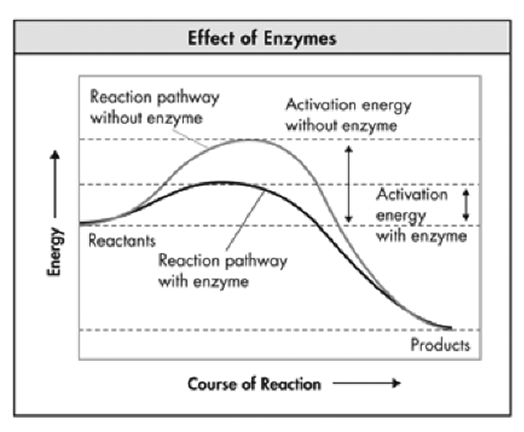
The graph shows how enzymes affect reactions in cells. Which statement best summarizes the information shown in the graph?
a)
Enzymes increase the energy of the reactants.
b)
Enzymes decrease the energy level of the products.
c)
Enzyme decrease the activation energy of the reaction.
d)
Enzymes reverse the direction of the reaction.
40.
During photosynthesis, what type of energy transfer takes place?
a)
Heat -> Chemical Potential
b)
Chemical Potential -> Light
c)
Light -> Chemical Potential
d)
Heat -> Light
41.
An experiment is performed on plants to see how different liquids affect plant growth. Each plant in the experiment is given a different liquid; water, apple juice, or milk. Each plant has the same amount of soil, sunlight, and listens to the same music. In this investigation, what are the controlled variables?
a)
Type of plant, amount of music, and sunlight
b)
Water, apple juice, milk
c)
Plant growth
42.
A chemical reaction is balanced when
a)
both sides have the same elements
b)
Both sides have the same  number of atoms
c)
Same subscripts
d)
Same coefficients
43.
If reaction starts with 20g of reactants it should produce 
a)
a total of 40g of products
b)
a total of 10g of products
c)
a total of 80 g of products
d)
a total of 20g of products
44.
In a reaction A + B ----> C,  reactant A has 5g and product  C has 9g. How many grams does reactant B should have? 
a)
4g
b)
5g
c)
9g
d)
14g
45.
What are the raw materials of photosynthesis?
a)
oxygen and carbon dioxide
b)
oxygen and glucose
c)
carbon dioxide and water
d)
water and glucose
46.
What are the products of photosynthesis?
a)
oxygen and carbon dioxide
b)
oxygen and glucose
c)
carbon dioxide and water
d)
water and glucose
47.
What is the chemical formula for glucose?
a)
C6H12O6
b)
C6H6O12
c)
C12H6O12
d)
C6O2H6
48.
Which of these conditions would decrease the rate of photosynthesis in a plant?
a)
Above average precipitation
b)
Changing the daylight hours from 14 hrs to 10 hrs
c)
Changing the CO2 concentration from 380 ppm to 410 ppm
d)
All of these choices
49.
Which choice correctly shows the gases that enter and exit plants during photosynthesis?
a)
Enter: Oxygen
Exit: Carbon dioxide
b)
Enter: Water vapor
Exit: Glucose
c)
Enter: Carbon dioxide
Exit: Oxygen
d)
Enter: Light
Exit: Water vapor
50.
After photosynthesis, plants store their energy as _________ .
a)
chlorophyll
b)
pigment
c)
glucose (sugar)
d)
Oxygen
51.
Which of the following is the correct equation for PHOTOSYNTHESIS?
a)
CO2 + light + H2O --> O2 + Sugar
b)
CO2 + sugar + H2O --> O2 + light
c)
O2 + light + H2O --> CO2 + Sugar
d)
CO2 + O2 + H2O --> Light+ Sugar
52.
A student is collecting the gas given off from a plant in bright sunlight at a temperature of 27°C. The gas being collected is probably ________.
a)
oxygen
b)
carbon dioxide
c)
ATP
d)
glucose
53.
If carbon dioxide is completely removed from a plant’s environment, what would you expect to happen to the plant’s production of high-energy sugars (rate of photosynthesis)?
a)
Sugar production will likely increase.
b)
Sugars will not be produced.
c)
The rate of sugar production will decrease .
d)
Fewer sugars will be produced at first, but then the plant will recover.
54.
How would light intensity generally affect the rate of photosynthesis?
a)
Increases the rate, up to a point
b)
Increases the rate
c)
Decreases the rate
d)
No relationship to the rate
55.
How would the concentration of CO2 in water affect photosynthesis?
a)
The higher the CO2, the greater the rate
b)
The higher the CO2, the lower the rate
c)
CO2 concentration doesn't affect photosynthesis
d)
a greater rate of photosynthesis causes higher CO2 concentrations 
56.
If we enclosed a plant in an air-proof bottle, what would happen to the rate of photosynthesis 
a)
Gradually slow down to zero because CO2 is used up
b)
Shows a constant rate as long as the light remains on
c)
Gradually speeds up because O2 builds up
d)
Gradually slows down because glucose builds up
57.

Why does the rate of photosynthesis decrease at high temperatures?

a)

Enzymes are denatured

b)

Enzymes do not have enough kinetic energy

58.

What organelle is responsible for photosynthesis?

a)

mitochondria

b)

chloroplast

c)

ribosomes

d)

cytoplasm

59.

Select all that apply: How do plants use the glucose that they make in photosynthesis?

a)

They break it down for energy

b)

They use it to make their cell walls

c)

They use it for locomotion

d)

They convert it into polypeptides

60.
The purpose of cellular respiration is to produce ?
a)
energy
b)
oxygen
c)
sugar
d)
protein
61.
What is the sugar that carbs are broken down to?
a)
sucrose
b)
maltose
c)
glucose
d)
lactose
62.
What is the energy organelle?
a)
nucleus
b)
mitochondria
c)
ribosomes
d)
lysosomes
63.
The waste gas given off by cellular respiration is?
a)
oxygen
b)
carbon dioxide
c)
nitrogen
d)
methane
64.
This process releases chemical energy from sugars and other carbon-based molecules to make ATP when oxygen is present.
a)
photosynthesis
b)
light-independent reaction
c)
cellular respiration
d)
light-dependent reaction
65.
What is the correct equation for cellular respiration?
a)
6O2 + C6H12O6 -> 6CO2 + 6H2O + Energy
b)
6O2 + C6H12O6 + Energy -> 6CO2 + 6H2O
c)
6CO2 + 6H2O -> 6O2 + C6H12O6 + Energy
d)
6CO2 + 6H2O + Energy -> 6O2 + C6H12O6
66.

Which of the following is a reactant of cellular respiration

a)

Carbon Dioxide

b)

Water

c)

Oxygen

d)

ATP

67.

Which statement is true regarding cellular respiration?

a)

The reactants of cellular respiration are identical to the reactants of photosynthesis.

b)

The reactants of cellular respiration are obtained from the products of photosynthesis.

c)

The products of cellular respiration are the same as the products of photosynthesis

d)

Cellular respiration only occurs in autotrophs, photosynthesis occurs only in heterotrophs.

68.

A decrease in the amount of oxygen available will....

a)

not have an effect on the amount of energy produced during cellular respiration

b)

decrease the amount of glucose produced during cellular respiration

c)

cause the amount of water produced during cellular respiration to increase

d)

decrease the amount of energy produced during cellular respiration