
 Worksheets
Cement Manufacturing (Cover Page)
Total questions: 77
Worksheet time: 39mins

Based on the cover page, which title best describes the document’s focus?
Manufacturing and Industrial Processes with Plant Visit: Cement Manufacturing
Civil Engineering Design of Concrete Structures
Environmental Impacts of Mining Operations
Mechanical Workshop Safety Procedures
According to the provided definition, cement in a narrower sense refers to which of the following?
Any adhesive substance of any kind
Binding materials used in building and civil engineering construction
Only naturally occurring clayey soils
A mixture of sand and gravel

Fill in the blank: Cements of this kind are finely ground powders that, when mixed with _______, set to a hard mass.
water
oil
sand
alcohol
Which component, also known as calcium oxide, is the primary component of cement and comprises 60–65% of its composition?
Silica
Lime
Alumina
Magnesia
State two effects of excessive lime in cement as described: _______ and _______.
instability; affects strength and setting time
improves color; increases durability
reduces workability; increases plasticity
enhances water resistance; decreases porosity
Silica accounts for what percentage range of cement composition, and how does sufficient silica influence cement properties? Choose the option that best matches both.
3–8%; decreases strength and reduces setting time
19–25%; increases strength and increases time to set
0.1–3%; gives toughness and color
01–0.5%; increases initial setting time
Alumina in cement enhances quick-setting quality but requires what condition for desired quality, and what is the risk of excessive alumina?
Low temperatures; improves toughness
High temperatures; can weaken cement
Vacuum conditions; causes color change
High pressures; increases instability only
According to the text, if magnesia content exceeds 3%, what is the stated consequence for cement?
It becomes more workable and gains strength
It becomes unstable and loses strength
It sets faster but gains hardness
It changes color without strength impact
Identify the component sourced from fly ash, iron ore, and scrap iron, and state two properties it imparts to cement through reactions at high temperatures.
iron oxide; color and strength and hardness
calcium carbonate; setting time and workability
silicon dioxide; plasticity and durability
alumina; resistance to chemical attack and whiteness
Calcium sulfate is present in cement in the form of gypsum. What is its quantity range (as written) and its effect on setting?
60–65%; increases final setting time
19–25%; decreases initial setting time
3–8%; accelerates final set
01–0.5%; increases the initial setting time
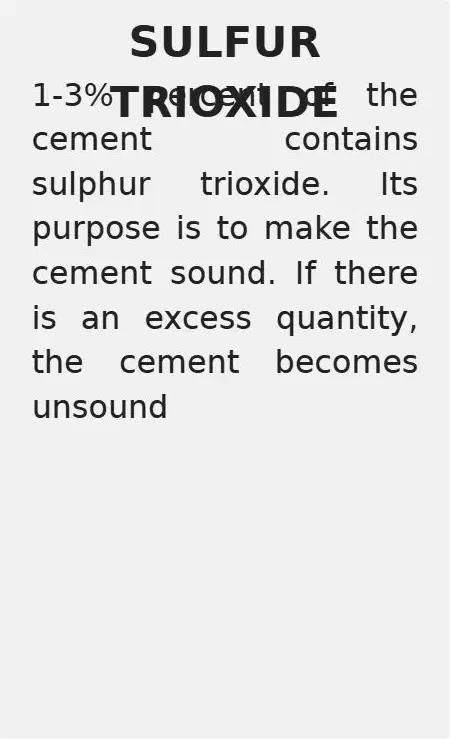
According to the material, what is the typical percentage range of sulfur trioxide (SO3) in cement, and what is its stated purpose?
0.1–1% ; improves workability
1–3% ; makes the cement sound
3–5% ; accelerates setting
5–7% ; increases early strength
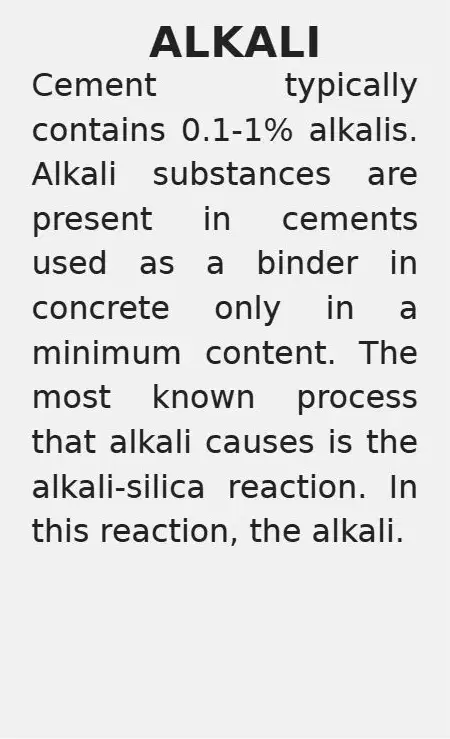
Cement typically contains 0.1–1% alkalis. Alkalis are kept at a minimum content in concrete because excess alkali can cause which process?
Alkali–silica reaction
Hydration reaction
Carbonation process
Sulphate attack
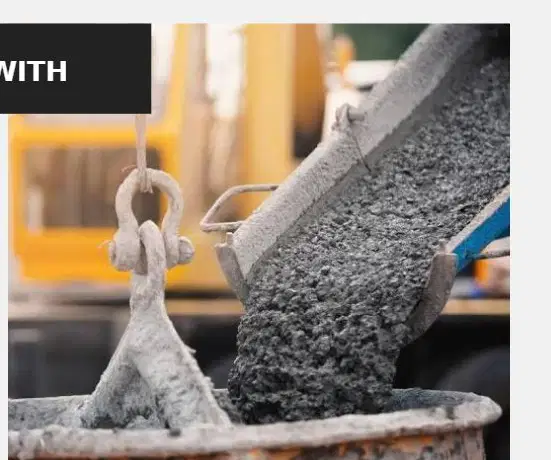
Identify the application area shown: Images depict cement being mixed and poured using a concrete mixer, shovel, and chute, forming a workable mass for construction. What is the primary application of cement illustrated on this page?
Mortar for bricklaying
Concrete production
Soil stabilization
Decorative plaster
A contractor must choose between on-site concrete production and using pre-cast concrete products for a project requiring rapid installation with consistent quality and minimal curing time on site. Which option should they select and why?
Use pre-cast concrete products because they are manufactured off-site under controlled conditions, delivered ready for installation, enabling rapid assembly and consistent quality with reduced on-site curing time.
Use on-site concrete production because it allows for more customization and longer curing times on site.
Use on-site concrete production because it is always faster and ensures better quality control than pre-cast products.
Use pre-cast concrete products because they require extensive on-site curing and are less consistent in quality.

The slide labeled "MORTAR" shows four images of fresh mortar being applied between concrete masonry units (CMUs) and along block courses using a trowel. Based on this, what is the primary construction use illustrated for cement mortar on this page?
As a decorative surface coating on finished floors
As a bonding material for laying blocks and masonry units
As a high-strength concrete for bridge decks
As a grout for filling deep cavities only
The page titled "PAVEMENT" presents images of pedestrian sidewalks and stone block pavements arranged in patterns. Which TWO features are characteristic of the pavements depicted?
Use of interlocking stone or block units
Presence of continuous asphalt mat without joints
Patterned joints between units
Use exclusively for indoor flooring
Consider the "SOIL STABILIZATION" page showing heavy equipment spreading and mixing materials across a roadway subgrade. If you were planning a cement-stabilized base layer, which sequence best matches the operations evidenced by the images?
Place asphalt first, then spread cement slurry, then compact subgrade
Spread or distribute cement over subgrade, mix with soil using reclaimer, moisture condition, then compact and finish
Excavate to rock, place cobblestones, then apply mortar joints
Lay concrete slabs, then rip and remix with soil to improve drainage
Identify the application domain shown: The page displays multiple photos of large-scale construction activities, including a concrete slab with rebar, workers pouring and leveling concrete, a long multi-span highway bridge over green fields, and a crew working on a canal-like concrete structure. Which application of cement is being illustrated?
Residential home interiors
Infrastructure project
Cement packaging process
Laboratory testing of cement
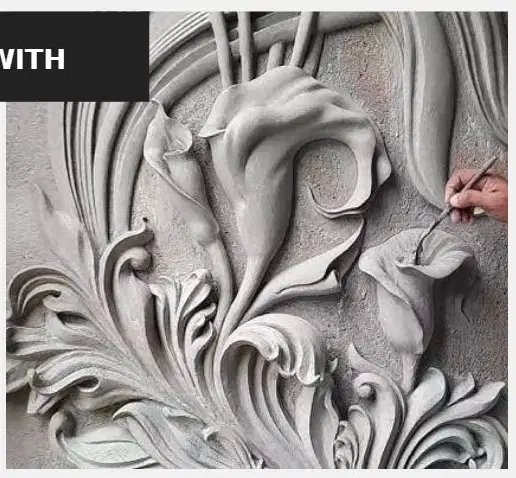
Based on the images, which specific uses of cement in arts and design are demonstrated? Select all that apply.
Ornamental relief carving on façades
Creation of a petri dish for lab work
Geometric floral wall motif sculpted from cement
Sculptural furniture-like form using cement and metal supports

The slide title states: "PROCESS IN MAKING CEMENT" and mentions discovering the process for the most common type of cement. Which specific type is identified as the most common?
Blended cement
Portland Cement
Masonry cement
Gypsum cement
Cement is defined as a binder used in construction. According to the text, which function best describes what cement does when used in construction?
It remains flexible to allow movement of materials
It sets, hardens, and adheres to other materials, binding them together
It prevents moisture from entering materials by acting as a sealant
It expands to fill voids and create insulation
Which of the following are listed as components of Portland cement on the slide? Select all that apply.
Silicon
Aluminum
Iron
Gypsum only
Shale, Clay
According to the section, Portland cement is made by heating raw materials rich in oxides of silicon, calcium, aluminum, and iron to approximately what temperature range?
600–800 °C
900–1100 °C
1200–1400 °C
1500–1700 °C
Fill in the blank: The chemical reactions within the partially molten mass during Portland cement manufacturing result in the formation of four main cement materials: Tricalcium Silicate, Dicalcium Silicate, Tricalcium Aluminate, and _______.
Tetracalcium alumino-ferrate
Calcium carbonate
Magnesium oxide
Silicon dioxide
A process engineer wants to prioritize monitoring of phases that together could account for at least 80% of the cement mass. Based on the given ranges, which combination of main cement materials alone can meet or exceed 80% at their upper bounds?
Tricalcium Silicate + Dicalcium Silicate
Tricalcium Silicate + Tricalcium Aluminate
Dicalcium Silicate + Tetracalcium alumino-ferrate + Gypsum
Tricalcium Silicate + Dicalcium Silicate + Gypsum
The page titled “PROCESS IN CEMENT MAKING” serves what role in the section?
It provides a detailed flowchart of unit operations.
It announces the start of the overall cement making process overview as a title page.
It lists safety protocols for plant visits.
It compares Portland cement with other cements.
According to the section, what is the specified moisture content of raw material before blending in the dry process?
Less than 1%
Exactly 5%
Between 10% and 15%
More than 30%
Compare the wet process and the preheater/calciner process in terms of fuel use and process characteristics. Select all statements that are supported by the content.
Wet process requires high fuel consumption because fuel must evaporate 30+% of slurry water.
Preheater/calciner process allows enhanced fuel efficiency and high production rates.
Wet process is described as a kind of high-efficiency direct combustion solid-gas heat exchange equipment.
Preheater/calciner disperses and suspends cement raw meal powder in airflow to speed reactions.
A plant currently processes moist raw materials and struggles to control kiln chemistry while minimizing fuel. Based on the evidence, which process should be adopted and why?
Adopt the preheater/calciner process because it enhances fuel efficiency and production rates, and its design disperses and suspends raw meal powder in airflow, enabling rapid fuel combustion and calcium carbonate decomposition.
Adopt the dry process because it is best for handling moist raw materials and provides the easiest chemistry control.
Adopt the wet process because it is the most fuel efficient and allows for rapid decomposition of calcium carbonate.
Adopt the preheater/calciner process because it is easiest to control chemistry for moist raw materials.
According to the diagram, which unit immediately follows the crusher in the dry cement-making process?
Preheater tower
Secondary crusher
Grinding mill
Kiln

Heat is recycled from the clinker cooler in Stage 2 (Pyro Processing) primarily to:
Reduce fuel demand for preheating and kiln burning by improving thermal efficiency.
Cool the rotary kiln to prevent overheating.
Increase the speed of cement grinding in Stage 3.
Store excess heat for later use in Stage 1.
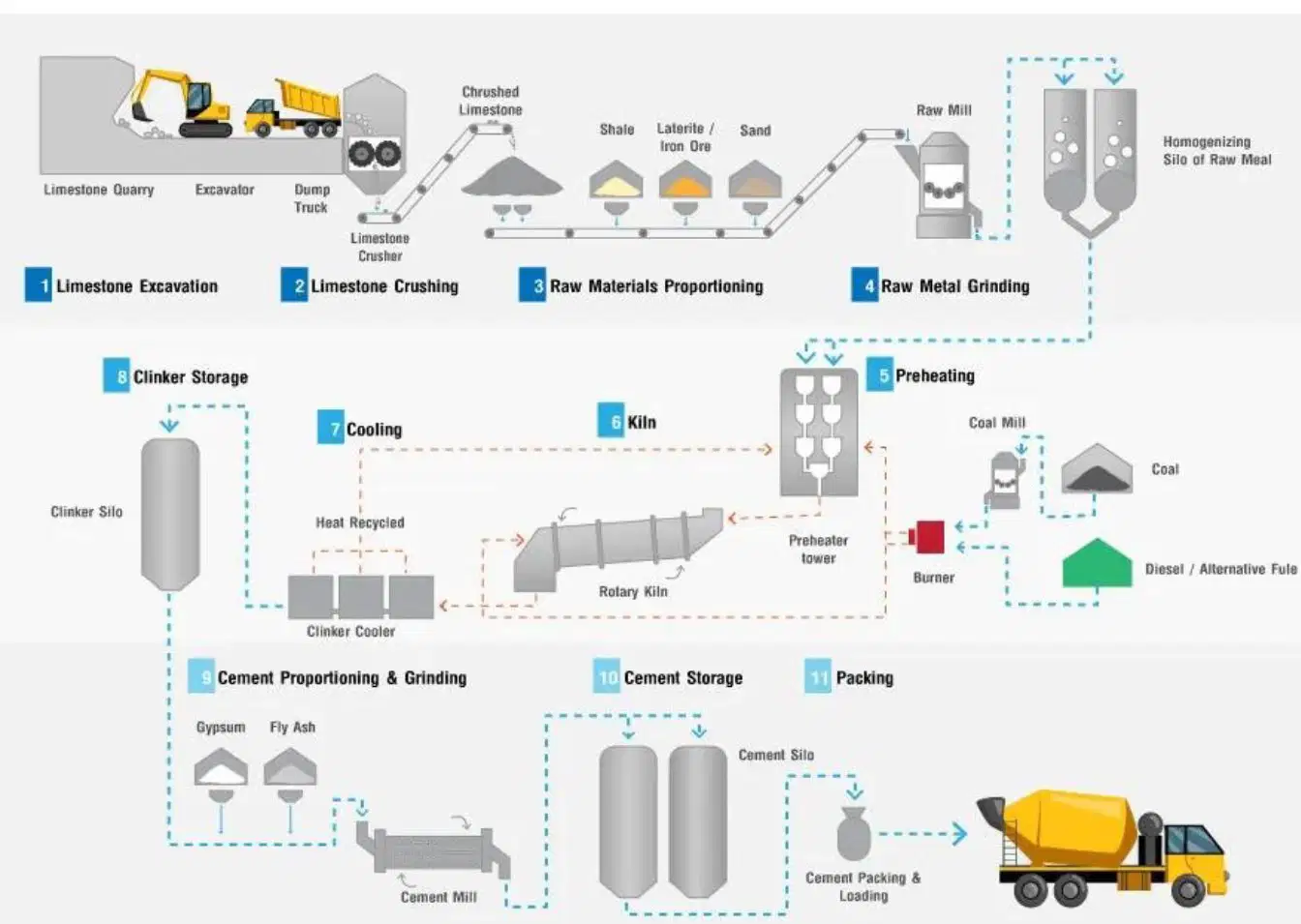
Fill in the blank based on the Stage 3 diagram: After cement proportioning and grinding with additives such as _______ and fly ash, the product moves to cement storage before packing.
gypsum
limestone
clay
sand
According to the material, which raw material accounts for 80% of cement raw materials and is the main cement manufacturing material?
Clay materials
Limestone
Coal
Iron ore
A cement plant is built 25 km from a limestone quarry, making belt conveyors impractical. Based on the content, what transportation implication does this have?
Use rail to reduce blending time
Transport by trucks, leading to higher transportation fees and inconvenience
Delay extraction until a conveyor is installed
Switch to importing limestone by ship to cut costs
Fill in the typical proportion ranges for cement raw materials before grinding: _______ limestone, 10–15% clay, 0.5–1.5% iron ore, and 8.5–11% coal.
67–75%
20–30%
40–50%
80–90%
Which statement best explains why properly balancing limestone with other raw materials is essential before grinding begins?
It ensures correct chemical composition for different cement grades
It allows vertical roller mills to rotate faster
It reduces the need for pre-homogenization storage
It aligns proportions determined by laboratory analysis with process requirements
According to the text, what core equipment is used for dry process cement production to preheat the raw meal?
Rotary cooler
Cyclone preheater
Ball mill
Electrostatic precipitator
Fill in the blank: Inside the cyclone preheater, raw meal meets the _______ emitting from the rotary kiln and performs suspension heat exchange with it, helping plants save energy and reduce environmental pollution.
exhaust gas
cooling water
raw coal
limestone
Which temperature is stated for heating the preheated raw meal in the rotary kiln during calcination to transform it into clinker?
1200°C
1350°C
1450°C
1600°C
Using the calcination description, identify TWO correct statements about the rotary kiln during this phase.
Calcination occurs at ambient temperature to avoid reactions.
The heat source comes from a burner at the front using natural gas or coal fuels.
Intense heat triggers reactions between calcium and silicon dioxide compounds.
Preheating, calcining, and cooling happen simultaneously inside the weigh hopper.
According to the process described, the clinker’s temperature is reduced in a grate cooler using forced air drawn from outside by grate cooling fans. From what range does the temperature drop to about 120°C during this cooling?
950-1050°C
1150-1250°C
1350-1450°C
1550-1650°C
Fill in the blank: After cooling, the clinker is transported via conveyors to _______ or hoppers for storage, ready for the cement grinding stage.
silos
kilns
mills
furnaces
Which practice is highlighted as reducing the cement plant’s energy consumption in the cooling and grinding stage?
Using water quenching for clinker cooling
Recycling hot air from the cooler back to the rotary kiln
Operating the kiln at a lower rotation speed
Adding gypsum before the cooling stage

On the page titled "EQUIPMENT USED IN CEMENT-MAKING," what is the stated purpose of the section?
To explain the chemistry of clinker formation
To list safety protocols for plant visitors
To introduce the names of equipment used in cement-making
To compare different brands of cement

According to the diagram text, vertical roller mills are widely used in which specific stage of cement production?
Clinker cooling
Grinding process of raw materials
Final cement packaging
Gypsum addition

Fill in the blank based on the page text: The _______ is the main gas-solid reaction unit of the cement raw meal pre-decomposition system.
Cyclone preheater
Rotary kiln
Clinker cooler
Raw mill
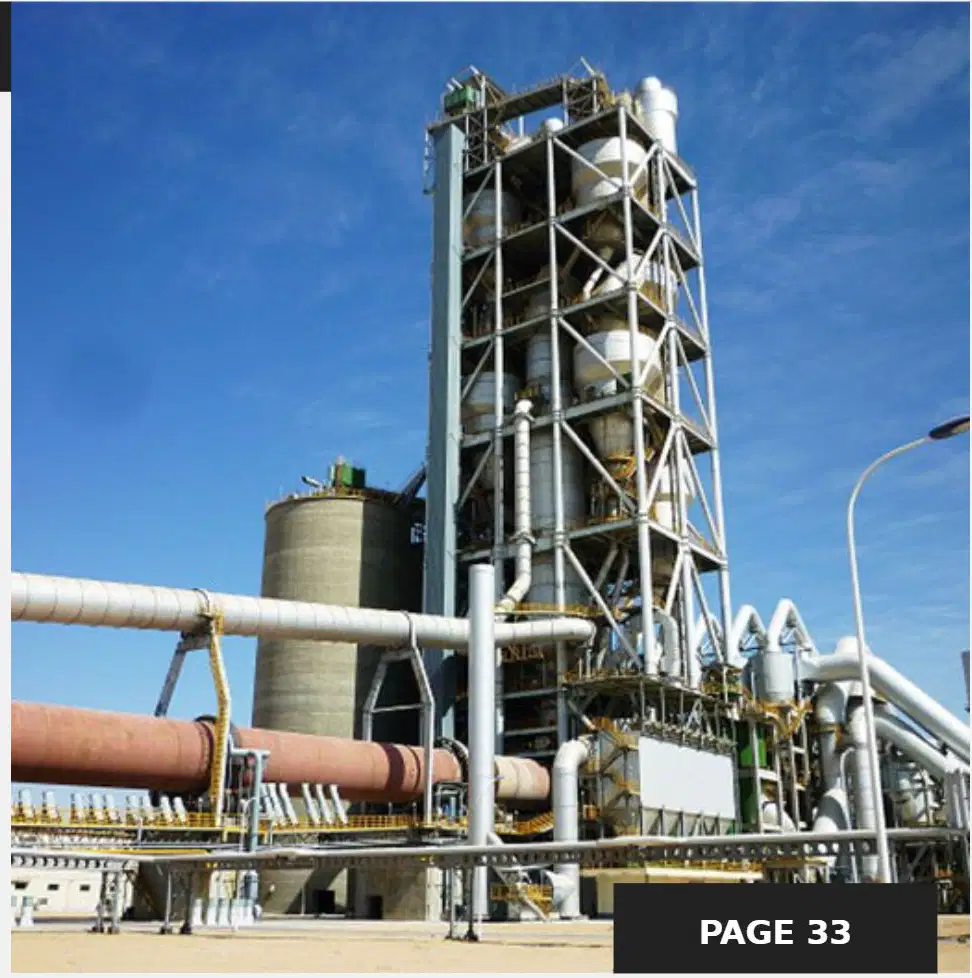
Which two sources of high-temperature gases does the cyclone preheater fully use, according to the description?
Exhaust gas from the kiln tail
Ambient air intake at the stack
High-temperature flue gas from combustion at the bottom of the decomposition furnace
Steam produced in the rotary kiln cooling jackets
Hot gases from the clinker cooler

Identify the primary chemical transformation described for the rotary kiln: Limestone is decomposed into ________, which forms the basis of cement clinker particles under high temperatures.
calcium oxide
calcium carbonate
silicon dioxide
magnesium oxide

Based on the diagram text, which statement best characterizes the rotary kiln in cement production?
It is a small laboratory unit for testing raw meals.
It is a physically large process unit where limestone decomposes into calcium oxide at high temperatures.
It is primarily used to cool clinker using ambient air.
It stores finished cement before dispatch.
Reasoning with the process flow shown across pages: If the cyclone preheater fully utilizes high-temperature gases from the kiln tail, what is a plausible operational benefit for the subsequent rotary kiln stage, based solely on the provided descriptions?
It reduces the heat load on the rotary kiln, making the kiln stage more energy-efficient.
It increases the amount of raw meal required in the rotary kiln.
It eliminates the need for high-temperature decomposition in the rotary kiln.
It causes the rotary kiln to operate at a lower temperature than required.
Based on the diagram and caption, what is the primary function of the clinker cooler in cement production?
To raise the temperature of clinker for grinding
To lower the temperature and carry the clinker from the kiln
To mix gypsum with clinker
To calcine raw meal into clinker

Fill in the blank: The clinker cooler _______ the temperature and carries the clinker from the kiln.
lowers
raises
measures
ignites
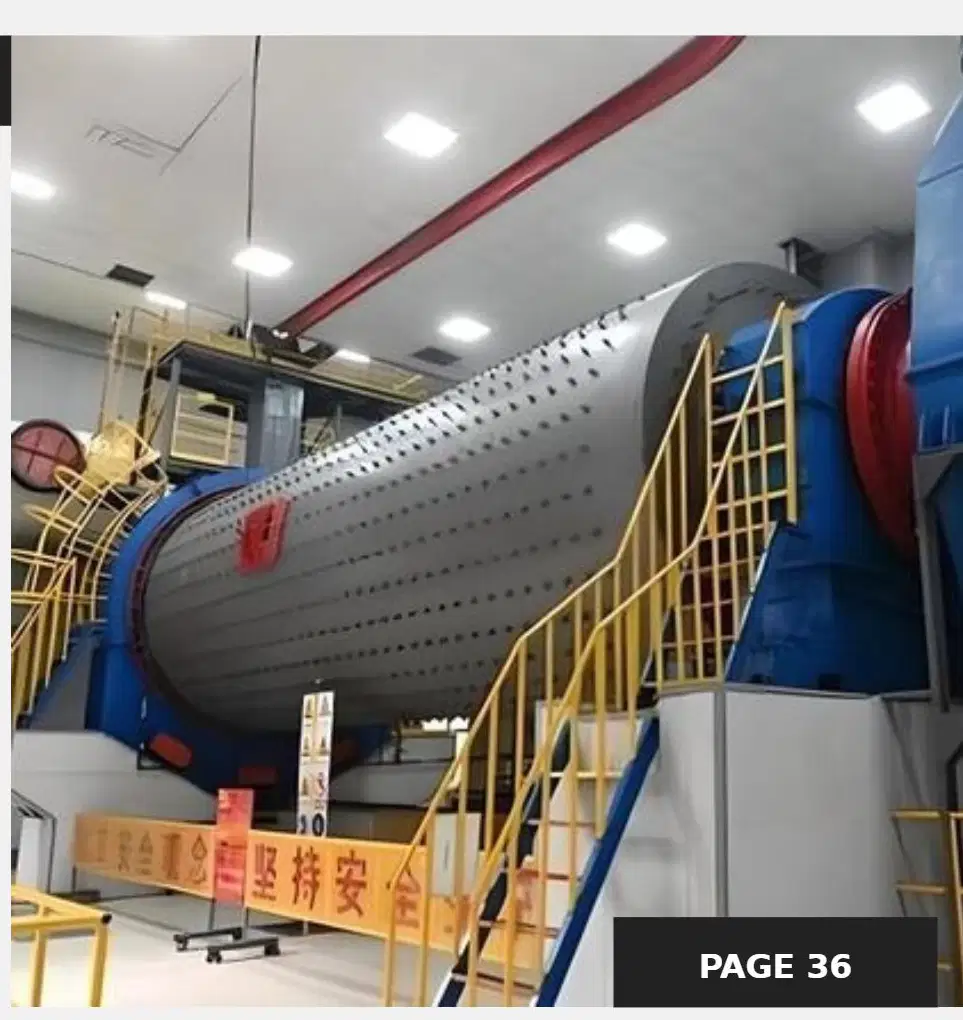
Which statement best describes the role of ball mills as shown?
They sinter raw meal into clinker using high heat.
They are used for grinding hard raw materials only in wet processes.
They grind cement clinker as finished cement, similar to mills used for grinding hard raw materials in dry and semi-dry processes.
They cool the clinker before storage.

Select ALL correct statements about the ball mills shown.
They operate similarly to mills used for grinding hard raw materials.
They exclusively function in wet processes.
They grind clinker into finished cement.
They are installed outdoors without enclosures.
According to the page on conveyor belts, what is their specific use in this cement plant context?
To feed raw meal into the kiln
To transport the product into silos for storage
To load bags onto trucks for dispatch
To mix additives into clinker

In cement manufacturing, what is the primary function of the equipment shown (silos)?
Grinding clinker into cement
Storing the cement for use
Heating raw meal in the kiln
Packaging cement into bags
Define quality inspection as presented in the content on cement manufacturing.
Quality inspection is the activity of checking, measuring, or testing a good or service’s characteristics and comparing the results with the specific requirements to confirm compliance.
Quality inspection is the process of packaging cement for transportation to customers.
Quality inspection refers to the marketing strategies used to promote cement products.
Quality inspection is the financial analysis of cement manufacturing costs.
Which statement best describes the purpose of chemical analysis in raw material testing for cement manufacturing?
To measure the moisture content of limestone and clay
To verify that raw materials contain the required proportions of calcium, silica, alumina, and iron
To determine the particle size distribution of gypsum
To check the consistency of the final cement paste

A batch of limestone shows correct particle size and acceptable consistency but has an imbalance in silica and alumina proportions. Which specific test identified this issue, and why?
Physical Analysis, because it checks the particle size and consistency of the material.
Chemical Analysis, because it tests raw materials for their chemical composition to ensure the required proportions of calcium, silica, alumina, and iron.
Mechanical Testing, because it evaluates the strength and durability of the material.
Thermal Analysis, because it measures the response of materials to changes in temperature.

After grinding clinker with gypsum and other additives to form cement, the final product undergoes extensive quality tests. Which test specifically evaluates the cement's particle size to determine its strength and hydration properties, and what instrument is typically used?
Loss on Ignition test using a muffle furnace
Fineness Test using a Blaine Air Permeability Apparatus or sieves
Chloride content test using titration with silver nitrate
Compressive strength test using a universal testing machine

Fill in the blank: The cement's _______ (particle size) is crucial to determine its strength and hydration properties.
fineness
color
setting time
porosity

A quality engineer wants to quickly assess whether a batch of cement might show slower hydration due to larger particle size. Based on the provided information, which practical approach should they choose?
Measure Loss on Ignition to check unburnt carbon
Use a Blaine Air Permeability Apparatus or sieves to perform a fineness test
Determine chloride content through titration
Run a sulfate expansion test

Which statement best explains why the fineness test is included in final product testing of cement?
Because fineness (particle size) directly influences cement strength development and hydration properties.
Because fineness determines the color of the cement.
Because fineness affects the cost of cement production.
Because fineness is related to the cement's resistance to weathering.
Identify the temperature range used in the Loss on Ignition (LOI) test for cement and state what the test measures.
900 – 1000°C (1650 – 1830°F); measures the amount of moisture and volatile compounds present by determining weight loss on heating
400 – 500°C (750 – 930°F); measures the compressive strength of cement
1200 – 1300°C (2190 – 2370°F); measures the setting time of cement
200 – 300°C (390 – 570°F); measures the fineness of cement

Which sequence correctly outlines the steps for determining chloride content as described: crushing the concrete sample, extracting chloride with hot dilute nitric acid, and then adding silver nitrate to precipitate any chloride present?
Add silver nitrate, crush the sample, then extract with nitric acid
Crush the sample, add silver nitrate, then extract with nitric acid
Extract with nitric acid, crush the sample, then add silver nitrate
Crush the sample, extract chloride with hot dilute nitric acid, then add silver nitrate
According to the insoluble residue test description, what is the maximum allowed percentage of insoluble residue in Portland cement per ASTM standard, and why is this limit important?
1.50%; insoluble residue improves workability
0.75%; insoluble residue is a non-cementing material that can reduce compressive strength
0.25%; insoluble residue accelerates setting time
2.00%; insoluble residue increases durability
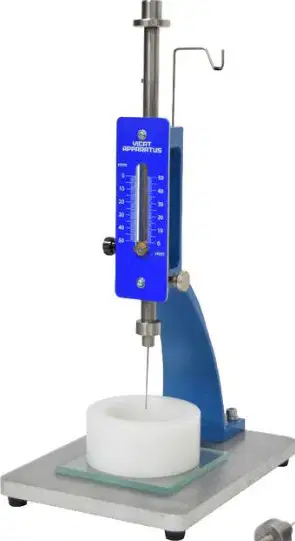
Name the apparatus used to check the setting times of cement and state the primary purpose of the consistency test.
Vicat apparatus; to determine the amount of water required to produce a cement paste of specific consistency
Le Chatelier apparatus; to measure the soundness of cement
Blaine apparatus; to determine the fineness of cement
Slump cone; to measure the workability of concrete
Which statement best explains why consistency and setting time tests are critical in construction applications?
They ensure cement paste color remains uniform
They verify the cement will set properly in practical applications and help evaluate workability and setting time
They determine only the heat of hydration of the cement
They are used solely to assess sulfate resistance
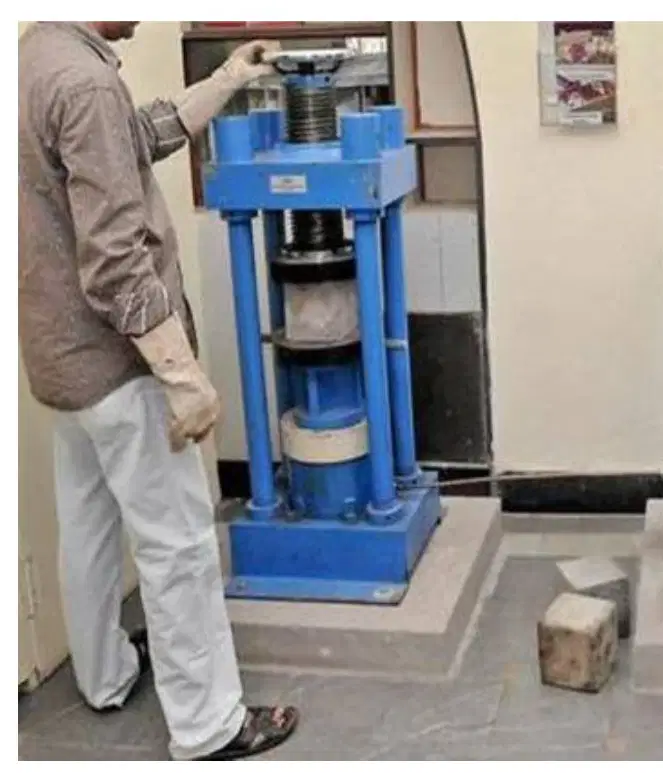
In the compressive strength test, at which curing ages are cement mortar cubes typically tested according to the description?
1, 14, and 56 days
3, 7, and 28 days
2, 10, and 21 days
7, 21, and 35 days
The standard procedure for preparing specimens for the compressive strength test involves which of the following steps?
Mixing cement and sand with a specific water-cement ratio, pouring into cube molds, curing, and testing with a Compression Testing Machine
Directly placing dry cement in the Compression Testing Machine without molding or curing
Mixing cement with gravel only, pouring into cylindrical molds, and testing immediately after mixing
Using only water and cement, pouring into any available container, and testing after 24 hours
Select the most appropriate tests for a cement sample suspected of high moisture and volatile content, and a concrete core suspected of high chloride.
Use Loss on Ignition (LOI) for the cement to measure weight loss after heating at 900–1000°C, indicating moisture/volatile content; use the chloride content test on the concrete by crushing, extracting with hot dilute nitric acid, then adding silver nitrate to precipitate chloride, ensuring levels are within acceptable limits
Use X-ray diffraction for the cement and a slump test for the concrete core
Use pH testing for both cement and concrete core
Use compressive strength testing for the cement and carbonation depth test for the concrete core
Which test ensures that cement does not undergo excessive expansion after setting, preventing cracks?
Heat of Hydration Test
Le Chatelier’s soundness test
Sulfate Resistance Test
Chloride Permeability Test
Fill in the blank: The soundness test ensures that cement does not undergo _______ after setting, which can cause cracks.
excessive expansion
rapid hardening
color change
loss of strength
Which outcome is specifically associated with high heat of hydration during cement hydration, especially in mass concrete works?
Delayed setting
Thermal cracking
Carbonation
Increased sulfate resistance
In a project involving a massive concrete foundation, which property should be monitored to avoid temperature-related damage, and why?
Monitor the heat of hydration because high heat released during cement hydration can cause thermal cracking in mass concrete works.
Monitor the compressive strength because low strength can cause early failure in mass concrete works.
Monitor the water-cement ratio because excess water can cause shrinkage cracks in mass concrete works.
Monitor the air content because high air content can cause reduced durability in mass concrete works.
Which statement best explains why chloride permeability testing is important for reinforced concrete structures?
It measures resistance to freeze–thaw cycles.
It determines the cement’s alkali content.
It evaluates permeability of cement to chlorides, which helps prevent corrosion of steel.
It quantifies expansion after setting.
The slide displays the title “LIST OF COMPANY OPERATION.” Based on this slide, what is the explicit subject introduced?
List of Company Operation
Cement Kiln Temperature Profiles
Raw Meal Proportioning Calculations
Environmental Impact Assessment

