
NEW
Font size
 Worksheets
Quiz on Firm and Industry Concepts
Total questions: 60
Worksheet time: 30mins
What is the main aim of every private business according to the provided material?
To increase the number of employees
To minimize cost and make profits
To expand internationally
To reduce production speed
What is the main benefit of "Managerial Economies" for large firms?
They can employ competent managers in various fields to increase productivity.
They do not need any managers.
They only hire unskilled workers.
They reduce productivity by hiring more managers.
A firm employs 10 units of labor and produces a total of 200 goods. What is the Average Product (A.P)?
A. 20
B. 2000
C. 10
D. 2
What happens to marginal product (MP) when total product (TP) is at its maximum?
Marginal product is at its maximum
Marginal product is at zero
Marginal product is negative
Marginal product is increasing
Which of the following best defines the location of industry?
The process of selling products in a market
The siting of a firm at a particular place
The transportation of goods to different cities
The employment of skilled labor in a factory
A plastic bottle manufacturing firm set up near a brewery is an example of which advantage of localization?
Provision of infrastructural facilities
Development of subsidiary industries
Organized market
Government policy
Which of the following best describes a demand curve?
A curve that shows the relationship between supply and price.
A graphical representation of demand schedule, sloping downward from left to right.
A straight line showing constant demand at all prices.
A curve that slopes upward from left to right.
What is the income effect in the context of demand?
A decrease in price leads to a decrease in real income
A decrease in price enables a consumer to buy more due to increased real income
An increase in price leads to increased demand
A decrease in price leads to less consumption
Which of the following best describes the substitution effect?
Consumers buy less of a product when its price falls
Consumers substitute a product with another when its price rises
Consumers substitute a product with another when its price falls
Consumers ignore price changes
What is a characteristic of Giffen goods?
Consumption rises as price falls
Consumption falls as price falls
Consumption remains constant regardless of price
Consumption rises as income rises
Which of the following is an example of goods of ostentation?
Salt
Second hand clothes
Luxurious cars
Bread
What happens to the demand for a commodity when a person forms a habit of consuming it?
Demand increases as price increases
Demand decreases as price increases
Demand does not change with price
Demand fluctuates randomly
Why do goods of necessity have zero elasticity of demand?
Consumers can easily reduce the quantity they buy
Consumers cannot reduce the quantity they buy regardless of price changes
The price never changes
They are luxury items
Which of the following is an example of a factor that can cause a shift in the demand curve?
The price of the commodity itself
The income of the consumer
The color of the product
The size of the packaging
According to the text, what does a leftward shift in the demand curve represent?
An increase in demand
A decrease in demand
No change in demand
An increase in supply
How does the supply of a commodity that serves two or more purposes affect the supply for other purposes?
It does not affect the supply for other purposes
It increases the supply for all purposes equally
The supply for one purpose will affect the supply for the other purpose
It decreases the supply for all purposes
What is meant by competitive supply?
When two products satisfy the same want and compete for satisfaction
When two products are always produced together
When the supply of one product does not affect the other
When products are supplied at the same price
Why are products in competitive supply considered rivals?
Because they compete for the satisfaction of the same wants
Because they are always sold together
Because they are produced in the same factory
Because they have the same price
How does the entry of new businesses into the market affect supply?
It decreases supply
It has no effect on supply
It increases supply
It reduces demand
If a firm adopts a capital-intensive method of production, what is the likely effect on supply?
Supply will decrease
Supply will increase
Supply will remain unchanged
Demand will decrease
What is meant by "change in quantity supplied" in economics?
A shift of the entire supply curve due to non-price factors
A movement along the same supply curve due to a change in price
A decrease in demand for a commodity
An increase in production costs
According to the text, what happens when the price of a commodity increases, assuming other factors remain constant?
The supply curve shifts to the left
The quantity supplied increases
The demand decreases
The equilibrium price falls
In a free market, what happens if the quantity demanded is higher than the quantity supplied?
The price will fall due to excess supply
The price will remain constant
The price will increase due to excess demand
The supply curve will shift to the right
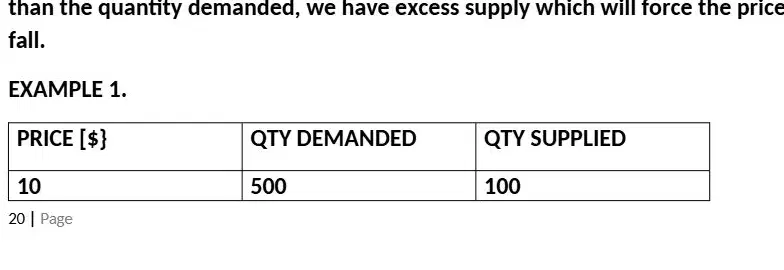
Based on the example table, if the price is $10, what is the quantity demanded and quantity supplied?
500 demanded, 100 supplied
100 demanded, 500 supplied
500 demanded, 500 supplied
100 demanded, 100 supplied
The equilibrium price in a capitalist economic system is determined by:
The government setting the price
The interaction of demand and supply forces in the market
Producers only
Consumers only
What does the movement from point A to B on the supply curve represent?
A change in supply due to non-price factors
A change in quantity supplied due to a change in price
A shift in the demand curve
A decrease in equilibrium price
What is the formula for calculating excess demand (Excess DD)?
Excess DD = QD - QS
Excess DD = QS - QD
Excess DD = QD + QS
Excess DD = QD / QS
Given QD = 42 - 2P and QS = 12 + 4P, what is the equilibrium price?
5
6
7
8
If the price falls to $4.00, what is the term used to describe the situation where the quantity demanded exceeds the quantity supplied?
Excess supply
Equilibrium
Excess demand
Surplus
Which of the following equations represents a supply curve?
QD = 21 - 3P
QS = 21 + 3P
QD = 12 - 2P
QD = 25 + 0.25P
What is the primary objective of a firm according to traditional economic theory?
A. Maximizing social welfare
B. Maximizing employee satisfaction
C. Maximizing profit
D. Maximizing market share
. In the short run, a firm can vary:
A. All of its inputs
B. Only fixed costs
C. Only variable inputs
D. Neither fixed nor variable inputs
What does the Law of Diminishing Returns state?
A. As more units of a variable input are added to fixed inputs, total output always increases at an increasing rate.
B. Adding more of a variable input to fixed inputs will eventually lead to smaller increases in output.
C. The cost per unit of output always decreases as production increases.
D. Output decreases as inputs increase.
4. In perfect competition, firms are said to be:
A. Price makers
B. Price takers
C. Government regulated
D. Monopolistic
5. Which of the following best describes marginal cost?
The cost of producing one more unit of output
The total cost divided by the number of units produced
The total cost of all inputs used
The change in profit from selling one more unit
What is meant by "scale of production"?
The amount of goods produced in a single batch
The total revenue generated by a company
The number of workers in a business
The size or level at which a business produces goods or services
Which of the following is a benefit of increasing the scale of production?
Diseconomies of scale
Decreased productivity
Higher variable costs
Lower average cost per unit
When a business grows too large and becomes inefficient, it experiences:
Break-even output
Diseconomies of scale
Economies of scale
Constant returns to scale
Which of the following is an example of an internal economy of scale?
Lower interest rates in the economy
Bulk buying of raw materials
Lower corporate tax rates
Improved national infrastructure
A firm that increases its production but sees no change in average cost is experiencing:
Constant returns to scale
Diseconomies of scale
Decreasing returns to scale
Increasing returns to scale
Which of the following is the most important factor for the location of a steel plant?
Government policy
Availability of labor
Availability of water
Proximity to raw materials
The process of industries concentrating in a particular area is known as:
Urbanisation
Localisation
Industrialisation
Globalisation
Which of these is NOT a factor affecting the location of an industry?
Market availability
Entertainment facilities
Transportation
Raw materials
Which type of industry is most likely to be located near the source of raw material?
IT industry
Footwear industry
Cotton textile industry
Iron and steel industry
Which of the following industries is most likely to be located near the market?
Cement industry
Paper industry
Sugar industry
Newspaper printing
Which of the following is an example of a localized industry cluster?
Fishing in Kerala
Tea plantations in Assam
IT companies in Bangalore
Rice farming in Punjab
Why do perishable goods industries prefer to be located near the market?
To reduce taxes
To avoid pollution
To reduce labor costs
To ensure timely delivery
Which factor is most significant for the location of a hydroelectric power plant?
Water availability
Skilled labor
Market proximity
Raw materials
Which of the following is a disadvantage of industrial localization?
Easier infrastructure development
Cost reduction due to shared facilities
Efficient use of resources
Regional imbalance
What does the Law of Demand state?
When price decreases, quantity demanded decreases
Demand remains constant regardless of price
When price increases, demand increases
When price increases, quantity demanded decreases
Which of the following is not a determinant of demand?
Price of related goods
Production cost
Consumer tastes and preferences
Consumer income
A good for which demand increases as consumer income increases is known as a:
Inferior good
Normal good
Giffen good
Complementary good
If the price of coffee rises and the demand for tea increases, these two goods are:
Complements
Substitutes
Normal goods
Inferior goods
The demand curve generally slopes:
Horizontally
Vertically
Downward from left to right
Upward from left to right
What does a demand curve show?
The income level of consumers
The relationship between supply and quantity
The total cost of production
The relationship between price and quantity demanded
If the price of a good decreases, what usually happens to the quantity demanded, according to the law of demand?
It increases
It decreases
It stays the same
It becomes negative
A demand schedule is best described as:
A graph showing supply and demand
A table that shows the quantity demanded at different prices
A list of all products in a store
A calendar of production deadlines
When plotting a demand curve, which of the following is typically placed on the horizontal (X) axis?
Price
Time
Income
Quantity demanded
Which of the following would cause a movement along the demand curve, rather than a shift in the curve?
A change in the price of the good itself
A change in consumer income
A change in the price of a related good
A change in consumer preferences
What happens at the point where the demand and supply curves intersect in a market?
Prices will continue to rise
The market is in disequilibrium
There is a surplus of goods
The quantity demanded equals the quantity supplied

