
 Worksheets
Unit Four Exam
Total questions: 60
Worksheet time: 30mins
In which of the following organisms did the process of photosynthesis most likely originate?
land plants
prokaryotes
fungi
unicellular aquatic eukaryotes
Which of the following statements best describes the relationship between autotrophs and heterotrophs?
Autotrophs produce their organic molecules from CO₂ and other inorganic molecules, whereas heterotrophs obtain their organic molecules from compounds produced by other organisms.
Heterotrophs produce their organic molecules from CO₂ and other inorganic molecules, whereas autotrophs obtain their organic molecules from compounds produced by other organisms.
Both autotrophs and heterotrophs produce some of their organic molecules from CO₂ and other inorganic molecules.
Heterotrophs are considered the producers of the biosphere, whereas autotrophs are consumers.
Which of the following statements best describes the conditions under which the Calvin cycle and cellular respiration occur in plants?
The Calvin cycle and cellular respiration both occur only in the light.
The Calvin cycle occurs only in the light, and cellular respiration occurs only in the dark.
The Calvin cycle occurs only in the dark, and cellular respiration occurs in both the dark and the light.
The Calvin cycle and cellular respiration both occur in the dark and the light.
Which of the following statements correctly describes a distinction between autotrophs and heterotrophs?
Only heterotrophs perform cellular respiration.
Only heterotrophs have mitochondria.
Only autotrophs can produce organic molecules from CO₂ and other inorganic materials.
Only autotrophs require oxygen to produce organic molecules.
One way in which photosynthesis in a typical C₄ plant differs from that in a C₃ plant is that the C₄ plant:
does not produce any oxygen gas.
carries out the Calvin cycle only in the chloroplasts of bundle-sheath cells.
keeps its stomata more open so that more CO₂ can enter the plant.
avoids the use of rubisco entirely; instead, it uses PEP carboxylase to catalyze all carbon fixation.
actively pumps oxygen gas away from the cells that contain rubisco.
The relationship between photosynthesis and cellular respiration is best described as:
Photosynthesis produces glucose and oxygen, which are used in cellular respiration to produce energy.
Cellular respiration produces glucose and oxygen, which are used in photosynthesis to produce energy.
Photosynthesis and cellular respiration are unrelated processes.
Both processes only occur in animal cells.
Which of the following processes is directly associated with photosystem I?
receiving electrons from the thylakoid membrane electron transport chain
generating molecular oxygen
extracting hydrogen electrons from the splitting of water
passing electrons to NADP+
Which of the following observations would be the best indicator that an organism lacks photosystem II?
It produces glucose in the light and dark.
It does not produce CO2 in the dark.
It does not produce O2 in the light.
It produces CO2 in the light.
What are the products of linear electron flow in the light reactions of photosynthesis?
heat and fluorescence
ATP and P700
ATP and NADPH
ADP and NADP+
A mutation that disrupts cyclic electron flow in the light reactions of photosynthesis will specifically reduce the production of which of the following molecules?
CO2
ATP
NADPH
ADP and NADP+
Which of the following processes would be most directly affected if a thylakoid membrane is punctured so that the interior of the thylakoid is no longer separated from the stroma?
splitting of water
flow of electrons from photosystem II to photosystem I
synthesis of ATP
reduction of NADP+
In chloroplasts, the photosynthetic electron transport chain acidifies which of the following cellular compartments?
mitochondrial matrix
stroma
thylakoid space
cytosol
In a plant, which of the following reactions produces molecular oxygen (O2)?
Splitting of water (photolysis) during the light reactions of photosynthesis.
Respiration in mitochondria.
Fermentation in yeast.
Photosynthesis in dark reactions.
Which of the following molecules will accumulate if light reactions occur normally, but the Calvin Cycle is inhibited?
CO2 and glucose
H2O and O2
ADP, (P_i), and NADP+
ATP and NADPH
Photosynthesis plays a critical role in capturing and storing energy for use in biological processes. What is the primary product of photosynthesis that stores energy for later use?
Oxygen
ATP
Carbon dioxide
Glucose
During the light-dependent reactions of photosynthesis, an electrochemical gradient is established across the thylakoid membrane. What is the significance of this gradient?
It directly powers the conversion of carbon dioxide into glucose.
It drives the splitting of water molecules to produce oxygen.
It provides the energy needed to reduce NADP+ to NADPH.
It is used by ATP synthase to produce ATP from ADP and inorganic phosphate.
If a plant were unable to transfer energy captured in the light reactions to ATP and NADPH, which of the following would be the most immediate consequence?
The Calvin cycle would slow down or stop due to a lack of ATP and NADPH.
The plant would produce excess glucose and store it in the roots.
Oxygen would not be released as a byproduct of photosynthesis.
Photosystem II would overheat and become nonfunctional.
A new type of algae has been discovered that thrives in low-light environments. Researchers are studying how these algae might be adapted to efficiently capture and use energy in such conditions. The algae appear to have a modified form of ATP synthase that operates more effectively with a smaller proton gradient. Based on this observation, which of the following modifications might have evolved in this algae to enhance its photosynthetic efficiency in low-light conditions?
A higher density of chlorophyll molecules to capture more light.
A reduced need for water as a reactant in photosynthesis.
An increased rate of glucose consumption to boost ATP production.
A more efficient Calvin cycle that requires fewer ATP molecules.
During cellular respiration, the Krebs cycle plays a vital role in energy production. Which of the following statements best describes the outcome of the Krebs cycle?
The Krebs cycle converts glucose into lactic acid.
The Krebs cycle generates ATP, releases carbon dioxide, and transfers electrons to NADH and FADH₂.
The Krebs cycle directly produces large amounts of ATP by oxidative phosphorylation.
The Krebs cycle splits water molecules to release oxygen.
During the light-dependent reactions of photosynthesis, an electrochemical gradient is established across the thylakoid membrane. What is the significance of this gradient?
It directly powers the conversion of carbon dioxide into glucose.
It is used by ATP synthase to produce ATP from ADP and inorganic phosphate.
It provides the energy needed to reduce NADP+ to NADPH.
It drives the splitting of water molecules to produce oxygen.
Where in the plant leaf do Calvin cycle occur?
Thylakoid
Stomata
Stoma
Stroma
Granum
To make photosynthesis more efficient, which of the following should be eliminated?
photophosphorylation
ATP synthase
proton gradient
photorespiration
Which of the following occurs during Calvin (Light Independent) cycle?
NADP+
Release of oxygen
regeneration of carbon dioxide
carbon fixation
Which of the following events is most immediately associated with the absorption of energy by chlorophyll molecules of the reaction-center complex?
An electron is excited.
ATP is synthesized from the energy absorbed.
NADP+ is reduced to NADPH.
A molecule of water is split.
Movement of the chromosomes during anaphase would be most affected by a drug that prevents
nuclear envelope breakdown.
cell wall formation
elongation of microtubules.
shortening of microtubules.
formation of a cleavage furrow
If a sperm cell contains 12 chromosomes, it comes from an animal that has _____ chromosomes.
4
8
12
16
24
Eukaryotic chromatin is composed of which of the following macromolecules?
DNA and RNA
DNA only
DNA and proteins
DNA and phospholipids
Which of the following cellular events occur in the G1 phase of the cell division cycle?
normal growth and cell function
DNA replication
the beginning of mitosis
break down of the nuclear membrane
What is the name of the microtubule-organizing center found in animal cells as an identifiable structure present during all phases of the cell cycle?
centriole
centrosome
centromere
kinetochore
Students in a biology lab isolated cells in various phases of the cell cycle. A population of cells that have twice the DNA of G1 phase cells was most likely isolated from which of the following part of the cell cycle?
between the G1 and S phase
in the G2 phase
immediately after cytokinesis
at the beginning of the S phase
The mitotic spindle plays a critical role in which of the following processes?
splitting of the cell (cytokinesis) following mitosis
triggering condensation of chromosomes
dissolving of the nuclear membrane
separation of sister chromatids
Which of the following statements describes a characteristic feature of metaphase?
alignment of chromosomes on the equator of the cell
separation of the centromeres
cytokinesis
separation of sister chromatids
Which of the following events would be most likely to produce cells with several nuclei?
repeated cytokinesis without mitosis
repeated mitosis with simultaneous cytokinesis
repeated mitosis without cytokinesis
multiple S phases without mitosis
Cell A has half as much DNA as cells B, C, and D in a mitotically active tissue. Cell A is most likely in _______.
G1
G2
prophase
metaphase
One difference between cancer cells and normal cells is that cancer cells _______.
are unable to synthesize DNA
are arrested at the S phase of the cell cycle
continue to divide even when they are tightly packed together
cannot function properly because they are affected by density-dependent inhibition
Vinblastine is a standard chemotherapeutic drug used to treat cancer. Because it interferes with the assembly of microtubules, its effectiveness must be related to _______.
disruption of mitotic spindle formation
suppression of cyclin production
myosin denaturation and inhibition of cleavage furrow formation
inhibition of DNA synthesis
Through a microscope, you can see a cell plate beginning to develop across the middle of a cell and nuclei forming on either side of the cell plate. This cell is most likely _______.
an animal cell in the process of cytokinesis
a plant cell in the process of cytokinesis
a bacterial cell dividing
a plant cell in metaphase
Chemotherapeutic drug designed to treat cancer cells?
It is safe enough to prevent all apoptosis.
It does not interfere with metabolically active cells.
It specifically inhibits cells entering G0.
It specifically inhibits the cell division cycle in rapidly dividing cells.
Cells from advanced malignant tumors often have very abnormal chromosomes and an abnormal number of chromosomes. Which of the following best explains the association between malignant tumors and chromosomal abnormalities?
Cancer cells are no longer density-dependent.
Cancer cells are no longer anchorage-dependent.
Cell cycle checkpoints are not in place to stop cells with chromosome abnormalities.
Transformation introduces new chromosomes into cells.
Besides the ability of some cancer cells to over proliferate, which of the following situations is most likely to result in a tumor?
changes in the order of cell cycle stages
lack of appropriate cell death
inability to form spindles
failure of cells to enter S phase
Which of the following statements best describes cells in culture that do not exhibit either density-dependent inhibition or anchorage dependence?
The cells are unable to form spindle microtubules.
The cells follow an altered series of cell cycle phases.
The cells show characteristics of tumors.
The cells have nonfunctional MPF.
Which of the following statements best describes density-dependent inhibition?
As cells become more numerous, they begin to squeeze against each other, restricting their size.
As cells become more numerous, the cell surface proteins of one cell contact the adjoining cells, and they signal each other to stop dividing.
As cells become more numerous, the protein kinases they produce begin to compete with each other, such that the proteins produced by one cell essentially cancel those produced by its neighbor.
As cells become more numerous, the level of waste products increases, which slows metabolism and inhibits growth.
Which of the following molecules is maintained at a relatively constant level throughout the cell cycle but requires a cyclin to become catalytically active?
PDGF
MPF
cyclin
Cdk
Progression beyond the G2 checkpoint into mitosis is triggered by which of the following molecules?
PDGF
MPF
cyclin
Cdk
At what stage of the cell cycle is the cyclin component of MPF destroyed?
in late G1
at mid-S phase
in early G2
in late M
Which of the following statements best describes what would happen if MPF (maturation-promoting factor) is introduced into immature frog oocytes that are arrested in G2?
The cells would remain arrested in G2.
The cells would enter G0.
The cells would enter mitosis.
The cells would begin DNA synthesis.
Which of the following statements best describes what happens to MPF during mitosis?
It is completely degraded.
It is phosphorylated by a Cdk, which inactivates it.
The cyclin component of MPF is degraded.
The Cdk component of MPF is degraded.
If all chromosomes are not attached to the mitotic spindle at the M phase checkpoint, the cells would most likely be arrested at which of the following points in the cell division cycle or mitosis?
telophase
prophase
G2
metaphase
The drug cytochalasin B blocks the function of actin. Which of the following aspects of the animal cell cycle would be most disrupted by cytochalasin B?
spindle formation
spindle attachment to kinetochores
cell elongation during anaphase
cleavage furrow formation and cytokinesis
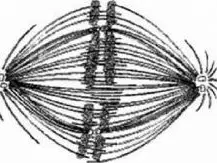
If the cell whose nuclear material is shown in the accompanying figure continues toward completion of mitosis, which of the following events would occur next?
spindle formation
nuclear envelope breakdown
formation of telophase nuclei
segregation of daughter chromosomes
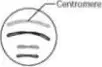
The unlettered circle at the top of the accompanying figure shows a diploid nucleus with four unreplicated chromosomes. The circles labeled 1 to 5 show various combinations of these chromosomes. Which chromosomal configuration would be observed at prometaphase of mitosis?
II
III
IV
V
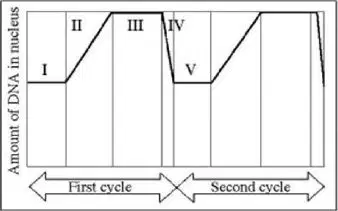
Amount of DNA per nucleus over the cell division cycle. Which region of the accompanying figure represents S phase?
I
II
III
IV
Which of the following structures or molecules is required in order for motor proteins to facilitate movement of chromosomes toward the poles in mitosis?
intact centromeres
actin microfilaments
ATP as an energy source
intact cohesin
Taxol is an anticancer drug extracted from the Pacific yew tree. In animal cells, Taxol prevents microtubule depolymerization, which interferes with which of the following processes?
chromosome separation
cytokinesis
centriole duplication
chromosome condensation
Which of the following statements best explains how neurons and some other specialized cells divide infrequently?
They no longer have active nuclei.
They have entered into G0.
They can no longer degrade cyclins.
They no longer produce MPF.
Cells from advanced malignant tumors often have very abnormal chromosomes and an abnormal number of chromosomes. Which of the following best explains the association between malignant tumors and chromosomal abnormalities?
Cancer cells are no longer density-dependent.
Cancer cells are no longer anchorage-dependent.
Cell cycle checkpoints are not in place to stop cells with chromosome abnormalities.
Transformation introduces new chromosomes into cells.
Which of the following statements best describes density-dependent inhibition?
As cells become more numerous, they begin to squeeze against each other, restricting their size.
As cells become more numerous, the cell surface proteins of one cell contact the adjoining cells, and they signal each other to stop dividing.
As cells become more numerous, the level of waste products increases, which slows metabolism and inhibits growth.
As cells become more numerous, the protein kinases they produce begin to compete with each other, such that the proteins produced by one cell essentially cancel those produced by its neighbor.
Which of the following statements best describes what would happen if MPF (maturation-promoting factor) is introduced into immature frog oocytes that are arrested in G2?
The cells would remain arrested in G2.
The cells would begin DNA synthesis.
The cells would enter G0.
The cells would enter mitosis.
Taxol is an anticancer drug extracted from the Pacific yew tree. In animal cells, Taxol prevents microtubule depolymerization, which interferes with which of the following processes?
cytokinesis
centriole duplication
chromosome separation
chromosome condensation
Which of the following structures or molecules is required in order for motor proteins to facilitate movement of chromosomes toward the poles in mitosis?
intact centromeres
intact cohesin
ATP as an energy source
actin microfilaments

