
 Worksheets
Triangles
Total questions: 99
Worksheet time: 50mins
What is the primary reason triangles are used in bridges, towers, and engineering structures?
They are the easiest shape to construct.
They are the strongest geometric shape, resisting deformation and distributing forces effectively.
They are the lightest geometric shape.
They are the most visually appealing shape.
Why can't a triangle be deformed without changing the lengths of its sides?
Because it has equal angles.
Because it is a rigid polygon.
Because it is the smallest polygon.
Because it has curved sides.
How does a triangle distribute weight when a force is applied to it?
The weight is concentrated at one corner.
The weight is spread evenly across its three sides through compression and tension.
The weight is absorbed entirely by the base.
The weight is distributed unevenly among its sides.
Which of the following is NOT a reason why triangles are used in engineering structures?
They ensure stability.
They allow structures to support heavy loads efficiently.
They are the most flexible geometric shape.
They resist deformation.
What is one of the learning outcomes related to triangles mentioned in the material?
Understand the history of triangles
Know what is a Triangle
Learn about quadrilaterals
Memorize the angles of a square
Which of the following is a learning outcome about the classification of triangles?
Understand the different Classifications of a Triangle
Learn about the properties of circles
Memorize the types of quadrilaterals
Study the history of polygons
What mathematical problems involving triangles are students expected to solve as per the learning outcomes?
Problems related to the volume of a cube
Problems related to the Areas, Perimeter, and other problems involving a Triangle
Problems related to the circumference of a circle
Problems related to the angles of a rectangle
What is the definition of a triangle?
A plane figure with 4 sides and 4 vertices
A plane figure with 3 sides, 3 vertices, and an interior angle sum of 180°
A solid figure with 3 faces and 3 edges
A plane figure with 5 sides and 5 vertices
In the triangle ABC, which side is considered the base and which is the height?
AB is the base, and BC is the height
BC is the base, and AD is the height
AC is the base, and AB is the height
AD is the base, and BC is the height

Which of the following objects is an example of a triangle in real life?
A circular plate
A triangular slice of pizza
A rectangular book
A hexagonal nut
What is the sum of the interior angles of a triangle?
90°
180°
360°
270°
Which of the following statements is true about the sum of angles in a triangle?
The sum of angles in a triangle is always 90°.
The sum of angles in a triangle is always 180°.
The sum of angles in a triangle is always 360°.
The sum of angles in a triangle depends on the type of triangle.
What are the vertices of a triangle?
The points where the sides of the triangle meet.
The angles formed inside the triangle.
The line segments that form the triangle.
The area enclosed by the triangle.
What is the correct definition of the sides of a triangle?
The angles formed at each vertex.
The points where the triangle's edges meet.
The line segments connecting the vertices.
The sum of the triangle's angles.

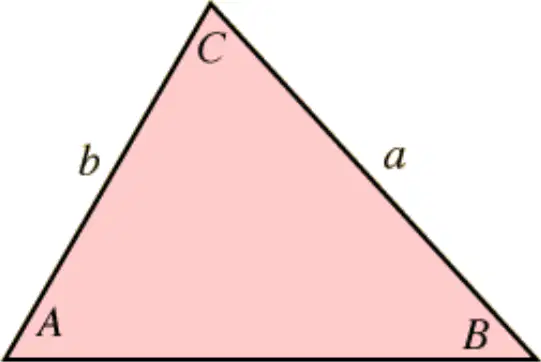
What is the orientation of the vertices (A, B, C) in the given triangle diagram?
Clockwise.
Counterclockwise.
Random.
Depends on the triangle type.
If a triangle has vertices A, B, and C, what are the sides opposite to these vertices labeled as?
α, β, γ.
a, b, c.
x, y, z.
p, q, r.
Which type of triangle has all three sides of equal length?
Scalene
Isosceles
Equilateral
Right
What is the defining characteristic of a scalene triangle?
All sides are equal
Two sides are equal
All sides are of different lengths
One angle is 90°
Which type of triangle has one angle greater than 90°?
Acute
Right
Oblique
Scalene
What is the difference between an isosceles triangle and a scalene triangle?
An isosceles triangle has two equal sides, while a scalene triangle has all sides of different lengths.
An isosceles triangle has all sides equal, while a scalene triangle has two equal sides.
An isosceles triangle has one angle greater than 90°, while a scalene triangle has all angles less than 90°.
An isosceles triangle has one right angle, while a scalene triangle has no right angles.
Which type of triangle is defined by having all angles less than 90°?
Acute
Right
Oblique
Scalene
What is a right-angled triangle?
A triangle with all angles less than 90°
A triangle with one angle equal to 90°
A triangle with all sides equal
A triangle with one angle greater than 90°
What is the side opposite to the right angle in a right-angled triangle called?
Base
Altitude
Hypotenuse
Perpendicular
In a right-angled triangle, what are the other two sides (apart from the hypotenuse) called?
Base and altitude
Hypotenuse and base
Altitude and hypotenuse
Base and perpendicular
What is an acute-angled triangle?
A triangle with all angles measuring exactly 90°
A triangle with all angles measuring less than 90°
A triangle with one angle measuring more than 90°
A triangle with one angle measuring exactly 90°
Which of the following is true for an acute-angled triangle?
All angles are obtuse
All angles are acute
One angle is right
One angle is obtuse
If a triangle has angles measuring 50°, 56°, and 74°, what type of triangle is it?
Acute-angled triangle
Right-angled triangle
Obtuse-angled triangle
Equilateral triangle
What is an obtuse-angled triangle?
A triangle in which all angles are less than 90°
A triangle in which one of the interior angles measures more than 90°
A triangle in which one angle is exactly 90°
A triangle in which all angles are equal
In an obtuse-angled triangle, if one angle measures more than 90°, what can be said about the sum of the remaining two angles?
The sum of the remaining two angles is more than 90°
The sum of the remaining two angles is equal to 90°
The sum of the remaining two angles is less than 90°
The sum of the remaining two angles is equal to the obtuse angle
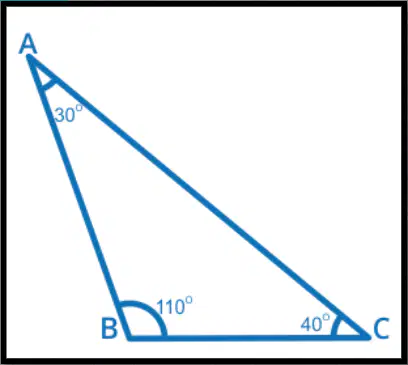
Which of the following is an example of an obtuse-angled triangle?
A triangle with angles 60°, 60°, and 60°
A triangle with angles 90°, 45°, and 45°
A triangle with angles 30°, 110°, and 40°
A triangle with angles 80°, 50°, and 50°
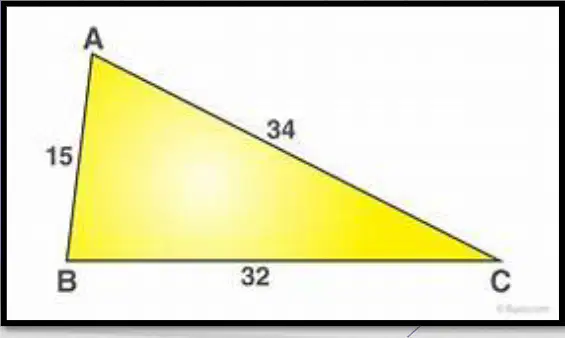
What is a scalene triangle?
A triangle with all sides of equal length
A triangle with two sides of equal length
A triangle with all sides of different lengths
A triangle with one right angle
Which of the following is true about the angles of a scalene triangle?
All angles are equal
Two angles are equal
All angles are of different measures
One angle is always 90 degrees
What distinguishes a scalene triangle from other types of triangles?
It has one right angle
It has all sides and angles of different measures
It has two sides of equal length
It has all sides of equal length
What is the definition of an isosceles triangle according to Euclid?
A triangle with all sides of equal length
A triangle with exactly two sides of equal length
A triangle with no sides of equal length
A triangle with at least two sides of equal length
What is the modern definition of an isosceles triangle?
A triangle with all sides of equal length
A triangle with exactly two sides of equal length
A triangle with at least two sides of equal length
A triangle with no sides of equal length
In the diagram provided, which two sides of the triangle are equal in length?
AB and BC
AC and BC
AB and AC
None of the sides are equal
What is the definition of an isosceles triangle according to Euclid?
A triangle with all sides of equal length
A triangle with exactly two sides of equal length
A triangle with no sides of equal length
A triangle with at least two sides of equal length
How does the modern definition of an isosceles triangle differ from Euclid's definition?
It states that a triangle must have all sides of equal length
It states that a triangle must have no sides of equal length
It states that a triangle must have at least two sides of equal length
It states that a triangle must have exactly two sides of equal length
In the diagram provided, what type of triangle is ΔDEF?
Scalene triangle
Right triangle
Isosceles and equilateral triangle
Obtuse triangle
Which of the following is true about an isosceles triangle?
It has no sides of equal length
It has exactly two sides of equal length according to Euclid
It has at least three sides of equal length
It cannot be equilateral
What is the unequal side of an isosceles triangle called?
Hypotenuse
Base
Altitude
Vertex
In an isosceles triangle, the angles opposite to the two equal sides are:
Always equal
Always unequal
Sometimes equal, sometimes unequal
Right angles
How is the altitude of an isosceles triangle measured?
From one side to another side
From the base to the vertex
Along the base
Along the hypotenuse
In the triangle ABC, if AB = AC, what can be said about ∠ABC and ∠ACB?
∠ABC > ∠ACB
∠ABC < ∠ACB
∠ABC = ∠ACB
∠ABC + ∠ACB = 180°
What is an equilateral triangle?
A triangle with all sides equal in length
A triangle with two sides equal in length
A triangle with no sides equal in length
A triangle with one right angle
How many sides does an equilateral triangle have?
3
4
5
6
What is the measure of each interior angle in an equilateral triangle?
60°
90°
45°
120°
What is the perimeter of an equilateral triangle if the side length is 5 units?
15 units
10 units
20 units
25 units
Which formula is used to calculate the area of an equilateral triangle?
√3/4 × (side)²
1/2 × base × height
side × side
π × radius²
Which triangle congruence criterion states that all three sides of one triangle are equal to the corresponding sides of another triangle?
SAS
ASA
SSS
AAS
What does the SAS triangle congruence criterion require?
Two angles and a non-included side.
Two sides and the included angle.
All three sides are equal.
Two angles and the included side.
Which triangle congruence criterion involves two angles and the included side?
ASA
SSS
SAS
AAS
The AAS triangle congruence criterion requires:
Two sides and the included angle.
Two angles and the included side.
Two angles and a non-included side.
All three sides are equal.
If two triangles are congruent by the SSS criterion, what must be true about their sides?
Two sides and the included angle are equal.
All three sides are equal.
Two angles and the included side are equal.
Two angles and a non-included side are equal.
What is the definition of similar triangles?
Triangles with the same size and shape.
Triangles with the same shape but different sizes.
Triangles with equal perimeters.
Triangles with equal areas.
Which of the following is true about the angles of similar triangles?
Corresponding angles are equal.
All angles are different.
Angles are proportional to the sides.
Angles are always 90 degrees.
What is the relationship between the sides of similar triangles?
Corresponding sides are equal.
Corresponding sides are proportional.
Corresponding sides are perpendicular.
Corresponding sides are parallel.
A diagram showing two similar triangles, one smaller and one larger, with corresponding sides and angles labeled. What property do similar triangles always have?
Corresponding angles are equal and corresponding sides are proportional.
All sides are equal in length.
All angles are right angles.
The triangles are congruent.
What is the ratio of the short side to the long side in similar triangles?
4:6 = 8:12 = 2:3
4:8 = 6:12 = 1:2
6:4 = 12:8 = 3:2
4:12 = 6:8 = 1:3
If the short side of a triangle is 6 m and the long side is 12 m, what is the ratio of the short side to the long side?
1:2
2:3
3:4
4:5
In the given triangles, if the short side of the smaller triangle is 4 m, what is the length of the short side of the larger triangle?
8 m
6 m
12 m
10 m
What is the proportional relationship between the sides of the two triangles shown in the image?
The sides are proportional with a ratio of 2:1.
The sides are proportional with a ratio of 1:2.
The sides are proportional with a ratio of 2:3.
The sides are proportional with a ratio of 3:4.
If the hypotenuse of the smaller triangle is 7.21 m, what is the hypotenuse of the larger triangle?
14.42 m
12 m
10 m
8 m
What is the value of X in the larger triangle if the smaller triangle has sides 3, 4, and 5, and the larger triangle has a side of 7.5 corresponding to the smaller triangle's side of 3?
12.5
10
15
9
Which mathematical property is used to solve for X in the given triangles?
Triangle Similarity
Pythagorean Theorem
Congruence of Triangles
Area of Triangles
If the ratio of the sides of the smaller triangle to the larger triangle is 3:7.5, what is the ratio of the hypotenuse of the smaller triangle to the hypotenuse of the larger triangle?
5:12.5
3:5
4:7.5
5:10
What is the first step in solving for X using the proportion 3/7.5 = 5/X?
Cross-multiply the terms.
Add the numerators.
Subtract the denominators.
Divide both sides by 3.
What is the sum of the interior angles of a triangle?
90°
180°
360°
270°
If the measures of two angles in a triangle are 60° and 70°, what is the measure of the third angle?
50°
60°
70°
80°
Which of the following statements is true about the angles in a triangle?
The sum of the angles in a triangle is always 90°.
The sum of the angles in a triangle is always 180°.
The sum of the angles in a triangle is always 360°.
The sum of the angles in a triangle depends on the type of triangle.
A triangle has angles measuring 45°, 45°, and 90°. What type of triangle is this based on its angles?
Acute triangle
Right triangle
Obtuse triangle
Equilateral triangle
What is the sum of the exterior angles of a triangle?
180°
270°
360°
90°
If the exterior angles of a triangle are labeled as α, β, and γ, which equation represents their sum?
m∠α + m∠β + m∠γ = 180°
m∠α + m∠β + m∠γ = 270°
m∠α + m∠β + m∠γ = 360°
m∠α + m∠β + m∠γ = 90°
Which of the following statements is true about the exterior angles of a triangle?
The sum of the exterior angles is always 180°.
The sum of the exterior angles is always 360°.
The sum of the exterior angles depends on the type of triangle.
The sum of the exterior angles is always less than 360°.
What does the Exterior Angle Theorem state about the relationship between the exterior angle and the interior angles of a triangle?
The exterior angle is equal to the sum of the two opposite interior angles.
The exterior angle is equal to the difference of the two opposite interior angles.
The exterior angle is equal to the product of the two opposite interior angles.
The exterior angle is equal to the average of the two opposite interior angles.
If the two opposite interior angles of a triangle are 40° and 50°, what is the measure of the exterior angle?
90°
100°
80°
70°
Which of the following equations correctly represents the Exterior Angle Theorem for a triangle?
d = a × b
d = a + b
d = a - b
d = (a + b)/2
Why is the Exterior Angle Theorem important in geometry?
It helps calculate the area of a triangle.
It provides a relationship between the angles of a triangle.
It determines the length of the sides of a triangle.
It is used to find the perimeter of a triangle.
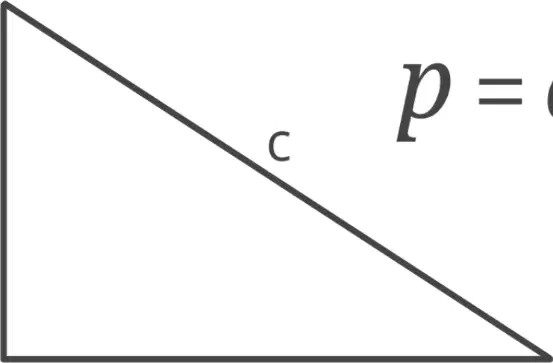
What is the formula for the perimeter of a triangle?
p = a + b + c
p = a × b × c
p = a² + b² + c²
p = a + b - c
If the sides of a triangle are 3 cm, 4 cm, and 5 cm, what is its perimeter?
12 cm
15 cm
10 cm
9 cm
Which of the following best describes the perimeter of a triangle?
The sum of the lengths of its sides
The product of the lengths of its sides
The area enclosed by the triangle
The difference between the longest and shortest sides
What is a right triangle?
A triangle with all angles equal
A triangle with one right angle
A triangle with no angles equal
A triangle with two right angles
In a right triangle, what is the hypotenuse?
The side opposite the right angle
The shortest side of the triangle
The side adjacent to the right angle
The angle opposite the hypotenuse
How are the vertices of a triangle typically labeled?
Using lowercase letters
Using numbers
Using capital letters
Using symbols
How are the sides of a triangle typically named?
Using capital letters
Using lowercase letters
Using numbers
Using symbols
What determines the name of a side in a triangle?
The angle opposite the side
The length of the side
The position of the side
The vertex adjacent to the side
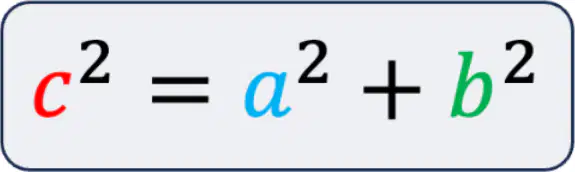
What does the Pythagorean Theorem state about the sides of a right triangle?
The square of the hypotenuse is equal to the sum of the squares of the other two sides.
The square of one side is equal to the square of the hypotenuse minus the square of the other side.
The sum of all three sides is equal to the square of the hypotenuse.
The square of the hypotenuse is equal to the product of the other two sides.
If the lengths of the two shorter sides of a right triangle are 3 and 4, what is the length of the hypotenuse?
5
6
7
8
Which formula can be used to calculate the length of side $ a $ in a right triangle if the hypotenuse $ c $ and side $ b $ are known?
a=c2−b2
a=c2+b2
a=c2−b2
a = c + b
In the Pythagorean Theorem, what does the variable $ c $ represent?
The hypotenuse
One of the shorter sides
The area of the triangle
The perimeter of the triangle
If a right triangle has sides $ a = 6 $, $ b = 8 $, what is the value of $ c $?
10
12
14
16
What is the formula for sin A in a right triangle?
opposite/hypotenuse
adjacent/hypotenuse
hypotenuse/opposite
adjacent/opposite
What is the formula for cos A in a right triangle?
opposite/hypotenuse
adjacent/hypotenuse
hypotenuse/opposite
opposite/adjacent
What is the formula for tan A in a right triangle?
opposite/adjacent
adjacent/hypotenuse
hypotenuse/opposite
adjacent/opposite
What is the formula for csc A in a right triangle?
hypotenuse/opposite
opposite/hypotenuse
adjacent/hypotenuse
adjacent/opposite
What is the formula for sec A in a right triangle?
hypotenuse/adjacent
adjacent/hypotenuse
opposite/hypotenuse
adjacent/opposite
What is the formula for cot A in a right triangle?
adjacent/opposite
opposite/adjacent
hypotenuse/opposite
adjacent/hypotenuse
What is an oblique triangle?
A triangle with a right angle
A triangle with all angles equal
A triangle which does not contain a right angle
A triangle with one obtuse angle
Which formula represents the Law of Sines?
a² = b² + c² - 2bc cos(A)
a/sin(A) = b/sin(B) = c/sin(C)
a² + b² = c²
sin(A) + sin(B) = sin(C)

