
 Worksheets
zfadswwetru
Total questions: 91
Worksheet time: 48mins
Molecular Spectroscopy deals with the interaction of electromagnetic radiation with _______.
molecule
atom
ion
crystal
Electromagnetic radiation consists of discrete packets of energy which are called:
Electrons
Photons
Protons
Neutrons
A photon consists of an oscillating electric field (E) and an oscillating magnetic field (M) which are _______ to each other.
perpendicular
parallel
opposite
adjacent
According to MOT, in molecules, atomic orbitals combine to form _______ which surround the molecule.
molecular orbitals
ionic bonds
lattice structures
atomic nuclei
Molecular bonds have _______ potential energy than in separate atomic orbitals.
Higher
Lower
Same
Variable
Electrons prefer to stay in a molecular bond according to MOT.
True
False
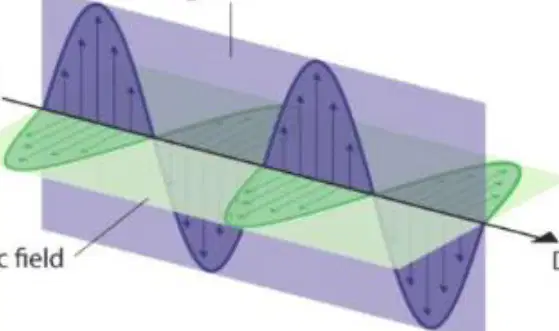
Refer to the diagram showing the electromagnetic wave. What are the two fields shown as oscillating and perpendicular to each other?
Electric field and Magnetic field
Gravitational field and Electric field
Sound field and Pressure field
Thermal field and Magnetic field
Refer to the molecular orbital diagram. Which orbital has lower energy?
Molecular orbital
Atomic orbital
Hybrid orbital
Anti-bonding orbital
What is the principle of UV-Visible Spectrometer based on?
The measurement of spectrum of a sample containing atoms/molecules.
The measurement of temperature changes in a sample.
The measurement of electrical conductivity of a sample.
The measurement of mass of a sample.
Spectrum is a graph of intensity of absorbed or emitted radiation by sample versus ______ or wavelength (λ).
frequency (ν)
temperature (T)
pressure (P)
volume (V)
A spectrometer is an instrument designed to measure the spectrum of a ______.
compound
force
temperature
pressure
The absorption of light by any absorbing material is governed by which two laws?
Bouger-Lambert law and Beer’s law
Newton’s law and Beer’s law
Bouger-Lambert law and Newton’s law
Beer’s law and Boyle’s law
Who suggested the Bouger-Lambert law in 1729?
Picre Bouguer
Isaac Newton
James Clerk Maxwell
Albert Einstein
Bouger-Lambert law is often attributed to which scientist?
Johann Heinrich Lambert
Isaac Newton
James Clerk Maxwell
Albert Einstein
According to Bouger-Lambert law, the amount of light absorbed is proportional to the thickness of the absorbing material and is independent of the intensity of the incident light.
True
False
Absorption Spectroscopy is an analytical technique which concerns with the measurement of absorption of ______ radiation.
electromagnetic
thermal
mechanical
acoustic
The UV radiation region extends from ______ nm to ______ nm.
10 nm to 400 nm
400 nm to 700 nm
1 nm to 10 nm
700 nm to 1000 nm
The common solvent used for preparing sample to be analyzed in absorption spectroscopy is either ______ or ______.
ethyl alcohol or hexane
water or acetone
benzene or toluene
chloroform or ether
What does Beer’s Law state about the amount of light absorbed by a material?
The amount of light absorbed by a material is proportional to the number of absorbing molecules (concentration).
The amount of light absorbed by a material is independent of its concentration.
The amount of light absorbed by a material decreases as the concentration increases.
The amount of light absorbed by a material is proportional to the temperature of the solution.
Write the equation for Beer Lambert’s Law and define each term:
A = ε b c; A = absorbance, ε = molar absorptivity, b = path length, c = concentration.
A = ε + b + c; A = absorbance, ε = energy, b = base, c = constant.
A = ε / (b c); A = absorbance, ε = emission, b = breadth, c = capacity.
A = ε b / c; A = absorbance, ε = molar absorptivity, b = path length, c = coefficient.
Which of the following is NOT a limitation of Beer’s Law?
Different forms of the absorbing molecules are in equilibrium.
Solute and solvent form association complexes.
The compounds are charged by irradiation.
The law is always obeyed regardless of conditions.
Beer’s Law is rigorously obeyed provided a single species gives rise to the observed absorption.
True
False
Fill in the blank: At room temperature, molecules are in the lowest energy levels, denoted as _____
E₀
E₁
E₂
E₃
What is the energy difference (ΔE) when a molecule absorbs UV-visible light and an electron is promoted to a higher energy state?
ΔE = hν = En - E₀, where n = 1, 2, 3, ... etc; ΔE = 35 to 71 kcal/mole.
ΔE = mc^2, where m is mass and c is the speed of light.
ΔE = RT ln(K), where R is the gas constant and K is the equilibrium constant.
ΔE = q + w, where q is heat and w is work.
List one condition under which Beer’s Law may not be obeyed.
Different forms of the absorbing molecules are in equilibrium.
The solution is perfectly dilute.
The path length is always constant.
The solvent does not absorb any light.
Explain the significance of molar absorptivity (ε) in Beer Lambert’s Law.
Which of the following is NOT a possible electronic transition?
σ → σ* transition
π → π* transition
σ → π* transition
n → σ* transition
σ → n* transition
Fill in the blank: The energy required for a σ → σ* transition is _______.
large
small
moderate
very low
Methane (CH₄) has only C-H bonds and can undergo which type of electronic transition?
σ → σ* transition
π → π* transition
n → π* transition
n → σ* transition
Compounds containing multiple bonds like alkenes, alkynes, carbonyl, nitriles, and aromatic compounds undergo π → π* transitions.
True
False
Alkenes generally absorb in which region?
100 to 150 nm
170 to 205 nm
250 to 300 nm
300 to 350 nm
Which atoms in saturated compounds are capable of n → σ* transition?
A) Hydrogen
B) Oxygen, Nitrogen, Sulfur, Halogens
C) Carbon
D) Phosphorus
n → σ* transitions usually require more energy than σ → σ* transitions.
True
False
The number of organic functional groups with n → σ* peaks in UV region is small. What is the range of these peaks?
100-150 nm
150-250 nm
250-350 nm
350-450 nm
What happens during an n → π* transition?
An electron from a bonding orbital is promoted to anti-bonding π* orbital.
An electron from a non-bonding orbital is promoted to anti-bonding π* orbital.
An electron from a non-bonding orbital is promoted to bonding π orbital.
An electron from a bonding orbital is promoted to non-bonding orbital.
Compounds containing which types of double bonds involving hetero atoms undergo n → π* transitions?
A) C=O, C=N, N=O
B) C-H, N-H, O-H
C) C-C, N-N, O-O
D) C-F, N-F, O-F
n → π* transitions require minimum energy and show absorption at longer wavelength around ______ nm.
300
180
220
400
Are σ → π* and π → σ* transitions forbidden or allowed electronic transitions?
Forbidden electronic transitions (only theoretically possible)
Allowed electronic transitions (commonly observed)
Forbidden for σ → π* but allowed for π → σ*
Allowed for σ → π* but forbidden for π → σ*
Which electronic transitions show absorption in the region above 200 nm accessible to UV-visible spectrophotometer?
n → π* and π → π*
σ → π* and π → σ*
n → σ* and σ → σ*
π → σ and σ → π
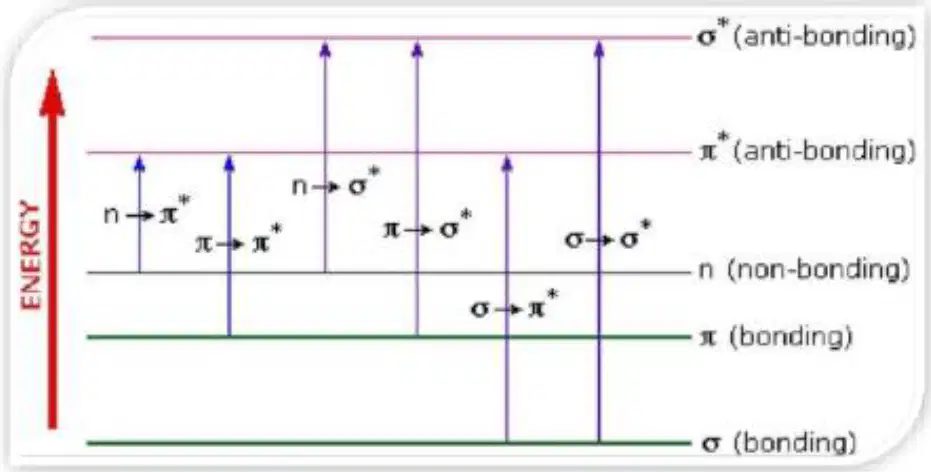
Refer to the diagram titled 'The possible electronic transitions can graphically shown as:' and identify which transition requires the highest energy.
σ → σ*
π → π*
n → π*
σ → π*
What is the process called when a molecule absorbs energy and transitions from the ground state (S0) to an excited singlet state (S1 or S2)?
Fluorescence
Excitation (Absorption)
Phosphorescence
Quenching
Refer to the Jablonski Energy Diagram (Figure 1). Fill in the blank: The process where a molecule returns from an excited singlet state (S1) to the ground state (S0) by emitting a photon is called _________.
Fluorescence
Phosphorescence
Internal Conversion
Intersystem Crossing
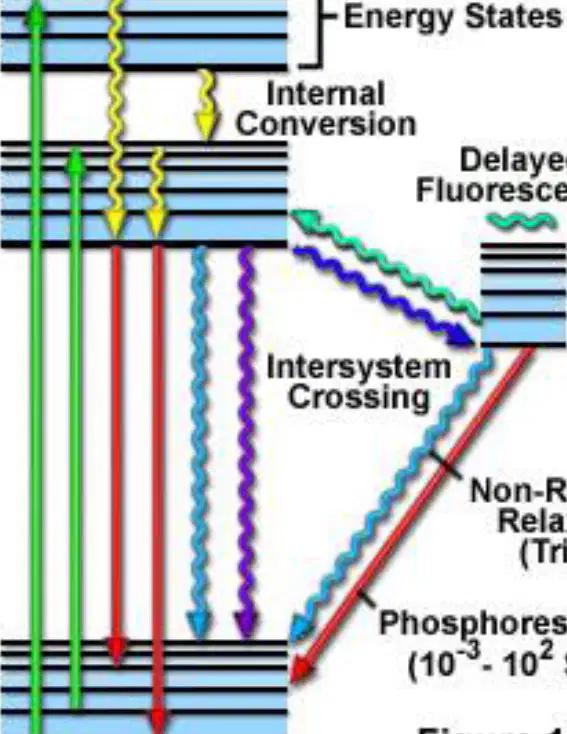
Refer to the Jablonski Energy Diagram (Figure 1). Which process occurs on the timescale of 10−3to102 seconds?
Fluorescence
Phosphorescence
Excitation
Quenching
Intersystem crossing is a process where a molecule transitions from an excited singlet state to an excited triplet state.
True
False
Which of the following is NOT a component of a UV-Visible spectrophotometer?
Detector
Sample compartment
Filters & Monochromator
Source
Oscilloscope
Fill in the blank: The five basic optical instrument components are Source, Wavelength Selector, Sample Container, Detector/Photoelectric Transducer, and _________
Signal Processor & Readout
Light Amplifier
Voltage Regulator
Cooling System
Which of the following is a UV radiation source?
Tungsten lamp
Deuterium lamp
Mercury vapour lamp
Carbonone lamp
Mercury arc lamp is a source of UV radiation.
True
False
Fill in the blank: The three sources of visible radiation are Tungsten lamp, Mercury vapour lamp, and _________
Carbonone lamp
Sodium lamp
Neon lamp
Halogen lamp
Which of the following is NOT a UV radiation source?
Hydrogen lamp
Xenon discharge lamp
Mercury vapour lamp
Mercury arc lamp
Wavelength selectors output a limited, narrow, continuous group of wavelengths called a _______.
band
zone
patch
cluster
What are the two types of wavelength selectors?
Filters and Monochromators
Prisms and Lenses
Mirrors and Gratings
Absorbers and Emitters
What is the function of a monochromator in spectroscopy?
To detect radiation
To select and scan a broad range of wavelengths
To amplify signals
To store samples
Monochromators are used in most scanning spectrometers including UV, visible, and IR instruments.
True
False
Which of the following is NOT a type of prism used in monochromators?
Refractive type
Reflective type
Diffraction type
None of the above
Fill in the blank: The two types of grating used in monochromators are _______ type and transmission type.
Diffraction
Reflection
Absorption
Polarization
Spectroscopy requires all materials in the beam path other than the analyte to be as _______ to the radiation as possible.
transparent
opaque
reflective
absorbent
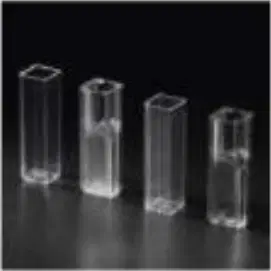
Which material can be used for sample cuvettes in the wavelength range 220 - 3800 nm?
Optical Glass
Special Optical Glass
Quartz (Infrared)
Quartz (Far-UV)
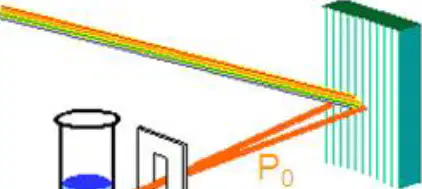
Refer to the diagram of a single beam spectrophotometer. Which component is responsible for separating polychromatic light into a narrow band of wavelength?
Detector
Wavelength selector
Sample compartment
Light source
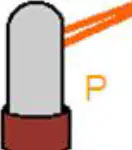
In a single beam spectrophotometer, the transmitted intensity after the sample is measured by the _______.
detector
monochromator
light source
cuvette
In a single beam instrument, the light beam follows a single path from the source, to the monochromator, to the sample cell, and finally to the detector.
True
False
Which of the following statements is true about continuous sources used in UV-Vis Spectrophotometers?
They emit radiation of only one wavelength
They emit radiation of all wavelengths within the spectral region
They are unstable and of low intensity
They are used only for infrared radiation
Sources of radiation should be ______ and of high intensity.
stable
volatile
weak
unpredictable

Which lamp is used for visible and near IR radiation?
Tungsten Lamp
Deuterium Lamp
Mercury Lamp
Sodium Lamp

The Deuterium Lamp is used for ______ radiation and covers the wavelength range of 200-400 nm.
ultraviolet
infrared
visible
microwave
Ideally, the output of a wavelength selector would be a radiation of a ________ wavelength.
single
double
variable
broad
No real wavelength selector is ideal, usually a ________ of radiation is obtained.
band
beam
pulse
stream
The ________ this bandwidth is, the better performance of the instrument.
narrower
wider
higher
lower
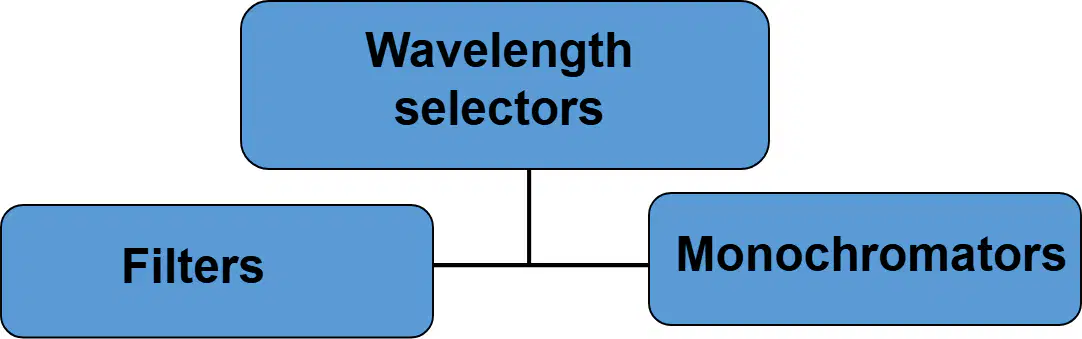
Which of the following are types of wavelength selectors?
Filters
Monochromators
Both A and B
None of the above
Filters permit certain ________ (bandwidth of ~ 50 nm) to pass through. Fill in the blank.
bands of wavelength
types of energy
levels of intensity
sources of light
The simplest kind of filter is ________, the most common of this type of filters is ________. Fill in the blanks.
absorption filters, colored glass filters
interference filters, dichroic filters
polarizing filters, plastic filters
neutral density filters, gelatin filters
Filters are used in which region?
visible region
ultraviolet region
infrared region
microwave region
What does colored glass absorb and transmit?
Colored glass absorbs a broad portion of the spectrum (complementary color) and transmits other portions (its color).
Colored glass absorbs all colors and transmits none.
Colored glass absorbs only ultraviolet light and transmits all visible light.
Colored glass absorbs its own color and transmits the complementary color.
Which of the following is NOT a disadvantage of colored glass filters?
They are not very good wavelength selectors
They can be used in instruments utilized in research
They allow the passage of a broad bandwidth
They absorb a significant fraction of the desired radiation
Colored glass filters are very good wavelength selectors and can be used in instruments utilized in research.
True
False
Why do colored glass filters give a chance for deviations from Beer’s law?
Because they allow the passage of a broad bandwidth.
Because they increase the path length of light.
Because they absorb all wavelengths equally.
Because they enhance the sensitivity of the detector.
What is the primary use of monochromators?
Measuring temperature
Spectral scanning (varying the wavelength of radiation over a considerable range)
Measuring pressure
Generating electricity
Monochromators can be used for which region?
Infrared
UV/Vis
Microwave
X-ray
All monochromators are similar in mechanical construction.
True
False
Fill in the blank: All monochromators employ ________, mirrors, lenses, gratings or prisms.
slits
filters
coils
detectors
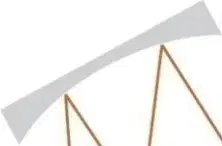
What is the function of the concave mirrors in a reflection grating monochromator?
To collimate polychromatic radiation from the entrance slit into a beam of parallel rays.
To disperse the light into its component wavelengths.
To focus the monochromatic light onto the detector.
To absorb stray light and reduce noise.

In a reflection grating monochromator, what happens when rays fall on the reflection grating?
Different wavelengths are reflected at different angles.
All wavelengths are absorbed by the grating.
The rays pass through the grating without any change.
All wavelengths are reflected at the same angle.

Which component in the reflection grating monochromator is responsible for dispersing the light?
The grating.
The detector.
The entrance slit.
The focusing mirror.
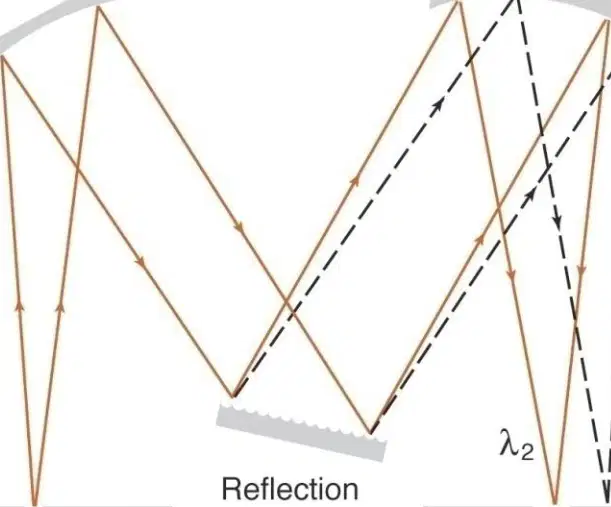
The orientation of the reflection grating directs only one narrow band wavelength to the exit slit of the monochromator.
True
False
1. The reflection grating is ruled with a series of closely spaced, parallel grooves with repeated distance ____.
d
λ
n
θ
The grating is covered with ____ to make it reflective.
Al (Aluminum)
Cu (Copper)
Fe (Iron)
Pb (Lead)
When polychromatic light is reflected from the grating, each groove behaves as ____ of radiation.
a new point source
an absorber
a filter
a lens
When adjacent light rays are in phase, they reinforce one another. This is called ____.
constructive interference
destructive interference
diffraction
polarization
When adjacent light rays are not in phase, they partially or completely cancel one another. This is called ____.
destructive interference
constructive interference
diffraction
refraction
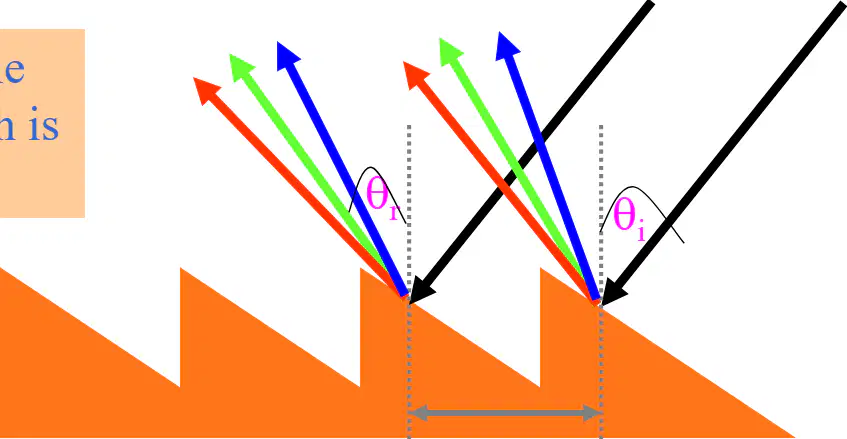
What is the Echelette Grating equation as shown in the image?
nλ = d (sin θi + sin θr)
nλ = d (cos θi - cos θr)
nλ = d (sin θi - sin θr)
nλ = d (cos θi + cos θr)
According to the image, what is observed for each reflection angle θr?
A certain wavelength is observed.
The intensity remains constant.
No reflection occurs.
All wavelengths are absorbed.

