Wayground logo

Free Printable Worksheets

Font size

S
M
L
XL
Worksheets

Bio 110 Lab Practical Exam II Review

Total questions: 61

Worksheet time: 1hrs 28mins

Name
Class
Date
1.

What type of protein is bromelain?

a)

lipase

b)

protease

c)

kinase

d)

ligase

2.

Enzymes are an example of

a)

Lipids

b)

Carbohydrate

c)

Protein

d)

Nucleic Acid

3.

What happens when enzymes are heated to a high temperature?

a)

The enzymes die.

b)

The shape of the enzyme are changed and it denatures

c)

The enzymes' amino acid sequence changes.

d)

The enzymes remain the same

4.
An enzyme speeds up a reaction by
a)
lowering the activation energy.
b)
raising the activation energy.
c)
releasing energy.
d)
absorbing energy.
5.

When looking at the enzyme substrate model, the substrate turns into what at the end of the chemical reaction?

a)

Nothing

b)

It does not change

c)

Products

d)

Pieces

6.

What are two factors that can affect an enzymes ability to function?

a)

No changing

b)

temperature and pH

c)

night and day

d)

hot and cold

7.
What is the function of an enzyme?
a)
enzymes break themselves into small pieces
b)
enzymes slow down chemical reactions
c)
enzymes speed up chemical reactions
d)
enzymes combine products to form reactants 
8.

How does an enzymes shape relate to its function?

a)

the shape of the enzyme has no relation to its function

b)

the enzyme is shaped specially for certain substrates to perform a specific reaction

c)

the enzyme shape acts as a receptor to certain products

d)

the enzyme shape can fit into specific substrates to cease a reaction
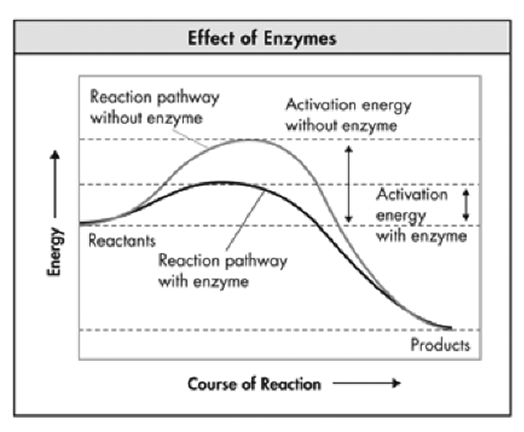
9.
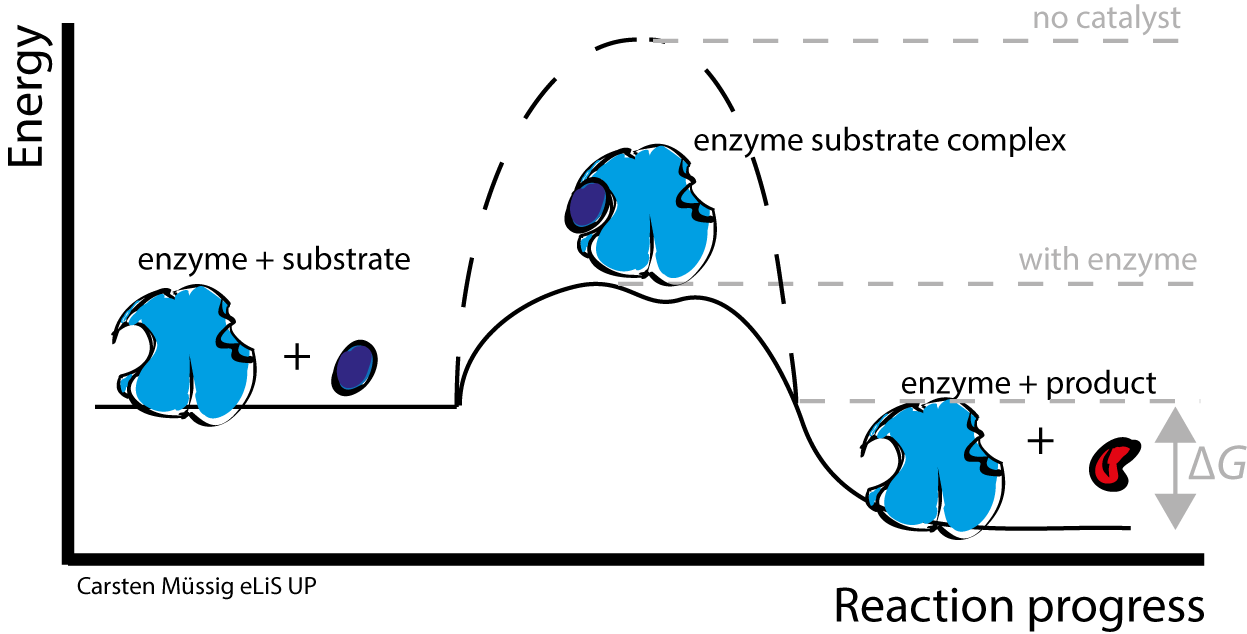
The graph shows how enzymes affect reactions in cells. Which statement best summarizes the information shown in the graph?
a)
Enzymes increase the energy of the reactants.
b)
Enzymes decrease the energy level of the products.
c)
Enzyme decrease the activation energy of the reaction.
d)
Enzymes reverse the direction of the reaction.
10.
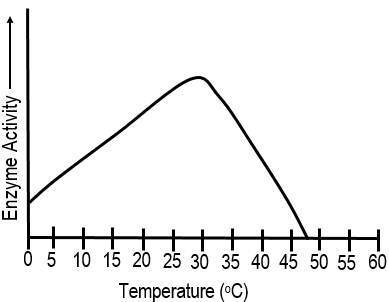
Based on the graph, what temperature does this enzyme work best? 
a)
15 C
b)
40 C
c)
30 C
d)
47 C
11.
Any substance that is acted upon by an enzyme is called a(n)?
a)
Coenzyme
b)
Substrate
c)
Vitamin
d)
Polypeptide
12.

You perform an enzyme-controlled reaction. Based on your results, which of the following is true?

a)

The enzyme works best when the pH is alkaline

b)

The enzyme was most active at pH 4.6

c)

The temperature must have increased and then decreased during the course of the experiment

d)

The salinity was altered during the experiment

13.

In the diagram, what is letter A?

a)

product

b)

enzyme-substrate complex

c)

substrate

d)

active site

14.

Letter D...

a)

enzyme

b)

active site

c)

substrate

d)

products

15.

Letter B...

a)

substrate

b)

active site

c)

enzyme

d)

products

16.

Letter C...

a)

products

b)

substrate

c)

enzymes

d)

active site

17.

Letter E...

a)

active site

b)

products

c)

substrate

d)

enzyme

18.

Match the following

a)

Mitochondria

1.

Makes energy (ATP)

b)

Cell membrane

2.

allows things in an out (selectively permeable)

c)

Nucleus

3.

Command center; houses DNA, boss

d)

Vacuole

4.

Storage bubble

e)

Ribosomes on the ER

5.

Make proteins

19.
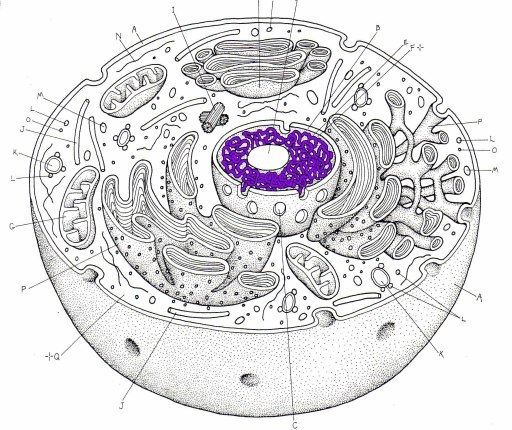
Which type of cell?
a)
Prokaryote
b)
Eukaryote
20.
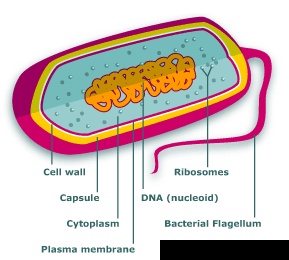
What kind of cell is this?
a)
Eukaryotic
b)
Prokaryotic
21.
What type of cell has a nucleus? 
a)
eukaryotic
b)
prokaryotic 
22.

Prokaryotes are _______________ and include ______________.

a)

single cells, DNA but not a nucleus.

b)

multiple cells, a nucleus with DNA

23.

Eukaryotic cells have...

a)

DNA but no nucleus.

b)

a nucleus with DNA and organelles.

24.

One main difference between prokaryotic and eukaryotic cells is that...

a)

only prokaryotic cells have cell walls

b)

only eukaryotic cells have a nucleus

c)

only prokaryotic cells have ribosomes

d)

only eukaryotic cells have DNA

25.
What tool do you use to view the cells?
a)
metric ruler
b)
centrifuge
c)
microscope
d)
telescope
26.
Which cell is larger, more complex and has a nucleus?
a)
Eukaryotic
b)
Prokaryotic 
27.
Which cell is smaller, more simple and does not have a nucleus?
a)
Eukaryotic 
b)
Prokaryotic 
28.
Humans and plants are made of ______________ cells because they both have a nucleus. 
a)
Eukaryotic 
b)
Prokaryotic 
c)
Fungi
d)
What?
29.
Ribosomes are found in both prokaryotic and eukaryotic cells. What is the main function of ribosomes.
a)
to make proteins 
b)
to make sugar
c)
to make oil
d)
to make cells 
30.
Animal, fungi, plant, and protista cells are all examples of which type of cell?
a)
Eukaryotic
b)
Prokaryotic
c)
Both prokaryotic and eukaryotic
31.
Which of the following is an enzyme filled organelle that breaks down waste in the cell?
a)
lysosomes
b)
chloroplast
c)
mitochondria 
d)
Golgi apparatus 
32.
The ____________ packages and processes material before it exports out of the cell.
a)
Vacuoles
b)
mitochondria
c)
Golgi apparatus 
d)
nucleus 
33.

Prokaryotic cells do not have…….

a)

membrane bound organelles

b)

cell membrane

c)

DNA

d)

genetic material

34.

Which organelle controls what goes in and out of the cell?

a)

nucleus

b)

nucleolus

c)

cell membrane

d)

nuclear membrane

35.
This organelle creates energy.
a)
Nucleus
b)
Ribosome
c)
Mitochondria
d)
ER
36.

What organelle does this image represent?

a)

Golgi Apparatus

b)

Ribosome

c)

Mitochondria

d)

Chloroplast

37.

This organelle makes lipids for the cell.

a)

Rough ER

b)

Smooth ER

c)

Golgi body

d)

nucleus

38.

Which organelle is this?

a)

Golgi Apparatus

b)

Mitochondria

c)

Nucleus

d)

Chloroplast

39.

This structure provides protection to plant cells and is made of cellulose.

a)

chloroplast

b)

cell membrane

c)

cell wall

d)

cytoplasm

40.

Ribosomes are produced here

a)

nucleus

b)

nuclear membrane

c)

nucleolus

d)

chromosomes

41.

Which of the images below represents a chloroplast?

a)
b)
c)
d)
42.

What is the function of this organelle?

a)

modify and build proteins

b)

break down proteins

c)

make lipids for the membrane

d)

store extra material, like water and food

43.

Proteins are produced at this organelle.

a)

golgi body

b)

ribosome

c)

cytoskeleton

d)

cilia

44.

Where do plants get the energy for photosynthesis to take place?

a)

nutrients in the soil

b)

the sun

c)

chlorophyll

d)

bee pollination

45.
What gas  do plants give off after conducting photosynthesis that humans/animals need in order to live?
a)
Oxygen
b)
Carbon
c)
Nitrogen
d)
Hydrogen
46.
What are the 3 key ingredients needed for photosynthesis
a)
glucose, oxygen, carbon dioxide
b)
carbon dioxide, water, glucose
c)
water, soil, sunlight
d)
sunlight, water, carbon dioxide
47.
What is the name of the sugars a plant produces after photosynthesis
a)
Glucose
b)
Sugar
c)
ATP
d)
Oxygen
48.

Which of the following is the correct equation for PHOTOSYNTHESIS?

a)

CO2 + light + H2O --> O2 + Sugar

b)

CO2 + O2 + H2O --> Light+ Sugar

c)

CO2 + sugar + H2O --> O2 + light

d)

O2 + light + H2O --> CO2 + Sugar

49.
Passive transport is called "passive" because it occurs WITHOUT
a)
cause.
b)
energy.
c)
a concentration gradient.
d)
a cell wall.
50.
Osmosis is the diffusion of _____ across a membrane
a)
glucose
b)
NaCl
c)
proteins
d)
water
51.
_____________ allows some things to enter and leave cells, while keeping other things out of the cell.
a)

Nucleus control center of the cell

b)

Selectively Permeable golgi apparatus

c)
A selectively permeable membrane
d)

Non Permeable membrane

52.
Cells sometimes use energy to transport materials across the cell membrane.  This is called
a)

Simple Diffusion

b)
osmosis
c)

Facilitated diffusion

d)
active transport
53.

When the concentration of solutes on both sides of a membrane is the SAME, the solution is

a)
isotonic
b)
hypertonic
c)
hypotonic
54.
If there is 25% oxygen inside the cell and 50% oxygen in the outside blood, which direction will the oxygen move?
a)
Out of the cell
b)
Into the cell
c)
The cell is at equilibrium
55.
A cell contains 25% NaCl and is placed in a solution that has 5% NaCl.  Which of the following is correct about what will happen to the cell?
a)
The solution is hypotonic and the cell will swell.
b)
The solution is hypotonic and the cell will shrink
c)
The solution is hypertonic and the cell will swell
d)
The solution is hypertonic and the celll will shrink.
56.
In the given scenario what will happen to the organism: salt is poured onto eggplant.
a)
Water will move out of the eggplant cells and the cells will shrink.
b)
Water will move out of the eggplant cells and the cells will swell.
c)
Water will move into the eggplant cells and the cells will swell.
57.
An animal cell placed in a hypertonic (salty) solution will
a)
Shrink
b)
Swell
c)
Stay the same
58.
Which type of diffusion is being represented in this picture?
a)
Passive Diffusion
b)
Simple Diffusion
c)
Active Diffusion
d)
Facilitated Diffusion
59.

A solution is considered hypotonic to the cell if it has....

a)

A lower amount of water compared to the cell.

b)

A higher amount of solute compared to the cell.

c)

A lower amount of solute compared to the cell.

60.

Match the following

a)

Hypertonic

1.

The solution contains a high concentration of solute an and low concentration of water

b)

Hypotonic

2.

The solution contains a low concentration of solute an and high concentration of water

c)

Isotonic

3.

The solution has an equal concentration of solute and water compared to the inside of the cell

61.

Using the image, choose the correct form of transport and explanation of how you know:

a)

Active transport, because the molecules are crossing the membrane using a protein

b)

Passive transport because the molecules are crossing the membrane using a protein

c)

Active transport because the molecules are moving from low to high concentration

d)

Passive transport because the molecules are moving from high to low concentration