
 Worksheets
B4 ONLY - RNA and Protein Synthesis Activity
Total questions: 209
Worksheet time: 3hrs 45mins
Which of the following is a component of DNA?
Ribose sugar
Deoxyribose sugar
Uracil
Phospholipid
What is the function of mRNA in protein synthesis?
Stores genetic information
Carries amino acids to the ribosome
Carries the genetic code from DNA to the ribosome
Forms the structure of ribosomes
Which nitrogenous base is found in RNA but not in DNA?
Adenine
Thymine
Uracil
Guanine
What is the basic unit of a protein?
Nucleotide
Amino acid
Fatty acid
Monosaccharide
Which sequence of DNA bases would pair with the sequence AGT?
TCA
AGT
UCA
GTC
Which of the following best describes a codon?
A three-nucleotide sequence on mRNA that codes for an amino acid
A protein that speeds up chemical reactions
A sugar found in DNA
A type of RNA that carries amino acids
Which component is NOT part of a DNA nucleotide?
Phosphate group
Deoxyribose sugar
Ribose sugar
Nitrogenous base
What is the role of tRNA during translation?
Transcribes DNA into RNA
Delivers amino acids to the ribosome
Replicates DNA
Synthesizes mRNA
Which of the following is a correct base pairing in DNA?
Adenine–Uracil
Cytosine–Guanine
Thymine–Guanine
Adenine–Cytosine
Which molecule contains the anticodon?
mRNA
tRNA
DNA
rRNA
Given the DNA sequence TAC, what is the corresponding mRNA codon?
ATG
UAC
AUG
TUG
If a DNA strand has the sequence GGA TCC, what would be the complementary DNA strand?
CCT AGG
GGA TCC
CCU AGG
GGU ACC
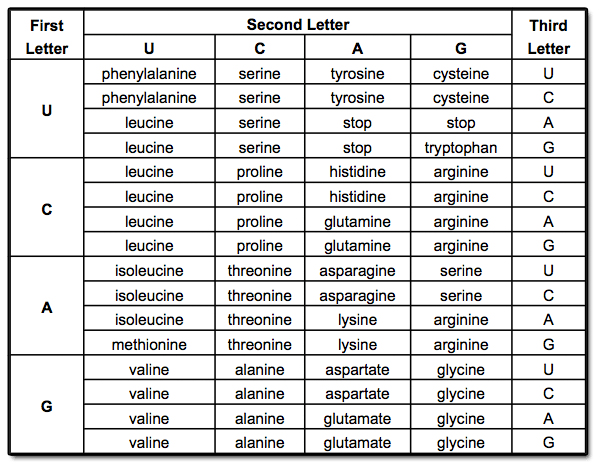
Using a codon chart, what amino acid does the mRNA codon UUU code for?
Leucine
Phenylalanine
Methionine
Glycine
Which process describes the synthesis of mRNA from a DNA template?
Translation
Replication
Transcription
Mutation
How does the sequence of nucleotides in DNA determine the sequence of amino acids in a protein?
By forming hydrogen bonds with amino acids
By coding for mRNA, which is translated into amino acids
By directly attaching to amino acids
By creating ribosomes
Which of the following best explains why a change in the DNA sequence can affect an organism’s traits?
It changes the number of chromosomes
It alters the sequence of amino acids in a protein
It increases the amount of RNA produced
It doubles the amount of DNA
Which of the following is the correct sequence of events in protein synthesis?
Replication → Transcription → Translation
Transcription → Translation → Replication
Transcription → Translation
Translation → Transcription
A DNA sequence reads CCG. What is the corresponding tRNA anticodon?
GGC
CCG
UUG
GGU
Which scientific explanation best supports the idea that DNA is the molecule of heredity?
DNA is found only in animals
DNA can be transferred between organisms and still function
DNA is made of proteins
DNA is not present in bacteria
Which of the following statements about the origin of DNA is supported by scientific evidence?
DNA was created by humans
DNA evolved from simpler molecules over time
DNA has always existed in its current form
DNA is only found in plants
A mutation changes the DNA codon from GAA to GUA. Using a codon chart, predict how this mutation might affect the protein produced.
It will always produce the same protein
It may result in a different amino acid, possibly altering the protein’s function
It will have no effect on the protein
It will stop protein synthesis
Given the mRNA sequence AUG GCU UAC, use a codon chart to determine the sequence of amino acids produced.
Methionine–Alanine–Tyrosine
Alanine–Methionine–Tyrosine
Tyrosine–Alanine–Methionine
Methionine–Tyrosine–Alanine
A scientist observes that a certain protein is not being produced in a cell. Which part of gene expression might be malfunctioning?
DNA replication
Transcription or translation
Cell division
Photosynthesis
If a DNA sequence is mutated so that a stop codon appears early in the mRNA, what is the most likely result?
The protein will be longer than normal
The protein will be shorter and possibly nonfunctional
The protein will not be affected
The protein will be made twice
A student is given a DNA sequence and asked to model the process of protein synthesis. Which steps should the student include in their model?
Transcription and translation
Replication and translation
Replication and transcription
Translation and mutation
A change in the nucleotide sequence of DNA results in a different amino acid being incorporated into a protein. What is this type of change called, and what could be its effect?
Silent mutation; no effect
Missense mutation; may alter protein function
Nonsense mutation; always beneficial
Frameshift mutation; always neutral
A researcher uses a model to show how mRNA is translated into a protein. What evidence would support the accuracy of this model?
The model shows tRNA matching codons with anticodons and adding amino acids in the correct order
The model shows DNA being directly converted into protein
The model shows amino acids forming DNA
The model shows ribosomes making mRNA
A student claims that all mutations in DNA will result in a change in an organism’s traits. Use your knowledge of gene expression to evaluate this claim.
The claim is always true
The claim is false; some mutations do not change the amino acid sequence or protein function
The claim is true only for plants
The claim is true only for animals
A gene is expressed only in certain types of cells. What does this suggest about gene expression?
All genes are always expressed in every cell
Gene expression is regulated and can be cell-specific
Genes are only present in some cells
Gene expression does not affect proteins
A scientist wants to explain how the structure of DNA allows it to specify traits in an organism. Which explanation is most accurate?
The sequence of nucleotides in DNA determines the sequence of amino acids in proteins, which influence traits
The shape of DNA determines the color of an organism
DNA is made of amino acids, which are traits
DNA is only important for cell division
Which shows the correct complementary DNA strand of ATG?
ATG
TAC
TAG
CGC
What are the supplies in the "house" analogy?
the building sites
the amino acids
the copies of the blueprints
the delivery trucks
Which molecule uses DNA as a template to carry instructions out of the cell?
tRNA
mRNA
rRNA
DNA Polymerase
What is the process of turning DNA into mRNA?
Central Dogma
Transcription
Translation
Transformation
mRNA is analogous to
the original blueprints
a copy of the blueprints
the finished house
the building site
_______ is made during transcription and ________ is made during translation.
mRNA / a protein
a protein / mRNA
Ribosome / Nucleus
mRNA / tRNA
Which RNA bases would pair with TAC in transcription?
AUG
ATG
GCA
GCA
A triplet (3 bases) of mRNA is called a
codon
anticodon
amino acid
peptide bond

What amino acid is represented by the codon CAG?
Aspartic Acid
Histidine
Glutamine
Methionine
How many amino acids are coded for by this sequence of nucleotides:
ATG GGA ACT
4
3
6
2
Translation happens in the -
Nucleus
Ribosome
Chloroplast
Smooth Endoplasmic Reticulum
Amino acids are joined together in order to form
DNA
ribosomes
proteins
RNA
What is the correct sequence?
RNA --> DNA --> Protein
Protein --> RNA --> DNA
DNA --> RNA --> Protein
DNA --> Protein --> RNA
What represents the "building site" or place of construction in the house analogy?
r RNA
m RNA
ribosome
t RNA
How many nitrogen bases (letters) code for 3 amino acids?
3
6
9
27

What is the location in the cell for transcription?
nucleus
cytoplasm
ribosome
mitochondria

What brings the amino acids to the ribosome to assemble a protein?
mRNA
tRNA
rRNA
DNA

What is the location in the cell for translation?
Ribosome
Nucleus
Lysosome
Golgi apparatus

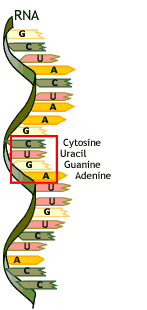
What is the structure shown in the image?
tRNA
mRNA
rRNA
xRNA

What is the structure shown in the middle of the pink box?
tRNA
Amino Acid
Anticodon
Codon

What is the structure shown in the middle of the pink box?
tRNA
Amino Acid
Anticodon
Codon
What are the three parts that make up a nucleotide?
Sugar, Phosphate, nitrogenous base
Sugar, phosphate, hydrogen bond
Phosphate, base, hydrogen bond
sugar, base, hydrogen bond
Which sugar is found in DNA?
ribose
deoxyribose
sucrose
glucose
Which base is NOT found in DNA?
Uracil
Cytosine
Thymine
Guanine
Match each base with the type of nucleic acid it is found in.
Thymine
Found only in DNA, not in RNA
Adenine
Found in both DNA and RNA
Cytosine
Found in both DNA and RNA
Guanine
Found in both DNA and RNA
Which molecule is double stranded?
mRNA
tRNA
rRNA
DNA
According to Chargaff's Rule, in DNA Adenine pairs with
Uracil
Thymine
Cytosine
Guanine
According to Chargaff's Rule, Cytosine pairs with
Uracil
Thymine
Adenine
Guanine
Which enzyme is responsible for separating the strands of DNA during replication?
DNA polymerase
RNA polymerase
Helicase
Ligase
Which enzyme is responsible for adding new bases during DNA replication?
DNA polymerase
RNA polymerase
Helicase
Ligase
Which enzyme is responsible for adding new bases during transcription?
DNA polymerase
RNA polymerase
Helicase
Ligase
Match the following types of RNA/DNA with their roles in protein synthesis.
mRNA
Determines the order of amino acids in a polypeptide
tRNA
Brings amino acids to the ribosome during translation
rRNA
Forms the core structure of ribosomes
DNA
Contains genetic instructions for protein synthesis
Which type of RNA is responsible for bringing amino acids to the ribosome?
mRNA
tRNA
rRNA
DNA
Which type of RNA is responsible for making up the ribosome?
mRNA
tRNA
rRNA
DNA
What is the purpose of a ribosome?
To make more DNA
To make mRNA
To make amino acids
To make polypeptides
Which process takes place outside of the nucleus?
DNA replication
Transcription
Translation
Ribosome production
A codon is found on which type of RNA molecule?
mRNA
tRNA
rRNA
DNA
An anticodon is found on which type of RNA molecule?
mRNA
tRNA
rRNA
DNA
Which type of point mutation will NOT result in a frameshift?
Insertion
Deletion
Substitution
Inversion
All mutations are bad.
True
False
All genes are turned on in all cells at all times.
True
False
For proteins to be made, DNA must be copied into________.
Chromosomes
Chromatin
RNA
cytoplasm
Once the DNA is copied into RNA, it goes to what organelle to begin protein synthesis?
nucleus
rIbosome
cytoplasm
centriole
How many nucleotide bases make up a code for an amino acid?
3
2
5
4
3 nucleotide bases form code to make _________________.
proteins
DNA
mutations
amino acids
Amino acids form a chain to make ______________.
ladders
nucleotides
protiens
steak
How are proteins related to traits?
Proteins determine traits.
Proteins are not related to traits.
Proteins are responsible for my eye color.
Traits make proteins.
Proteins acts as ________________ for many processes in the cell.
acids
chemical triggers
bases
messengers
A mutation is a _______________ in the nucleotide base sequence of a gene.
wrinkle
change
bump
tumor
A substance that causes a genetic mutation is called a _________.
acid
chemical
poison
mutagen
Mutations always cause harmful affects to an organism.
True
False
Some mutations cause no apparent change to an organism.
True
False
Some mutations are (a) for the organism.
A mutation where a base is left out of a genetic sequence is a _______________.
translocation
deletion
insertion
substitution
A mutation where a base is added is called a ____________.
deletion
insertion
translocation
substitution
A mutation where a different base is used in the place of another is a ______________.
deletion
insertion
translocation
substitution
For the original code CTGGAG, what type mutation is CTGGGG?
deletion
insertion
substitution
translocation
For the original code CTGGAG what type mutation is CTGGTGGAG?
deletion
insertion
substitution
translocation
For the original code CTGGAG, what type mutation is CTAG?
deletion
insertion
substitution
translocation

The mRNA leaves the ________ to find the ribosome to make proteins.
cell
nucleotide
nucleus
mitochondrion
DNA holds the code for making
lipids
carbohydrates
proteins
sugars
Choose the sequence of the mRNA strand that would be match up with to the following strand:
GTAGTCA
UATUAGA
ACGACTG
CAUCAGU
CATCAGT

What is the location in the cell for translation?
nucleus
mitochondria in cytoplasm
ribosome in cytoplasm
chloroplast in cytoplasm
Where are proteins assembled (put together) in a cell?
Nucleus
Ribosome
Cell Membrane
Muscles
What is a gene?
A molecule that makes up the sides of the DNA molecule
A type of protein that determines inherited characteristics
A piece/strand of DNA that has instructions for a certain trait
A piece/strand of RNA that has instructions for a certain trait
Which letters represent the four bases of DNA?
U (Uracil), T (Thymine), C (Cytosine), G (Guanine)
A (Adenine), U (Uracil), C (Cytosine), G (Guanine)
A (Adenine), T (Thymine), C (Cytosine), G (Guanine)
A (Adenine), T (Thymine), C (Cytosine), S (Sugar)
What makes up the sides of the DNA molecule?
Amino acids
Proteins
Sugar phosphate group
Nitrogen bases
What is a chromosome?
A type of protein that determines inherited characteristics
A molecule that makes up the sides of the DNA molecule
A structure that contains DNA
A cell part where proteins are made
What are nitrogen bases?
Proteins
Amino acids
The rungs of the DNA ladder
The building blocks of proteins
Where are chromosomes stored in a cell?
Nucleus
Ribosome
Cytoplasm
Cell membrane
What does DNA stand for?
Deoxyribonucleotide acid
Dioxyribonucleic acid
Ribonucleic acid
Deoxyribonucleic acid
Where are proteins made in a cell?
Cytoplasm
Ribosome
Cell membrane
Nucleus
What is the process of making proteins called?
DNA replication
Cell division
Gene expression
Protein synthesis
What are the building blocks of proteins?
Amino acids
Nucleotides
Lipids
Carbohydrates
In what process is mRNA synthesized?
Transcription
Translation
DNA Replication
Mitosis
Where does TRANSCRIPTION occur?
Nucleus
Ribosome
Cytoplasm
Mitochondria
Match the following reasons with their corresponding statements about why transcription must occur where DNA can be found.
because DNA can't leave
Transcription happens in the nucleus since the genetic material remains inside.
because ribosomes are in the nucleus
Transcription is not dependent on ribosomes being present in the nucleus.
because DNA polymerase is found there
Transcription does not require DNA polymerase, which is used in DNA replication.
because helicase unzips the DNA
Transcription begins after the DNA strands are separated by a specific enzyme.
Which of the following is a codon?

ATG
AUG
AUT
How many codons equals 1 amino acid?
1
2
3
4
How many nucleotides equal 1 amino acid?
1
2
3
4
On which molecule can an anticodon be found?
mRNA
DNA
tRNA
rRNA

Where is the anticodon located?
at the top of the molecule it's found on
at the bottom of the molecule it's found on
on the right of the molecule it's found on
on the left of the molecule it's found on
What is the purpose for anti-codons?
to ensure the correct amino acid is dropped off
to match the strand of DNA
to decode a sequence of 4 nucleotides into an amino acid
to make me hate biology

A polypeptide is a sequence of ____________________ held together by a ______________ bond.
amino acids; peptide
fatty acids; ionic
proteins; hydrogen
fatty acids; covalent
Which two thing are found on a molecule of tRNA?
amino acids; anticodons
amino acids; codons
ribose sugar; proteins
deoxyribose sugar; codons
How do you know when to begin translating a strand of mRNA?
look for AUG
start at the beginning
look for ATG
when Ms. H tells me to
How do you know when to STOP translating a strand of mRNA?
look for STOP on the decoder
stop at the end of the strand
you don't
when Ms. H tells me to
TRANSCRIBE this DNA sequence: TACGTTACT
AUGCAAUGA
ATGCAATGA
AUGGATUGA
TACGTTACT
TRANSLATE this RNA sequence: AUGCAAUGA
Met-Glu-Stop
Met-His-Stop
Thr-Glu-Stop
Thr-Pro-Stop
A DNA nucleotide may be made up of a phosphate group, along with
deoxyribose sugar and uracil
ribose sugar and cytosine
deoxyribose sugar and thymine
ribose sugar and adenine
Which of the following units are repeatedly joined together to form a strand of DNA? (This is the MONOMER of DNA.)
amino acids
nucleotides
fatty acids
polysaccharides
The important enzyme related with transcription is;
gyrase
DNA polymerase
RNA polymerase
ligase
The corresponding DNA for a portion of mRNA coded CUG is (a) .


Match each cellular structure with the molecule it synthesizes as shown in the diagram.
ribosomes
Molecule 3
chloroplasts
Glucose
the cell membrane
Phospholipids
the nucleus
Molecule 1

DNA strands 1 and 2 are able to separate and rejoin easily due to (a)
GTAGTCA
ATG GGA ACT CCA

Use your codon chart to match the mRNA ACU to the correct amino acid.
Thr
Ala
Val
Gly
Amino Acids are built up to make_______
DNA
mRNA
Lipids
Proteins

Use your codon chart to find the amino acid that codes for the mRNA codon GCA
Thr
Ala
Pro
Ser
What does DNA determine?
traits of living things
traits of nonliving things
organization of living things
Did Not Attempt
What are the names of the nitrogenous bases?
adenine
cytosine
thymine
guanine
Adenine always pairs with...
thymine
cytosine
guanine
adenine
Cytosine always pairs with...
thymine
cytosine
guanine
adenine
What is the shape of DNA?
double helix
single helix
squiggle
twisty step looking thing
Which list is in the correct order from biggest to smallest?
organism-cell-nucleus-chromosome-DNA-gene
gene-DNA-chromosome-nucleus-cell-organism
organism-DNA-cell-gene-chromosome-nucleus
organism--cell-nucleus-gene-chromosome-DNA

What are the x-shaped objects called inside of the nucleus of a cell?
genes
DNA
chromosomes
cocodrilo peludo que sonríe


When these bond together, they form a protein
Amino Acids
Peptide Bonds
Ribose
Nucleotides
A permanent change in the DNA sequence
which can affect a single gene or group of genes
Homeostasis
Somatic Cell
Chromosomal Mutation
Gene Mutation

One nucleotide base is changed so only one amino acid
is affected
Frameshift Mutation
Substitution Mutation
Translocation
Inverse Mutation
A frameshift mutation is which of the following?
Point mutation
Insertion
Deletion
Subtitution
THEBIGFATREDCATSAT is normal, what is this:
THEBIGFATREDATSAT
Substitution
Insertion
Deletion

The following image are examples of ________________.
Mutagens
Mutaitons
Chromosomes
Germ Cells
What is a gamete?
a body cell (ex. skin or heart cell)
an autosome
a sex cell (ex. sperm or egg)
a somatic cell
Which of the following is an example of a somatic cell?
egg cells
stomach cells
sperm cells
gametes
Which shows a insertion mutation from the following DNA strand:
GATCATGTA
GATCATCTA
GATCATGGTA
GATATGTA
GATCATGTA
Which statement is correct?
DNA is translated into mRNA; mRNA is transcribed into a sequence of amino acids (proteins). Proteins give us our traits
DNA is transcribed into mRNA; mRNA is translated into a sequence of amino acids (proteins). Proteins give us our traits
mRNA is transcribed into DNA; DNA is translated into a sequence of amino acids (proteins). Proteins give us our traits
DNA is transcribed into tRNA; tRNA is translated into a sequence of amino acids (proteins). rRNA give us our traits
What is the Central Dogma of Biology?


Which of the following statements is true?
Transcription occurs in the mitochondria while Translation occurs in the chloroplast
Translation occurs in the nucleus while Transcription occurs in the cytoplasm
Transcription occurs in the nucleus while Translation occurs in the cytoplasm
Translation occurs in the mitochondria while Transcription occurs in the chloroplast
DNA molecules separate into single strands which are then used to construct two identical strands of DNA. This process ensures genetic-
consistency
variability
diversity
reduction
Study the sentences describing the steps of protein synthesis. Which sequence places the steps in the correct order?
1. Transfer RNA picks up individual amino acids and carries them to the ribosome.
2. Ribosomal RNA bonds mRNA and tRNA.
3. A single strand of DNA serves as a template for making mRNA.
4. Messenger RNA carries the sequence of nucleotides to the ribosomes.
5. A protein is synthesized.
2,5,3,4,1
3,4,1,2,5
3,2,4,5,1
2,4,1,5,3
A biologist collects DNA samples from two sisters. The younger sister has blond hair. The older sister has red hair. The sisters have different traits because their DNA contains different —
orders of nucleotides
types of sugar molecules
sized phosphate groups
types of nitrogenous bases

The diagram shows a disorder of chromosome 15. Which of the following identifies the type of chromosomal mutation that has occurred on the bottom strand (pictured above).
Duplication
Inversion
Deletion
Insertion
A segment of a DNA strand is shown.
3' AGGTCAGGT 5'
Which of these is the correct complementary DNA strand for the segment shown?
5' UCCAGUCCA 3'
5' AGGTCAGGT 3'
5' TCCAGACCA 3'
5' TCCAGTCCA 3'
Students are modeling mRNA during the process of protein synthesis. Which answer choice correctly describes the model of the mRNA strand being transcribed?
The mRNA strand is complementary to the DNA template strand; however, uracil instead of adenine is paired with thymine.
The mRNA strand is complementary to the DNA template strand; however, uracil instead of thymine is paired with adenine.
The mRNA strand is an exact copy of the DNA template strand; however, uracil instead of adenine is paired with thymine.
The mRNA strand is an exact copy of the DNA template strand; however, uracil instead of thymine is paired with adenine.

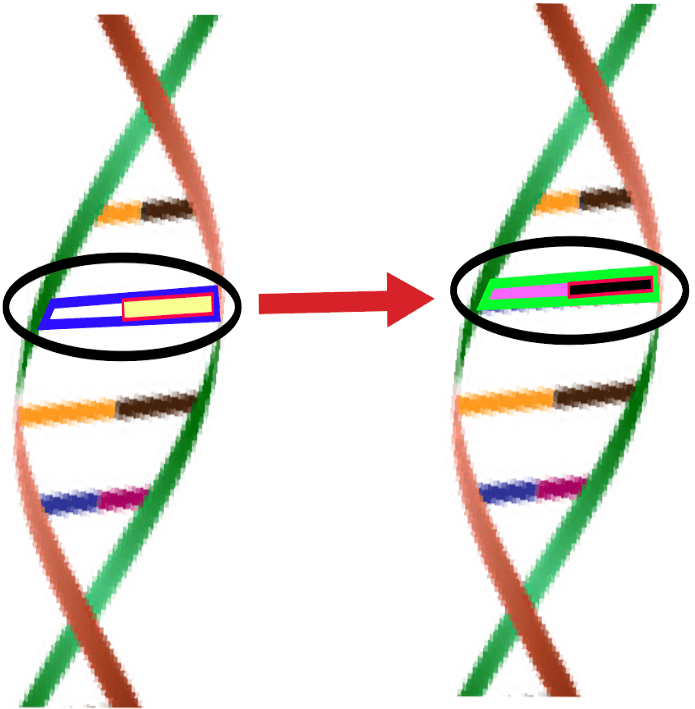
The model shows a mutation to a partial sequence of bases in a gene. Which type of mutation does the model demonstrate?
Insertion
Deletion
Substitution
Exposure to the building material asbestos has been linked to certain types of cancers. Asbestos causes mutations in the p53 gene, which controls tumor suppression.
Which statement best explains why people with cancer due to asbestos exposure do not pass the mutation on to their offspring?
The mutation occurred in gametic cells.
The mutation occurred in somatic cells.
The mutation is recessive.
The mutation is sex-linked.

A sequence of a DNA template strand is shown.
'3 TAC TTC GTC ATG 5'
Explain how to use the mRNA Codon Chart provided and write the amino acid sequence that would be produced with this template.
Tyr- Phen- Val- Met
Met- Lys- Glut- STOP
Tyr- Phen-Val- STOP
Met- Lys- Glut- Tyr

A mutation causes the following change in DNA.
Original DNA sequence:
TACGCATGGAAT
DNA sequence after mutation:
TACGTATGGAAT
The amino acid substitution that will result from this point mutation is (a) .

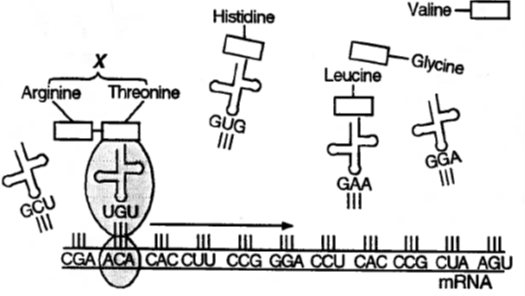
The diagram below shows the process of translation. Which of the following describes the role of structure 2?
carries amino acids to a ribosome
directs the order of amino acids in a protein
attaches amino acids to each other in a protein
acts as a catalyst in controlling chemical reactions
What components make up the backbone of the DNA molecule?
Purine and Deoxyribose
Pyrimidines and purines
deoxyribose and phosphate groups
phosphate groups and pyrimidines
Students are modeling mRNA during the process of protein synthesis. Which answer choice correctly describes the model of the mRNA strand being transcribed?
The mRNA strand is complementary to the DNA template strand; however, uracil instead of adenine is paired with thymine
The mRNA is complementary to the DNA template strand; however, uracil instead of thymine is paired with adenine
The mRNA is an exact copy of the DNA template strand; however, uracil instead of adenine is paired with thymine
The mRNA is an exact copy of the DNA template strand; however, uracil instead of thymine is paired with adenine


AATCATGGA


