
 Worksheets
TEST: Economics Unit 2: Economic Systems
Total questions: 37
Worksheet time: 19mins
Name
Class
Date
1.
Explain what you think a most valuable point (MVP) is from these two units and how you can use that information in your life.
4 lines
2.
What is the system that results from everyone's choices, or how a society coordinates the production and consumption of goods and services?
a)
government
b)
nation-state
c)
business
d)
economy
3.
Economic decisions are based on customs from the past.
a)
Traditional
b)
Command
c)
Market
d)
Mixed
4.
Individuals are encouraged by government incentives to develop new ideas and businesses.
a)
Traditional
b)
Command
c)
Mixed
d)
Market
5.
Economic decisions are made by central planners, like the government.
a)
Traditional
b)
Command
c)
Market
d)
Mixed
6.
Buyers and sellers make economic decisions.
a)
Traditional
b)
Command
c)
Market
d)
Mixed
7.
Which two economic goals seem to contradict each other?
a)
Freedom and Growth
b)
Equity and Security
c)
Efficiency and Equity
d)
Growth and Stability
8.
What are the three fundamental economic questions every economy must answer?
a)
What businesses to start, where to locate, who to hire
b)
How to grow GDP, reduce unemployment, increase exports
c)
How much to tax, where to invest, who gets benefits
d)
What to produce, how to produce, for whom to produce
9.
Which economic goal focuses on fair distribution of societal wealth?
a)
Economic Equity
b)
Economic Growth
c)
Economic Freedom
d)
Economic Efficiency
10.
In a traditional economy, economic decisions are primarily based on:
a)
Government regulations
b)
Market demand
c)
Technological innovation
d)
Cultural customs and historical practices
11.
What characterizes a command economy?
a)
Centralized government control
b)
Consumer-driven choices
c)
Decentralized decision making
d)
Completely free market interactions
12.
In the Circular Flow model, what do households provide to the factor market?
a)
Government regulations
b)
Labor and resources
c)
Finished products
d)
Investment capital
13.
Which economic system allows individuals to make economic decisions with minimal government interference?
a)
Command Economy
b)
Traditional Economy
c)
Free Market Economy
d)
Mixed Economy
14.
What does economic scarcity fundamentally mean?
a)
Insufficient technological capabilities
b)
Limited resources compared to unlimited wants
c)
Complete lack of resources
d)
Government restrictions on production
15.
Which economic goal emphasizes continuous improvement in goods and services?
a)
Economic Growth
b)
Economic Freedom
c)
Economic Security
d)
Economic Stability
16.
What distinguishes a mixed economy from other economic systems?
a)
No government intervention
b)
Complete government control
c)
Pure market principles
d)
Combination of traditional, market, and command elements
17.
Which economic system primarily relies on historical customs for decision-making?
a)
Mixed Economy
b)
Traditional Economy
c)
Market Economy
d)
Command Economy
18.
What is the primary mechanism for resource allocation in a free market economy?
a)
Equal distribution
b)
Supply and demand
c)
Government planning
d)
Historical traditions
19.
Economic efficiency primarily focuses on:
a)
Making the most of society's resources
b)
Fair wealth distribution
c)
Maximum profit generation
d)
Government intervention
20.
Which economic goal aims to provide support for less fortunate members of society?
a)
Economic Freedom
b)
Economic Security
c)
Economic Stability
d)
Economic Growth
21.
In a command economy, who primarily makes economic decisions?
a)
Local community leaders
b)
Individual consumers
c)
Centralized government
d)
Business owners
22.
Economic stability primarily means:
a)
Constant economic growth
b)
Elimination of economic fluctuations
c)
Predictable availability of goods and services
d)
Government control of markets
23.
What distinguishes economic freedom?
a)
Complete lack of regulations
b)
Guaranteed income levels
c)
Ability to make economic decisions without government interference
d)
Unlimited resource access
24.
Which economic system allows the most individual economic autonomy?
a)
Free Market Economy
b)
Command Economy
c)
Mixed Economy
d)
Traditional Economy
25.
Economic equity primarily concerns:
a)
Technological innovation
b)
Government control
c)
Fair distribution of societal wealth
d)
Maximum profit generation
26.
Which of the following is NOT a question economies must answer?
a)
What to produce
b)
Why to produce
c)
For Whom to produce
d)
How to produce
27.
Which of the following is true about politics and economics?
a)
Politicians always agree on what's best for America
b)
Republicans and Democrats usually pursue different economic goals
c)
The government never gets involved in any aspect of the American economy
d)
Every state follows the same economic program
28.
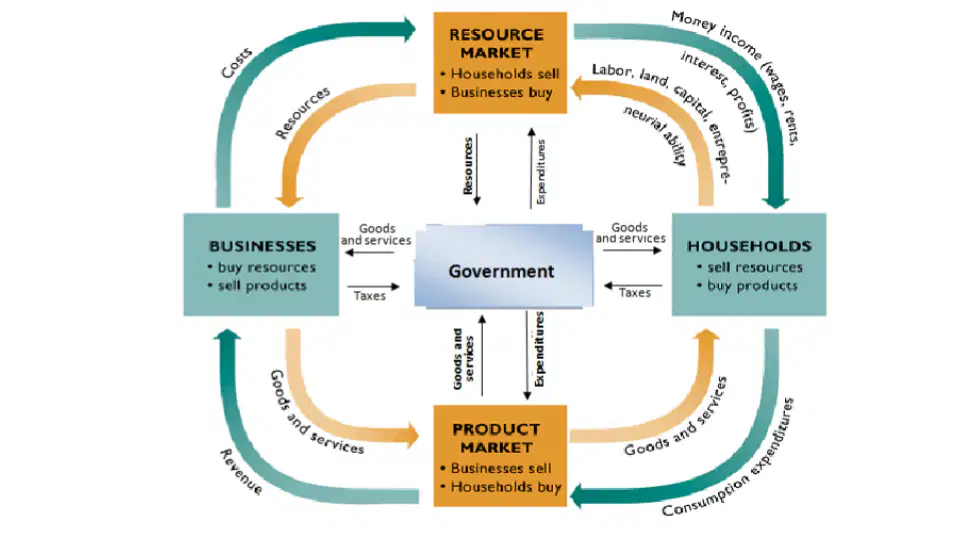
Which box do you go to make a purchase?
a)
Product Market
b)
Resource Market
c)
Households
d)
Businesses
e)
Government
29.
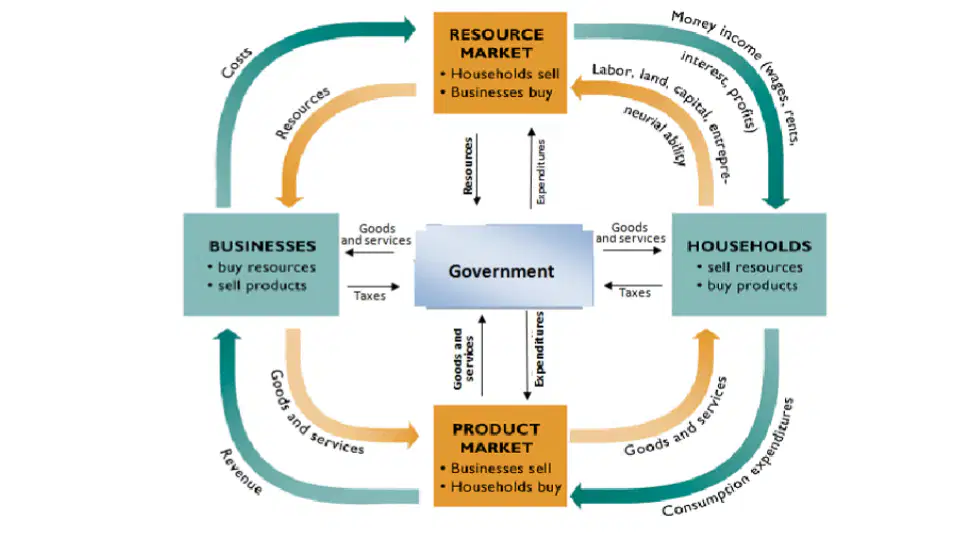
Which box collects taxes and provides public goods/services to an economy?
a)
Product Market
b)
Resource Market
c)
Households
d)
Businesses
e)
Government
30.
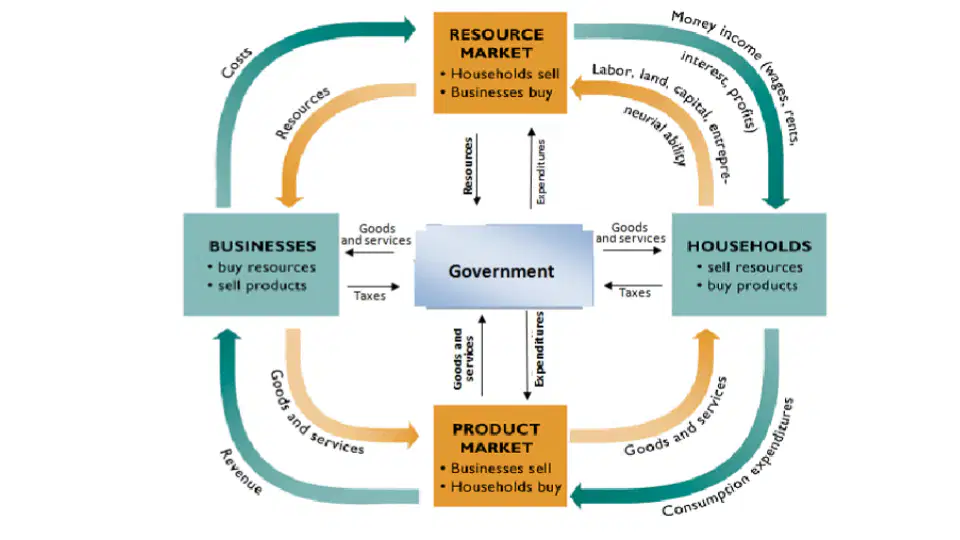
Which box do the four factors of production come from?
a)
Households
b)
Resource Market
c)
Product Market
d)
Businesses
e)
Government
31.
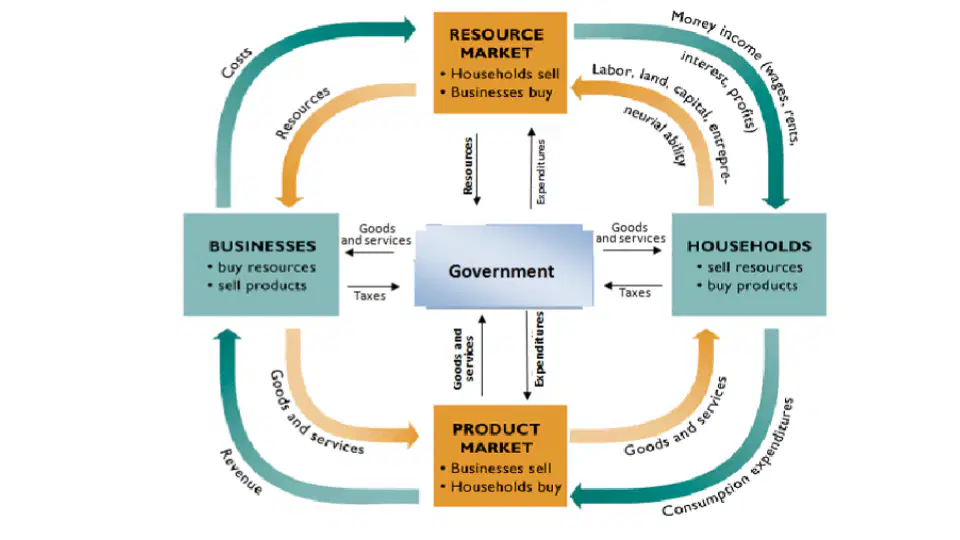
Which of the following brings money, wages, company perks, salaries, retirement benefits, and health insurance to the Resource Market?
a)
Households
b)
Resource Market
c)
Product Market
d)
Businesses
e)
Government
32.
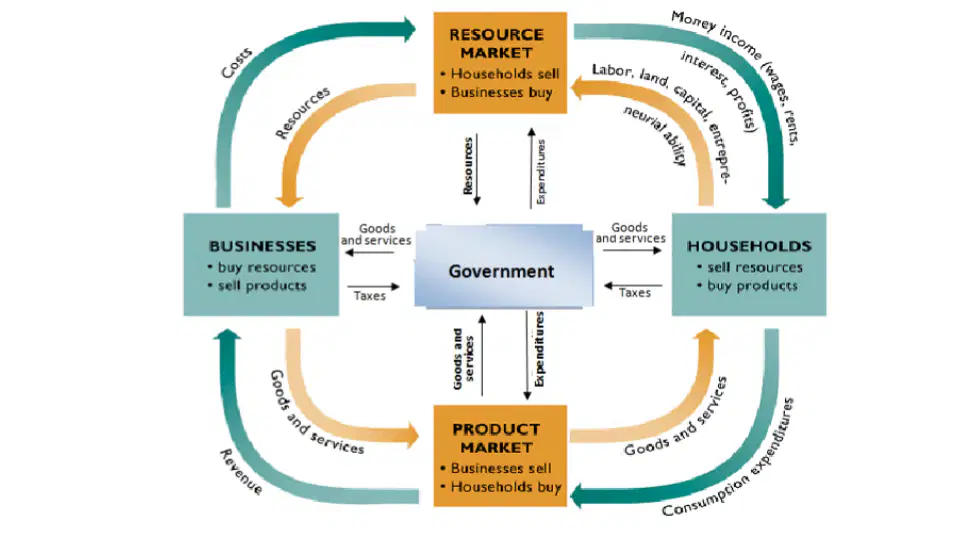
Which of the following allows the circular flow to keep flowing around smoothly and therefore the economy to continue going and growing? (hint: there is more than 1 checkbox!)
a)
Money
b)
Goods & Services
c)
Taxes
d)
Land
e)
Government
33.
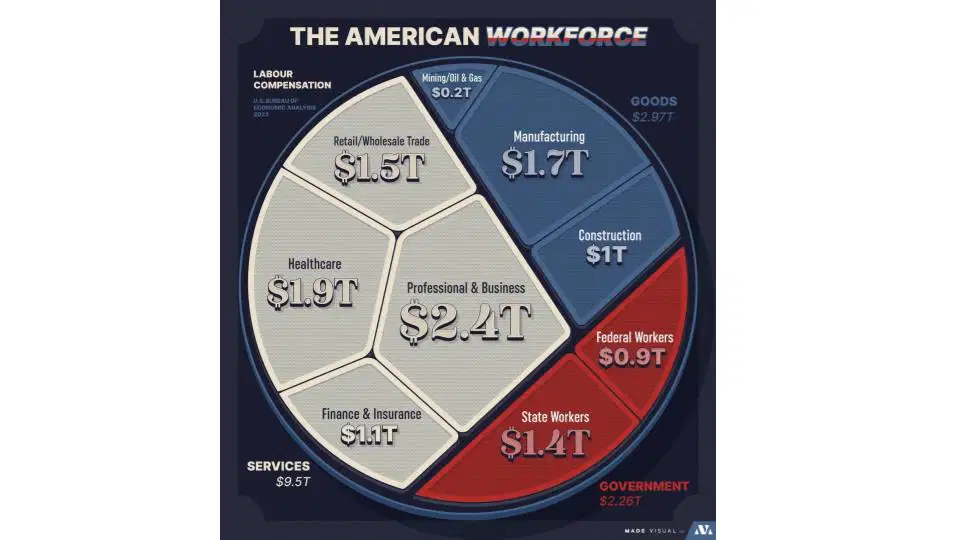
Based on the distribution of labor compensation in the American workforce, what does the graphic suggest about the structure of the U.S. economy?
a)
The U.S. economy relies more heavily on producing goods than providing services.
b)
Government jobs provide more compensation than any private sector.
c)
The service sector plays a dominant role in the U.S. economy compared to goods-producing industries.
d)
Retail and manufacturing are the largest contributors to labor compensation in the U.S. economy.
34.
Scenario 1: In the country of Zandovia , the government makes all the major economic decisions. They set prices for goods and services, determine what gets produced, and allocate resources to specific industries. The government also controls most of the property and owns all major factories.
a)
Command Economy
b)
Mixed Economy
c)
Traditional Economy
d)
Market Economy
35.
Scenario 2: In the town of Vironya , economic decisions are based on customs and traditions. Families work the same jobs that their ancestors did, with skills passed down through generations. Bartering is common, and the community decides what is produced and how it is shared, based on long-held practices.
a)
Command Economy
b)
Mixed Economy
c)
Traditional Economy
d)
Market Economy
36.
Scenario 3: In the nation of Marvona , businesses and consumers drive the economy. People are free to start businesses and compete with one another. Supply and demand determine what is produced, how much it costs, and what wages are paid. The government’s involvement in the economy is minimal.
a)
Command Economy
b)
Mixed Economy
c)
Traditional Economy
d)
Market Economy
37.
Scenario 4: In the country of Kryptara , businesses operate in a mostly free market, but the government steps in to regulate key industries like healthcare and transportation. Taxes are used to provide public services, and laws are in place to ensure consumer safety and fair competition.
a)
Command Economy
b)
Mixed Economy
c)
Traditional Economy
d)
Market Economy
100 %

