
 Worksheets
Chapter 23: Brain Disorders - Seizures
Total questions: 80
Worksheet time: 40mins
What is epilepsy?
A chronic disturbance of the nervous system characterized by persistent seizures due to abnormal electrical activity of the brain
A temporary loss of memory
A type of headache
A muscle disorder
Focal seizures affect only one part of the brain and usually come with a warning sign or aura.
True
False
Generalized seizures involve both sides of the brain and usually do not have a warning sign or aura.
True
False
Absence seizure causes you to _______ or stare into space for a few seconds. Common in children.
blank out
jump up
fall asleep
run around
Which type of seizure is described as brief sharp like jerks of muscles or a group of muscles?
Absence seizure
Myoclonic seizure
Clonic seizure
Tonic seizure
Clonic seizures consist of a rhythmic jerking movement of the arms and legs.
True
False
Tonic refers to a seizure in which there is sudden tension or stiffness that can affect your arms, legs, or entire body.
True
False
Atonic seizure is without a tone, muscles suddenly become _______.
limp
stiff
swollen
rigid
Status epilepticus is a medical emergency because irreversible brain damage can occur if the seizure is not controlled.
True
False
Name two possible causes of seizures mentioned in the text.
Brain or cerebral tumor, Hyperpyrexia (extremely high temperature), stroke, metabolic toxicity (electrolyte imbalance)
Dehydration, mild headache, seasonal allergies, low blood pressure
Sprained ankle, muscle cramps, paper cut, mild cough
Nasal congestion, toothache, mild fever, sunburn
What is the postictal state?
The postictal state is a period that begins when a seizure subsides and ends when the patient returns to baseline. It can last between 5-30 minutes and includes symptoms such as lethargy, confusion, headache, speech impairment, muscle soreness, and changes in vital signs.
The postictal state is a period of increased alertness and energy immediately following a seizure, typically lasting several hours.
The postictal state is the time before a seizure begins, characterized by aura and warning signs.
The postictal state refers to a permanent neurological deficit that develops after repeated seizures.
Which of the following is NOT a treatment for seizures?
Antiepileptic drugs
Drinking alcohol
Keto diet
Biofeedback and surgery
Patients with seizures should be advised not to operate heavy machinery and some are not permitted to drive.
True
False
Fill in the blank: TIA stands for _________.
Transient Ischemic Attack
Total Internal Artery
Temporary Ischemic Arrest
Transitional Intracranial Aneurysm
What is the purpose of an implanted vagus nerve stimulator in epilepsy treatment?
It is helpful for generalized epilepsy for many patients with uncontrolled seizures.
It is used to monitor blood pressure in epilepsy patients.
It is primarily for treating migraine headaches.
It is used to deliver insulin to diabetic patients.
Which of the following is a symptom that may be observed during the postictal state?
Headache
Increased energy
Euphoria
None of the above
What does CVA stand for?
Cerebrovascular Accident
Cardiovascular Accident
Cerebral Vascular Aneurysm
Carotid Vascular Assessment
Which diagnostic tests are used for TIA?
Carotid duplex ultrasound
Blood tests, MRI, and EEG
Angioplasty procedure with stent implantation or carotid endarterectomy
All of the above
Fill in the blank: A CT scan is what will tell us if it was a ______ or a CVA.
TIA
seizure
tumor
infection
Which of the following is NOT a modifiable risk factor for stroke?
Age
Smoking
Sedentary lifestyle
Hypertension
Aspirin helps prevent platelet aggregation and is recommended for TIA.
True
False
Which of the following is a nonmodifiable risk factor for stroke?
A) Gender
B) Smoking
C) Hypertension
D) Obesity
Fill in the blank: Both hemorrhagic and ischemic strokes cause brain cells to die and lead to ______ impairments.
functional
visual
respiratory
digestive
Which of the following is a pathophysiology of stroke?
Cerebral thrombosis
Embolus
Intracerebral hemorrhage
All of the above
Cocaine and methamphetamine cause vasoconstriction and brain ischemia.
True
False
What is an aneurysm?
An abnormal ballooning of an artery wall.
A blockage in a vein.
A narrowing of a capillary.
A rupture of a heart valve.
What is an arteriovenous malformation (AVM)?
A congenital abnormality that is a tangled mass of malformed, thin-walled, dilated vessels that form abnormal communication between the arterial and venous systems.
A benign tumor composed of smooth muscle cells and fibrous tissue.
A blockage in the arterial system caused by a blood clot.
An infection of the arterial wall leading to aneurysm formation.
What is the goal time to get a patient with suspected heart ischemia to the cardiac catheterization lab?
60-90 minutes.
120-150 minutes.
30-45 minutes.
180-210 minutes.
For ischemic stroke, what is the door-to-needle goal for IV tPA?
Within 60 minutes of arrival.
Within 30 minutes of arrival.
Within 90 minutes of arrival.
Within 120 minutes of arrival.
Which of the following is NOT a warning sign of a stroke?
A) Facial drooping
B) Arm weakness
C) Speech difficulty
D) Stomach pain
What does the acronym FAST stand for in recognizing stroke symptoms?
F- facial drooping, A- arm weakness, S- speech difficulty, T- it's TIME to call 911.
F- finger numbness, A- ankle pain, S- stomach ache, T- take a rest.
F- foot swelling, A- abdominal pain, S- sneezing, T- try to relax.
F- fever, A- anxiety, S- sweating, T- take medicine.
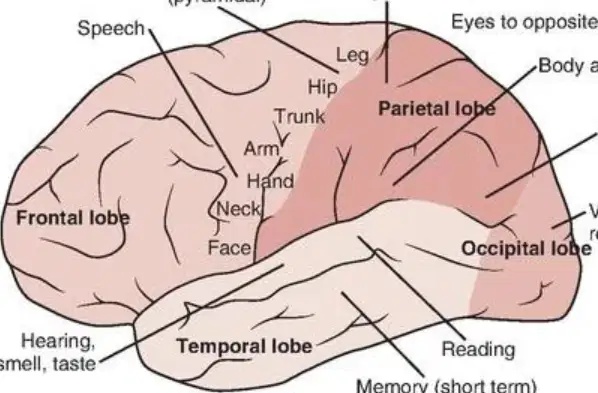
Refer to the diagram of the brain. Which lobe is responsible for memory (short term)?
Frontal lobe
Parietal lobe
Occipital lobe
Temporal lobe
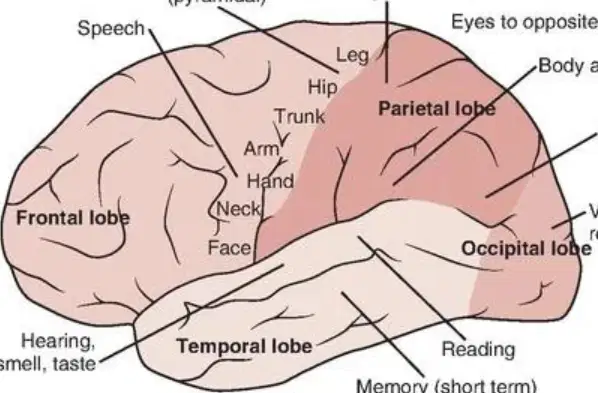
Refer to the diagram of the brain. The parietal lobe is associated with which of the following functions?
A) Hearing, smell, taste
B) Body awareness
C) Visual reception
D) Speech
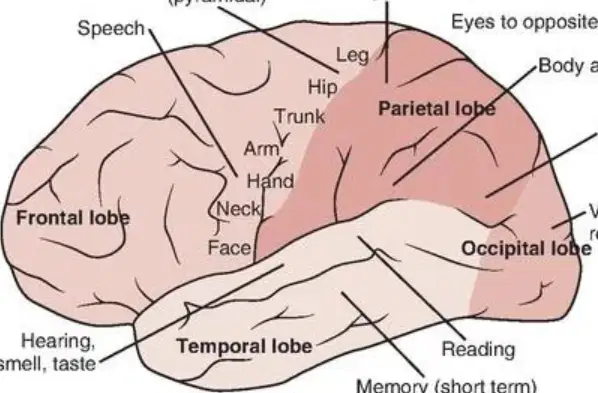
Fill in the blank: The occipital lobe is primarily responsible for _________
visual reception
hearing
touch sensation
language processing
Which of the following is NOT listed as a diagnostic test for stroke?
MRI or cerebral angiogram
EEG
Blood pressure measurement
Lumbar puncture
Thrombolytic therapy should be started within 60 minutes of arrival IF INDICATED.
True
False
Fill in the blank: tPA (Tissue Plasminogen Activator) is a ________ drug used for stroke patients.
thrombolytic
antibiotic
antihypertensive
anticoagulant
What is the goal during an ischemic stroke?
To block blood flow to the brain
To restore blood flow before permanent brain damage occurs
To increase blood pressure
To reduce muscle function
Fill in the blank: Complications of stroke include extension of hemorrhage or rebleed, seizures, and _________.
hydrocephalus
hypertension
diabetes
asthma
Which of the following is NOT a management step in Phase I of stroke management?
Maintain an adequate airway
Establish baseline data regarding vital signs
Discharge and referrals
Preserve joint and muscle function
The purpose of establishing baseline data regarding vital signs, level of consciousness, neuromuscular function, and neurologic status in Phase I of stroke management is to:
Monitor for changes and detect early signs of deterioration
Administer medications more efficiently
Reduce the need for further diagnostic tests
Ensure immediate discharge planning
Plans for rehabilitation should begin at what point in Phase II of stroke management?
After discharge
When the patient is admitted
After complications arise
After Phase I is complete
Patients who have had strokes can be prone to rapid mood swings and spontaneous weeping.
True
False
Which of the following is a step in Phase III of stroke management?
Preventing complications that may interfere with rehabilitation
Visiting nurse
Establishing baseline data
Collaborating with the health care team
Fill in the blank: All health care workers must be _______ and accepting when dealing with stroke patients who experience rapid mood swings and spontaneous weeping.
patient
careless
impatient
indifferent
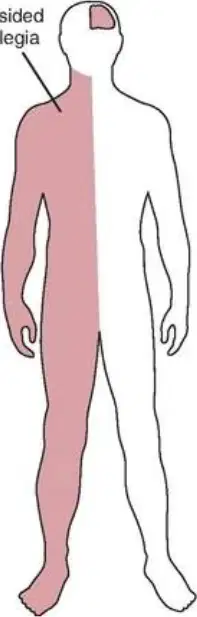
Refer to the diagram. Which of the following is a symptom of left-sided brain damage?
Quick and impulsive behavior
Speech problems, aphasia
Short attention span
Neglects left side

Right-sided brain damage typically results in:
Right-sided hemiplegia
Slow and cautious behavior
Left-sided hemiplegia
Difficulty in following verbal commands
Brain tumors may begin in the brain itself, or they may begin in the ________, cranial nerves, or pituitary gland.
meninges
ventricles
cerebellum
thalamus
Which of the following is NOT a possible treatment for brain tumors?
Surgery
Radiation therapy
Chemotherapy
Antibiotics
Routine neurologic assessments, including activities of daily living, pain assessment and control, are part of ________ for brain tumors.
Nursing Management
Medical Diagnosis
Surgical Procedure
Pharmacologic Therapy
Complications of brain tumors include:
Hydrocephalus
Intercerebral hemorrhage
Both A and B
None of the above
Bacterial meningitis is the inflammation of the membranes covering the brain and spinal cord and is caused by ________.
an infectious agent
a genetic mutation
excessive exercise
vitamin deficiency
Which immunization can prevent meningitis, especially in college kids?
Influenza
Meningitis
Hepatitis B
Varicella
What is a classic sign of meningitis that is aggravated by moving the head and is tested by having the patient put their chin to their chest?
Brudzinski sign
Babinski sign
Trousseau sign
Chvostek sign
Fill in the blank: A patient with meningitis may show photophobia, which means ________.
light sensitivity (lights hurting their eyes)
difficulty swallowing
loss of smell
hearing voices
Which of the following is NOT a symptom of meningitis?
Severe headache
Nuchal rigidity
Petechial rash
High blood sugar
How is meningitis diagnosed?
Blood pressure measurement
Lumbar puncture to collect cerebrospinal fluid (CSF)
X-ray
Urine test
Early recognition and prompt treatment of meningitis can prevent permanent disability.
True
False
Which medication is given along with antibiotics to decrease inflammation in meningitis patients?
Ibuprofen
Dexamethasone
Paracetamol
Aspirin
Viral meningitis is milder than bacterial meningitis.
True
False
Fill in the blank: The most common viruses causing viral meningitis are ________, arboviruses, HIV, and herpes simplex virus.
enteroviruses
adenoviruses
retroviruses
rhinoviruses
Which of the following is NOT a sign or symptom of viral meningitis?
A) Headache
B) Fever
C) Photophobia
D) High blood pressure
What is encephalitis?
An acute inflammation of the brain that is serious and sometimes fatal
A mild headache
A chronic skin condition
A digestive disorder
Which of the following are classic symptoms of encephalitis?
Stiff neck, photophobia, and lethargy
Nausea and vomiting
Rash and itching
Joint pain
Fill in the blank: Encephalitis is an acute inflammation of the ______ that is serious and sometimes fatal.
brain
liver
lungs
kidneys
What is the recommended treatment for encephalitis?
Antibiotics
Symptomatic with general supportive measures
Surgery
Chemotherapy
The most common types of viral encephalitis in the United States are caused by herpes simplex virus 1, West Nile virus, and the enteroviruses.
True
False
What is a brain abscess?
A) A continuous pain in the head
B) Puss filled pocket of infected material in the brain
C) A type of viral infection
D) A skin rash
Fill in the blank: Headaches are defined as ______ pain in the head.
continuous
intermittent
sharp
dull
Which foods can trigger a migraine headache?
Citrus fruits, chocolate, alcohol (especially red wine), Msg
Bread and rice
Milk and cheese
Apples and bananas
Cluster headaches usually cause intense pain in or around ______ on one side of the head.
one eye
the jaw
the neck
the ear
What are the common causes of tension headaches?
Stress and muscle tensions
Viral infection
Dehydration
Allergies
Do tension headaches typically cause nausea, vomiting, or light sensitivity?
Yes
No
Fill in the blank: The medication used for migraines is _________.
Propranolol (Inderal)
Amoxicillin
Metformin
Lisinopril
What is Trigeminal Neuralgia (Tic Douloureux)?
A common headache
A rare facial pain syndrome related to pressure on the nerve root
A type of muscle spasm
A viral infection
Fill in the blank: The pain in trigeminal neuralgia is usually localized on ________ side of the face.
one
both
upper
lower
Which of the following is NOT a trigger for trigeminal neuralgia attacks?
A) Exposure to drafts
B) Light touch or vibration
C) Drinking cold or very hot liquids
D) Sleeping
Bell’s Palsy is associated with which of the following?
Edema and ischemia of facial nerve
Herpes simplex virus
Stress
Exposure to cold and pregnancy
All of the above
Fill in the blank: The main symptom of Bell’s Palsy is ________ of the facial muscles.
numbness and partial or total paralysis
swelling and redness
itching and burning
loss of taste sensation
What is the treatment for Bell’s Palsy?
Patch over the eye and artificial tears
Corticosteroids
Acyclovir
All of the above

