
Font size
 Worksheets
Learning objectives
Total questions: 58
Worksheet time: 29mins
The principle of insurable interest states that:
The insured must have a financial stake in the subject matter of insurance.
Insurance can be taken out on anything, regardless of ownership.
Insurable interest is not required for a valid insurance contract.
Only insurance companies need to have an insurable interest.
The principle of indemnity in insurance means that the insured is restored to their financial position prior to the loss. How do insurance companies uphold this principle?
By paying the insured more than the actual loss
By providing profits to the insured after a loss
By ignoring the actual value of the loss
By compensating the insured only for the actual amount of loss suffered
The principle of utmost good faith in insurance contracts requires parties to disclose which type of facts?
Only facts that benefit the insurer
Only personal opinions about the contract
All material facts that could affect the contract
Irrelevant details not related to the contract
The principle of subrogation allows an insurer to assume the legal rights of the insured after compensation. How does subrogation arise?
When the insurer compensates the insured for a loss and acquires their legal rights against third parties
When the insured pays the premium to the insurer
When the insurer refuses to pay a claim
When the insured cancels the insurance policy
The principle of contribution is defined as the value added by a particular component to the overall property. How is the amount of contribution determined?
By using the replacement cost of the property
By estimating the cost of the component alone
By comparing the property's value with and without the component
By calculating the depreciation of the component
The principle of proximate cause is defined as:
The direct, dominant cause of a loss in insurance claims.
The first event in a chain of events leading to a loss.
A minor contributing factor to an insurance claim.
A cause that is unrelated to the loss in question.
Fill in the blank: The principle of insurance that requires the insured to have a financial stake in the subject matter of the insurance is called _________
Utmost Good Faith
Insurable Interest
Indemnity
Subrogation
Fill in the blank: The principle of insurance that requires both parties to act honestly and disclose all relevant information is called _________.
Insurable Interest
Indemnity
Subrogation
Utmost Good Faith
Fill in the blank: The principle of insurance that determines the actual cause of loss when multiple causes are involved is called _________.
Indemnity
Contribution
Proximate Cause
Subrogation
Fill in the blank: The principle of insurance that ensures the insured is compensated only to the extent of the loss suffered is called _________.
Indemnity
Subrogation
Contribution
Utmost Good Faith
Fill in the blank: The principle of insurance that allows the insurer to take over the rights of the insured after compensation is paid is called _________.
Indemnity
Subrogation
Contribution
Utmost Good Faith
Fill in the blank: The principle of insurance that states if multiple policies cover the same risk, each insurer will contribute to the compensation is called _________.
Contribution
Subrogation
Indemnity
Proximate Cause
What is the definition of insurable interest?
The ability to insure anything you want.
The right to insure without any financial interest.
The right to insure arising out of legally recognized financial interest which a person has in the subject matter of insurance.
The right to insure only your own property.
Fill in the blank: A legally recognized financial interest is a financial interest that is recognized under the ________ or statute.
federal reserve
banking act
tax code
common law
A person whose financial interest in the subject matter of insurance is not recognized by the law does not have insurable interest.
True
False
Which of the following is NOT an example of insurable interest? Choose the correct answer.
A) A thief insuring stolen goods
B) Creditor and debtor
C) Husband and wife
D) Parent and children
Fill in the blank: The Vehicle Ownership Certificate (VOC) is an example of ________ interest in property.
beneficial
insurable
legal
nominal
Fill in the blank: Subject matter of insurance is the ______, limb, property, rights or any potential legal liability insured under a policy.
contract
life
premium
agent
Fill in the blank: Subject matter of contract is the insured’s ______ interest subject matters of insurance.
financial
personal
legal
physical
Which of the following best describes the difference between subject matter of insurance and subject matter of contract?
Subject matter of insurance is the financial interest, while subject matter of contract is the property insured.
Subject matter of insurance is the life, limb, property, rights or liability insured, while subject matter of contract is the insured’s financial interest in those matters.
Both terms mean the same thing.
Subject matter of contract is always higher in value than subject matter of insurance.
Is it allowed for someone to buy an insurance policy for their brother-in-law?
True
False
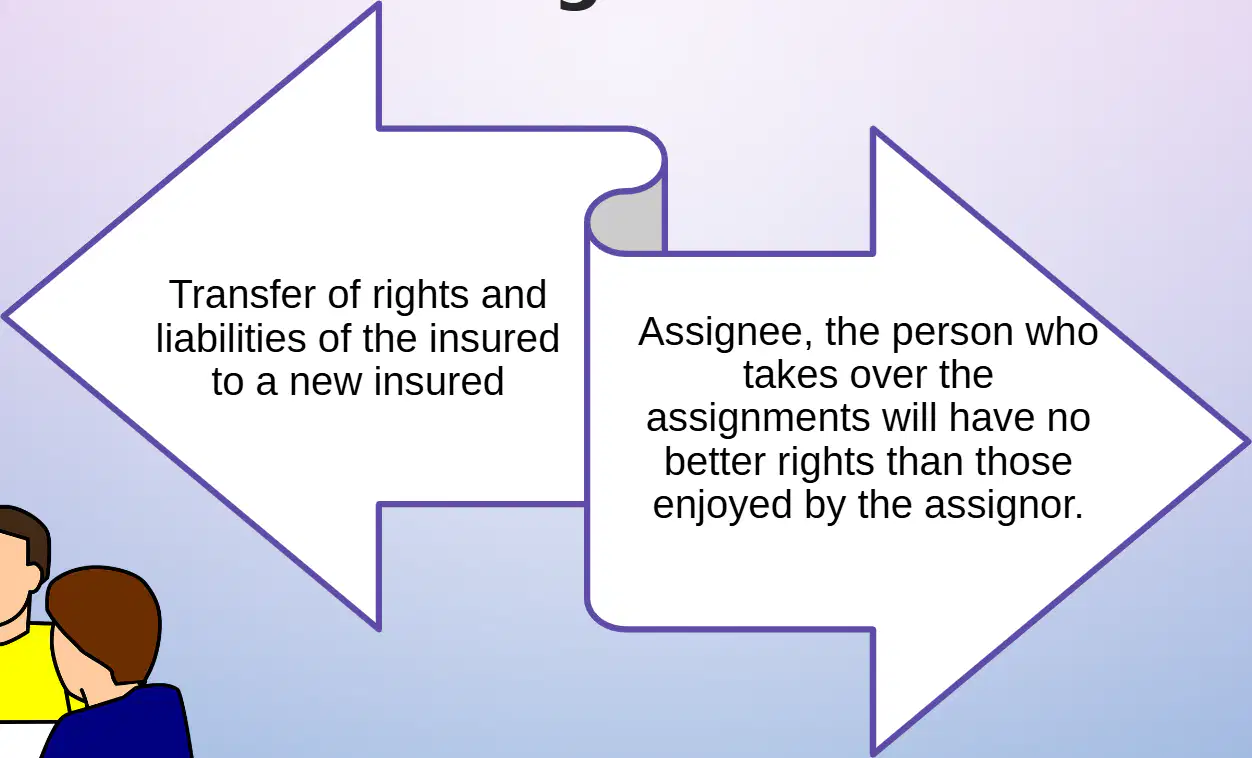
Fill in the blank: Assignment is the transfer of rights and liabilities of the insured to a new _______.
policy
agent
beneficiary
insured
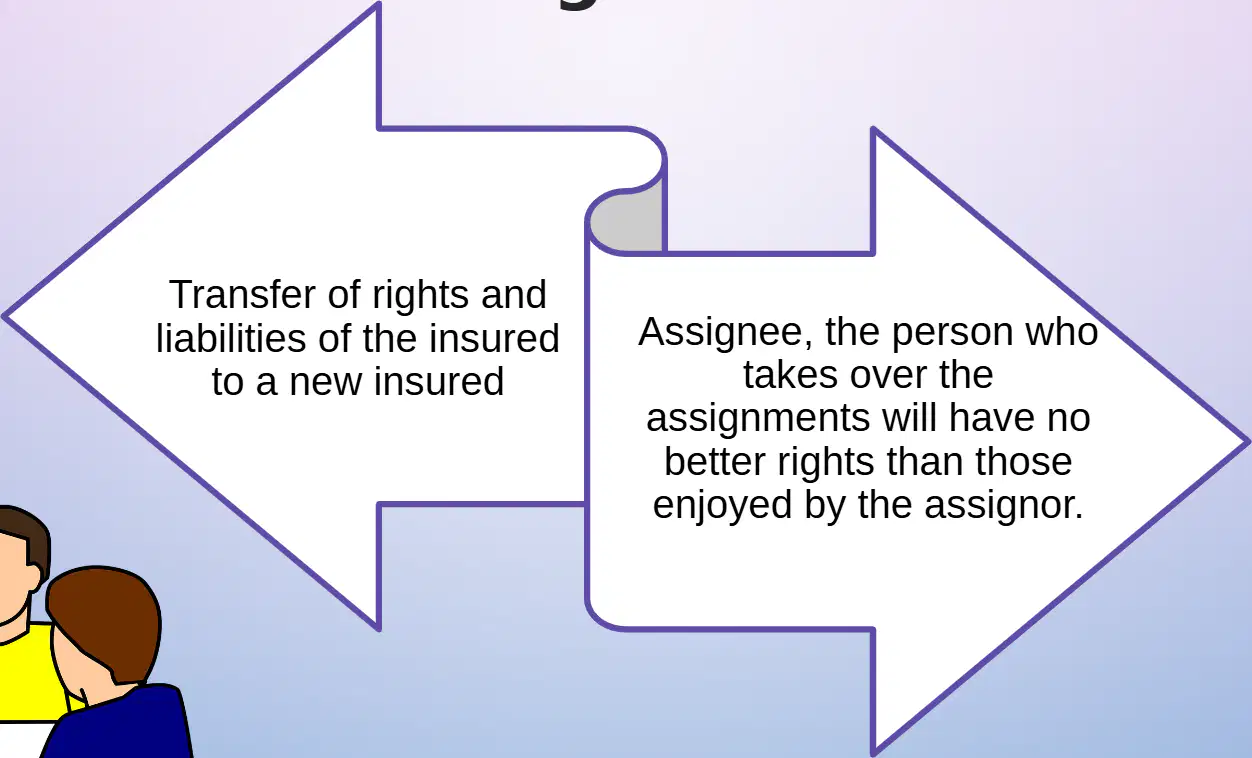
Fill in the blank: The assignee, the person who takes over the assignments, will have no better rights than those enjoyed by the _______.
assignor
creditor
debtor
guarantor
General rule: Prior consent is required ______ an assignment of a policy can be affected.
unless
before
after
during
According to the example, can the vendor of a house assign his fire policy to the purchaser without the insurer's consent?
Yes
No
Before the assignment of the insurance policy takes place, who is the assignor?
Insured
New insured
Insurance Company
Policy Document

What happens to the ownership of the policy after assignment according to the diagram?
The policy remains with you
The policy is transferred to the third person
The policy is cancelled
The policy is shared between you and the third person

Fill in the blank: After assignment, the policy becomes ______ policy according to the diagram.
his
us
their
our
Who is the assignee in the process of assignment?
You
New insured
Insurance Company
Policy Document
What is the duty of utmost good faith in insurance contracts?
To disclose fully and accurately all material facts
To hide material facts
To disclose only some facts
To disclose facts only when asked

What does 'Uberrimae Fidei' mean in the context of insurance contracts?
Only partial disclosure is needed
No disclosure is required
Disclosure is optional
Full disclosure is crucial
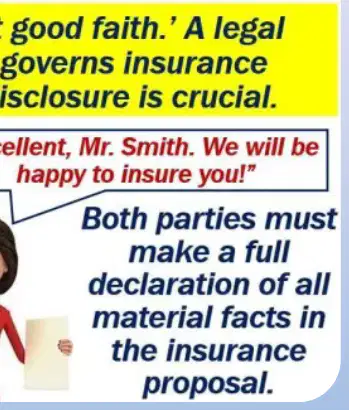
Fill in the blank: Both parties must make a full declaration of all ________ facts in the insurance proposal.
hidden
secondary
material
irrelevant
What is a material fact? Fill in the blank: A material fact is defined as a fact which would influence the _______ _______ in accepting the risk or fixing the premium.
claims adjuster
prudent underwriter
insurance agent
policyholder
Fill in the blank: The duty to disclose material facts lasts until the _______ of the insurance contract.
completion
renewal
termination
approval
The proposer is required to notify the changes to the insurer, otherwise the contract would be voidable.
True
False
Fill in the blank: The duty of disclosure will terminate upon the _______ of the contract.
inception
renewal
modification
assignment

Utmost good faith is breached if the duty of ______ is not observed.
confidentiality
obedience
disclosure
loyalty
Which of the following are breach of utmost good faith? Please select more than 2.
Fails to provide the insurer with information relating to the material fact
Provides all information accurately
Misrepresents a material fact
Both A and C
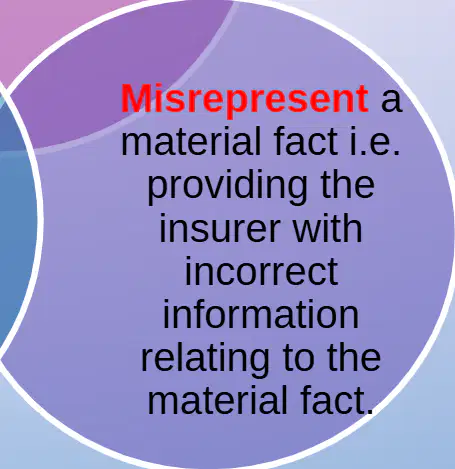
Misrepresenting a material fact to the insurer is considered a breach of utmost good faith.
True
False
Fill in the blank: Proximate cause means the ________ that sets in motion a train/chain of events which brings about a result, without the intervention of any force started and working from a new and independent source.
active, efficient cause
passive, indirect cause
remote, secondary cause
immediate, unrelated cause
Which of the following best describes a 'proximate cause'?
The remote cause in a sequence of events
The dominant cause that overshadows other causes
Any minor contributing factor
The least important cause
The causes that are not dominant and are overshadowed by the main cause are called ________ causes.
remote
immediate
direct
primary
Look at the sequence of images: a car accident, an ambulance, a gravestone, and a person with a heart attack. Based on the concept of proximate and remote causes, which event is most likely to be considered the proximate cause of the loss?
Car accident
Ambulance arrival
Death (gravestone)
Heart attack
What is the principle of indemnity in insurance? Fill in the blank: Insured shall be ______ to the same financial position after the loss as he has enjoyed immediately before it.
RESTORED
REMOVED
REDUCED
REJECTED
What is the object of the principle of indemnity in insurance?
To make the insured better off after the loss
To ensure the insured is neither better nor worse off before the loss
To allow the insured to make a profit
To prevent insurance claims
The effect of the principle of indemnity is to prevent the insured from making a profit out of loss.
True
False
When is indemnity applied to insurance contracts?
Only to benefit contracts
Only to indemnity contracts
To all insurance contracts
To no insurance contracts
Fill in the blank: There are two types of insurance contracts: ________ and benefit contracts.
contract of indemnity
contract of guarantee
contract of agency
contract of sale
Which type of insurance contract is described as 'an insurance contract where the subject matter of insurance can be quantified in economic terms'?
contract of life insurance
contract of indemnity
contract of guarantee
contract of annuity
Which type of insurance contract is life insurance an example of?
Contract of indemnity
Benefit contract
Which method of providing indemnity involves monetary payment made directly to the insured claimant based on market value, cost of repair, or depreciation as resulted from the damage?
Cash
Repair
Replacement
Reinstatement
Which method of providing indemnity involves the insurer assuming responsibility for repair to make good the damage, with payment for repair work made directly to the repairer?
Cash
Repair
Replacement
Reinstatement
Which method of providing indemnity involves substitution of lost, destroyed, or damaged item with a similar one, with the cost of replacement paid by the insurer?
Cash
Repair
Replacement
Reinstatement
Which method of providing indemnity involves reconstruction of destroyed or damaged buildings at the original or alternative site, with the insurer responsible for increase in the cost of reconstruction?
Cash
Repair
Replacement
Reinstatement
X has a burglary policy covering stock in his or her business premises. He or she insured his or her stock valued at RM 140,000 for a sum insured of RM 120,000. A theft involving violent and forcible entry took place at his or her premises. The thieves took away RM 80,000 worth of stock, X filed a claim against his or her insurer. How much will he or she recover from his or her policy? Amount recoverable = ________
RM 68,571.43 (calculated as RM 120,000 / RM 140,000 x RM 80,000)
RM 80,000 (full value of stolen stock)
RM 120,000 (sum insured)
RM 60,000 (partial value of stolen stock)
A fire occurred in a sundry shop, damaging part of the building and some stock. The owner has effected a standard fire policy with sum insured on building for the amount of RM 120,000 and of stock RM 80,000. After investigation, the claim was found to be valid and the amount of losses were assessed to be RM 12,000 for the building and RM 7,800 for the stock. At the time of loss, the values of the building and the stock were found to be RM 150,000 and RM 120,000 respectively. Calculate the amount payable separately for the building and the stock. Fill in the blanks:
Amount payable for the building: RM 8,000 Amount payable for the stock: RM 6,400
Amount payable for the building: RM 10,000 Amount payable for the stock: RM 7,000
Amount payable for the building: RM 9,600 Amount payable for the stock: RM 5,200
Amount payable for the building: RM 12,000 Amount payable for the stock: RM 7,800
MR. BEN PURCHASED A COMPREHENSIVE MOTOR POLICY FROM AN AUTHORIZED INSURANCE AGENT IN HIS TOWN. THE SUM INSURED WAS RM 60,000. THE MARKET VALUE OF THE CAR WAS RM 75,000. HE WAS ISSUED WITH THE COVER NOTE. TWO MONTHS LATER, HIS CAR INVOLVED IN AN ACCIDENT. THE DAMAGE TO THE CAR WAS ESTIMATED AT RM 20,000. HE SUBMITTED A CLAIM FOR THIS AMOUNT. CALCULATE THE CLAIM PAYABLE TO MR. BEN. (MARCH 2014) What is the claim payable to Mr. Ben?
RM 20,000
RM 12,000
RM 18,000
RM 16,000
Fill in the blank: The principle of insurance that requires both parties to act honestly and disclose all relevant information is called _________.
Insurable Interest
Indemnity
Subrogation
Utmost Good Faith

