
NEW
Font size
 Worksheets
Special Transactions Quiz
Total questions: 25
Worksheet time: 13mins
Which of the following best describes a partnership?
A business owned and operated by a single individual.
A business structure involving two or more individuals sharing profits, losses, and responsibilities.
A corporation with shareholders and a board of directors.
A non-profit organization managed by volunteers.
What is the legal basis for requiring a partnership with a capital of P3,000 or more to be recorded in the SEC?
Securities and Exchange Commission Act.
Civil Code, Articles 1771-1772.
Partnership Act of 2020.
Business Registration Act.
What is one disadvantage of a partnership compared to a corporation?
Greater source of capital
Better management
Unlimited liability
Fewer constraints on actions
Why might a partnership be less effective than a corporation in raising large amounts of capital?
Partnerships have limited capital
Partnerships have better management
Partnerships have fewer constraints on actions
Partnerships are subject to less government regulations
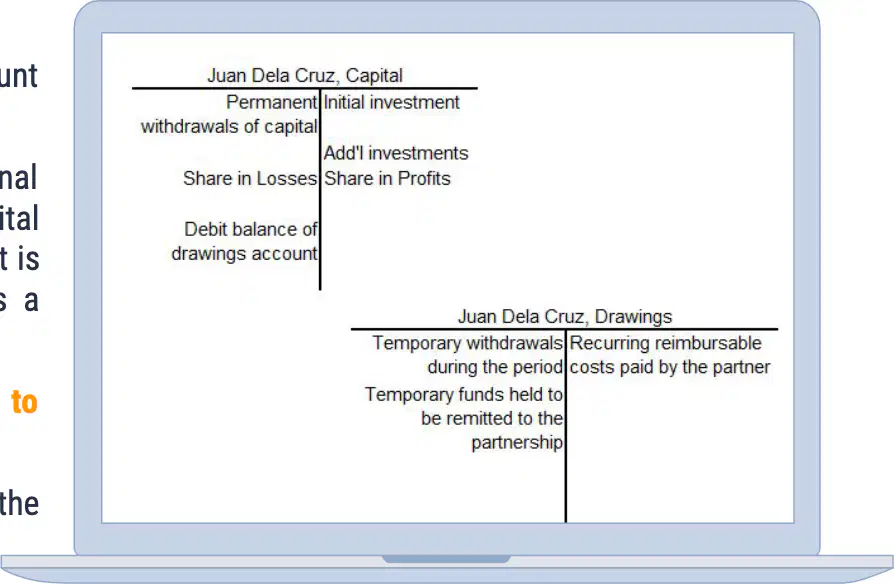
What does "Receivable from a Partner" represent in a partnership's ledger accounts?
Loan obtained by the partnership from a partner
Loan extended by the partnership to a partner
Permanent withdrawals of capital
Share in profits

According to Article 1797 of the Civil Code, if the share of each partner in the profits has been agreed upon, how should the share of each in the losses be distributed?
In proportion to their capital contribution
In the same proportion as the profits
Equally among all partners
Based on the industrial partner's contribution
If an industrial partner contributes capital in addition to their services, what share do they receive in the profits under Article 1797 of the Civil Code?
A share in proportion to their capital contribution
No share in the profits
A share equal to the other partners' profits
A share based on the losses incurred
What happens to salaries paid to partners in the absence of any agreement when the partnership incurs losses?
Salaries are not paid
Salaries are paid as an expense
Salaries are paid even when operations yield losses
Salaries are converted into bonuses
When profits and losses are distributed based on capital contributions, which of the following is NOT a method of determining the capital contribution?
Original
Beginning of the year
End of the year
Total revenue
What happens to a business after a partner is disassociated, according to the definition of dissolution?
The business is immediately terminated.
The business continues until the remaining partners decide to liquidate it.
The business is sold to a third party.
The business is automatically incorporated.
What is the journal entry for the purchase of a withdrawing partner's interest by the remaining partners in a partnership?
Outgoing partner's capital (Dr.), Payment made (Cr.)
Outgoing partner's capital (Dr.), Purchasing partner's capital (Cr.)
Outgoing partner's capital (Cr.), Purchasing partner's capital (Dr.)
Outgoing partner's capital (Cr.), Payment made (Dr.)

What is recorded in the books of the corporation during the incorporation of a partnership?
The receipt of transferred assets and liabilities along with the issuance of share capital to the incorporators.
Only the liabilities of the partnership.
The equity interests of the partners.
The total value of shares issued.
In what order is the available cash of a partnership used to settle claims?
Inside creditors, outside creditors, owners' capital balances.
Outside creditors, inside creditors, owners' capital balances.
Owners' capital balances, inside creditors, outside creditors.
Partnership creditors, separate creditors, owners' capital balances.
Which of the following is an example of an inside creditor in a partnership?
A bank that provided a loan to the partnership.
A supplier who delivered goods to the partnership.
A partner who lent money to the partnership.
A customer who paid in advance for services.
What is the purpose of the lump-sum payment in the liquidation process?
To pay off liabilities and distribute the remaining amount to partners.
To invest in new assets for the partnership.
To pay only the creditors of the partnership.
To avoid selling non-cash assets.
In partnership liquidation, outside creditors are given priority over inside creditors.
False
True
In case of a partner’s capital deficiency, solvent partners must absorb the deficiency in accordance with their profit and loss ratio.
True
False
Corporate liquidation requires assets to be measured at historical cost.
True
False
Insolvency means that a company’s total liabilities exceed the fair valuation of its total assets.
True
False
n a joint operation, parties have rights to the assets and obligations for the liabilities of the arrangement.
True
False
n a joint venture, parties have rights to the net assets of the arrangement.
True
False
Under PFRS 15, revenue is recognized when the performance obligation is satisfied.
True
False
Revenue is recognized only when cash is received from the customer.
True
False
partnership has unlimited liability, which means creditors can go after partners’ personal assets after exhausting partnership assets.
True
False
Partnership interest can be freely transferred without the consent of other partners.
True
False

