
 Worksheets
World Religions – 100-Item Multiple Choice Quiz
Total questions: 117
Worksheet time: 1hrs 2mins
Shintoism originated in which country?
China
Japan
The word 'Shinto' means 'the way of the __.'
A. Gods
B. Buddha
What is the sacred scripture of Shintoism?
Kojiki
Tripitaka
Who are the divine spirits worshipped in Shinto?
Kami
Bodhisattvas
The Torii gate symbolizes the entrance to a __.
Shrine
Temple
The Shinto sun goddess is named __.
A. Amaterasu
B. Guanyin
Purification in Shinto is done through __.
Misogi
Meditation
The Three Sacred Treasures include the mirror, sword, and __.
Jewel
Crown
The main place of worship in Shintoism is called a (a) .
Shintoism emphasizes harmony with __.
Nature
Society
Confucianism originated in __.
China
Japan
The founder of Confucianism is __.
Confucius
Lao Tzu
The sacred text of Confucianism is the __.
Analects
Vedas
Respect for parents and elders is called __.
Filial piety
Meditation
Confucius emphasized moral order in the __.
Family
Government
Daoism was founded by __.
Lao Tzu
Confucius
The main text of Daoism is the __.
Tao Te Ching
Kojiki
The 'Dao' means __.
The Way
The Law
The Yin-Yang symbol represents __.
Daoism teaches harmony with __.
Nature
Wealth
Theravada Buddhism is known as the __.
Lesser Vehicle
Greater Vehicle
Theravada focuses on __.
Individual enlightenment
Group rituals
The followers of Theravada seek to become __.
Arhats
Bodhisattvas
The main scripture of Theravada is the __.
Pali Canon
Vedas
Theravada Buddhism is dominant in __.
Thailand
Japan
The historical Buddha is known as __.
Siddhartha Gautama
Lao Tzu
The Four Noble Truths teach about __.
Suffering
Creation
The Eightfold Path leads to __.
Nirvana
Heaven
The Middle Way teaches (a) .
The Buddhist monastic community is called __.
Sangha
Kami
Mahayana means __.
Greater Vehicle
Lesser Vehicle
Mahayana emphasizes __.
Compassion
Isolation
33. A Bodhisattva seeks enlightenment for __.
All beings
Self only
Mahayana Buddhism is common in __.
China and Japan
Sri Lanka
The Buddha of Infinite Light is __.
Amitabha
Shiva
The main scripture of Mahayana is the __.
Lotus Sutra
Tripitaka
All beings have __ according to Mahayana.
Buddha-nature
Sinful nature
Zen Buddhism is a branch of __.
Mahayana
Theravada
Mahayana promotes (a) as a virtue.
The ultimate goal of Mahayana is __.
Enlightenment for all
Wealth
Hinduism originated in __.
India
China
The oldest sacred texts of Hinduism are the __.
Vedas
Sutras
The concept of duty and righteousness is called __.
Dharma
Nirvana
The law of cause and effect is known as __.
Karma
Li
The cycle of birth and rebirth is called __.
Samsara
Moksha
Liberation from rebirth is called __.
Moksha
Karma
The ultimate reality or world soul is called __.
B. Vishnu
A. Brahman
The preserver god is __.
Vishnu
Shiva
The destroyer god is (a) .
The creator god is __.
Brahma
Vishnu
The sacred river of Hinduism is the __.
Ganges
Nile
The sacred language of Hinduism is __.
Sanskrit
Pali
The holy text that teaches duty is the __.
Bhagavad Gita
Tao Te Ching
Hinduism teaches respect for all forms of __.
Life
Wealth
Shinto means
The way of the Gods
The Chronicles of Japan
Harmony with Nature
None of the above
Makoto means
Purity
Harmony with nature
Festivals
Sincerity
This Sacred Book of Shinto means “The Records of the Ancient Matters”
Kojiki
Shimenawa
Nihon Shoki
Both A and B
A place for worship for Shintoism, and this is where Matsuris or festivals often take place where priests perform rituals on the shrine grounds
Matsuri
Jinjas
Shinto Shrines
Both B and C
Is a spring festival marked on February 3, the beginning of spring. It is also known as Setsubun and involves a bean-throwing festival.
Rissun
Seijin Shiki
Aki Matsuri
Matsuri
What are the Core Value of Shinto
Purity, Makoto (Sincerity), Harmony with nature, Matsuri, Focus on here, now
Shide, Purity, Sincerity, Festivals, Focus on here now.
Purity, Tori, Shimenawa, Harmony with nature
Makoto, Simenawa, Shide, Purity
Are traditionally used to demarcate holy area limits and are supposed to fend off bad spirits.
Tori
Shimenawa
Shide
None of the above
These are the Sacred Symbols except:
Shimenawa
Tori
Makoto
Shide
This Sacred Book of Shinto means “The Chronicles of Japan”
Kojiki
Nihon Kojiki
Shoki
Nihon Shoki
Is a Japan's native belief system and predates historical records
BUDDHISM
JUDAISM
TAOISM
SHINTOISM
A gate that separates the profane from the sacred
Torii
Jinja
Kami
Kojiki
Japanese indigenous religion; means way of spirits
Mantra
Animism
Buddhism
Shinto
All living beings have the potential to be enlightened; no one is too bad or lowly; Use mantras in repetition
Buddhism
Confucianism
Score
Animism
Little is known about life before Shinto; however, we believe the people indigenous to Japan have always had a deep appreciation and belief in what?
animism
nature
substance
religion
What is this well known volcano in Japan named?
Torii Gate
Taipei
Mt. Hiei
Mt. Fuji
This is a path covered with what in Japan.
Lateen Sails
Samurai
5 Classics
Torii Gate
Invisible spirit/power; can be forces of nature, elements of landscape, spirits of deceased; not considered God/gods
Torii
Kami
Shinto
Kojiki
What is the term for all religions around the world that are native to a land and often based on nature?
buddhism
materialism
animism
shinto
To live together in harmony through tolerance
nature
compare
coexist
nothing
Sacred word, chant, or sound that is repeated over and over to advance one's spiritual growth
mandala
chakra
mantra
mudra
appreciate a person's interest in them, they want you to be happy, if treated properly they will intervene to bring benefits in health, exams, and business success
kojiki
kami
torii
shinto
According to Confucius, rulers should govern by
_____________.
the law
Military might
a monopoly on natural resources
setting a good example
The woman is taking a civil service exam in China. How does that relate to Confucianism?
if she passes her family is honored as a "Confucius" household.
Confucius loved tests. She is honoring him.
Confucius was an honorable test-taker. He failed them all
Knowledge of the Confucian classic has traditionally been the basis of the state civil service exam in China.
Confucius' main goal was to have________ in society.
fun
order
happiness
work
In China on Tomb-sweeping Day, families visit the graves of the deceased relative. why did Confucius say people should honor and respect their elders?
So that their elders will fund their children's education
Because children should sweep away all memory of their ancestors so they may rest in peace
Because elders do not need to show the younger members of the family any respect or lead by example
Because filial piety respect of children for their parents was critical to he social order

Confucius' ideas were put into to book called_______.
The Quran
the Bible
The Analects
The Buddha
Confucius said people in ____________must set a good example.
Jail
Love
Authority
Trouble
Where did Confucianism originate?
India
Arabia
China
Japan
Who was Kongfuzi?
Confucius
A teacher whose teaching influenced the lives of people
Neither answer is correct
Both answers are correct
According to the mandate of Heaven, what happened if a ruler governed poorly?
If a ruler governed poorly, heaven withdrew its support and the ruler lost power
Nothing, there is nothing anyone can do.
The ruler must undergo a rigorous training-course to get better
The ruler must meditate and as the heaven for answers.
Confucius was born in China during the Zhou dynasty. At the time of his birth, how did many Chinese views their emperor?
They revered him. They thought he should stay emperor until his death
They disliked him but did not see the justification to get rid of him.
They loved him and thought he was doing a wonderful job.
They thought he has lost the Mandate of Heaven because of all the turmoil and civil war.
How is a harmonious society created according to Confucianism?
Through individuals following the social rules appropriate to their station in life
By making certain that foreign elements are not allowed in.
Though democratic processes that allow each individual to vote for those who will rule them.
By praying to Confucius for mercy.
Confucianism is a way of life taught by Confucius. What country is the origin of Confucius?
What is the known symbol of Confucianism?

Star of David

Image of Confucius

Yin and Yang symbol

Statue of Buddha
The Confucianism teaching that give family the highest regard.
Filial Piety
Benevolence
Worship to ancestors
Gentleman
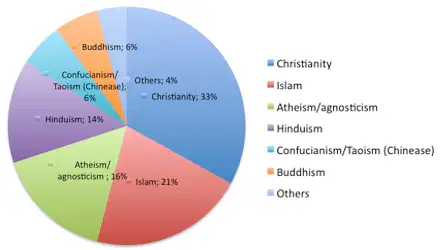
Based from the figure, Confucianism ranks ___ in terms of with highest number of followers from the given major religions of the world.
First
Second
Third
Last
How many basic relationships must be observed in the society, according to Confucianism?
10
5
4
3
The sacred book or text which is said to be the compilation of Confucius teachings.
Torah
Bible
Analects
Tao Te Ching
This is the ultimate goal of Confucianism followers.
To become like Confucius
To be a good leader
To achieve peace
To become a "perfected person" or "junzi"
Reciprocity of this statement: "What you do not want done to your self, (a) do to others"
The concept in Kankana-ey culture similar with Confucius teaching that means helping one another.
Binadang
Inayan
Onjon
All of the above
What virtue do you most of the time apply in your everyday life?
love
righteousness
wisdom
propriety
(always behave)
loyalty

Confucianism and Daoism emerged during the ______________ Period in ancient China.
Peace and Harmony
Important Art
Warring States
Mao Zedong

Who is considered to be the founder of Daoism?
Confucius
Lao Tzu
Sun Tzu
Mao Zedong

Daoists believe the government should _________________________ in peoples' lives.
bring harmony
make changes
be important
not interfere

There is a big emphasis on _______________ in Daoist beliefs.
balance
zen
meditation
yoga
Confucius and Laozi introduced belief systems to restore order after which dynasty began to fall?
Qin
Han
Shang
Zhou
"The universe is a balance of opposites" is a belief of which system?
Confucianism
Daoism
Legalism

Confucianism is named after its founder, Confucius.
True
False

Confucius was...
a poor child and a good student
a rich child and a good student
a poor child and a bad student
a rich child and a bad student

Confucius had several minor government jobs before he became a...
king
nobleman
teacher
artisan

Confucius was distressed by people's lack of...
decency
knowledge in math
morals
vocabulary

Confucius felt that "the answer" to China's problems was...
more crops for food supply
monotheism
polytheism
better moral leadership in families and in the government

Confucius believed people should behave well because it is the will of...
the emperor
the people
Heaven
Nirvana

Dao means...
"the way", or guiding force of all reality
enlightened one
Heaven
happiness

The symbol of Daoism is the...
apple of wisdom
cross
yin yang
olive tree

The yin yang symbol represents a way of understanding...
Heaven
government
religion
opposites

Daoists believed that people and governments...
needed to create a surplus of money
needed to take nature as their example
needed to do whatever makes them happy
needed to acquire (get) as much wealth as they could

Daoists belived a wise ruler should govern in harmony with...
the people
knowledge
peace
nature

