wayground logo

Free Printable Worksheets

Font size

S
M
L
XL
Worksheets

Unit 3: Cells Review

Total questions: 56

Worksheet time: 3hrs 1mins

Name
Class
Date
1.
Which cell structure is correctly paired with its primary function? 
a)
ribosome-protein synthesis
b)
mitochondrion-movement
c)
vacuole-cell division
d)
nucelus-storage of nutrients
2.
What is the job of the mitochondria?
a)
Makes Energy
b)
Uses Sunlight in Plants
c)
Creates Protein
d)
Protects the cell
3.
Where in the cell are proteins made? 
a)
Ribosome
b)
Cell Membrane
c)
Chloroplast
d)
Nucleus
4.
Why is the nucleus important? 
a)
It give the cell its energy
b)
It stores genetic information
c)
It uses sunlight for food
d)
It makes the proteins
5.
What does the cell membrane do for cells? 
a)
Allows things in and out
b)
Protection & structure for plant cells
c)
Controls the cell
d)
Holds DNA 
6.
Why are organelles important? 
a)
Each have a specific function
b)
Each give the cell energy
c)
Each protect the cell
d)
Each uses the sunlight
7.
This forms a boundary between the inside of the cell and the outside of the cell. 
a)
Cell Membrane
b)
Lipid Cleric Layer
c)
Membrane Gate
d)
Protein Receptors 
8.
A ______________ is composed of a phosphate and glycerol head and 2 fatty acid chain tails. 
a)
phospholipid 
b)
Carbohydrate
c)
Cholesterol 
d)
Protein 
9.
"Water Loving"
a)
Hydrophobic
b)
Hydrophilic 
c)
Hydroelectric 
d)
Hydroloric
10.
"Water Fearing" 
a)
Hydrophobic
b)
Hydrophilic 
c)
Hydroelectric 
d)
Hydroloric
11.
The majority of the cell membrane is made of which macromolecule?
a)
Lipids
b)
Carbs
c)
Proteins
d)
Nucleic acids
12.
How many layers thick is the lipid bilayer?
a)
1
b)
2
c)
3
d)
4
13.
Hydrophobic region of the cell membrane?
a)
E
b)
B
c)
C
d)
14.
Hydrophilic portion of cell membrane?
a)
A
b)
C
c)
D
d)
15.
Which of the following states that the cell membrane isn't rigid (it is moveable)?
a)
Phospholipid Bilayer
b)
Fluid Mosaic Model
c)
Selectively Permeable Membrane
16.
Cell membrane allows some things to pass freely and others to not
a)
Phospholipid Bilayer
b)
Selectively Permeable Membrane
c)
Fluid Mosaic Model
17.
___________ strengthens and stabilizes the cell membrane.
a)
Carbohydrates 
b)
Proteins 
c)
Phospholipids 
d)
Cholesterol
18.

A mode of transport that does not require energy

a)

Passive Transport

b)

Facilitated Diffusion

c)

Selectively Permeable

d)

Slightly Permeable

19.

The type of transport that requires the use of transport proteins

a)

Passive Transport

b)

Facilitated Diffusion

c)

Active Transport

d)

Vesicular Transport

20.

The passage of a substance from an area of high concentration to an area of low concentration

a)

Active Transport

b)

Diffusion

c)

Vesicular Transport

d)

Exocytosis

21.

Transport proteins for water are called:

a)

Glu-T

b)

Sodium-Potassium Pump

c)

Aquaporins

d)

Cohesive Channels

22.

Transport that occurs directly across the cell membrane

a)

Vesicular Transport

b)

Active Transport

c)

Facilitated Diffusion

d)

Passive Transport

23.

The energy molecule that powers some modes of transport

a)

ADP

b)

ATP

c)

AGP

d)

ABP

24.

A water box divided with a membrane has 60 mg of salt placed on the right. What will happen?

a)

Water will move to the left.

b)

Salt will move to the right.

c)

Water will move to the right.

d)

Salt will move to the left.

25.
Another term for equilibrium is...
a)
Equality
b)
Babycakes
c)
Homeostasis
d)
Balance
26.
Osmosis is the ______
a)
when the smell of the neighbors trash moves through the neighborhood
b)
smell of cookies moving through the kitchen
c)
movement of water across a semi-permeable membrane
d)
movement of gases across a room
27.
What is this image?
a)
a nucleus
b)
proteins
c)
cell membrane
d)
lipids
28.
The picture is an example of _________________.
a)
osmosis
b)
isotonic
c)
diffusion
d)
active transport
29.
Which way would the purple molecules move through the semi-permeable membrane?
a)
From the  A side  to the B-side
b)
From the B side to the A side
c)
none of the purple molecules would move
30.
Which type of Passive Transport is being represented in this picture?
a)
Passive Diffusion
b)
Simple Diffusion
c)
Active Diffusion
d)
Facilitated Diffusion
31.
What is the difference between active and passive transport?
a)
Active does not need energy and passive uses ATP (energy)
b)
Active uses ATP (energy) and passive does not need energy
c)
Active stores transport proteins and passive releases 
d)
Active uses hormones and passive does not 
32.
What forms the channels and pumps in the phospholipid bilayer?
a)
carbohydrates
b)
proteins
c)
hydrophilic heads 
d)
lipids
33.
Which is true about active transport?
a)
It does not require energy
b)
It requires energy
c)
It moves substances down the concentration gradient
d)
it moves material from high to low concentration
34.
Which of the following is not an example of active transport?
a)
sodium potassium pump
b)
endocytosis
c)
exocytosis
d)
facilitated diffusion
35.
A cell in a hypotonic solution will
a)
swell
b)
shrink 
c)
stay the same size
d)
impossible to tell
36.
A cell in a hypertonic solution will
a)
Swell
b)
Stay the same size
c)
Shrink
d)
Impossible to tell
37.
A cell in an isotonic solution will
a)
swell
b)
shrink
c)
stay the same size
d)
impossible to tell
38.
This cell  is in a _____________ solution.
a)
Hypertonic
b)
Hypotonic
c)
Isotonic
39.
This cell is in a _________ solution.
a)
Hypotonic
b)
Hypertonic
c)
Isotonic
40.
Question Image

What are the nitrogen base pairs from DNA nucleotides to RNA nucleotides?

a)

DNA: A

1.

RNA: U

b)

DNA: T

2.

RNA: A

c)

DNA: G

3.

RNA: C

d)

DNA: C

4.

RNA: G

41.

Transcription, part of the central dogma, is the process by which genetic information encoded in DNA is transferred to a(n) _.

a)

amino acid sequence

b)

DNA molecule

c)

RNA molecule

d)

phospholipid molecule

42.

_ carries genetic information from the nucleus out into the cytoplasm

of the cell.

a)

DNA

b)

DNA nucleotide

c)

RNA

d)

amino acid sequence

43.

What would represent the strand of DNA template from which the mRNA strand

CUC AAG UGC UUC was made?

(a)  

44.

What are the parts of translation?

45.

The enzyme involved in transcription phases initiation, elongation, and termination is _.

(a)  
46.
Genetic info flows in one direction. Which best represents this flow?
a)
DNA-protein-RNA
b)
Protein-RNA-DNA
c)
RNA-protein-DNA
d)
DNA-RNA-protein
47.
In RNA, Uracil pairs with ______. 
a)
cytosine
b)
adenine
c)
guanine
d)
thymine
48.

Why must transcription occur where DNA can be found?

a)

because DNA can't leave

b)

because ribosomes are in the nucleus

c)

because DNA polymerase is found there

d)

because helicase unzips the DNA

49.
What is the location in the cell for transcription?
a)
nucleus
b)
cytoplasm
c)
ribosome
d)
mitochondria
50.
What is the location in the cell for translation?
a)
nucleus
b)
mitochondria
c)
ribosome
d)
chloroplast
51.
The mRNA leaves the ________ to find the ribosome to make proteins.
a)
cell
b)
nucleotide
c)
nucleus
52.
What is the three base sequence of mRNA that codes for a single amino acid?
a)
Anticodon
b)
Codon
c)
Protein
53.
How many amino acids are coded for by this sequence of nucleotides:
ATG GGA ACT CCA
a)
4
b)
2
c)
6
d)
12
54.
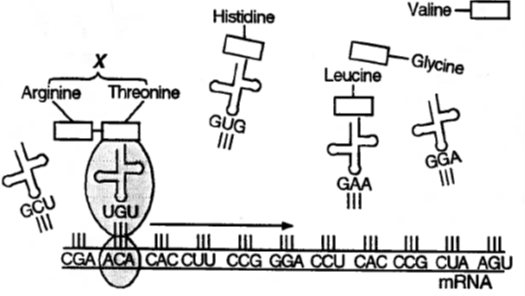
What process is going on in this photo? 
a)
Transcription 
b)
Translation 
c)
Replication 
d)
All the above 
55.
Which statement is describing the process of protein synthesis?
a)
DNA is copied into mRNA which is translated into protein
b)
DNA is copied into DNA
c)
DNA is copied into lysosome
56.
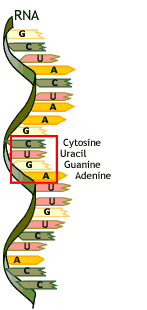
Contains the bases adenine, uracil, cytosine and guanine
a)
DNA
b)
RNA
c)
Both