
 Worksheets
Energy Flow and Biogeochemical Cycles in Ecosystems
Total questions: 99
Worksheet time: 50mins
Energy in the ecosystem flows from the sun to plants, then to animals, and finally to other organisms. Which of the following best describes this flow of energy?
Energy flows from the sun to plants, then to animals, and finally to other organisms.
Energy flows from animals to plants, then to the sun, and finally to other organisms.
Energy flows from other organisms to animals, then to plants, and finally to the sun.
Energy flows from the sun directly to animals, then to plants, and finally to other organisms.
The important stages and processes in the cycling of essential nutrients between organisms and the environment include which of the following? Also, what is the role of decomposers in the food web?
Nutrient uptake, assimilation, decomposition, and recycling; decomposers break down dead matter and return nutrients to the environment.
Only photosynthesis and respiration; decomposers produce energy for plants.
Evaporation and condensation; decomposers create new nutrients from sunlight.
Transpiration and precipitation; decomposers store nutrients in living organisms.
What is a food chain?
A food chain is the process of repeated eating and being eaten, where energy flows from one organism to another.
A food chain is a group of animals living together in one place.
A food chain is a type of plant that grows in water.
A food chain is a method of cooking food using fire.
Which of the following best describes a food web?
A single chain of organisms eating and being eaten
A set of interconnected food chains by which energy and materials circulate within an ecosystem
Only the transfer of energy from plants to herbivores
The process of photosynthesis
Fill in the blank: Green plants, the primary producers of food in most terrestrial food webs, belong to the ______ trophic level.
first
second
third
fourth
Carnivores, which feed on herbivores, belong to the second trophic level.
True
False
According to the passage, what happens to the energy that is not used for respiration or growth in organisms?
Some is stored in the form of fat for future utilization and some is not used at all.
All of it is immediately converted to heat and lost.
It is entirely excreted as waste products.
It is used only for movement and not for any other function.
What are biogeochemical cycles?
The flow of energy in an ecosystem
The cycling of nutrients through living and non-living components of the ecosystem
The process of photosynthesis
The transfer of heat in the atmosphere
Fill in the blank: The reservoir for the gaseous type of biogeochemical cycle is in the ________ or hydrosphere.
atmosphere
lithosphere
biosphere
cryosphere
Which of the following cycles are considered gaseous types of biogeochemical cycles?
Carbon, oxygen, and nitrogen cycles
Phosphorus cycle
Water cycle only
Sulfur cycle only
The sedimentary type of biogeochemical cycle is represented by which cycle?
Nitrogen cycle
Carbon cycle
Phosphorus cycle
Oxygen cycle
Fill in the blank: The great bulk of the material in the sedimentary type of biogeochemical cycle is in the ________ crust.
earth's
oceanic
mantle
atmospheric
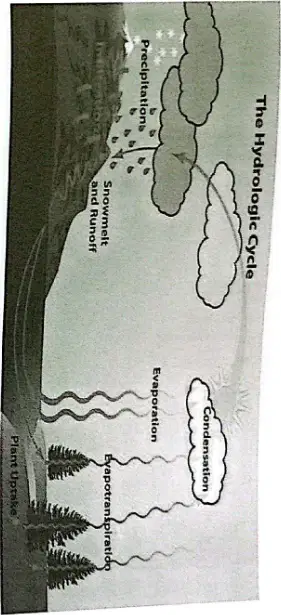
What is the water cycle?
The water cycle involves a series of changes that involves the conversion of water from one phase to another, such as evaporation, condensation, and precipitation.
The water cycle is the process by which plants make their own food using sunlight.
The water cycle is the movement of air masses across the globe.
The water cycle is the process of rocks breaking down into smaller pieces over time.
Which process in the water cycle involves water vapor cooling and forming clouds?
Condensation
Evaporation
Precipitation
Infiltration
According to the passage, what role do forests play in the water cycle?
Forests prevent erosion, distribute precipitation gradually, and help maintain an even flow of water in rivers and streams.
Forests increase the rate of evaporation, causing frequent droughts.
Forests block rainfall from reaching the ground, reducing groundwater levels.
Forests absorb all water, preventing any flow into rivers and streams.
The water cycle only involves the evaporation and precipitation of water.
True
False
What environmental problems can result from the reduction of forests, according to the passage?
Reduction of forests can lead to decreased water resources, increased erosion, and a decline in the quality of water.
Reduction of forests can increase the population of aquatic animals.
Reduction of forests can cause a rise in urban development and industrialization.
Reduction of forests can result in more frequent volcanic eruptions.
What is the main role of plants in the carbon-oxygen cycle?
They release carbon dioxide into the atmosphere
They assimilate carbon dioxide and convert it to glucose
They burn fossil fuels
They store carbon dioxide in the soil
Based on the passage, what is one major cause of increased carbon dioxide in the atmosphere?
Plant respiration
Burning of fossil fuels
Ocean evaporation
Nitrogen fixation
Fill in the blank: The rapid injection of carbon dioxide into the atmosphere from the burning of fossil fuels and clearing of forests can result in an increase in _________
global temperature
soil fertility
ocean salinity
mineral deposits
What process converts atmospheric nitrogen (N2) into a form usable by plants?
Nitrification
Denitrification
Nitrogen fixation
Decomposition
The carbon-oxygen cycle is related to the flow of energy in the ecosystem because:
it involves the exchange of gases during photosynthesis and respiration, which transfers energy between organisms.
it only affects the water cycle in the ecosystem.
it is responsible for the movement of minerals in the soil.
it prevents the flow of energy in the ecosystem.
According to the passage, why do organisms need nitrogen?
To make vital organic compounds such as amino acids, proteins, DNA, and RNA.
To provide energy for cellular respiration.
To help in the absorption of sunlight for photosynthesis.
To regulate body temperature in organisms.
Which process in the nitrogen cycle converts gaseous nitrogen into ammonia?
Nitrification
Denitrification
Nitrogen fixation
Ammonification
What is the role of nitrification in the nitrogen cycle?
Nitrification converts ammonia in soil to nitrite ions and then to nitrate ions, which are easily taken up by plants as a nutrient.
Nitrification converts nitrate ions directly into atmospheric nitrogen gas.
Nitrification breaks down organic matter into ammonia and methane.
Nitrification is the process by which plants fix atmospheric nitrogen into proteins.
Denitrification is the process where bacteria convert nitrates into nitrogen gas, releasing it back into the atmosphere.
True
False
How have humans drastically intervened in the nitrogen cycle, according to the passage?
By burning fossil fuels, which emits nitric oxide into the atmosphere, eventually producing nitric acid (HNO3), a component of acid rain.
By increasing the amount of oxygen in the atmosphere through photosynthesis.
By reducing the amount of carbon dioxide in the atmosphere through deforestation.
By introducing large amounts of phosphorus into aquatic systems.
Refer to the diagram of the phosphorus cycle. Which of the following is NOT a part of the phosphorus cycle shown in the diagram?
Fertilizer runoff
Nitrogen fixation
Marine animals
Sediments
What is the main reservoir of phosphorus in the ecosystem?
Rocks and natural phosphate deposits
Atmosphere
Living organisms
Oceans
Which of the following is NOT a function of microorganisms in the phosphorus cycle?
Accomplishing chemical reactions
Increasing productivity of the ecosystem
Reducing the need for oxidation-reduction reactions
Transferring phosphorus from producers to consumers
A limiting factor is a factor, which, by its relative scarcity or unfavorability may hinder the growth, range, distribution, size, number and survival of organisms in an area.
True
False
According to Liebig's Law of the Minimum, plant growth is limited by the ________ essential material available in the smallest amount.
most closely approaching the critical minimum needed
least important and most abundant
most recently discovered
most expensive to obtain
Who discovered the Law of the Minimum in 1840?
Justus von Liebig
Dmitri Mendeleev
Gregor Mendel
Louis Pasteur
According to Shelford's Law of Tolerance, organisms have an ecological minimum and maximum, with a range in between which represents the limits of tolerance.
True
False
What is the process by which water moves from the environment to living things and back to the environment?
Water moves from the environment to living things through absorption by roots and returns to the environment through transpiration as vapor.
Water moves from the environment to living things through photosynthesis and returns to the environment through respiration.
Water moves from the environment to living things through evaporation and returns to the environment through condensation.
Water moves from the environment to living things through osmosis and returns to the environment through precipitation.
Describe the importance of the water cycle to living things.
The water cycle is important to living things because it provides purified water necessary for survival and maintains the balance of water in the environment.
The water cycle is important because it increases the amount of salt in oceans.
The water cycle is important because it prevents plants from absorbing water.
The water cycle is important because it causes permanent droughts in some areas.
Describe how plants are important in maintaining water quality.
Plants are important in maintaining water quality because they absorb water and filter out impurities through their roots, and help prevent soil erosion.
Plants are important in maintaining water quality because they release more impurities into the water.
Plants are important in maintaining water quality because they increase soil erosion and water pollution.
Plants are important in maintaining water quality because they prevent water from being absorbed into the soil.
Why isn't water used up even though every living thing needs so much water?
Because water is continuously recycled through the water cycle.
Because new water is constantly created by plants.
Because water is only used by animals, not plants.
Because water is unlimited and never changes form.
When a rice field dries up, water goes to:
the air through evaporation
the soil only
the rice plants only
nowhere, it disappears
Oceans and lakes do not dry up like rice fields because:
they are constantly replenished by rainfall and rivers
they are smaller in size than rice fields
they are covered to prevent evaporation
they are not exposed to sunlight
Rain comes from:
clouds
the ground
trees
the sun
Water does not always follow the same path as shown in the water cycle you sketched. Use the 'Water Cycle Score Card' to record the path you followed in the game.
Water always follows the same path in the water cycle.
Water sometimes follows different paths in the water cycle.
Water never follows the same path in the water cycle.
Water follows a random path every time in the water cycle.
Which of the following best illustrates the paths of water in the activity using arrows in all the seven stations?
A diagram showing arrows indicating the movement of water through all seven stations.
A list of the names of the seven stations without arrows.
A written description of the water cycle without any diagrams.
A diagram with only three stations illustrated.
In the game, the stations that seemed to be visited by the most water molecules indicate what?
They are key points in the water cycle where water spends more time.
They are the least important parts of the water cycle.
They are rarely involved in the movement of water molecules.
They are not part of the water cycle.
Which of the following is a part of the water cycle that might not have been included in the game, and where could it be included in the cycle?
Infiltration, included after precipitation when water seeps into the ground
Evaporation, included before condensation
Condensation, included after precipitation
Transpiration, included after evaporation
Water moves through the cycle because of the Sun's energy. If the Sun's energy were blocked from Earth, the water cycle would stop. What makes water move through the cycle, and what would happen if the Sun's energy were blocked from Earth?
The Sun's energy makes water move through the cycle, and if it were blocked, the water cycle would stop.
Gravity makes water move through the cycle, and if the Sun's energy were blocked, the cycle would speed up.
Wind makes water move through the cycle, and if the Sun's energy were blocked, the cycle would continue as normal.
The Moon's energy makes water move through the cycle, and if the Sun's energy were blocked, the cycle would increase.
The water cycle is important to plants and animals because:
it provides water necessary for survival.
it increases soil erosion.
it reduces the amount of oxygen in the air.
it causes permanent droughts.
The water on the bare slope was:
quickly washed away by runoff.
absorbed into the soil.
evaporated instantly.
remained stagnant on the surface.
What happened to the water on the planted slope?
The water was absorbed by the plants on the slope.
The water evaporated instantly from the slope.
The water remained on the surface of the slope.
The water turned into ice on the slope.
Plants affect the movement of both water and sediments through the water cycle by:
absorbing water and stabilizing soil with their roots
increasing evaporation and causing soil erosion
blocking all water flow and preventing sediment movement
removing all water from the soil and leaving sediments behind
The two slopes affected the quality of the water by causing a change. What was the effect and how did the change occur?
The two slopes increased runoff, leading to poorer water quality due to more sediment entering the water.
The two slopes improved water quality by filtering out all pollutants.
The two slopes had no effect on the water quality at all.
The two slopes caused the water to become cleaner by adding minerals.
Forests are important for maintaining the balance of water in a watershed because they:
help regulate the flow and quality of water
increase soil erosion and runoff
reduce groundwater recharge
cause frequent flooding
You fall as rain onto a mountain. You go to _____
Mountain
Ocean
Desert
Forest
You fall as snow onto a mountain. You go to _____
Mountain
River
Desert
Forest
You fall as rain onto a stream. You go to _____
Stream
Mountain
Cloud
Desert
You fall as rain onto an ocean. You go to _____
Ocean
Mountain
Desert
Forest
You fall as snow onto an ocean. You go to _____
Ocean
Mountain
Desert
Forest
You fall as rain onto a parking lot. You go to _____
Stream
Cloud
Mountain
Tree
You evaporate into the air. You go to _____
Cloud
River
Mountain
Tree
You soak into the ground and become part of the groundwater. You go to _____
Groundwater
Clouds
River
Ocean
You soak into the ground and get absorbed by a plant's roots. You go to _____
Plant
Cloud
River
Mountain
You roll downhill and become part of a stream. You go to _____
Stream
Mountain
Cloud
Desert
You roll downhill and become part of the stream. You go to _____
Stream
Mountain
Cloud
Desert
You get frozen in ice and stay there. You stay at _____
Mountain
Desert
Forest
Beach
You are one of the countless water molecules in an ocean and you stay there. You stay at _____
Ocean
Cloud
River
Lake
You evaporate into the air. You go to _____
Cloud
River
Mountain
Tree
A kelp plant takes you in, releases you through its leaf, and transpires you into the air. You go to _____
Cloud
Ocean
Soil
Rock
Go to Plant, but not draw a card. Then go directly to _____
Cloud
River
Mountain
Desert
You evaporate into the air. You go to _____
Cloud
River
Mountain
Desert
An animal comes to the stream and licks you up. You go to _____
Animal
School
Market
Garden
You continue rolling downhill and become part of the ocean. You go to _____
Ocean
Lake
River
Pond
You become part of an underground stream that flows to an ocean. You go to _____
Ocean
Lake
Desert
Mountain
You become part of an underground stream that flows to a spring, where you become part of a stream. You go to _____
Stream
Lake
Ocean
Cloud
A plant takes you in through its roots. You go to _____
Plant
Animal
Rock
Cloud
You are pumped out of the ground from a well to irrigate a farm. You go to _____
Plant
River
Lake
Ocean
After using you to process food, the animal urinates and you end up on the ground. You go to _____
Mountain
River
Desert
Forest
You are exhaled from a human's lungs into the air as vapor. You go to _____
Cloud
Rock
Tree
River
A person uses you for brushing his/her teeth. You go to _____
Stream
Kitchen
Garden
Garage
The plant transpires you through its leaves into the air as vapor. You go to _____
Cloud
Soil
Root
Rock
The plant uses you to grow. You stay at _____
Plant
Sun
Water
Soil
The plant stores you in its edible fruit. You go to _____
Animal
Mineral
Water
Rock
The volume of pore space in the material varies for different types of soil material such as gravel and clay. Which statement is correct?
Gravel has more pore space than clay.
Clay has more pore space than gravel.
Both gravel and clay have the same pore space.
Neither gravel nor clay has pore space.
The kind of soil that would give the most runoff during a rainstorm is:
Clay soil
Sandy soil
Loamy soil
Peaty soil
Which type of soil material can store the greatest amount of ground water?
Clay
Sand
Silt
Gravel
What are the two main types of freshwater ecosystems discussed in the chapter?
Lotic and Lentic
Marine and Estuarine
Desert and Forest
Tundra and Taiga
Objective: Discuss horizontal and vertical zonation of life in lakes and ponds. Which of the following is NOT a factor affecting the distribution of organisms in freshwater ecosystems?
Amount of light
Water temperature
Soil type
Nutrients
Objective: Appreciate the great significance of the freshwater ecosystems in the balance of nature. True or False: Freshwater species are as widely distributed as marine species.
True
False
Fill in the blank: The most obvious and significant feature of lotic ecosystems is the continuous ________ that influences the life and activities of organisms inhabiting them.
moving water
sunlight
sediment deposition
plant growth
Which of the following is an example of an animal that survives strong currents in flowing waters?
Salmon
Leech
Snail
Clam
Fill in the blank: Streams with large areas exposed to direct sunlight are ________ than those shaded by trees, shrubs, and high steep banks.
warmer
colder
drier
slower
Which of the following statements is true about streams with high pH?
They support more abundant aquatic life and larger species populations.
They generally have low nutrient load.
They have less carbonates and bicarbonates.
They are always acidic.
What are the main sites of primary production in streams according to the passage?
Riffles
Pools
Banks
Floodplains
According to the passage, what is the primary reason stream ecosystems differ from lakes, ponds, and terrestrial ecosystems?
The source of energy input
The amount of rainfall
The type of vegetation
The altitude of the region
Which of the following statements is TRUE based on the passage?
Pools in streams are the main sites of primary production.
Riffles in streams are the main sites of primary production.
Pools in streams are not important for organic material.
Streams do not have pools or riffles.
What is the main function of pools in streams as described in the passage?
Pools are considered as the catch basins of organic materials and are major sites of carbon dioxide production.
Pools are the primary source of oxygen in streams.
Pools serve as habitats for only aquatic plants.
Pools are responsible for increasing the water temperature in streams.
Lakes are inland depressions containing standing water.
True
False
What are the two main ways energy is lost in stream ecosystems according to the passage?
Energy is lost through streamflow to downstream systems (geological) and through heat loss from respiration (biological).
Energy is lost through photosynthesis and sedimentation.
Energy is lost through evaporation and nutrient uptake.
Energy is lost through animal migration and plant growth.
According to the passage, what factors influence the amount of light that penetrates the water in lentic ecosystems?
Natural attenuation, silt and other material carried into the lake, and phytoplankton.
Temperature, wind speed, and fish population.
Water pH, dissolved oxygen, and aquatic plants.
Mineral content, salinity, and presence of amphibians.
What is thermal stratification in lakes?
Thermal stratification is the temperature layering or stratification in lakes, where warm water is less dense than cold and floats to the surface, while colder, denser water sinks to the bottom. This occurs most often during the period of summer stagnation.
Thermal stratification is the process by which lakes freeze from the bottom up during winter.
Thermal stratification refers to the mixing of all water layers in a lake, resulting in uniform temperature throughout.
Thermal stratification is the chemical separation of water in lakes due to pollution.

