
 Worksheets
TM212C - Midterm
Total questions: 87
Worksheet time: 2hrs 11mins
Which statement best defines the ASEAN Harmonized Tariff Nomenclature (AHTN)?
A bilateral free trade agreement among ASEAN members
An eight-digit commodity classification system based on the HS maintained by the WCO
A list of prohibited imports within ASEAN
A regional currency used to price cross-border trade
What was the primary purpose for conceptualizing the AHTN by the ten ASEAN Member States?
To replace the World Customs Organization (WCO)
To establish a uniform tariff nomenclature that facilitates trade within the region
To set common exchange rates across ASEAN
To create a single ASEAN customs authority
In which year was the first edition of the AHTN introduced?
1967
1984
1999
2004
Which of the following is NOT listed as a function of the AHTN in the material?
Serving as a standardized tariff language across ASEAN
Forming the basis for preferential tariff arrangements under AFTA and other FTAs
Supporting the collection of international trade statistics
Setting monetary policy for ASEAN currencies
ASEAN was formally established on 8 August 1967 in Bangkok, Thailand. Which combination correctly lists two of the founding ASEAN members and their currencies as shown?
Philippines – Thai Baht; Singapore – Philippine Peso
Indonesia – Indonesian Rupiah; Malaysia – Malaysian Ringgit
Thailand – Singapore Dollar; Indonesia – Malaysian Ringgit
Malaysia – Indonesian Rupiah; Thailand – Philippine Peso
Which of the following is NOT listed as a component of the AHTN?
General Rules for the Interpretation of the HS
Section and Chapter Notes with Subheading Notes
A list of systematically arranged headings and subheadings
Schedules of tariff rates for each ASEAN member
In the AHTN, what do the seventh and eighth digits specifically represent?
World Customs Organization global chapters
ASEAN subheadings for products important to regional trade
National tariff lines for each member state
Special safeguards for sensitive products
According to the material, which statement best explains how the AHTN keeps current with international changes to the HS?
It is revised independently by each member state every two years.
It automatically adopts all HS updates, with past revisions incorporated in 2007, 2012, 2017, and 2022.
It changes only when ASEAN leaders issue a summit declaration.
It follows a ten-year static cycle unrelated to HS amendments.
Which of the following is identified as a benefit of using the AHTN for ASEAN countries?
It removes the need for customs classification.
It ensures consistency in the classification of goods and promotes transparency.
It allows members to ignore HS updates.
It eliminates tariff schedules across the region.
What commitment is required of each ASEAN Member State regarding the application of the HS and AHTN?
Use the AHTN only up to the sixth digit for selected sectors
Apply the HS and use the AHTN up to the eight-digit level in all trade-related transactions
Adopt national schedules without reference to the HS
Report trade statistics using any preferred coding
Which legal instrument primarily authorizes the implementation of the AHTN in the Philippines?
Republic Act No. 12145
Executive Order No. 688, series of 1981
ASEAN Charter Article 10
World Customs Organization Protocol
Under the CMTA (Republic Act No. 10863), which body is granted authority to administer tariff schedules and nomenclature in the Philippines?
Department of Trade and Industry
Bureau of Customs
Tariff Commission
National Economic and Development Authority (NEDA)
The HS is reviewed by the WCO every four to six years. Given that HS 2022 took effect on January 1, 2022, when is the next AHTN review expected to take place?
Before 2023
Before 2025
Before 2027
Before 2030
What is the primary purpose of the General Interpretative Rules (GIRs) in the HS/AHTN?
To provide legally binding titles for Sections and Chapters
To state the principles for classifying goods under the HS
To list every product in each Chapter
To assign tariff rates for each heading
According to the material, how many Sections compose the HS?
10
17
21
99
Which example correctly pairs an HS Section with its product scope as given?
Section I: Vehicles, aircraft, vessels and associated transport equipment
Section VII: Plastics and articles thereof; rubber and articles thereof
Section XV: Live animals; animal products
Section XVII: Base metals and articles of base metal
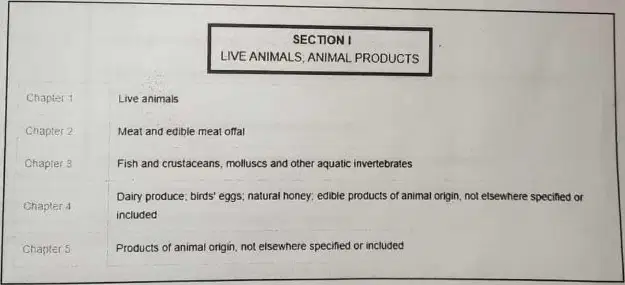
Based on Section I illustrated (Live Animals, Animal Products), which of the following is listed as a Chapter within this Section?
Cereals
Edible vegetables and certain roots and tubers
Dairy produce; birds' eggs; natural honey; edible products of animal origin, not elsewhere specified or included
Coffee, tea, maté and spices
What is stated about the titles of Sections, Chapters, and Subchapters?
They are legally binding and determine classification.
They are for ease of reference and should not be quoted to support classification.
They are used to set tariff rates for each product.
They replace Section Notes and Chapter Notes.
How many HS Chapters are there, and which Chapter is reserved for future use?
21 Chapters; Chapter 21
77 Chapters; Chapter 1
99 Chapters; Chapter 77
99 Chapters; Chapter 98
Which statement best reflects the relationship between Section titles and actual product classification coverage?
All articles of base metal must be classified only in Section XV because of its title.
Section titles are pointers; many articles of base metal may be classified in other Sections despite the title of Section XV.
Section titles override Section Notes.
Section titles allow skipping Chapter Notes when classifying.
Which HS Section covers live animals and animal products, and spans Chapters 1 to 5?
Section I
Section II
Section IV
Section VII
Mineral products fall under which HS Section and chapter range?
Section V, Chapters 25 to 27
Section VI, Chapters 28 to 38
Section IX, Chapters 44 to 46
Section X, Chapters 47 to 49
Plastics and articles thereof; rubber and articles thereof are classified in which HS Section?
Section VII
Section VIII
Section XI
Section XII
A shipment of vehicles and aircraft should be classified under which HS Section and chapter range?
Section XVII, Chapters 86 to 89
Section XVI, Chapters 84 and 85
Section XVIII, Chapters 90 to 92
Section XX, Chapters 94 to 96
Which HS Section is dedicated to natural or cultured pearls, precious or semi-precious stones, and precious metals, and corresponds to Chapter 71?
Section XIV
Section XV
Section XIX
Section XXI
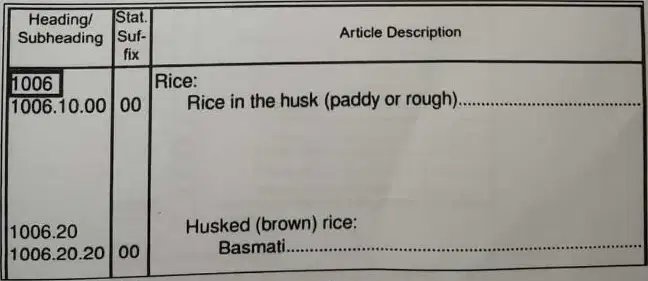
In the four-digit HS heading example shown (1006), what commodity group does the heading identify?
Rice
Wheat
Maize (corn)
Barley
Which statement best describes the World Customs Organization (WCO)?
A private trade association focused on logistics companies
An intergovernmental institution enhancing international cooperation in customs administration
A regional bloc that negotiates free trade agreements for Asia
A nongovernmental watchdog monitoring multinational corporations
In what year was the WCO originally established, and under what name?
1948, General Agreement Council
1952, Customs Co-operation Council
1967, World Customs Secretariat
1995, World Trade Organization
Which of the following is a key area of focus for the WCO?
Patent registration
Classification of goods and customs valuation
Maritime insurance underwriting
Exchange rate stabilization
What major responsibility of the WCO supports the classification of goods in international trade?
Maintaining the Harmonized System (HS)
Administering the WTO dispute settlement mechanism
Setting national tariff rates
Issuing letters of credit
Which figure most closely reflects the WCO’s membership and its share of global trade volume overseen?
120 members; 60% of global trade
150 members; 75% of global trade
186 members; about 98% of global trade
210 members; nearly 100% of global trade
Which objective is emphasized in the WCO’s vision and objectives?
Eliminating all customs duties worldwide
Improving the efficiency and effectiveness of customs administrations
Nationalizing private logistics firms
Setting exchange rate policy for member countries
Which activity is listed among the WCO’s main functions to pursue its mandate?
Negotiating bilateral investment treaties
Examining technical and economic aspects of customs systems to recommend harmonized practices
Issuing binding rulings on maritime disputes
Managing national tax collection
How does the WCO ensure equality in decision-making among its members?
Weighted voting based on GDP
One representative per member with one vote each
Veto power for founding members
Rotating decision rights among regional blocs
Which committee manages the development and application of the Harmonized System and resolves classification disputes?
Permanent Technical Committee
Harmonized System Committee
Enforcement Committee
Capacity Building Committee
Under Rules of Origin and Valuation, which body works alongside the WTO to harmonize rules of origin and offer advisory opinions?
Technical Committee on Rules of Origin
Finance Committee
Information Management Sub-Committee
Integrity Sub-Committee
Which cluster includes groups dedicated to intelligence, counterfeiting, cybercrime, and enforcement networks?
Procedures and Facilitation
Tariff and Trade Affairs
Enforcement and Compliance
Capacity Building
Which committees focus on human resource development and strengthening ethical standards of customs administrations?
Policy Commission and Finance Committee
Scientific Sub-Committee and HS Working Party
Capacity Building Committee and Integrity Sub-Committee
Technical Committee on Customs Valuation and Information Management Sub-Committee
Which international body created and maintains the Harmonized System (HS)?
World Trade Organization (WTO)
World Customs Organization (WCO)
International Monetary Fund (IMF)
United Nations Conference on Trade and Development (UNCTAD)
What is the primary purpose of the Harmonized System (HS)?
To regulate exchange rates
To provide a standardized framework for naming and categorizing traded goods
To set global minimum tariffs
To certify products for safety
Which of the following is NOT listed as an important use of the HS?
Basis for Customs tariffs
Basis for Rules of Origin
Tool for setting monetary policy
Monitoring of controlled goods such as narcotics and chemical weapons
According to the HS structure, how many sections and chapters does it contain, and what is special about Chapter 77?
21 sections and 99 chapters; Chapter 77 covers services
20 sections and 97 chapters; Chapter 77 is for agricultural goods
21 sections and 97 chapters; Chapter 77 is reserved for future use
22 sections and 100 chapters; Chapter 77 is for technology products
In the HS six‑digit code, what do the first two digits represent?
The subheading
The section
The chapter
The national extension
Which statement best describes the General Rules for the Interpretation of the Harmonized System (GIR)?
They are optional guidelines countries may follow when convenient.
They establish six hierarchical rules to ensure consistent classification of goods.
They determine national tariff rates for each product.
They authorize countries to expand codes for national use.
What is the role of the Harmonized System Committee under the WCO?
Setting exchange rates and customs valuation
Overseeing proper application and revision of the HS, issuing explanatory notes, and advising on classification matters
Negotiating Free Trade Agreements on behalf of member states
Collecting customs revenue for contracting parties
When did the Philippines officially adopt and begin implementing the HS, and which law later reinforced this implementation?
Adopted in 1995, implemented in 1996; reinforced by the Tariff and Customs Code
Adopted on July 1, 1988, implemented in October 1988; reinforced by the Customs Modernization and Tariff Act (CMTA)
Adopted in 2001, implemented in 2002; reinforced by Executive Order 688
Adopted in 1998, implemented in 1999; reinforced by ASEAN Trade in Goods Agreement
Which sections of the CMTA embed the HS by incorporating the General Rules for Interpretation and the official list of tariff headings?
Sections 1608 and 1609
Sections 1610 and 1611
Sections 1501 and 1502
Sections 1700 and 1701
Section 1608 only
What was adopted by the Philippines and other ASEAN member states in 2004 to extend HS classification for national use?
10-digit National Tariff Schedule
6-digit Harmonized System (HS)
8-digit ASEAN Harmonized Tariff Nomenclature (AHTN)
Alphabetical Index of the HS
Compendium of Classification Opinions
According to the material, how frequently are HS updates typically recommended under Article 7 of the HS Convention?
Every year
Every two to three years
Every four to six years
Every eight to ten years
Only when major trade disputes arise
In the Philippines, which CMTA section governs the implementation of HS amendments, including public consultation and a NEDA Board Resolution?
Section 1611
Section 1608
Section 1600
Section 1608 of the CMTA
Section 1701
Which supporting HS publication offers detailed guidance but is not legally binding?
HS Database
Classification Decisions
Explanatory Notes
Alphabetical Index
Compendium of Classification Opinions
Which tool is described as a subscription-based platform with searchable versions of the HS and related tools?
Alphabetical Index
HS Database
Explanatory Notes
Classification Decisions
Review Sub-Committee portal
Which document presents all decisions made by the HS Committee in tabular format?
Compendium of Classification Opinions
Classification Decisions
Alphabetical Index
General Rules for Interpretation
NEDA Board Resolution
Which document establishes the procedure for applying for an Advance Ruling on tariff classification related to importation or exportation of goods?
Commission Order No. 2017-01
Republic Act No. 11063
ASEAN Trade in Goods Protocol
Revised Kyoto Convention Annex
Under the Commission Order, where must applications for an Advance Ruling on tariff classification of goods be filed?
Bureau of Customs (BOC)
Department of Trade and Industry (DTI)
Tariff Commission
World Customs Organization (WCO)
According to the Order, tariff classification refers to determining the subheading in which system?
Harmonized Commodity Description and Coding System (HS)
ASEAN Harmonized Tariff Nomenclature (AHTN)
Philippine Standard Commodity Classification (PSCC)
International Standard Industrial Classification (ISIC)
Which request is explicitly directed to the Bureau of Customs (BOC) rather than the Tariff Commission under this Order?
Advance Ruling on tariff classification
Advance Rulings on valuation and rules of origin
Applications for movement of goods from free zones
Appeals on tariff subheading disputes
Which is NOT listed as an objective of the Advance Ruling system in this Order?
Provide certainty and predictability to international trade
Help importers and exporters make informed decisions based on legally binding rules
Enable establishment of a system aligned with international agreements and best practices
Increase customs duties to raise government revenue
What is the best definition of an Advance Ruling on Tariff Classification as used in this Order?
An informal verbal opinion by a customs officer
An official written decision by the Commission providing the appropriate tariff classification of goods under the AHTN prior to importation or exportation
A recommendation from the WCO on global tariff trends
A contract between an importer and the Bureau of Customs
Which party is eligible to apply for an Advance Ruling on tariff classification?
Only the importer of record
Any member of the general public
An Applicant or his/her Authorized Representative
Only a customs broker licensed in ASEAN
According to the conditions for application, an Advance Ruling application must cover which of the following?
Any number of products as long as they are in the same shipment
Only one product or good, as determined by the Commission
All goods imported within a 90-day period
Products with identical HS subheadings only
What is the required lead time for filing an application for an Advance Ruling relative to importation or exportation?
At least 30 days before
At least 60 days before
At least 90 days before
Within 10 days after
Which procedural requirement is specified for filing an Advance Ruling application?
Submit a single copy of the application form with no attachments
Submit three copies of the filled-out form with supporting documents and samples if required
Submit digital copies only via email
Submit copies after payment of fees and assignment of reference number
Which of the following is a ground for non-acceptance of an Advance Ruling application?
Application filed more than 120 days before importation or exportation
Inability to determine tariff classification based on presented information/documents
Submission of product samples when not requested
Payment of filing fee via bank transfer
Within how many calendar days shall the Commission acknowledge receipt and notify the Applicant of the need for additional information or on-site verification?
3 calendar days
7 calendar days
10 calendar days
30 calendar days
Which is a ground for non-issuance of an Advance Ruling by the Commission?
The application uses the prescribed form and includes complete documents
The Applicant allows on-site verification within the requested time
The goods are subject to pending court litigation or an administrative review involving tariff classification
The Applicant pays the filing fee promptly
Which action allows an applicant to discontinue the process before a decision is made on an Advance Ruling?
Appeal
Withdrawal of application
Reconsideration
Modification
When an Advance Ruling is issued, what is its typical effectivity relative to the date of issuance unless otherwise specified by law?
Retrospective to one year prior
Effective upon issuance
Effective after publication only
Effective after court approval
An Advance Ruling generally remains valid until which of the following occurs?
A change in the applicant’s business name
The end of the fiscal year
It is modified or revoked under legal provisions
A new commissioner assumes office
Which remedy asks the issuing authority to review and potentially change its own Advance Ruling based on new facts or arguments?
Appeal
Reconsideration
Publication
Withdrawal
Which of the following best differentiates modification from revocation of an Advance Ruling?
Modification cancels the ruling entirely; revocation only updates parts of it
Modification updates terms or scope; revocation cancels the ruling in whole or in part
Both are identical actions under the law
Modification is requested by courts; revocation is requested by applicants only
If a party disagrees with an Advance Ruling after reconsideration is denied, what formal step is next in the legal hierarchy?
File an appeal under applicable rules
Request publication
File for confidentiality
Withdraw the application
Publication of Advance Rulings primarily serves which purpose while respecting confidentiality provisions?
Public awareness and guidance on classification or valuation issues
Creating binding contracts with traders
Replacing existing tariff laws
Exposing confidential business strategies
Which statement aligns with confidentiality provisions related to Advance Rulings?
All details of rulings must be fully disclosed to the public
Confidential business information provided in applications should be protected even when rulings are published
Applicants must waive confidentiality to receive a ruling
Only financial data is confidential; technical data is not
Under RA 10863, which body is authorized to adopt an official seal as shown, symbolizing elements such as the agricultural sector, trade and industry sector, and the wheel of progress?
Tariff Commission
Bureau of Internal Revenue
Department of Trade and Industry
Department of Finance
In the depicted official seal, the gear-like image labeled 'WHEEL OF PROGRESS' most directly conveys which idea?
Judicial independence
Continuous economic advancement
Environmental sustainability
International diplomacy
According to SEC. 1700, who are members of the Congressional Customs and Tariff Oversight Committee by virtue of their positions?
The Secretaries of Finance and Trade
The Chairpersons of the Committee on Ways and Means of the Senate and House
The Commissioner of Customs and the Tariff Commission Chairperson
All members of the Senate Finance Committee
How many additional members from each House are designated to the Congressional Customs and Tariff Oversight Committee under SEC. 1700?
Two (2)
Three (3)
Four (4)
Five (5)
Which of the following is NOT one of the stated functions of the Congressional Customs and Tariff Oversight Committee under SEC. 1700?
Monitor implementation of the Act
Review collection performance of the Bureau
Appoint the Commissioner of Customs
Review implementation of the Bureau’s programs
To further its objectives, what information may the Committee require the Bureau to submit under SEC. 1700?
Industry audits, collection performance data, and status reports on administrative, civil, and criminal actions
Only annual budget proposals
Only international trade agreements
Personnel files of all customs officers
Under SEC. 1700, which legislative bodies are represented by the Chairpersons of the Ways and Means Committees shown in the diagram?
Senate and House of Representatives
Department of Finance and Bureau of Customs
Supreme Court and Court of Appeals
Senate only
According to SEC. 1700 as depicted, who designates the members of the Congressional Oversight Committee?
The Secretary of Finance and the Customs Commissioner
The Senate President and the House Speaker
The Chief Justice and the Ombudsman
The National Economic and Development Authority
Based on SEC. 1800, which official promulgates the implementing rules and regulations upon the recommendation of the Commissioner?
The House Speaker
The Secretary of Finance
The Senate President
The Tariff Commission Chairperson
Applying the roles illustrated, which pairing correctly matches the official with the role for implementing RA 10863?
Senate President — promulgates IRR; Secretary of Finance — designates oversight members
House Speaker — recommends IRR; Customs Commissioner — chairs Senate Ways and Means
Secretary of Finance — promulgates IRR; Commissioner — recommends IRR
Tariff Commission Chair — designates oversight members; Senate President — recommends IRR
Which function under SEC. 1603 of RA 10863 directly involves deciding cases related to anti-dumping, countervailing, or safeguard measures?
Adjudication of trade remedies
Conduct of customs valuation audits
Issuance of import licenses
Collection of tariffs at ports
Under RA 10863, which activity best reflects the Tariff Commission’s role in promoting national competitiveness?
Maintaining police power over customs districts
Studying the impacts of tariff policies on industries and consumers
Negotiating international treaties on behalf of the state
Operating bonded warehouses
According to SEC. 1603, which of the following illustrates the Commission’s administrative responsibility over tariff schedules?
Drafting criminal penalties for smuggling offenses
Administering and updating the national tariff nomenclature and schedules
Issuing judicial warrants against erring importers
Setting exchange rates for customs valuation

