
 Worksheets
Science: Earth and Space - Test 2, Chapter 2
Total questions: 79
Worksheet time: 54mins
Grace is studying earthquakes for her geography project. She learns that about 80% of the world's earthquakes occur in a specific region. In which region do most of these earthquakes take place?
Alpide belt
Indian Ocean belt
circum-Pacific belt
Middle Eastern belt
While planning a trip from southern Europe to Indonesia, Olivia reads about a major earthquake zone that stretches across this entire region. She wants to know what this earthquake zone is called. What is the name of this zone?
Alpide belt
Indian Ocean belt
circum-Pacific belt
Middle Eastern belt
While exploring a riverbank, Arjun notices that most of the ground is covered by deposits of sand and mineral fragments, usually laid down by water. These deposits are called ___?
sediments
silicates
continents
tectonic plates
Olivia is reading about the structure of the Earth for her science project. She wonders, the inner core of the earth is thought to be ___?
gas
liquid
plasma
solid
After a powerful earthquake shakes their city, Rohan and Mason are curious about how scientists determine the amount of energy released. They learn that the most reliable method for measuring this energy is the ___ scale.
EEW
modified Mercalli
moment magnitude
Richter magnitude
After a recent earthquake in their town, Ava and Jackson are curious about how the damage to buildings and roads is measured. They learn that the scale used to measure the damage an earthquake does is the ___ scale.
EEW
modified Mercalli
moment magnitude
Richter magnitude
Charlotte is studying earthquakes for her geology class. She learns that eighty-five percent of all earthquakes are ___ earthquakes. What type of earthquakes is she most likely to encounter in her research?
deep-focus
shallow-focus
intermediate-focus
no-focus
While hiking near a volcano, Nora finds a particle or block of solid volcanic ejecta on the ground. This is a(n) ___.
aa
pillow
pyroclast
pahoehoe
While helping Abigail with her science homework, she asks, "What is the middle of the earth's three main layers called?" What should you tell her?
crust
core
mesoterre
mantle
While hiking, Abigail picks up a piece of solid rock from the ground and wonders what the earth's outer layer made of solid rock is called. It is the ___.
crust
core
mesoterre
mantle
Sophia is reading about the structure of the Earth. She learns that the central portion of the earth is the ____.
crust
core
mesoterre
mantle
While watching a documentary, Nora learns that scientists use earthquake waves to study Earth's ____.
interior
atmosphere
motion
age
Oliver is fascinated by earthquakes and wants to learn more about them. The study of earthquakes is called ____.
seismology
biology
astronomy
meteorology
Charlotte is watching a documentary about volcanoes and learns that the strength of a volcanic eruption is measured using a scale called the ____.
Volcanic Explosivity Index (or VEI)
Richter Scale
Fujita Scale
Saffir-Simpson Scale
While hiking near an active geological site, Ava notices a mountain that has formed where molten rock has erupted from a hole in the earth's crust. This type of mountain is a(n) ____ mountain.
volcanic
fold
block
dome
Zoe is curious about the different layers of rocks and how mountains are formed. She decides to study the earth. The study of the earth is called ____.
geology
biology
astronomy
zoology
During a science class, Olivia wants to record the vibrations caused by a small earthquake. Which instrument should she use?
seismograph
barometer
thermometer
anemometer
While hiking, Daniel notices a range of mountains that seem to have formed where the edges of two adjacent tectonic plates are pushing together. What type of mountain is Daniel observing?
folded
fault-block
volcanic
dome
Samuel was reading about an earthquake that happened when rocks suddenly shifted deep beneath the earth's surface. This type of earthquake is a(n) ____ earthquake.
tectonic
volcanic
collapse
explosion
During a science fair, Daniel presents a project explaining that the rapid movement of tectonic plates during the Flood is responsible for most of Earth's features. He describes this idea as ____.
catastrophic plate tectonics
uniformitarianism
continental drift
seafloor spreading
During a geology field trip, Abigail is learning about earthquakes. Her teacher asks her: What is the point on the earth's surface directly above where an earthquake begins?
epicenter
exocenter
hypocenter
seismocenter
Oliver is watching a documentary about earthquakes. He learns that there is a specific point deep inside the earth where an earthquake actually starts. What is this point called?
epicenter
exocenter
hypocenter
seismocenter
While hiking near a volcano, Emma noticed large almond- or teardrop-shaped pieces of ejecta on the ground. These were formed when lava solidified after being thrown high into the air. What are these pieces called?
lapilli
volcanic ash
volcanic block
volcanic bomb
During a construction project, Charlotte notices that the rocks on one side of a fault have been shoved up and over the rocks on the other side. What major type of fault is Charlotte observing?
normal fault
tectonic fault
strike-slip fault
thrust fault
While hiking in the mountains, Lily notices a section of rock layers that have buckled upwards, forming an arch-like structure. What type of fold is this?
concline
anticline
syncline
procline
Liam is visiting a volcano and observes a channel through which gases, ash, and molten rock are ejected from the earth's interior. What is this channel called?
cone
caldera
vent
lava tunnel
While hiking near a volcano, Emma noticed a large, bowl-shaped hollow in the ground. A guide explained that it was formed by the collapse of an underground magma chamber. What is this feature called?
cone
caldera
vent
lava tunnel
Aria is hiking in a region where she notices a mountain with gently rounded slopes, but there are no signs of volcanic eruptions or lava on the surface. Which of the following statements best describes how this type of domed mountain formed?
Rock layers are pushed up as one plate moves beneath another at a subduction zone.
Molten rock on the surface of the earth forms a low dome-like structure.
Rocks on one side of a fault move upward while rocks on the other side move downward.
Molten rock pushes up overlying rock layers without reaching the surface.
Samuel is helping his teacher prepare a science project about the Earth's crust. He wants to know which element is the most abundant in the earth's crust. Can you help him choose the correct answer?
carbon
iron
silicon
oxygen
Noah is a scientist studying earthquakes. After a recent earthquake, he wants to find out exactly where it started underground. How does Noah determine the point where the earthquake began?
estimating the duration of the earthquake
calculating the amount of energy released
comparing damage in different areas
measuring travel time of seismic waves
Daniel is studying different volcanoes and wants to know which factor is most likely to cause a volcanic eruption to be violent. Which of the following should he consider?
large amount of dissolved gas
location near the sea
low-viscosity magma
peak covered in snow
Grace is studying geology and wants to know: What is the area between the upper mantle and the lower mantle?
Moho
Litho
Gutenberg discontinuity
transition zone
While hiking near a volcano, Maya noticed a long, hollow passage beneath the ground where lava once flowed. The surface had hardened, but the lava underneath had continued to move, creating this underground channel. What is this feature called?
lava tunnel
magma chamber
crater lake
ash cloud
During a hike, Benjamin notices a visible break in the rocks where one side appears to have shifted while the other remains in place. What is the fracture zone between stationary and moving rocks called?
fault
fold
joint
cleavage
While hiking, Priya finds a geology book that describes the different layers of the Earth. She reads about the boundary line that separates the crust from the mantle. What is this boundary line called?
Moho (or Mohorovičić discontinuity)
Asthenosphere
Lithosphere
Gutenberg discontinuity
While hiking near a mountain, Abigail notices an opening in the earth's surface where hot gases, ash, and molten rock are being ejected. What is this opening called?
volcano
canyon
glacier
oasis
Charlotte is studying Earth's layers for her geology class. She wants to know: What is the bottom of the mantle called?
core-mantle boundary (or Gutenberg discontinuity)
asthenosphere
lithosphere
Moho discontinuity
After a strong earthquake shakes their town, Priya and Liam notice that the ground on either side of a crack in the earth seems to have snapped back to a position with little or no stress. What is this idea called?
elastic rebound
fault slip
tectonic drift
seismic shift
Charlotte is working on a project that requires her to store and process geographic data from various sources. What type of computer system should she use?
geographic information system (or GIS)
relational database management system (RDBMS)
content management system (CMS)
enterprise resource planning (ERP)
While hiking, Michael notices a short cliff along a fault that has been polished smooth, known as a slickenside. How do slickensides provide evidence for the elastic rebound theory?
The fault is perpendicular to the ground.
The fault sprang to a position of little or no strain.
The rocks are soft and thus able to move easily.
The rocks were polished by rapid motion of the fault.
Maya is studying earthquakes and volcanoes for her science project. She notices that many volcanoes are found around the Pacific Ocean, an area known as the Ring of Fire. How does the existence of the Ring of Fire provide evidence for plate tectonics?
Most volcanoes appear to be located along subduction zones.
Most volcanoes occur in the same regions of the world.
Most volcanoes produce lava when they erupt.
Most volcanoes occur where molten rock reaches the surface.
A volcanologist is placing instruments near a volcano to help predict when the volcano will erupt. Which of the following instruments is he most likely to choose?
seismometer, to detect earthquakes caused by underground pressure
thermometer, to detect steam and hot gases released by the volcano
camera, to detect molten rock and volcanic ash released by the volcano
light meter, to detect the sun being blocked by volcanic ejecta
Arjun and Michael are hiking in a region with interesting rock formations. They notice one rock layer that cuts vertically through other layers, and another that runs horizontally between layers. What is the main difference between these two features?
A dike is vertical; a sill is horizontal.
A dike can form a bulging dome; a sill cannot.
A dike forms through a crack in a rock; a sill does not.
A dike can be exposed by erosion; a sill cannot.
After a powerful earthquake shakes a city, the U.S. Geological Survey releases a ShakeMap to help emergency responders. The ShakeMap displays how the strength of the earthquake changes in different neighborhoods. Which earthquake strength scale is used and why?
moment magnitude scale, because there is a single value for each earthquake
moment magnitude scale, because it is a scientific measure of earthquake strength
modified Mercalli scale, because the value depends on several factors
modified Mercalli scale, because each location has its own value
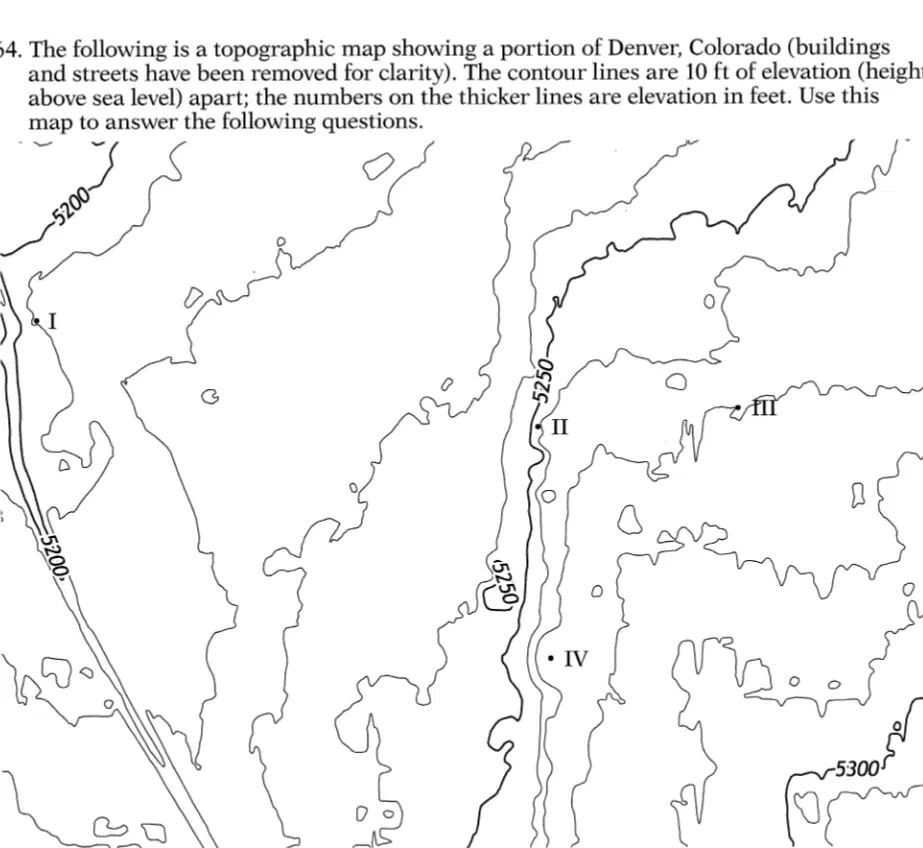
James is hiking in a region near Denver, Colorado, using a topographic map where the contour lines are 10 ft. of elevation (height above sea level) apart, and the numbers on the thick lines show elevation in feet. If James starts at point I and hikes to point IV, what is the approximate difference in elevation between these two points?
Point IV is 60 ft lower.
Point IV is 20 ft lower.
Point IV is 20 ft higher.
Point IV is 60 ft higher.
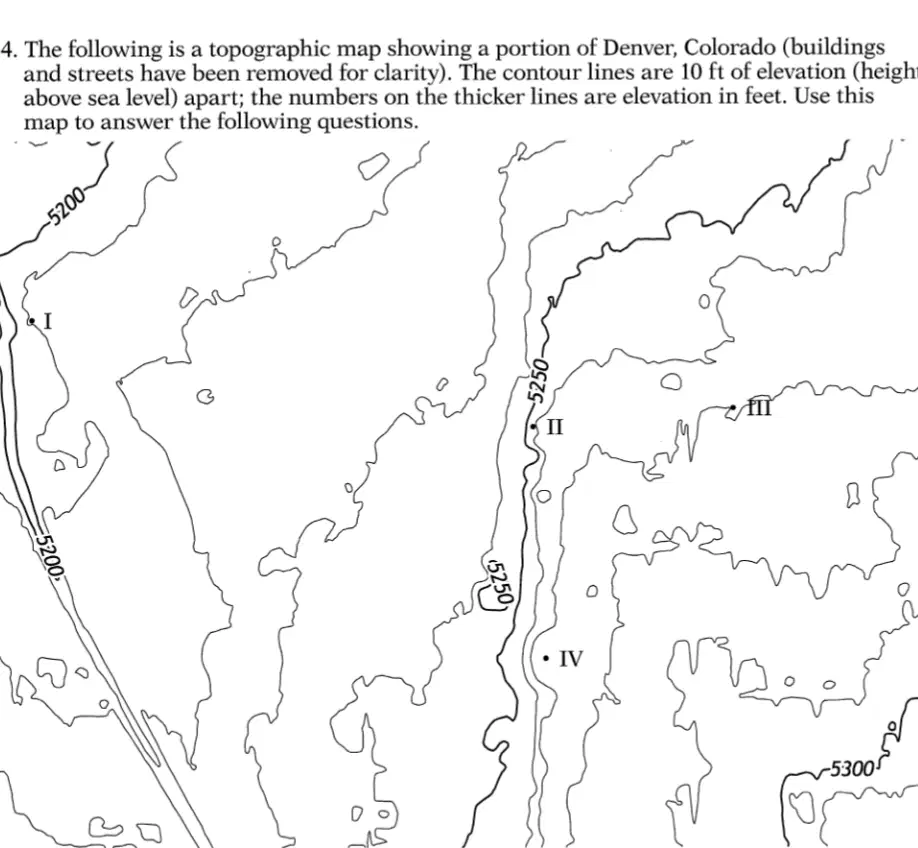
Samuel is planning a hiking trip and is using a topographic map to choose the best route. The contour lines on the map are 10 ft. of elevation (Height above sea level) apart; the numbers on the thick lines are elevation in feet. At which point would Samuel encounter the steepest slope?
point I
point II
point III
point IV
Hannah is an architect tasked with designing a steel skyscraper in an earthquake-prone city. Which technique should she use to most effectively reduce earthquake damage, and why?
Base-isolated system, because it separates the building from the foundation and absorbs seismic energy through isolators.
Fixed-base system, because it allows the building's beams and joints to absorb seismic energy, minimizing deformation.
Energy-dissipating device, because it increases the building's height and flexibility.
Base-isolated system, because it connects the building directly to the bedrock for maximum stability.
Anika is fascinated by earthquakes and wants to learn more about them. She discovers that the study of earthquakes is called (a) .
During a science fair, Luna explains to her classmates that the strength of a volcanic eruption is measured using a scale called the (a) .
While hiking with her friends, Ava noticed a mountain that had formed from molten rock erupting from a hole in the earth's crust. She wondered what type of mountain this was. What type of mountain did Ava see?
(a)
The study of the earth is called (a) .
An instrument used to record the vibrations caused by an earthquake is a(n) (a) .
The type of mountain that appears to have formed by the edges of two adjacent tectonic plates pushing together is a(n) (a) mountain.
An earthquake caused by sudden movements of rock beneath the earth's surface is a(n) (a) earthquake.
The idea that rapid movement of tectonic plates during the Flood is responsible for most of Earth's features is called (a) .
What is an underground channel that formed when surface lava hardened before the lava underneath it?
(a)
What is the fracture zone between stationary and moving rocks called?
(a)
What is the boundary line between the crust and the mantle called?
(a)
What is an opening in the earth's surface through which hot gases, ash, and molten rock are ejected from the earth's interior?
(a)
What is the bottom of the mantle called?
(a)
What is the idea that rocks on either side of a fault spring to a position of little or no stress after an earthquake?
(a)
What is a computer system that stores and processes geographic data from various sources?
(a)
Match the following
consists primarily of erupted volcanic ash and rock fragments held loosely together
cinder-cone volcano
volcano that probably will not erupt
extinct volcano
formed partly by explosive eruptions of ash and rock fragments and partly by mild lava flows
composite volcano
volcano that is inactive but can erupt again
dormant volcano
Match the following
large, irregularly shaped lump made of lava that hardened before being thrown out of the volcano
volcanic block
lave in water solidifies almost instantly, forming rounded structures
pillow lava
hardened lava that forms rough, jagged rocks with a crumbly texture
aa
Match the following
solid particles less than 2 mm in diameter
volcanic ash
solid ejecta larger than 2 mm but less than 64 mm in diameter
lapilli
hardened lava with a surface that is either smooth or ropy
pahoehoe
superheated cloud of gas and small particles that travels as an avalanche
pyroclastic flow
Modified True or False: The underground lava tunnel is the actual source of a volcanic eruption.
Magma chamber
Modified True or False: The fastest type of earthquake waves are S waves.
Surface waves are faster than P waves.
Modified True or False: A mass of underground volcanic rock that is similar to a laccolith but much larger is a batholith.
true
Modified True or False: The plastic rock on which the tectonic plates float is called the lithosphere.
Moho
asthenosphere
core-mantle boundary
Modified True or False: The molten rock beneath the surface of the earth is called magma.
Modified True or False: The general name for a mass of underground volcanic rock is a caldera.
Igneous intrusion
Modified True or False: Smaller earthquakes that often follow a larger earthquake at frequent intervals are called aftershocks.
Modified True or False: The underground lava tunnel is the actual source of a volcanic eruption.
(a)
Modified True or False: The fastest type of earthquake waves are S waves.
(a)
Modified True or False: A mass of underground volcanic rock that is similar to a laccolith but much larger is a batholith.
(a)
Modified True or False: The plastic rock on which the tectonic plates float is called the lithosphere.
(a)
Modified True or False: The molten rock beneath the surface of the earth is called magma.
(a)
Modified True or False: The general name for a mass of underground volcanic rock is a caldera.
(a)
Modified True or False: Smaller earthquakes that often follow a larger earthquake at frequent intervals are called aftershocks.
(a)

