
 Worksheets
Muscular System
Total questions: 77
Worksheet time: 33mins
The ability to forcefully contract their muscle fibers
The ability of the muscles to stretch or extend
Tough fibrous connective tissue that connects muscle to bone
When the myocardium contract its forces blood into which of the following?
Wave like contraction, longitudinal and circular layer alternating
ATP- the P stands for?
A nerve impulse to the axon terminal causes and influx of this into the axon terminal
Calcium influx into the axon terminal cause what to be released from vesicles
When the channels on the sarcolemma open what rapidly goes in help generate a + charge:
After the action potential has been generated what is released into the synaptic cleft to remove Acetylcholine?
AchE
Calcium
Sodium
Potassium
In the ATP-PC system what broken down to release energy initially?
Phosphate
Calcium
In the ATP-PC system, what has to be broken down in order to change ADP back in ATP?
Phosphate
Calcium
Creatine phosphate
What is the end result of anaerobic glycolysis?
Pyruvate
Lactate
Hydrogen
In anaerobic glycolysis the glucose used to fuel glycolysis yield which of the following ending anaerobic glycolysis
Pyruvate and Hydrogen
Pyruvate and oxygen
Pyruvate and acetyl coenzyme A
Lactate and Pyruvate
final step within the aerobic pathway that yields high amounts of ATP is called?
the step within the aerobic pathway that converts acetyl coenzyme A into carbon dioxide
responsible for sending nerve impulse away from the CNS
plasma membrane that wraps the muscle fibers and where the motor neuron "connects" to
The sarcoplasmic reticulum surrounds each
after an action potential, what is released from the sarcoplasmic reticulum?
Sodium
Potassium
Calcium
ATP
ACTIN
In comparison to other cells, skeletal muscles has more of which organelle?
The epimysium blends into which part in the body
This will allow troponin to unblock and cause tropomyosin to shift allowing for cross bridge formation
an influx of what cause a change in charge in the neuromuscular junction?
The point of ________is distal and typically crosses a joint when contracted.
The orbicularis oris is a circular muscle around which of the following?
when myosin head attach to actin this is called?
When myosin head slide toward the middle of the sarcomere, this is called a
Powerstroke
Power movement
Powerslide
motor neuron and the muscle fiber it stimulates
overstretching the muscle or tendon is called?
overuse resulting in inflammation
A smooth, sustained contraction, with no evidence of relaxation
A small involuntary movement
muscle fibers receive an impulse before complete relaxation occurs
Match the following
Skeletal
Striated
Elongated
Multinucleate
Voluntary
Cardiac
Striated
Short
Uninucleate
Involuntary
Smooth
Elongated
Uninucleate
Involuntary

__________ contain(s) actin and myosin, which are crucial for muscle contraction.
Myocytes
Fascicles
Myofilaments
Tropomyosin
Muscle contraction is a process where __________.
A. The sarcomere shortens
B. Myosin and troponin bind
C. Troponin and tropomyosin block calcium
D. Actin and myosin are at rest in the sarcomere
The sarcomere shortens
Myosin and troponin bind
Troponin and tropomyosin block calcium
Actin and myosin are at rest in the sarcomere
How many types of muscles are there?
2
4
3
1
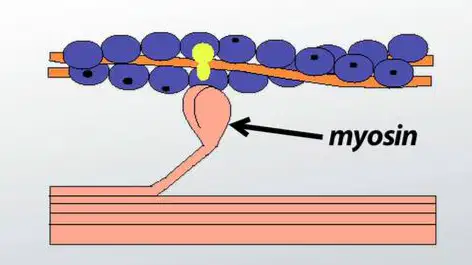
What is the role of myosin heads in the sarcomere structure as depicted in the diagram?
They bind to ATP only
They prevent actin and myosin from overlapping
They 'grab' onto actin forming a crossbridge
They detach actin from the sarcomere
What causes the muscle cell membrane gates to open during muscle contraction?
Release of Ca2+
Exchange of Na+ and K+
Binding of a neurotransmitter
Sliding of actin filaments
Which of the following muscle type is not striated?
smooth muscle
skeletal muscle
cardiac muscle
none of above
What is the role of the sarcoplasmic reticulum in muscle fibers?
It stores calcium ions.
It produces ATP.
It synthesizes proteins.
It transports oxygen.

What is the name of muscle #7? (a)
What is the name of muscle #8? (a)

What is the name of muscle #1? (a)
What is the name of muscle #2? (a)
What is the name of muscle #3? (a)
What is the name of muscle #4? (a)
What is the name of muscle #5? (a)
What is the name of muscle #6? (a)
What is the name of muscle #7? (a)

What is the name of structure #2? (a)
What is the name of structure #3? (a)
What is the name of structure #4? (a)
What is the name of structure #5? (a)
What is the name of structure #6? (a)
What is the name of structure #7? (a)
What is the name of structure #8? (a)
What is the name of structure #9? (a)
What is the name of structure #10? (a)
What is the name of structure #11? (a)

Identify the muscle labeled #4
Soleus
Sartorius
Achilles Tendon
Gastrocnemius

