
 Worksheets
Cardiovascular
Total questions: 80
Worksheet time: 40mins
Which term refers to the largest vein in the body that returns blood to the right atrium?
Ventricle
Vena cava
Venule
Aorta
What is the best definition of ventricle in the context of the heart?
Upper chamber of the heart
Small vein
One of two lower chambers of the heart
Largest artery
Which structure is described as a small vein?
Venule
Ventricle
Vena cava
Atrioventricle
The combining form angi/o most closely means:
Heart
Vessel
Vein
Aorta
The combining form aort/o refers to the:
Atrium
Valve
Aorta
Arteriole
Which term would most likely describe an imaging record of a blood vessel?
Angioplasty
Angiogram
Aortic stenosis
Venography
Based on the combining form angi/o, which procedure is intended to repair or open a vessel?
Angioplasty
Aortography
Phlebitis
Cardiomegaly
Aortic stenosis most directly refers to:
Inflammation of the aorta
Narrowing of the aorta
Imaging of the aorta
Rupture of the aorta
Which combining form means artery?
arter/o, arteri/o
ather/o
cardi/o
phleb/o
The term atherosclerosis best describes which condition?
Hardening of veins
Yellowish plaque with cholesterol and lipids found within the lining of an artery
Enlargement of the heart
Inflammation of the atrium
What does the combining form ather/o mean?
Joint
Yellowish plaque, fatty substance
Upper heart chamber
Blue
Cardi/o refers to which anatomical structure?
Lung
Heart
Artery
Vein
Which terminology corresponds to abnormal thickening of heart muscle, usually in the left ventricle?
Cardiomyopathy (hypertrophic)
Bradycardia
Endarterectomy
Cyanosis
Tachycardia is best described as:
A pulse slower than 60 bpm
A pulse faster than 100 bpm
Normal pulse of 60–100 bpm
Complete absence of pulse
Which term indicates failure of the heart in its pumping action leading to inadequate delivery of oxygen and nutrients?
Endarterectomy
Cardiogenic shock
Atherectomy
Arrhythmia
Which combining form means atrium (upper heart chamber)?
atri/o
arteri/o
brachi/o
steth/o
Which term refers to surgical removal of plaque from the inner lining of an artery?
Endarterectomy
Atherectomy
Phlebotomy
Pericardiocentesis
Which definition matches arteriosclerosis?
Narrowing of veins
Hardening of arteries
Inflammation of the pericardium
Clot dissolution
Hypercholesterolemia uses which combining form and means what?
cholesterol/o; elevated cholesterol
coron/o; heart attack
cyan/o; lack of oxygen
myx/o; muscle tumor
Which arteries come down over the top of the heart like a crown?
Pulmonary arteries
Carotid arteries
Coronary arteries
Brachial arteries
Cyanosis indicates which clinical finding?
Excess mucus
Bluish discoloration due to diminished oxygen content of the blood
Rapid heart rhythm
Removal of fluid from the pericardial space
A benign tumor derived from connective tissue with mucoid stroma is called:
Myxoma
Lymphoma
Carcinoma
Sarcoma of the lung
Hypoxia is defined as:
Excess oxygen in tissues
Inadequate oxygen in tissues
Lack of blood flow to the skin
Blue discoloration of the lips
Phlebotomy involves which structure and action?
Artery; dilation
Vein; opening for drawing blood
Heart; imaging
Lung; biopsy
Deep vein thrombosis (DVT) is associated with which condition noted in the text?
Endarterectomy
Thrombophlebitis
Arrhythmia
Cyanosis
Which instrument measures pressure?
Stethoscope
Sphygmomanometer
Cardiograph
Spirometer
Thrombolysis refers to:
Formation of a clot
Dissolution of a clot
Inflammation of a vein
Surgical removal of plaque
Which combining form means vein?
phleb/o
arteri/o
coron/o
sphygm/o
Which combining form refers to a valve in the cardiovascular system?
vas/o
valvul/o, valv/o
ven/o, ven/i
ventricul/o
Which term means pertaining to blood vessels?
Vascular
Venous
Valvotomy
Interventricular
Venipuncture is primarily performed to do what?
Dilate a cardiac valve
Start an intravenous infusion or for phlebotomy
Repair a vein surgically
Treat rheumatic fever
What best describes arrhythmias?
Inflammation of heart valves
Abnormal heart rhythms (dysrhythmias)
Blockage of coronary arteries
Excessive thickening of vessel walls
According to the material, arrhythmias are problems with which system of the heart?
Circulatory (blood flow) system
Conduction or electrical system
Immune defense system
Endocrine signaling system
Bradycardia is best defined as which of the following?
Abnormally fast heart rate
Abnormally slow heart rate
Irregular vessel dilation
Inflammation of a ventricle
Heart block (atrioventricular block) reflects failure of impulses to properly conduct from which node toward the atrioventricular bundle (bundle of His)?
SA node
Purkinje fibers
Bundle branches
Aortic node
Which combining form pair refers to a vein?
vascul/o
valv/o
ven/o, ven/i
ventricul/o
Atrial fibrillation most directly involves which heart chambers?
Ventricles contracting irregularly
Atria quivering instead of contracting in a coordinated rhythm
Aorta narrowing
Pulmonary veins constricting
Ventricular fibrillation is most dangerous because it can quickly lead to
low-grade fever
sudden cardiac death or cardiac arrest
mild chest discomfort only
gradual vision loss
Which immediate treatment can interrupt ventricular fibrillation so normal rhythm takes over?
Antibiotics
Defibrillation (electrical shock)
Steroids
Diuretics
Automatic external defibrillators (AEDs) are described as devices that are
used only in hospitals
found in public places and used in emergencies to reverse ventricular fibrillation
implanted under the skin
only for measuring pulse rate
Which minimally invasive procedure uses radiofrequency energy or extreme cold to destroy tissue causing arrhythmias?
Valve replacement
Catheter ablation
Coronary stent placement
Bypass grafting
Patent ductus arteriosus (PDA) refers to a passageway between which two vessels that remains open after birth?
Aorta and vena cava
Pulmonary vein and left atrium
Aorta and pulmonary artery
Coronary artery and aorta
Septal defects are described as small holes located where?
Between the aorta and pulmonary artery
In the walls between the atria or between the ventricles
In the valves of the heart
In the coronary arteries
Which of the following is NOT one of the four defects in tetralogy of Fallot?
Pulmonary artery stenosis
Ventricular septal defect
Hypertrophy of the right ventricle
Left atrial appendage closure
In tetralogy of Fallot, what does a shift of the aorta to the right cause?
Aorta overrides the interventricular septum
Closure of the ductus arteriosus
Increased oxygenation of blood in the lungs
Narrowing of the left ventricle
An infant with tetralogy of Fallot is often called a “blue baby” primarily due to
high fever
extreme degree of cyanosis present at birth
excess red blood cells
enlarged spleen
Which statement best defines congestive heart failure (CHF)?
The heart stops beating suddenly
The heart is unable to pump its required amount of blood
The lungs fill with air due to obstruction
Arteries widen and increase blood flow
Which symptom is a common sign of CHF due to fluid retention?
Pitting edema in legs, feet, and ankles
Skin rash on arms
Blurred vision
Increased hair growth
Pulmonary edema in CHF refers to
Fluid loss through kidneys
Fluid accumulation in the lungs
Air trapping in the lungs
Blood clot in a peripheral vein
Which treatment is mentioned to promote fluid loss in CHF management?
Increase dietary sodium
Use of diuretics
Daily corticosteroids
High-protein diet
What is the primary function of a left ventricular assist device (LVAD)?
Paces the heart’s electrical activity
Defibrillates during cardiac arrest
Pumps blood out of the left ventricle to the body
Filters toxins from the blood
Atherosclerosis is best described as
Deposition of fatty compounds in the inner lining of arteries
Sudden rupture of heart muscle fibers
Infection of the pericardium
Congenital absence of coronary arteries
The sequence of plaque formation, roughening, and clotting that stops blood flow can result in which outcome?
Myocardial infarction
Stroke only
Pulmonary embolism
Varicose veins
An infarct is defined in the material as
Area of temporarily weakened muscle
Area of dead myocardial tissue replaced by scar tissue
Collection of pus in the pericardium
Benign tumor of the heart wall
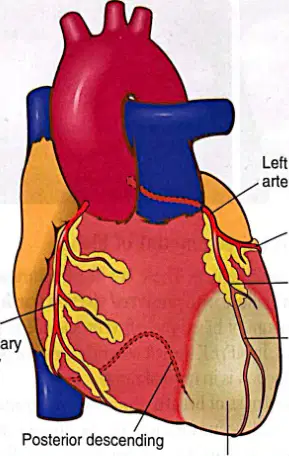
In the diagram of coronary artery occlusion, the area deprived of blood supply is labeled as
Zone of hyperperfusion
Zone of ischemia and infarction
Area of regeneration
Coronary sinus
After an acute myocardial infarction, what eventually replaces the infarcted area?
Healthy new myocardium
Scar tissue
Fatty tissue only
Cartilage
Which term best describes inflammation of the inner lining of the heart, often caused by bacterial infection?
Endocarditis
Pericarditis
Aneurysm
Hypertensive heart disease
A transient ischemic attack (TIA) from endocarditis is most directly caused by:
Heart valve stenosis
Mitral valve prolapse
Emboli lodging in brain vessels
Pericardial friction rub
Hypertensive heart disease primarily results from which change in the blood vessels?
Dilation of veins
Narrowing of arterioles
Calcification of capillaries
Occlusion of venules
In hypertensive heart disease, the left ventricle becomes enlarged because it must:
Pump against decreased resistance
Compensate for reduced blood volume
Pump more vigorously to overcome increased arterial resistance
Respond to congenital defects
Mitral valve prolapse (MVP) is defined as:
Narrowing of the mitral valve
Improper closure of the mitral valve
Inflammation of the mitral valve
Replacement of the mitral valve with a prosthesis
During auscultation, a midsystolic click is most characteristic of which condition?
Pericarditis
Mitral valve prolapse
Hypertensive heart disease
Aneurysm
Mitral regurgitation refers to:
Forward flow of blood into the aorta
Backflow of blood into the left atrium
Leakage between ventricles
Obstruction of the mitral valve
Which statement about heart murmurs is accurate?
They are always dangerous and require emergency surgery
They are extra heart sounds, often due to valvular defects
They cannot be heard with a stethoscope
They only occur in infants
Pericarditis is inflammation of which structure?
Endocardium
Myocardium
Pericardium
Aorta
Cardiac tamponade is caused by:
Scarring of heart valves
Collection of fluid in the pericardial cavity compressing the heart
Narrowing of arterioles
Backflow through the mitral valve
Rheumatic heart disease most commonly follows which childhood illness?
Otitis media
Streptococcal pharyngitis
Viral pneumonia
Chickenpox
Which heart valve problem is commonly associated with rheumatic heart disease?
Mitral stenosis
Aortic regurgitation only
Tricuspid atresia
Pulmonic insufficiency only
An aneurysm is best defined as:
A clot within a vein
Local widening (dilation) of an arterial wall
Inflammation of an artery
Complete occlusion of a vessel
The major danger of an aneurysm is:
Valve prolapse
Rupture and hemorrhage
Arrhythmia
Infection of the endocardium
Which condition is defined as a blood clot (thrombus) forming in a large vein, usually in a lower limb, that can lead to a pulmonary embolism if untreated?
Peripheral arterial disease (PAD)
Deep vein thrombosis (DVT)
Raynaud's disease
Varicose veins
What best describes hypertension (HTN) as presented?
Low blood pressure due to dehydration
High blood pressure, often essential with no identifiable cause
An irregular heart rhythm
Blockage of veins in the legs
Which lifestyle change is specifically mentioned as helpful for reducing blood pressure in essential hypertension?
Increasing sodium intake
Quitting exercise
Limiting sodium intake and losing weight
Increasing caffeine intake
Peripheral arterial disease (PAD) is primarily described as:
Blockage of veins that return blood to the heart
Blockage of arteries carrying blood to the legs, arms, kidneys, and other organs
Inflammation of capillaries in the skin
Spasm of venules in the fingers
Intermittent claudication, a sign of PAD in the lower extremities, is best defined as:
Numbness in the toes at night
Pain, tension, and weakness after walking that are absent at rest
Constant leg cramps at rest
Swelling of the ankles after standing
Which blood pressure range defines Hypertension (High Blood Pressure) Stage 1?
Systolic 120–129 and diastolic less than 80
Systolic 130–139 or diastolic 80–89
Systolic 140 or higher or diastolic 90 or higher
Systolic higher than 180 and/or diastolic higher than 120
Raynaud's disease is characterized by recurrent episodes of pallor and cyanosis primarily in which areas?
Heart and lungs
Fingers and toes
Neck and face
Abdomen and back
Which triggers are mentioned for Raynaud's episodes?
High-salt meals and dehydration
Cold temperatures, emotional stress, cigarette smoking, and caffeine
Intense exercise only
Bacterial infection
Varicose veins are described as:
Abnormally swollen and twisted veins, usually occurring in the legs
Inflamed arteries in the arms
Blocked capillaries in the skin
Blood clots in deep veins of the thigh
Which complication can result from the slow flow of blood in varicose veins?
Pulmonary fibrosis
Thrombosis (thrombo phlebitis)
Hypertrophic scarring
Hyperthyroidism

