
 Worksheets
G11 Q1 final exam revision 25-26
Total questions: 100
Worksheet time: 3hrs 17mins
Which of the following is the best evidence that the particles that make up a cathode ray had a negative charge?
The particles were produced by many different metals.
The ray was attracted toward a positive electric field.
Line emission spectra for an element are always the same.
The ray caused a phosphorescent screen to glow.
What is the electrical charge of the cathode & anode respectively ?
Negative & positive
Positive & negative
neutral & Positive
unknown
Which of the following sublevels can not be found in a given atom? select 3
4s
3f
2d
1p
Which of the following are similar in their electric charges? select 2
electron – Cathode
Alpha – Atom's nucleus
Cathode – Atom's nucleus
Alpha – Electron
If the difference of energy between 6th & 7th level is E1 so the difference between the 1st 2nd levels is …………
More than E1
Less than E1
Equal to E1
Quit more than E1
Which force holds protons and neutrons together in the atom nucleus?
electric force
gravity
strong nuclear force
weak nuclear force
Mass defect is ..
the sum of parent particles and daughter particles
the difference of mass of parent particles and daughter particles
the sum of daughter particles
the sum of parent particles
Which type of decay is a type of wave?
alpha
beta
gamma
Bohr's atomic model differs from that of Rutherford, this difference is obvious in Bohr’s postulate that the electron ............
is a negatively charged particle.
revolves around the nucleus in certain orbits.
produces a spectral line when it loses a quantum.
does not produce a spectral line when it loses a quantum.
According to Bohr’s atomic model, the electron, ..... to transfer from the first level K to the fourth level N
acquires a quantum
acquires 4 quanta
loses 4 quanta
loses a quantum
The shape of the s sub level
spherical
dumb bell
triangular
What's a valence electron?
the atomic number
electrons in the second energy level
electrons in the first level
electrons in the outermost energy level
If an electron moves from lower energy level to higher energy level it is called
excited state
ground state
neutral state
The vanadium atom (atomic number 23) in its ground state has the electronic configuration:
1s2 2s2 2p6 3s2 3p6 3d2 4s2 4p1
1s2 2s2 2p6 3s2 3p6 4s2 3d3
1s2 2s2 2p6 3s2 3p6 3d2 4s3
1s2 2s2 2p6 3s2 3p6 3d1 4s2 4p2
If an electron moves from n=5 to n=2 ...
it releases energy
it absorbs energy
What is the shape of 'p' orbitals?
Dumbbell shaped
Spherical shaped
Hybrid structure
Peanut shaped
How many orbitals in the f-orbital?
3
5
7
1
For an electron to change from ground state to an excited stated it must...
Absorb energy
Release energy
How many electrons can the s sublevel hold?
2
6
14
10
What are the orbitals for n=4
s, p
s, p, d
s
s, p, d, f
Who Proposed that electrons can jump between energy levels?
Plank
DeBrogile
Milliken
Bohr
Which one of the following does not represent the electronic configuration of an atom in its ground state?
1s2 2s2 2p6 3s1
1s2 2s2 2p6 3d1
1s2 2s2 2p3
1s2 2s2 2p4
The amount of energy required to move electron from one energy level to other
quantum
photon
ATP
The electron configuration of an atom is 1s2 2s2 2p6 The number of electrons in the atom is
5
3
6
10
The number of electrons in the 3d orbital of the atom of atomic number 24 is
7
10
4
5
How many electrons can the d sublevel hold?
2
14
10
6
If an electron moves from n=2 to n=4 ...
it releases energy
it absorbs energy
The atomic sublevel with the next highest energy after 4p is
5p
4d
5s
4f
electronic configuration of ion 19K+ is . . .
1s2 2s2 2p6 3s2 3p6 4s1
1s2 2s2 2p6 3s2 3p6 4s2
1s2 2s2 2p6 3s2 3p6 4s2 3d10 4p6 5s2 4d1
1s2 2s2 2p6 3s2 3p6
A three-dimensional region around a nucleus where an electron may be found is called ---?
orbital
circuit
circle
orbit
What is the electronic configuration for Phosphorus atom ? (15P)
1s2 2s2 2p6 3s2
1s2 2s2 2p6 3s2 3p5
1s2 2s2 2p3
1s2 2s2 2p6 3s2 3p3
The trend seen in the periodic table for valence electron number is:
they decrease across a period and match the group number.
they increase across a period and match the group number.
they decrease across a period and match the period number.
they increase across a period and match the period number.
As you move down the periodic table atoms get bigger. This is because ___________.
The atoms have more protons.
The atoms have more mass.
The atoms have more energy levels
The atoms have more nuetrons
Electronegativity is...
how easy it is to make friends.
how good an atom is at attracting electrons
the ability of an atom to lose electrons
the energy required to remove an electron from a specific atom
Which of the following elements has the smallest atomic radius?
Aluminum (Al)
Sodium (Na)
Sulfur (S)
Chlorine (Cl)
Which of the following will have a higher electronegativity than arsenic (As)?
Germanium (Ge)
Antimony (Sb)
Neon (Ne)
Carbon (C)
The minimum energy required to remove an electron from the ground state of an atom
energy levels
electron configuration
ionization energy
ionic bond
Our modern Periodic Table is organized by increasing....
atomic number
alphabetical order
oxidation numbers
average atomic mass
What is the name of family I
Alkali Metals
Alkaline Earth Metals
Boron Family
Halogen Family
Families all have similar
Names
atomic masses
properties
atomic numbers
Which has a lower ionization energy: Lithium or Potassium?
Lithium (Li)
Potassium (K)
An element that has the electron configuration [Ne]3s2 3p5 is in group
17
5
7
3
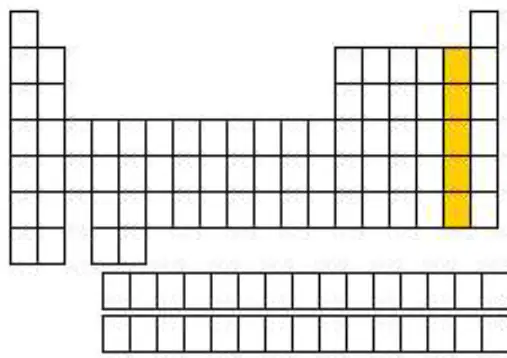
In the periodic table diagram, the far-right vertical group is highlighted. These are the
none of these
noble gases
alkaline earth metals
halogens
alkali metals
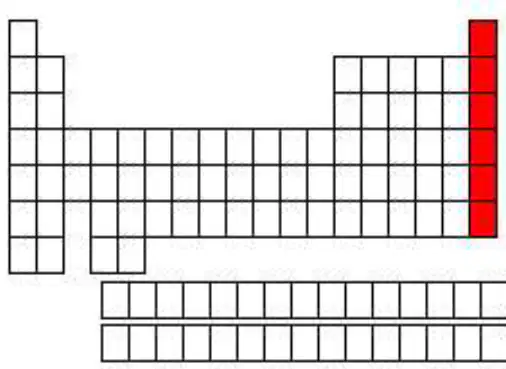
In the periodic table diagram, the far-right vertical group is highlighted. These are the
alkaline earth metals
alkali metals
halogens
none of these
noble gases
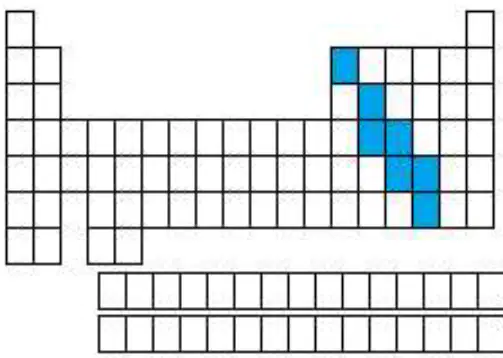
In the periodic table diagram, a staircase-shaped band along the metal–nonmetal boundary is highlighted. These elements are
nonmetals
metals
metalloids
How does the atomic radius affect the reactivity of alkali metals?
Smaller atomic radius increases reactivity
Reactivity is determined by atomic mass
Larger atomic radius increases reactivity
Atomic radius has no effect on reactivity
Which of the following generally applies to the noble gases?
high ionization energy, low electronegativity, low reactivity
high ionization energy, high electronegativity, high reactivity
low ionization energy, low electronegativity, low reactivity
high ionization energy, low electronegativity, high reactivity
What elements have zero electronegativity?
metals
nonmetals
noble gases
metalloids
Which of the following determines the identity of an element?
number of protons
atomic mass
number of neutrons
number of shells

What does the 6 represent?
Atomic mass
atomic number
chemical symbol
element name
Which of the following statements best describes the location of protons in an atom?
Protons are located in the electron cloud.
Protons are located in the nucleus.
Protons are located between the electron cloud and the nucleus.
Protons are located outside the atom.
An aluminum isotope consists of 13 protons, 13 electrons, and 14 neutrons. What is its mass number?
13
27
40
14
An aluminum isotope consists of 13 protons, 13 electrons, and 14 neutrons. What is its atomic number number?
13
27
40
14
Atoms of the same element, with different numbers of neutrons are called what?
Isomers
Replications
Isotopes
Bonded Pairs
dense center of an atom
nucleus
proton
electron cloud
electron region
What is an alpha particle?
It is a dominant particle in a subatomic world
It is a high-energy particle that has 2+ charge
It is a high-energy particle that has 2- charge
It is a helium atom with a neutral charge
Which of the following is the best evidence that the particles that make up a cathode ray had a negative charge?
The particles were produced by many different metals.
The ray was attracted toward a positive electric field.
Line emission spectra for an element are always the same.
The ray caused a phosphorescent screen to glow.
Choose one of the conclusions that Ernest Rutherford made based on the experimental results of his Gold-Foil experiment
He concluded that the atom is indivisible
He concluded that the atom is mostly empty space
He concluded that the atom has neutrons
He concluded that the atom is tightly packed with subatomic particles all mixed together
The different substances in a mixture
keep their physical properties
form new molecules
cannot be separated
combine chemically
Matter can be classified as either a __________ or a _____________.
Element or a Compound
Compound or a Solid
Pure Substance or a Mixture
Mixture or a Solid
Which of the following is an example of a compound?
Titanium
Dry Ice
Radium
Helium
Which of the following is a homogeneous mixture?
Diamond
Milk
Sulfuric Acid
Iron
Elements and Compounds are classified as _______.
Heterogeneous mixtures
Homogeneous mixtures
Pure substances
Unpure substances
Properties that DO depend on the amount of matter present.
Mass
Hardness
Extensive
Intensive
Which of the following is an extensive property?
Color
Mass
Odor
Luster
Which is an example of a chemical change?
A chemical going form a liquid to a solid
A chemical going from a solid to a gas
Bending a piece of wire until it breaks
The formation of bubbles when two chemicals are put together.
Which mixture type can also be called a solution?
Heterogeneous
Homogeneous
Elements
Compounds
AZX* --> AZX + 00 γ
alpha decay
beta positive decay
beta negative decay
electron capture
gamma decay
24094Pu —› ____ + 42He
23692U
24796Cm
24493Np
24295Am
85209At = ___ + 24He
Define nucleon number.
Number of neutrons in an atomic nucleus
Number of nucleons in an atomic nucleus
Number of protons and neutrons around a nucleus
Total number of protons and neutrons in an atomic nucleus
Any reaction that involves the particles in the nucleus of an atom are called ________?
Fission
Nuclear Reaction
Fusion
Particle Accelerator
13755Cs —› ____ + 0-1e
17872Hf
13753I
14154Xe
13756Ba
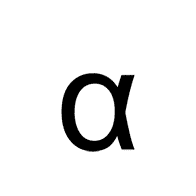
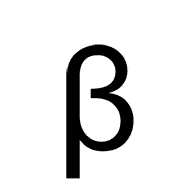
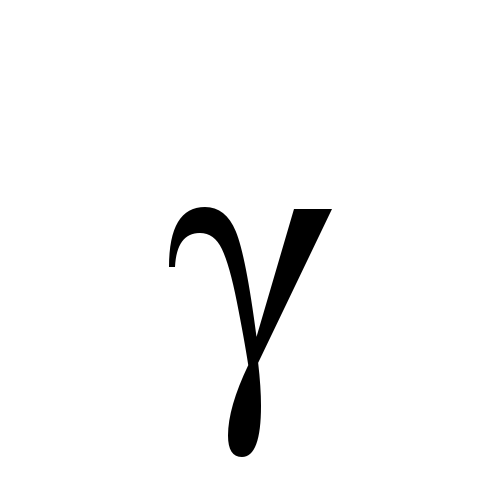
AZX --> AZ-1Y + 0+1e
alpha decay
beta positive decay
beta negative decay
electron capture
gamma decay

In a correctly written symbol what would be located in the "Z" position?
number of neutrons
atomic number
number of electrons
mass number
An alpha particle consists of...
2 protons and 2 neutrons
1 proton and 1 neutron
2 protons and 1 neutron
1 proton and 2 neutrons
Below are the correct answer of the writing of electron configuration, except... .
6f2
2p5
3d7
4s3

which of the following is the correct distribution of the last sub level in oxygen (O8) ?
a
b
c
d

Write the electron configuration
1s22s22p6
1s12s12p3
1s22s22p63s2
1s22s22p63s3
The electron configuration for Nitrogen is 1s22s22p3. What would the electron configuration of the ion look like if Nitrogen has a -3 charge?
1s22s22p6
1s22s2
1s22s22p3
1s22s22p5
The only noble gas that does not end with ns2, np6 is ………..
Radon
argon
neon
helium
The actual electronic configuration of chromium
(a)

Look at the periodic table to answer the questions
(a)

