
Font size
 Worksheets
I Trimonthly Review
Total questions: 88
Worksheet time: 44mins
What is a microorganism?
A living thing that is smaller than can be seen by the human eye.
A type of large animal found in forests.
A machine used to clean surfaces.
A visible plant in the garden.
What are prokaryotic organisms?
Cells that do not have a nucleus or membrane bound organelles.
Cells that have a nucleus and membrane bound organelles.
Multicellular organisms with specialized tissues.
Organisms that only live in extreme environments.
How do Prokaryotic organisms reproduce?
Binary Fission
Budding
Fragmentation
Spore Formation
Who was the first scientist to discover bacteria in the late 1600?
Antonie Van Leeuwenhoek
Robert Hooke
Louis Pasteur
Alexander Fleming
What are the 2 main kingdoms and their definitions in which bacteria is classified?
Archaebacteria and Eubacteria
Plantae and Animalia
Fungi and Protista
Monera and Protista
What is an anaerobic organism?
Any organism that can survive without oxygen.
Any organism that requires sunlight to survive.
Any organism that only lives in water.
Any organism that feeds on plants.
State the 3 different types of Archaebacteria and their characteristics.
Methanogens, Halophiles, Thermoacidophiles; Methanogens produce methane, Halophiles thrive in salty environments, Thermoacidophiles live in hot, acidic conditions.
Cyanobacteria, Halophiles, Thermoacidophiles; Cyanobacteria perform photosynthesis, Halophiles thrive in salty environments, Thermoacidophiles live in cold, acidic conditions.
Methanogens, Halophiles, Cyanobacteria; Methanogens produce oxygen, Halophiles thrive in fresh water, Cyanobacteria live in hot, acidic conditions.
Methanogens, Thermoacidophiles, Cyanobacteria; Methanogens produce methane, Thermoacidophiles live in cold, acidic conditions, Cyanobacteria thrive in salty environments.
What are the characteristics of “Eubacteria”? They live outside of harsh environments. They live in more conditions, often called “true bacteria”.
They live outside of harsh environments and are often called 'true bacteria'.
They only live in extreme environments.
They are multicellular organisms.
They do not survive in any environment.
A pathogen is:
a microorganism that causes disease
a type of nutrient
a harmless organism
a medicine used to treat illness
Pathogenic refers to:
An organism that causes disease
A harmless organism
A type of nutrient
A method of reproduction
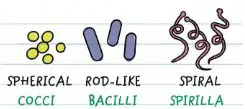
The 3 different types of classification for bacteria are:
Shape, cell wall structure, and metabolism
Color, habitat, and reproduction
Size, genetic material, and movement
Age, temperature tolerance, and nutrition
How do we call bacteria that are attached in pairs: ________
Diplo
Strepto
Staphylo
Mono
How do we call bacteria that are attached in chains: ________
Strepto
Staphylo
Spiro
Cocco
How do we call bacteria that are found in clusters: ________
Staphylo
Strepto
Bacilli
Spirochete
Based on where they are found, describe each type of bacteria:
Bacteria are classified based on their habitat, such as soil, water, or living organisms.
Bacteria are only found in water environments.
All bacteria are found exclusively in the human body.
Bacteria are classified only by their shape, not by where they are found.
Bacteria that interact closely with living organisms are called ________. What does this term mean?
symbiotic bacteria; they live in close association with another organism, often benefiting both
pathogenic bacteria; they cause diseases in living organisms
autotrophic bacteria; they produce their own food
anaerobic bacteria; they survive without oxygen
The type of medicine that kills bacteria is:
Antibiotic
Antacid
Analgesic
Antihistamine
Viruses are considered living organisms because:
They can reproduce only inside host cells and lack cellular structure, so they are not considered living organisms.
They have their own metabolism and can reproduce independently, so they are considered living organisms.
They are made up of cells and can carry out all life processes on their own.
They can move and respond to stimuli like living organisms.
What does a virus need to reproduce?
A host
Sunlight
Water
Oxygen
How do viruses reproduce?
Viruses reproduce by infecting other cells and forcing them to make more copies of the virus.
Viruses reproduce by dividing themselves like bacteria.
Viruses reproduce by growing larger and splitting into two.
Viruses reproduce by absorbing nutrients from their environment.
What are the two ways that a virus can enter a cell?
Viruses can enter the cell by having the correct ligand for the cell's membrane or by tricking the cell into thinking that it's a nutrient.
Viruses can enter the cell by photosynthesis or by producing oxygen.
Viruses can enter the cell by using cilia or flagella to swim inside.
Viruses can enter the cell by breaking down the cell wall with enzymes.
Why is the envelope able to combine with a cell membrane?
A virus's envelope has a structure similar to a cell membrane.
The envelope is made of DNA.
The envelope is a protein coat.
The envelope is a rigid structure.
What happens to the virus’s capsid when it enters the cell?
The virus’s capsid degrades when it enters the cell.
The virus’s capsid becomes stronger when it enters the cell.
The virus’s capsid replicates itself inside the cell.
The virus’s capsid remains unchanged after entering the cell.
What genetic material can viruses contain?
DNA & RNA
Only DNA
Only RNA
Proteins
What is the purpose of replication?
Replication allows the viral DNA to be copied.
Replication destroys the host cell immediately.
Replication prevents the virus from entering the cell.
Replication causes the virus to become inactive.
What additional steps do RNA viruses have to go through?
RNA viruses must go through reverse transcription, where the RNA is turned into DNA.
RNA viruses must directly translate their RNA into proteins without any processing.
RNA viruses must undergo mitosis before replication.
RNA viruses must convert their RNA into lipids before replication.
What is gene therapy?
The use of viruses to insert helpful genes into humans.
A method to increase muscle strength using drugs.
A technique for cloning animals.
A process to remove genes from plants.
What is a pathogen?
A pathogen is an agent that can cause disease.
A pathogen is a type of nutrient essential for growth.
A pathogen is a harmless organism found in water.
A pathogen is a device used to measure temperature.
What prevents disease in humans?
The immune system.
The digestive system.
The skeletal system.
The respiratory system.
What happens when a foreign organism enters the body of a human?
The immune system tries to kill the microorganism and remove it from the body.
The body ignores the microorganism and does nothing.
The microorganism immediately becomes part of the body.
The body helps the microorganism to grow and multiply.
What happens to the body the longer a pathogen is present?
The longer a pathogen is present, the more likely it is a disease will result.
The longer a pathogen is present, the less likely it is a disease will result.
The longer a pathogen is present, the body becomes immune to all diseases.
The longer a pathogen is present, the body instantly recovers from illness.
What is a disease?
A disease is any condition that prevents an organism from functioning normally.
A disease is a type of food that provides energy.
A disease is a tool used for building houses.
A disease is a form of entertainment.
What determines the symptoms that an infected organism goes through?
The type of pathogen determines the symptoms.
The age of the organism determines the symptoms.
The color of the organism determines the symptoms.
The weather determines the symptoms.
What are the symptoms of bumblefoot?
Swelling on the pads of chicken feet.
Loss of feathers on the wings.
Redness around the beak.
Cloudy eyes.
What do pathologists study?
Pathologists study disease and their causes.
Pathologists study weather patterns.
Pathologists study ancient civilizations.
Pathologists study animal behavior.
What medicine helps the body fight viruses?
An antiviral drug.
An antibiotic.
A painkiller.
A vitamin supplement.
What is the purpose of sterilization?
The purpose of sterilization is the killing or removal of all microorganisms from a surface.
The purpose of sterilization is to increase the growth of microorganisms.
The purpose of sterilization is to add nutrients to a surface.
The purpose of sterilization is to change the color of a surface.
What is evolution?
Change and development of an organism’s heritable traits that occurs over the span of many generations.
Sudden appearance of new species without any prior ancestors.
Growth and increase in size of an organism during its lifetime.
Adaptation of an organism to its environment without genetic change.
What influences evolution?
The environment.
The color of textbooks.
The shape of buildings.
The taste of water.
What are the 4 different sources of evidence for evolution?
Fossils, Geography, Embryology, Anatomy.
Fossils, Chemistry, Genetics, Astronomy.
Geography, Physics, Anatomy, Mathematics.
Embryology, Anatomy, Botany, Meteorology.
What are fossils?
The remains or impressions of a prehistoric organism preserved in petrified form as a mold or cast in rock.
A type of mineral found in caves.
A modern animal living in forests.
A type of rock formed from lava.
What do they study?
Age, location, environment, where was it found, sequences.
Only the color of the specimen.
Just the size and weight.
The weather on the day it was found.
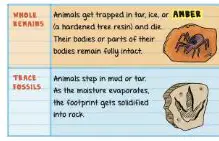
Mention the different kinds of fossils and their definitions.
MOLD REMAINS: Animals get trapped in tar, ice, or amber as hardened resin from old trees. Their bodies or parts of their bodies remain fully intact. TRACE FOSSILS: Animals step in mud or as the moisture evaporates, the footprint gets solidified into rock.
CAST FOSSILS: Fossils formed when minerals fill the mold and harden, creating a replica of the organism.
BODY FOSSILS: Fossils that include actual parts of the organism, such as bones, teeth, or shells.
CHEMICAL FOSSILS: Fossils that are formed from chemical traces left by ancient organisms in rocks.
Geography helps us understand evolution by:
Showing how physical barriers lead to species diversification.
Explaining the chemical composition of living organisms.
Describing the process of photosynthesis in plants.
Identifying the genetic code of different species.
Embryology suggests that evolution is supported by similarities in the early development of different species.
It shows that all species develop in exactly the same way.
It suggests that evolution is supported by similarities in early development.
It proves that evolution does not occur.
It indicates that species are unrelated.
Homologous structures are:
structures in different species that have similar anatomy due to shared ancestry
structures that perform the same function but have different evolutionary origins
body parts that look similar but have different functions
features that arise due to convergent evolution
Analogous structures are:
structures in different species that have similar functions but different evolutionary origins
structures in different species that have the same evolutionary origin and function
structures that are identical in form and function across all species
structures that have no function in any species
Vestigial structures are:
organs that have lost their original function through evolution
structures that are essential for survival
parts of the body that are always visible
organs that develop only in adulthood
The contributions of each of the following scientists were:
Their discoveries and inventions in their respective fields.
Their work in ancient philosophy.
Their contributions to literature and art.
Their involvement in political movements.
Who was Charles Darwin?
English naturalist, geologist and biologist, known as the Father of Evolution, proposed the theory of natural selection.
French mathematician, known for his work in geometry and calculus.
German physicist, famous for the theory of relativity.
Italian artist and inventor, renowned for painting the Mona Lisa.
Where did he make his greatest contributions for evolution?
In the Galapagos Islands
In the Amazon Rainforest
In the Sahara Desert
In the Himalayas
How was his ship called?
HMS Beagle
HMS Victory
Santa Maria
Endeavour
What is natural selection?
Mechanism by which individuals that have inherited beneficial adaptations produce more offspring than do other individuals.
Process by which all individuals in a population become identical.
Random changes in the DNA of an organism.
Method by which organisms choose their own traits.
What is artificial selection?
Process by which humans modify a species by breeding it for certain traits.
Natural process by which species evolve without human intervention.
Process by which organisms are selected randomly for reproduction.
Process by which environmental factors determine the traits of a species.
Where did Charles Darwin publish his findings?
In the book the Origin of Species.
In the journal Nature.
In the book The Double Helix.
In the magazine Scientific American.
What are the 4 conditions for natural selection to occur?
Variation - Individuals within a population differ
Descent with modification - the differences are at least, in part, passed from parents to offspring.
Overproduction - some individuals are more successful at surviving and reproducing than others.
Adaptation - the successful individuals succeed because of variant traits they have inherited and will pass into their offspring.
Natural selection acts of what?
Acts on traits that already exist.
Acts only on newly formed traits.
Acts on traits that are not inherited.
Acts on traits that do not affect survival.
What are the different types of adaptation?
Morphological - In structure or color that aids survival.
Physiological - jobs of body parts, controlling life processes, that aid survival.
Behavioral - An action that aids survival (mimicry).
The primate group includes what type of mammals?
Monkeys, Apes, Lemurs.
Cats, Dogs, Horses.
Whales, Dolphins, Seals.
Bats, Moles, Shrews.
Fill in the summary table to explain how each characteristic benefits primates. Characteristic: Flexible fingers and opposable thumb How is beneficial: ________
Can curl to grip objects firmly. They can swing from branch to branch.
Helps them run faster on the ground.
Allows them to see better at night.
Makes their fur thicker for warmth.
Fill in the summary table to explain how each characteristic benefits primates. Characteristic: Freely-rotating arms
Allows for greater flexibility and movement; makes primates well-suited for climbing.
Limits movement and makes climbing difficult for primates.
Reduces the ability to grasp objects securely.
Prevents primates from swinging between trees.
Fill in the summary table to explain how each characteristic benefits primates. Characteristic: Binocular vision How is beneficial: ________
Enhances clarity and depth perception, gives primates excellent eye-hand coordination, which allows them to precisely move through trees.
Improves hearing ability, allowing primates to detect predators from a distance.
Increases sense of smell, helping primates locate food sources more easily.
Strengthens limb muscles, enabling primates to run faster on the ground.
Fill in the summary table to explain how each characteristic benefits primates. Characteristic: Well-developed cerebrum How is beneficial: ________
Allows for more complex behaviors than are found in other mammals, which include elaborate social networks, caring for young, and even warfare between rival groups.
Improves the ability to digest tough plant material.
Enhances the strength of limb muscles for climbing.
Increases the speed of running compared to other mammals.
Mention the two major groups of primates, give an example and 1 characteristic.
The two major groups of primates are prosimians and anthropoids; an example of a prosimian is a lemur, which has a long tail.
The two major groups of primates are marsupials and rodents; an example of a marsupial is a kangaroo, which has a pouch.
The two major groups of primates are carnivores and herbivores; an example of a carnivore is a lion, which has sharp teeth.
The two major groups of primates are reptiles and amphibians; an example of a reptile is a snake, which has scales.
Which two hominid species are considered “human”? There are two hominis species in the genus Homo: Homo neanderthalensis and Homo sapiens.
Homo neanderthalensis and Homo sapiens
Homo erectus and Homo habilis
Australopithecus afarensis and Homo erectus
Homo habilis and Australopithecus africanus
The dwelling primate group that possesses prehensile tails is:
Old World monkeys
New World monkeys
Apes
Lemurs
Which primate is most closely related to human beings?
Chimpanzee
Gorilla
Orangutan
Baboon
The hominid species that first showed signs of bipedalism is:
Australopithecus afarensis
Homo sapiens
Neanderthal
Homo erectus
The first hominid species to migrate out of Africa was:
Homo erectus
Homo sapiens
Australopithecus afarensis
Neanderthal
The hominid species most related to modern H. sapiens is:
Homo neanderthalensis
Australopithecus afarensis
Homo erectus
Paranthropus boisei
The first hominid species to make and use tools was:
Homo sapiens
Australopithecus
Homo habilis
Neanderthals
H. sapiens evolved from which hominin species?
Homo erectus
Homo neanderthalensis
Australopithecus afarensis
Homo habilis
What is allele frequency and how is it calculated?
Allele frequency measures how common a certain allele is in a gene pool and is calculated by dividing the number of times an allele occurs by the total number of alleles.
Allele frequency is the ratio of dominant to recessive alleles in a population and is calculated by multiplying the number of dominant alleles by the number of recessive alleles.
Allele frequency refers to the number of genes in a chromosome and is calculated by dividing the total number of chromosomes by the number of alleles.
Allele frequency is the percentage of individuals with a specific genotype and is calculated by dividing the number of individuals with that genotype by the total population.
Mention how each source provides genetic variation:
a. Mutation - can produce new alleles. Mutations in reproductive cells can be passed on to offspring. b. Recombination - forms new genetic combinations that are passed on to offspring. c. Hybridization - New genetic information can be introduced into populations when species mate with other closely-related species.
a. Mutation - only affects physical appearance and cannot be inherited. b. Recombination - does not change genetic combinations. c. Hybridization - does not introduce new genetic information.
a. Mutation - always results in harmful effects. b. Recombination - only occurs in plants. c. Hybridization - only happens in laboratory settings.
a. Mutation - can only occur due to environmental factors. b. Recombination - prevents genetic variation. c. Hybridization - reduces genetic diversity.
How is a gene pool like a pool of genes?
It contains all of the genes/alleles of all the individuals in a population.
It is a physical pool where genes are stored.
It only contains dominant genes.
It refers to a group of genes found in water.
What does allele frequency measure?
How common a certain allele is in a gene pool.
The total number of genes in a population.
The rate of mutation in a species.
The number of chromosomes in a cell.
What is a normal distribution of traits?
A type of distribution in which the frequency is highest near the mean and decreases toward each extreme.
A distribution where all values are equally likely.
A distribution with only two possible trait values.
A distribution where the frequency is lowest at the mean and highest at the extremes.
What can you learn from looking at a phenotypic distribution?
How common each phenotype is in the population; whether or not the population is undergoing natural selection for that trait.
The exact genetic sequence of each individual in the population.
The environmental conditions affecting the population.
The evolutionary history of the species.
For the following type of selection, mention how it works and represent its graph: Type of Selection: Directional selection
Directional selection favors phenotypes at one extreme of a trait’s range; the graph shows a normal distribution shifted either to the right or left.
Directional selection favors phenotypes at both extremes; the graph shows two peaks at both ends of the trait’s range.
Directional selection favors the average phenotype; the graph shows a peak in the center of the trait’s range.
Directional selection results in random changes in phenotype frequency; the graph shows no clear pattern.
The observable change in allele frequencies over time is called _________.
microevolution
macroevolution
mutation
genetic drift
During stabilizing selection, the intermediate phenotype is selected for.
True
False
During disruptive selection, both extreme phenotypes are selected for.
True
False
During directional selection, the mean phenotype changes.
True
False
Gene flow can result in changes in allele frequency by:
introducing new alleles into a population
removing all alleles from a population
preventing any genetic variation
ensuring allele frequencies remain constant
Smaller populations are more affected by genetic drift because:
random changes in allele frequencies have a greater impact
natural selection is stronger in small populations
mutation rates are higher in small populations
gene flow is more frequent in small populations
Sexual selection can lead to highly exaggerated traits among males because:
Females prefer males with more pronounced traits, increasing their chances of reproduction.
Exaggerated traits help males avoid predators more effectively.
Males with exaggerated traits are less likely to compete for resources.
Exaggerated traits allow males to live longer than females.
The two types of genetic drift are:
Founder effect and bottleneck effect
Natural selection and mutation
Gene flow and genetic recombination
Directional selection and stabilizing selection
The two types of sexual selection are:
Intersexual selection and intrasexual selection
Natural selection and artificial selection
Directional selection and stabilizing selection
Disruptive selection and balancing selection

