
 Worksheets
Health Unit 4 Study Guide: Terms and Structures
Total questions: 44
Worksheet time: 22mins
Which term describes the process of sweating?
Perspiration
Plasma
Mastication
Atrophy
What is muscle tone?
The amount of tension in a muscle
Inflammation of the stomach lining
Colorless fluid part of blood
Waste away of tissue
Which blood component is the colorless fluid in which other parts are suspended?
Plasma
Red blood cells
White blood cells
Platelets
Gastritis is best defined as which condition?
Inflammation of the protective lining of the stomach
Clouding of the normally transparent lens
Spots containing extra melanin
Crystallized salt and calcium in urine
Which structure is a strong, flexible connective tissue?
Cartilage
Ligament
Tendon
Muscle fiber
Which step of digestion breaks down food into smaller pieces so enzymes can further digest it?
Mastication
Absorption
Elimination
Peristalsis
A compound fracture is characterized by which feature?
At least one end of the broken bone protrudes through the skin
Bone breaks but remains under the skin
Partial crack without displacement
Soft tissue injury without bone involvement
Which blood pressure range is described as "normal" in the study guide?
Below 120/80 and above 90/60
Exactly 120/80
Above 140/90
Below 90/60
Which disease is long-term and progressive, causing shortness of breath due to over-inflation of the alveoli?
Emphysema
Asthma
Bronchitis
Pneumonia
Which statement correctly describes external respiration?
Occurs in the lungs where oxygen diffuses into the blood and carbon dioxide diffuses into alveolar air
Occurs in tissues where oxygen diffuses out of blood and carbon dioxide diffuses out of cells
Regulates activities of all other glands
Filters wastes and adjusts the amount of salt and water
Which organ filters wastes and adjusts the amount of salt and water in waste depending on the body's needs?
Kidneys
Liver
Spleen
Pancreas
Which gland is known as the Master Gland because it regulates and controls the activities of all other glands?
Pituitary gland
Thyroid gland
Adrenal gland
Pineal gland
Which canal connects the middle ear to the nasopharynx?
Eustachian tube
External auditory canal
Vestibule
Semicircular canal
Match the skin structure to its description: Which layer is the outer, thinner layer composed of living and dead cells?
Epidermis
Dermis
Melanin
Hypodermis
Which part of the outer ear channels sound waves into the external auditory canal?
Auricle
Cochlea
Eardrum
Vestibule
Which inner ear structures are primarily responsible for balance?
Vestibule and semicircular canals
Cochlea and auricle
Eardrum and external auditory canal
Eustachian tube and cochlea
Which nervous system division includes the brain and spinal cord?
Central Nervous System
Peripheral Nervous System
Autonomic Nervous System
Somatic Nervous System
Which function is NOT part of the digestive system, based on the listed functions?
Gas exchange
Digestion
Absorption
Elimination
Which urinary system structure is NOT included in the list?
Ureters
Bladder
Urethra
Gallbladder
Which blood cells carry oxygen and contain hemoglobin?
Red blood cells
White blood cells
Platelets
Plasma cells
Which photoreceptor is very sensitive to light and allows us to see in dim conditions?
Rods
Cones
Pupil
Retina
Which muscle type forms the wall of the heart and is involuntary?
Cardiac muscles
Skeletal muscles
Smooth muscles
Flexor muscles
Which bone category includes the humerus, radius, ulna, femur, tibia, and fibula?
Long bones
Short bones
Flat bones
Irregular bones
Which system circulates blood to carry oxygen and nutrients to body cells and remove carbon dioxide and waste?
Cardiovascular system
Lymphatic system
Endocrine system
Urinary system
Which pituitary lobe is identified as the front lobe that produces six hormones?
Anterior lobe
Intermediate lobe
Posterior lobe
Adrenal medulla
Which option correctly lists the steps in the RICE procedure used for acute soft-tissue injuries?
Rest, Ice, Compression, Elevation
Reduce, Inspect, Close, Evaluate
Rest, Immobilize, Cool, Elevate
Relax, Ice, Constrict, Elevate
According to the concept note, what is the primary purpose of your nails?
Aid in gas exchange within fingertips
Protect and support the tissues of the fingers and toes
Increase dexterity by reducing friction
Store calcium needed for bone growth
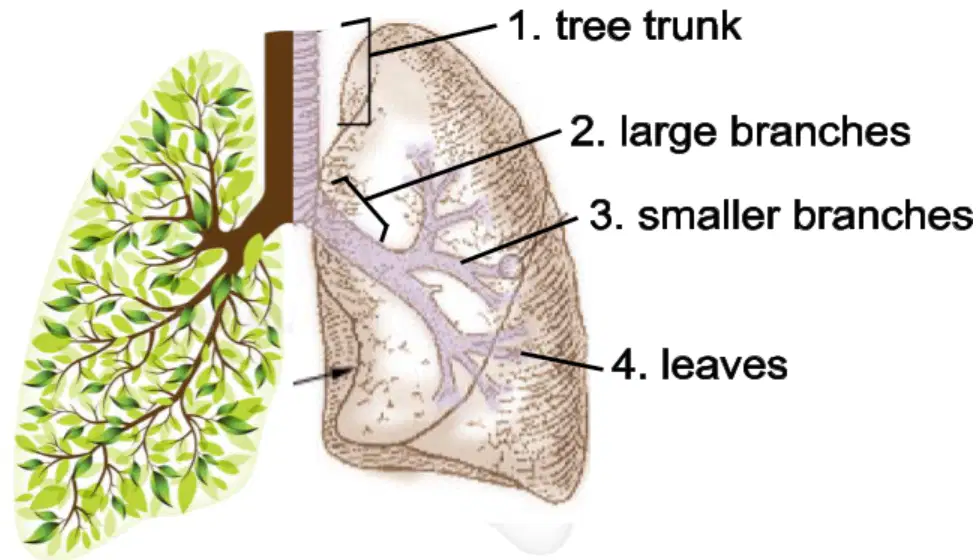
Which structure is best matched to the smaller branches labeled 3 in the diagram of the upside-down tree analogy?
Bronchi
Bronchiole
Trachea
Alveoli
A student sprains an ankle during practice. Applying RICE, which action specifically reduces swelling by countering fluid accumulation?
Rest to avoid further damage
Ice to slow local blood flow
Compression to limit edema
Elevation to improve strength
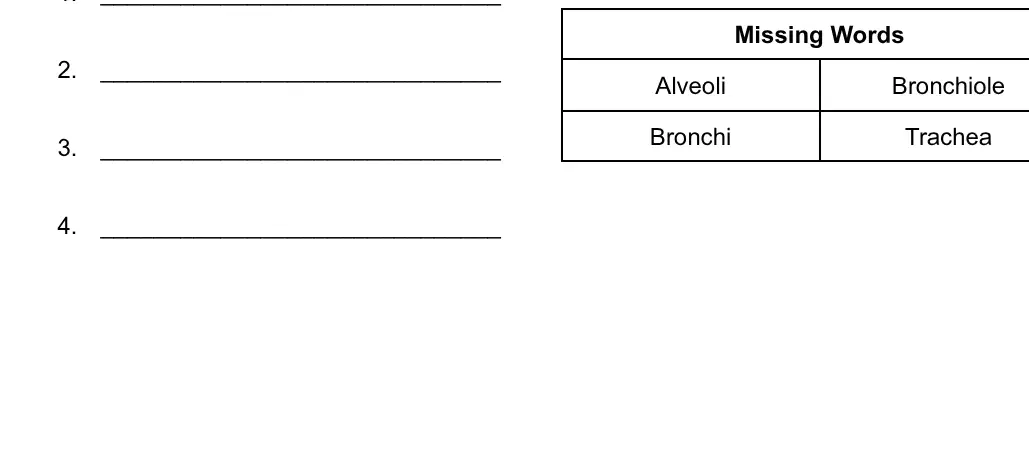
Consider the pathway of air using the upside-down tree analogy. Which sequence correctly traces airflow from entry to gas exchange?
Alveoli → Bronchi → Bronchiole → Trachea
Trachea → Bronchi → Bronchiole → Alveoli
Bronchiole → Trachea → Bronchi → Alveoli
Bronchi → Trachea → Bronchiole → Alveoli
According to the diagram showing the blood pathway, which structure receives blood from the right ventricle before it travels to the lungs?
Aorta
Pulmonary artery
Vena cava
Left atrium
Which statement best describes the function of rods in the human eye?
Rods detect color in bright light conditions.
Rods are very sensitive to light and allow vision in dim light.
Rods regulate the amount of light entering through the pupil.
Rods focus light onto the retina for sharp images.
What is the primary role of melanin in the skin, as stated in the material?
Melanin transports oxygen to skin cells.
Melanin gives the skin, hair, and eyes their color.
Melanin filters pathogens from the blood.
Melanin increases the eye’s focusing power.
Which structure is the opening that allows light to reach the inner eye?
Iris
Lens
Pupil
Cornea
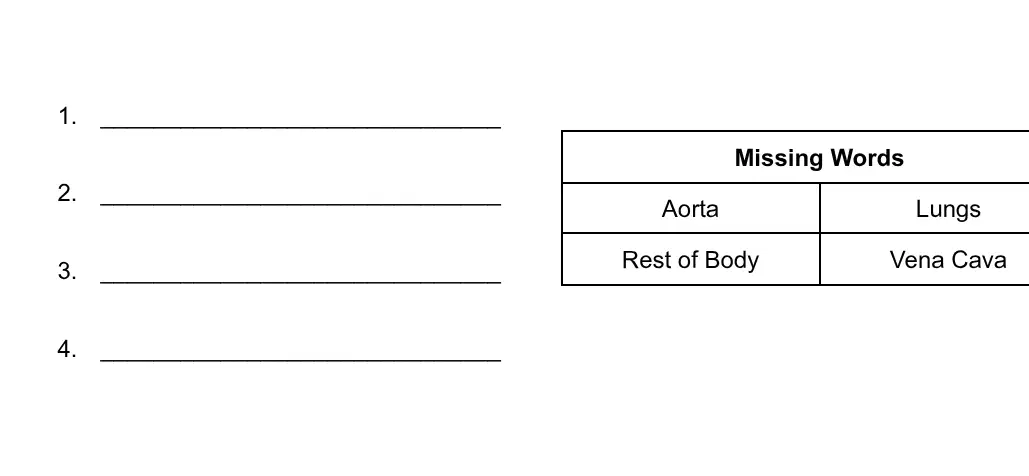
In the circulation diagram, which labeled destination completes box 1 (the first red-outlined box) using the provided word bank?
Aorta
Lungs
Rest of Body
Vena Cava
Which option correctly completes box 2 (the purple-outlined box) in the flowchart pathway using the word bank?
Aorta
Lungs
Rest of Body
Vena Cava
Which word from the bank best completes box 3 (the lower red-outlined box) to show blood returning to the heart after circulating through tissues?
Aorta
Lungs
Rest of Body
Vena Cava
Which structure is identified as the body’s largest sense organ?
Skin
Tongue
Retina
Cochlea
What process best explains how a dental cavity is formed?
Plaque made of bacteria, acid, food debris, and saliva clings to teeth; its acids dissolve enamel creating holes
Tooth nerves die after repeated chewing, leaving gaps in dentin
Calcium is leached from teeth by saliva, thinning enamel over time
Sugar directly drills holes through enamel without bacterial involvement
Auditory ossicles are described as three bones in either middle ear that are among the smallest in the human body. Which set correctly names their location and general characteristic?
Located in the middle ear; very small bones
Located in the inner ear; primarily cartilaginous
Located in the outer ear; largest bones
Located in the nasal cavity; medium-sized bones
Which statement distinguishes constipation from diarrhea?
Constipation involves difficulty having a bowel movement; diarrhea involves frequent bowel movements
Constipation involves frequent bowel movements; diarrhea involves difficulty passing stool
Constipation and diarrhea both involve no change in bowel frequency
Constipation is defined by watery stools; diarrhea by hard stools
Which function is correctly attributed to red blood cells?
Carry oxygen and contain hemoglobin
Produce digestive enzymes for the stomach
Filter metabolic wastes from blood
Transmit electrical impulses through nerves
Which description best captures the role of the kidneys in maintaining homeostasis?
Filter wastes and adjust salt and water in waste based on the body’s needs
Secrete acid and enzymes that digest food
Carry oxygen using hemoglobin
Inflame the bursa to reduce friction
A student compares the cardiovascular and lymphatic systems. Which conclusion aligns with the provided material’s emphasis on their similarities?
They share transport functions moving fluids and materials throughout the body
They both secrete digestive acids into the stomach
They are exclusively responsible for bone formation
They function only in hearing via the middle ear ossicles

