
 Worksheets
Economic Efficiency: Productive and Allocative
Total questions: 134
Worksheet time: 1hrs 7mins
Which statement best defines economic efficiency in this section?
Using scarce resources to maximize total output
Producing goods at the highest possible price
Equalizing total cost and total revenue
Eliminating opportunity cost from production
According to the text, productive efficiency occurs when a firm is producing at which cost condition?
At the lowest possible average cost
Where marginal cost equals price
At the highest possible marginal cost
Where total cost equals total revenue
Which condition characterizes allocative efficiency as described?
Price equals marginal cost
Average total cost equals marginal cost
Price equals average total cost
Marginal cost equals total cost
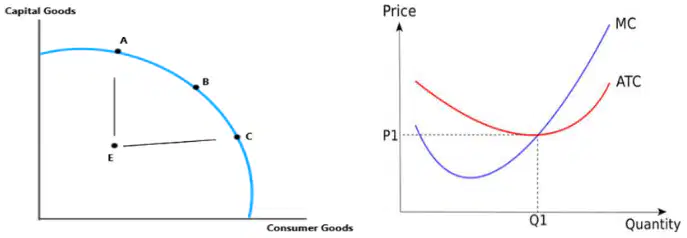
On the Production Possibility Curve (PPC), where does productive efficiency exist according to the section?
On the frontier/border of the PPC
At any point inside the PPC
At the midpoint between capital and consumer goods
Only at the extreme point with maximum consumer goods

Which market structure is described as pushing firms to long-run equilibrium at quantity q and price p, achieving the lowest average cost?
Perfect competition
Monopolistic competition
Oligopoly
Monopoly
In the provided table of price and marginal cost, which quantity is allocatively efficient? Price per unit is constant at 6; marginal cost per unit increases from 3 to 7 across quantities 1–5.
Quantity 2
Quantity 3
Quantity 4
Quantity 5
Why cannot allocative efficiency be expressed using a PPC curve according to the material?
Because allocative efficiency depends on price equaling marginal cost, not just physical production combinations
Because PPCs only show consumer goods and ignore capital goods
Because PPCs assume zero opportunity cost
Because PPCs require monopolistic pricing

In the supply and demand diagram where S = MC and D = MU, what condition marks the allocatively efficient quantity Q1?
Marginal utility equals marginal cost
Average total cost equals marginal cost
Price is below marginal cost
Marginal utility exceeds marginal cost
Which statement best defines Pareto Optimality in economic terms?
A condition where total output is maximized regardless of individual outcomes
A situation where it is impossible to make someone better off without making someone else worse off
An allocation in which government redistributes income to reduce inequality
A market setting where prices equal marginal cost for every firm
According to the concept of Dynamic Efficiency, which outcome signals successful reallocation of resources over time?
Output increases less than the increase in resources employed
Output increases relative to the increase in resources, reflecting productivity gains
Resources remain fixed while output rises due to inflation
Costs rise faster than output due to technological inertia

A firm adopts new production processes in response to competitive pressures and invests to meet changing market needs. What long-run cost effect is most consistent with dynamic efficiency?
The LRAC curve shifts upwards, raising costs at each output level
The LRAC curve becomes flatter but at the same average cost level
The LRAC curve shifts downwards, reducing average costs at each output level
The LRAC curve disappears because costs are no longer relevant
If a resource allocation is not Pareto efficient, what does the material imply about potential changes to improve economic efficiency?
No changes are possible without harming someone
There is scope for improvement, but compensation may be needed for negatively affected individuals
Only government intervention can restore efficiency in the long run
Efficiency can improve only by reducing total output
Which statement best defines market failure as used in economics?
A situation where government sets prices above equilibrium, creating shortages
When a free market fails to make optimum use of scarce resources and does not achieve productive or allocative efficiency
Any outcome in which demand exceeds supply in the short run
A market where producers cannot cover average costs, leading to exit
Which of the following is listed as a reason for market failure related to information?
External marginal benefits
Information failure exists
Positive consumption externalities
Provision of merit goods
According to the material, abuse of monopoly power in the market is categorized as which type of issue?
A cause of oversupply only
A reason for market failure
A type of positive externality
A form of merit good provision
Social Costs are defined as which formula?
Social Costs = Private Costs − External Costs
Social Costs = Private Costs + External Costs
Social Costs = External Costs − Private Costs
Social Costs = Private Costs × External Costs
Which definition correctly matches Private Costs?
Costs borne by all of society due to a particular action
Costs incurred and paid for by third parties not involved in the action
Costs incurred by an individual who produces a good or service
The change in the cost to parties other than the producer or buyer
Marginal Social Costs are computed as:
Private Marginal Costs + External Marginal Costs
Private Costs + External Costs
Marginal Private Benefits + Marginal External Benefits
Average Private Costs + Average External Costs
Which statement best describes External Marginal Costs?
The change in the producer's total cost due to producing an additional unit
The change in the cost to parties other than the producer or buyer due to production of an additional unit
The total cost society pays for the production of another unit
The marginal benefit experienced by consumers from one more unit
Social Benefits are defined by which relationship?
Social Benefits = Private Benefits × External Benefits
Social Benefits = Private Benefits + External Benefits
Social Benefits = External Benefits − Private Benefits
Social Benefits = Private Benefits ÷ External Benefits
Which statement indicates the presence of positive externalities according to the material?
If private benefits exceed social benefits
If social benefits rise more than private
If external costs are negative
If marginal private benefits equal marginal external benefits
Marginal Social Benefits are calculated as:
Marginal Private Costs + External Marginal Costs
Marginal Private Benefits + Marginal External Benefits
Total Social Benefits − Total Private Benefits
Average Private Benefits + Average External Benefits
Which description correctly defines Externalities?
Benefits and costs that are internalized by producers only
Side effects on third parties not involved in the action, arising from producers’ or consumers’ actions
Government taxes that change producer incentives
A market condition where equilibrium is always efficient
Which pairing correctly matches externality type with its impact?
Negative Externalities: side effects that benefit third parties
Positive Externalities: side effects that impose costs on third parties
Negative Externalities: side effects that negatively impact and impose costs on third parties
Positive Externalities: effects with no impact on third parties
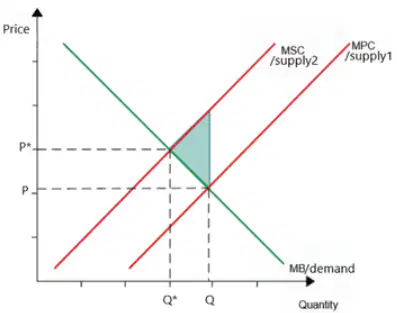
According to the diagram showing negative externalities of production, which curve represents the current level of supply before acknowledging social costs?
Marginal Private Cost (MPC) / Supply1
Marginal Social Cost (MSC) / Supply2
Marginal Social Benefit (MSB) / Demand
Marginal Private Benefit (MPB) / Demand
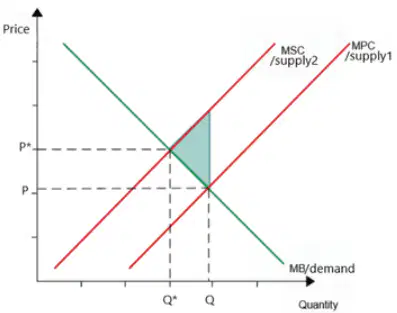
When negative externalities of production are not acknowledged, what immediate market outcome occurs as described in the text accompanying the supply-and-demand graph?
Firms undervalue and underproduce, moving price below equilibrium
Firms overvalue and overproduce, creating a disequilibrium
Consumers overvalue benefits, increasing demand beyond equilibrium
Government sets price controls to eliminate all deadweight loss
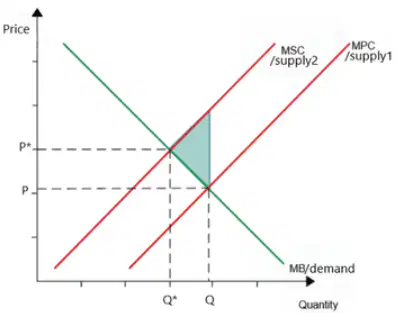
In the negative externality diagram, government intervention shifts the supply curve. Which direction does the shift occur and what happens to P and Q?
Supply shifts right; P decreases to P* and Q increases to Q*
Supply shifts left; P increases to P* and Q decreases to Q*
Supply shifts right; both P and Q increase beyond equilibrium
Supply shifts left; both P and Q decrease below equilibrium
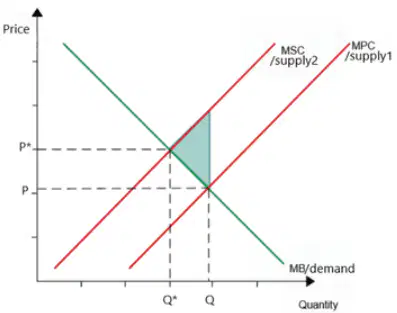
Which visual indicator marks deadweight welfare loss in both diagrams?
A rectangle between price lines
A triangle between socially optimal and private curves
A circle at the intersection of demand and supply
A vertical line showing the quantity constraint
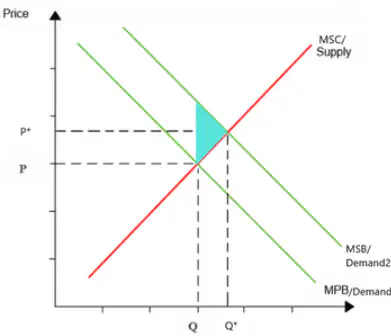
In the diagram focusing on positive externalities of consumption, what happens when positive externalities are not acknowledged?
Consumers undervalue benefits, producers underproduce, and the market is in disequilibrium
Consumers overvalue benefits, producers overproduce, and the market is efficient
Firms face higher social costs and raise prices to P*
Demand shifts left immediately due to taxation
Upon acknowledging positive externalities through government intervention, how does the demand curve shift and what are the resulting changes in P and Q?
Demand shifts left; P falls to P* and Q falls to Q*
Demand shifts right; P rises to P* and Q rises to Q*
Demand shifts right; P falls to P* while Q rises to Q*
Demand shifts left; P rises to P* and Q rises to Q*
Which statement best defines asymmetric information in an economic transaction?
Both parties possess identical and complete knowledge about the good or service.
One party holds greater material knowledge than the other, leading to an information imbalance.
Buyers have more preferences than sellers, creating market power.
Information is perfectly available but difficult to process for both parties.
Moral hazard most accurately refers to which situation?
Insured or protected individuals take greater risks because another party bears part of the cost.
Consumers misinterpret price signals due to inflation.
Sellers hide defects to charge higher prices.
Buyers and sellers negotiate with equal information and share risk fairly.
Which example best illustrates adverse selection as described in the material?
A patient honestly reporting all symptoms to receive a precise diagnosis.
An insured individual drives more carefully after purchasing comprehensive coverage.
An applicant for health insurance withholds information about smoking and drinking at the time of the policy sale.
A firm reduces prices after learning competitors’ costs.
According to the table of consequences, which is identified as a positive consequence of asymmetric information?
People are taken advantage of, lowering living standards.
Specialisation is encouraged, supporting trade and the division of labour.
Adverse selection occurs, generating negative externalities.
Information is withheld purposefully to mislead buyers.
Which statement distinguishes information failure in moral hazard from information failure in adverse selection, based on the examples provided?
Moral hazard involves purposeful withholding of information, while adverse selection is accidental.
Moral hazard arises when the protected party is more informed than the seeker of advice, whereas adverse selection involves information being withheld or portrayed inaccurately at the time of sale.
Adverse selection occurs after a transaction, while moral hazard only occurs before the transaction.
Both moral hazard and adverse selection occur only when information is complete and symmetric.
Which statement best defines Cost-Benefit Analysis (CBA) in economic decision-making?
A budgeting method for tracking past expenditures only
A technique for assessing a project’s desirability by weighing monetized costs against monetized benefits
A process that sets prices based solely on competitors’ actions
A legal framework for regulating public procurement
In the staged process of CBA, which step directly involves assigning money values to identified costs and benefits?
Identification
Monetary evaluation
Forecast
Decision-making
A city considers building a park. They list all tangible and intangible effects on residents and businesses, then compare them to the opportunity cost before deciding. Which advantage of CBA is most reflected here?
Ensures all costs and benefits are considered systematically
Eliminates uncertainty in future outcomes
Removes the need for interpretation of results
Guarantees zero public expenditure
Which disadvantage aligns with the CBA forecast stage described in the material?
Identification is tough
Shadow prices complicate valuation
Uncertainty in estimation of future consequences
Increased bureaucracy during interpretation
A nonprofit uses CBA to evaluate an investment project after interpreting results. According to the table, which pairing correctly matches the step with its advantage and a likely drawback?
Decision-making: advantage—supports investment projects; disadvantage—public expenditure concerns
Interpretation: advantage—eliminates all info that is not useful; disadvantage—no bureaucracy
Monetary evaluation: advantage—shadow prices; disadvantage—most items lack market prices
Identification: advantage—only direct costs considered; disadvantage—easy to perform
Which statement best defines the short-run in production theory?
A period of less than one year for all firms
A condition where at least one factor of production is fixed while others can vary
A situation where all factors of production are variable
A market phase when prices are fixed by regulation
According to the production function Q = A F(K, L), what do K and L represent?
Capital and labour inputs
Technology and quantity
Fixed costs and variable costs
Marginal product and average product
Which statement describes the Law of Diminishing Returns (law of variable proportions)?
Adding more fixed capital always increases average product
An additional unit of input eventually leads to a fall in marginal product
Average product equals total product multiplied by labour
Marginal product rises indefinitely as inputs increase
Total product is defined as:
Output per unit of a variable factor
The addition to output from one more unit of input
The total output a firm produces within a given period using given inputs
Total fixed cost plus total variable cost
Which cost remains constant with output in the short run and is depicted as a horizontal line in the cost graph?
Total variable cost (TVC)
Total cost (TC)
Average variable cost (AVC)
Total fixed cost (TFC)
Using the provided cost graph, which curve starts at the level of total fixed cost and follows the shape of the total variable cost because it combines both?
Average fixed cost (AFC)
Total cost (TC)
Marginal cost (MC)
Average total cost (ATC)
Which formula correctly expresses marginal cost?
MC = total fixed cost ÷ output
MC = change in cost ÷ change in quantity
MC = total cost ÷ output
MC = total variable cost ÷ output
Which set of average cost curves is shown in the second cost diagram and typically U-shaped in the short run due to diminishing returns?
AFC, AVC, ATC, and MC
TFC, TVC, and TC only
ATC and AVC only
Marginal product and average product
Recall: Which statement best defines an isoquant in production theory?
A curve showing combinations of inputs that yield a specific output level
A curve showing consumer utility levels for various goods bundles
A schedule of average costs at different output levels
A line where marginal cost equals average total cost
Recall: In the example isoquant diagram with points x, y, and z, what do these points represent?
Different output levels with the same inputs
The same output level achieved with different input combinations
The lowest-cost combination of inputs
Points where marginal product of labor is zero
Skill/Concept: According to the material, what distinguishes optimum output in the short run?
It occurs where average variable cost equals average fixed cost
It is the most efficient output at the lowest unit cost
It maximizes total revenue regardless of cost
It is found where marginal revenue equals average cost
Recall: Which statement about optimum output in the long run is correct?
Optimum output is identical to profit maximisation
Optimum output is not the same as profit maximisation
Optimum output is where price equals average variable cost
Optimum output occurs only when marginal cost is zero
Skill/Concept: On the short-run average cost (SRAC) curve, the optimum output occurs where which condition holds?
Marginal cost equals average total cost at the lowest point of ATC
Marginal revenue equals marginal cost at the highest point of ATC
Average variable cost equals average fixed cost at the midpoint
Price equals average total cost at the highest point
Strategic Thinking: Explain the initial downward slope of average cost in the cup-shaped curve described. Which factor primarily causes this?
Rising marginal cost from diminishing returns
Increased efficiency and better use of fixed factors (increasing returns)
Constant returns to scale maintaining average cost
Random demand fluctuations unrelated to production
Recall: In the long run production function, what is true about factors of production?
All factors are fixed, preventing input adjustment
Only labor is variable while capital is fixed
All factors are variable, allowing input manipulation
Only capital becomes variable while labor is fixed
Skill/Concept: Which statement correctly contrasts increasing and decreasing returns to scale?
Both imply output rises slower than inputs
Increasing returns: output rises faster than inputs; Decreasing returns: inputs rise faster than output
Increasing returns: inputs rise faster than output; Decreasing returns: output rises faster than inputs
Both imply output rises proportionately with inputs
Strategic Thinking: Interpreting the LRAC envelope diagram, what does the minimum efficient scale (MES) represent?
The highest output before economies of scale begin
The lowest output level at which costs are minimized
The output level where marginal cost first exceeds average cost
The point where diseconomies of scale are eliminated
Strategic Thinking: Based on the LRAC envelope curve, how does MES affect market structure?
Low MES creates natural monopoly; high MES fragments markets
Low MES leads to a fragmented market; high MES can lead to a natural monopoly
MES has no relation to market structure
MES only affects short-run pricing, not long-run structure
Which statement best defines Economies of Scale as used in this section?
Benefits from falling long-run average costs as output scale increases
Increase in total revenue when prices rise
Short-run gains from hiring more workers without capital changes
Costs decrease only due to government subsidies
Internal Economies of Scale in this section are described as the long-run result of which decision?
To produce on a larger scale
To limit output to avoid market saturation
To switch to a different industry
To reduce product variety
What is identified as the principal advantage for a firm benefiting from economies of scale?
Reduced cost per unit produced
Higher average fixed costs
Greater reliance on manual labor
Increased advertising budgets
Which example fits Technical Economies (advantages gained directly in the production process) listed in the table?
Cost saving through online advertising and booking systems
Increase purchase power, bulk buying, cheaper inputs
Specialisations and specialists/experts
Promote at lower rates, saving in costs of distribution
Purchasing economies primarily provide which advantage according to the table?
Increase purchase power, bulk buying, cheaper inputs
Better and cheaper access to borrowed funds
Specialisations and specialists/experts
More risk-averse due to diversified conglomerate activity
Managerial economies in the table are associated with which benefit?
Specialisations and specialists/experts
Promote at lower rates
Cheaper access to inputs
Reduced distribution distances
External economies of scale are described in this section as which of the following?
Cost-saving accruals to all firms in an industry as the scale increases
Savings limited to a single firm due to internal restructuring
Short-term discounts offered by suppliers
Government subsidies to reduce taxes
Which statement captures Economies of Concentration as presented?
Increase in the power of wealth and influence of government interventions such as taxes and tariffs
Firms reduce product lines to concentrate on core goods
Workers cluster in urban areas to reduce commuting time
A rise in interest rates that concentrates borrowing costs
Economies of Technology involve what, according to the section?
Use of better and advanced technologies and sciences in relation to economic activities
Reducing technology budgets to cut fixed costs
Eliminating research staff to avoid diseconomies
Limiting automation to preserve jobs
Which benefit of external economies is labeled Egalitarian in the notes?
All businesses in an industry enjoy these economies of scale equally
Only the largest firms capture cost savings
Benefits accrue to firms that export only
Savings are restricted to firms receiving tax rebates
According to the Benefits, what industry effect is linked to Growth?
Stimulates industry growth in particular regions and encourages rapid development of support industries and the wider geographic area
Reduces wages across all sectors
Eliminates fixed costs in new firms
Restricts market entry to incumbent firms
Diseconomies of Scale are defined in the section as occurring when which condition holds?
Long-run average cost increases as the scale of output increases
Short-run marginal cost falls as output expands
Average variable cost decreases with scale
Average fixed cost rises regardless of output
Which scenario best exemplifies Technical Diseconomies described?
Inefficiencies in production when firms grow faster than they can adapt and cannot meet demand, facing scalability issues
Bulk buying lowers input prices, improving margins
Advanced technology reduces processing time across units
Diversified activity reduces risk exposure
Organisational Diseconomies in the notes emphasize which challenge?
Inefficiencies in workforce management as growth requires additional workers, causing communication and motivation issues that reduce productivity
Higher freight rates due to traffic congestion
Limited access to borrowed funds at low interest
Excess specialization that raises training costs
Which statement matches Purchasing Diseconomies?
Laxity in purchasing due to additional cash inflows causing irresponsible spending, waste, higher costs, and lack of progress
Supplier bulk discounts reduce per-unit costs
Centralized procurement streamlines approval processes
Longer-term contracts stabilize input prices
Which external diseconomy increases distribution costs according to the list?
Traffic Congestion
Land Shortages
Shortage of Skilled Labour
Higher interest rates
Which formula correctly defines Total Revenue (TR) in this context?
TR = price × quantity
TR = total cost ÷ output
TR = marginal cost × quantity
TR = average revenue − average cost
Average Revenue (AR) is best described as:
Change in total revenue when output changes by one unit
Total revenue divided by output
Price minus average cost
Total cost divided by quantity
Marginal Revenue (MR) is defined as:
Total revenue per unit of output
Change in total revenue divided by change in total output
Total cost minus total revenue
Average revenue times quantity
According to the material, when a firm wants to sell more units, which statement is correct?
It must raise price because AR is lower than MR
It only sells more by reducing price; AR is always higher than MR
It keeps price constant because MR equals AR
It increases output without changing price since demand is perfectly elastic
Which statement distinguishes the three profit types correctly?
Normal profit is excess of cost; subnormal profit equals total revenue; supernormal profit occurs when price is below average cost
Normal profit is enough to keep the firm running; subnormal profit is less than normal profit; supernormal profit is any profit in excess of normal profit
Normal profit exists only for monopolies; subnormal profit occurs when TR > TC; supernormal profit is any loss
Normal profit requires TR > TC; subnormal profit requires MR > AR; supernormal profit means price equals average cost
Which condition signals subnormal profit for a firm, based on the vocabulary provided?
P > AC
MR > AR
P < AC (price less than average cost)
TR = TC
Supernormal profit, as described, is most likely observed when:
Total revenue equals total cost and the market is perfectly competitive
Price is less than average cost for a prolonged period
Total revenue exceeds total costs (TR > TC), typically in the short term and only for monopolies
Average revenue equals marginal revenue at all outputs
Which statement best defines market structure as used in this section?
The legal ownership of resources within a country
The way a market is organised by the number of firms and barriers to entry
Government policies that regulate international trade
Methods firms use to advertise products
In the spectrum of market structures, which combination correctly pairs the extreme ends for the number of firms and control over price?
Small number of firms and full control over price on the left; large number of firms and no control on the right
Large number of firms and no control over price on the left; small number of firms and full control on the right
Large number of firms and full control over price on the left; small number of firms and no control on the right
Small number of firms and no control over price on the left; large number of firms and full control on the right
Which market structure is described as having many firms, differentiated products, and few barriers to entry?
Perfect competition
Monopolistic competition
Oligopoly
Monopoly
According to the definitions provided, a pure monopoly falls at which end of the spectrum and has how many firms?
Left end; many firms
Middle; a few firms
Right end; just one firm
Left end; two dominant firms
Which factor is listed as a barrier to entry because it is hard to achieve and deters new firms due to consumer loyalty?
Access to capital
Advertising and brand names
Patents
Sunk costs
Using the example provided, if the top four firms have market shares of 10%, 15%, 20%, and 25%, what is the concentration ratio stated?
4:60
4:70
4:80
4:90
Which interpretation about concentration ratios is consistent with the notes?
Higher concentration ratios indicate more competitive markets
Lower concentration ratios suggest closer to monopoly
Higher concentration ratios suggest more monopolistic or oligopolistic markets
Concentration ratios do not relate to market structure
Under perfect competition, which characteristic specifies the role of individual firms regarding market price?
Firms set prices through collusion
Firms influence price via advertising
Firms are price takers with no influence on market price
Firms can price discriminate to increase revenue
In perfect competition, the demand curve for a firm implies which equality?
Demand is greater than marginal revenue and less than average revenue
Demand equals average revenue and equals marginal revenue
Demand equals total revenue but not marginal revenue
Demand equals marginal cost
What happens to abnormal (supernormal) profit in the short run under perfect competition, and why?
It persists because firms can collude to restrict supply
It disappears as entry increases supply, lowering price until profits return to normal
It increases because advertising raises demand indefinitely
It remains constant because marginal revenue is fixed
What is the shutdown price in the short run for a perfectly competitive firm as stated?
P = AR = ATC
P < MR
P = AR = AVC
P = MC
Which statement best defines a contestable market?
A market where existing firms face high barriers that prevent new entry
Any market structure where potential entrants are free and able to enter, creating a credible threat to incumbents
A market with a single seller that sets price without competitive pressure
A market with government-set prices and no private firms
In a perfectly contestable market, which feature is emphasized to make the market more competitive?
Mandatory cross-subsidisation to support new entrants
Government deregulation leading to no cost of entry
Strict limits on the number and size of firms
Price floors to prevent predatory pricing
Which combination of features characterizes monopolistic competition according to the text?
Few buyers and many sellers, homogeneous products, and high barriers to entry
Numerous buyers and sellers, few barriers to entry, differentiated products, and some influence on price
Single seller, unique product, and complete control over price
Many buyers and sellers, perfect information, and zero product differentiation
Why is marginal revenue below the demand curve in monopolistic competition?
Because firms face perfectly elastic demand at the market price
Because prices are set equal to marginal cost at all output levels
Because lowering price to sell additional units reduces revenue on previous units when products are differentiated
Because government regulation caps revenue regardless of price changes
Short-run outcomes in monopolistic competition can include abnormal profit when firms produce where MC = MR. What is a likely market response described in the text?
Increased barriers to entry prevent any new firms from entering
Incentives for new firms to enter due to low barriers, intensifying competition and shifting prices toward where demand meets ATC and MC
A legal requirement that firms collude to maintain abnormal profits
Immediate exit of all incumbents due to losses
In the long run under monopolistic competition, what outcome is expected as competition increases?
Firms produce at minimum ATC, eliminating excess capacity
Firms still produce where MC = MR, demand shifts left, and profits move toward normal with excess capacity
Persistent abnormal profits due to sustained brand loyalty
Price rises and quantity expands to maintain revenue
Which set of characteristics is typical of an oligopoly as outlined in the material?
Many small firms with independent pricing and no barriers to entry
A few dominant firms, interdependent decisions, substantial barriers to entry, and possible product differentiation
Single firm, no close substitutes, and free entry
Perfectly competitive firms with identical products and perfect information
What is a common consequence of price competition in oligopolies that can lead firms to favor non-price competition?
Guaranteed increases in market share for any price cut
Price rigidity due to uncertainty and risk in aggressive price wars
Rapid elimination of barriers to entry
Mandatory government price ceilings
Which statement best describes price leadership in an oligopolistic market?
A firm with market power sets a price that competitors tend to follow.
All firms independently set prices without reacting to rivals.
Government sets a regulated price that all firms must charge.
A cartel fixes prices and output across all member firms.
According to the kinked demand curve explanation, why do oligopoly firms face limited price competition?
Demand is more elastic for price cuts than for price rises, creating a kink and discouraging unilateral price changes.
Marginal cost is perfectly constant across all output levels.
Consumers are completely indifferent to price changes in oligopolies.
Firms cannot change prices due to legal restrictions.
In the kinked demand curve diagram, what happens if a firm raises price above the prevailing equilibrium price p?
Quantity demanded falls and marginal revenue decreases as consumers switch to rivals.
Quantity demanded increases and marginal revenue rises because demand is inelastic.
Quantity demanded stays constant but marginal cost increases.
Both quantity and marginal revenue increase due to price leadership.
Why is demand described as price elastic for a price rise under the kinked demand curve?
The percentage fall in demand is greater than the percentage rise in price.
The percentage rise in demand matches the percentage rise in price.
Demand does not change when price rises.
Price rises lead to a smaller percentage fall in demand than the price increase.
When a firm cuts price below p in the kinked demand framework, what is the short-term effect if rivals initially keep their prices?
A big increase in demand and a rise in revenue for the firm.
No change in demand and a fall in revenue.
A slight decrease in quantity demanded and a rise in marginal cost.
A decrease in marginal revenue with no change in market share.
In a price war where rivals match a firm’s price cut, how is demand for the firm characterized and what happens to revenue if price falls?
Demand is price inelastic; revenue falls.
Demand is price elastic; revenue rises.
Demand is perfectly elastic; revenue stays constant.
Demand is unit elastic; revenue remains unchanged.
The payoff matrix for Company A and B (choosing 1HIGHor 0.90 LOW) illustrates which game theory concept most clearly?
Prisoner’s Dilemma with a Nash equilibrium and dominant strategy.
A cooperative cartel with guaranteed joint profit maximization.
A zero-sum game where one firm’s gain equals the other’s loss.
Price leadership with no strategic interdependence.
Based on the definition provided, what is the Nash equilibrium in the pricing game between A and B?
Both firms set 1andeachearns 3m.
Both firms set 0.90andeachearns 1m.
A sets 0.90andearns 4m while B sets 1andearns 0.5m.
A sets 1andearns 3m while B sets 0.90andearns 4m.
Which statement correctly defines a dominant strategy in this context?
An option that yields the best outcome for a player regardless of the opponent’s choice.
A strategy that only works if rivals collude.
An option that maximizes joint profits for both players.
A strategy that changes based on marginal cost fluctuations.
Why can price rigidity associated with Nash equilibrium push firms toward collusion in oligopolies?
Because non-price competition is optimal, leading firms to seek legal price-fixing.
Because stable prices may leave firms dissatisfied with payoffs, incentivizing tacit collusion or cheating.
Because Nash equilibrium always results in maximum joint profits.
Because collusion eliminates the principal-agent problem entirely.
Which statement best defines a natural monopoly based on the section’s description?
A market with many sellers where price equals marginal cost
A single supplier with a substantial cost advantage, making duplication by rivals inefficient
Any firm that earns abnormal profits in the short run
A government-owned firm that never faces competition
According to the material, what happens to prices and profits in a monopoly compared with market equilibrium in perfect competition?
Prices are lower and firms earn normal profits due to competition
Prices equal marginal cost and profits are zero in the long run
Prices are higher than equilibrium, leading to supernormal (abnormal) profits
Prices fluctuate randomly and profits cannot be predicted
Which feature distinguishes a monopolist from firms in perfect competition, as stated in the text?
Low barriers to entry and being a price taker
High barriers to entry and being a price maker
Identical products and free entry
Many small firms and perfect information
If a natural monopoly behaves like a competitive firm, what is the stated equilibrium condition and consequence?
Price equals average total cost, causing higher output and no loss
Price equals long-run marginal cost, causing price and quantity loss without subsidies
Price equals average variable cost, causing shutdown in the short run
Price equals marginal revenue, causing maximum consumer surplus
Which statement reflects the concept of X-inefficiency described in the section?
Costs are minimized due to intense competition
Typical costs exceed those in competitive markets because the firm lacks incentives to lower costs
Marginal cost equals price, indicating allocative efficiency
Average total cost falls when the firm increases the range of goods produced
What welfare implication is noted if a perfectly competitive industry becomes a monopoly?
Consumer surplus increases and allocative efficiency improves
No change in welfare due to constant marginal cost
There is a welfare loss of area x and greater allocative inefficiency
Producer surplus decreases while consumer surplus remains unchanged
Which is an example of internal growth as defined in the material?
Merging with another firm to gain market share
Retaining profit and investing it in the business to expand
Raising prices to exploit consumer surplus
Receiving a government subsidy to cover losses
What is meant by economies of scope in the growth section?
Lower average costs from producing a larger output of a single product
Reduction in average total cost made possible by increasing the range of goods a firm produces
Lower marginal cost due to technological innovation only
Cost savings achieved exclusively through mergers
Which term describes a firm expanding by joining together through takeovers or mergers?
Internal growth
External Growth
Organic expansion
Franchising
Vertical integration involves a firm merging or taking over other firms in the supply chain. Which option correctly distinguishes its two directions?
Forward integration sells to new customers; backward integration focuses on advertising
Forward integration moves toward suppliers; backward integration moves toward retailers
Forward integration moves toward the forward supply chain; backward integration moves toward the backward supply chain
Forward integration diversifies products; backward integration standardizes products
Conglomerate integration is best defined as a firm merging with or taking over another firm that is:
Producing the same product line in the same industry
Operating at a different stage of the same supply chain
Producing in an unrelated industry
A direct competitor in the same market segment
Which statement best describes horizontal integration according to the material?
A firm merges with a supplier to secure inputs
A firm buys firms in unrelated industries to spread risk
A firm merges with or takes over another firm in the same industry
A firm licenses its brand to franchisers
Which is a stated reason for firms to pursue integration?
To increase regulatory oversight on competitors
To capture resources from other businesses
To reduce customer choice by legal mandate
To avoid economies of scale
Which is identified as a negative consequence of integration?
Economies of scale and scope
Improved market knowledge
Diseconomies of scale
Access to new resources
What is the definition of a cartel provided in the material?
A legal merger of firms to increase capacity
A formal agreement between firms to limit competition by limiting output or fixing prices
An informal industry association that shares research
A government-mandated price ceiling across firms
Which example matches the description of a price-fixing cartel agreement in the text?
Members set a minimum pricing strategy and raise prices in unison while avoiding discount pricing
Members agree on delivery routes to reduce shipping times
Members share technology patents to innovate new products
Members restrict advertising to maintain brand image
According to the table of consequences, which negative outcome is associated with cartels?
Economies of scale reduce costs for consumers
Prices are set at higher margins to maximize profit
Barriers to entry discourage new entrants, reducing competition
Market share is evenly divided among regions
Which statement best explains why short-term profit maximisation may not be of interest in the long term?
It guarantees permanent monopoly power for the firm.
High profits can attract new entrants and regulatory scrutiny, risking future profitability.
It ensures stakeholders always prefer the firm over competitors.
It eliminates the need for management to set other objectives.
According to the material, which description fits the Survival objective?
A profit-centred goal focused on maximising net income each quarter.
A common early-stage goal that prioritises covering total costs so the firm continues operating.
A pricing strategy to capture market share by setting very low prices.
A plan to raise profits by cross subsidising high-output product lines.
Profit satisfying is best described as a firm’s aim to:
Maximise turnover even if MR=0.
Make a reasonable profit level that satisfies all shareholders.
Maximise the volume of sales regardless of losses.
Price discriminate to capture consumer surplus.
Sales maximisation as an objective primarily seeks to:
Increase the firm’s market share by setting MR=0.
Maximise the volume of sales, sometimes using cross subsidisation to cover ATC.
Ensure survival by keeping the firm from falling into loss.
Maximise shareholder dividends through profit satisfying.
Which outcome or policy is linked directly to revenue maximisation in the text?
Setting output where MR=0 and accepting low prices to increase turnover.
Charging different prices based on willingness to pay.
Deterring entry through price wars to keep margins high.
Cross subsidising low-revenue products from high-revenue lines to minimise losses.
Penetration pricing is referenced as a policy that:
Aims to set high introductory prices to signal quality.
Supports revenue maximisation by accepting low prices to grow market share.
Ensures survival by covering total costs without regard to profit.
Eliminates the need for cross subsidisation at high output levels.
First-degree price discrimination, as defined, focuses on:
Charging the same price to everyone to simplify billing.
Grouping consumers by observable demographics to set two-tier prices.
Setting different prices for different consumers based on their willingness to pay.
Maximising sales volume by offering uniform discounts across all products.

