
 Worksheets
Study Guide: Cell System
Total questions: 63
Worksheet time: 32mins
What is the basic unit of structure and function in living things?
Atom
Cell
Tissue
Organ
All living things are composed of _______.
cells
atoms
molecules
tissues
The specific activity, process, or role that a part of an organism, cell, or system performs is called _______.
Function
Structure
Organism
System
What something is made of and how it is put together is called _______.
Structure
Function
Material
Design
Which of the following is NOT a function of cells?
Obtain energy
Bring in nutrients and water
Get rid of waste
Produce sound
The degree to which a microscope enlarges the visual size of an object, making it appear larger than its actual size, is called _______.
Magnification
Resolution
Refraction
Illumination
The detail and clarity in an image is called _______.
Resolution
Contrast
Brightness
Saturation
Cell Theory: All living things are made up of cells.
True
False
Cell Theory: Cells are the basic units of structure and function in living things.
True
False
Cell Theory: All cells come from pre-existing cells.
True
False
Proteins are made of cells.
True
False
What is the function of the cell wall?
The cell wall is a rigid layer which surrounds, protects and supports the cell.
The cell wall produces energy for the cell.
The cell wall stores genetic material.
The cell wall helps in protein synthesis.
What is the function of the Cytoplasm in a cell?
Converts energy in food to energy used by the cell
Holds cell organelles in place, transports materials (nutrients, proteins) around the cell, helps maintain cell shape
Produces proteins needed by cell
Contains DNA and controls cell activities
Which type of cells contain Mitochondria?
Only Plant
Only Animal
Both - Plant and Animal
Neither
Ribosomes __________ needed by cell.
produce proteins
store energy
digest food
control cell division
What is the function of the Cell Membrane?
Flexible barrier that surrounds a cell and controls what enters and leaves the cell
Breaks down food particles and worn-out cell parts
Packages and distributes materials from ER
Stores food, water, waste products or other materials
Which organelle contains DNA and controls cell activities?
Nucleus
Lysosomes
Golgi Apparatus
Vacuole
Endoplasmic Reticulum makes __________ and other substances.
proteins
carbohydrates
lipids
vitamins
What is the function of the Golgi Apparatus?
Packages and distributes materials from ER (endoplasmic reticulum)
Produces proteins needed by cell
Breaks down food particles and worn-out cell parts
Contains DNA and controls cell activities
Lysosomes break down __________ and worn-out cell parts.
food particles
water molecules
oxygen
vitamins
What is the function of the cell membrane?
Lets substances in and out of cell
Produces energy for the cell
Stores genetic information
Helps in cell division
Why is it important for the cell membrane to allow substances in and out of the cell?
It allows the cell to maintain homeostasis (stable internal environment).
It helps the cell to produce energy directly from sunlight.
It allows the cell to divide rapidly without control.
It makes the cell membrane rigid and inflexible.
What is a permeable membrane?
A membrane that allows liquids and gases to pass through it.
A membrane that blocks all substances from passing through.
A membrane that only allows solids to pass through.
A membrane that is completely impermeable to water.
What does selectively permeable mean?
Some substances can cross the membrane, others cannot.
All substances can freely cross the membrane.
No substances can cross the membrane at all.
The membrane allows only water to pass through.
Passive transport involves moving materials across the cell membrane and requires no energy.
True
False
Diffusion is the process by which molecules move from an area of higher concentration to an area of lower concentration.
True
False
Osmosis is the diffusion of water across a semipermeable membrane.
True
False
Facilitated diffusion involves proteins in the cell forming channels through which large molecules like sugar can pass.
True
False
Active transport requires cellular energy.
True
False
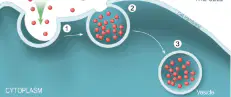
What process that takes particles into the cell?
Endocytosis
Exocytosis
digesting
repelling
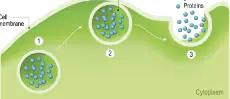
A process where a cell uses a bubble-like sac called a vesicle to export materials oute of the cell
Exocytosis
Endocytosis
Passive Transport
attach
Which of the following is NOT a function of cell division?
Repairs bones, muscle, and skin
Replaces aging or damaged cells and those that die from disease
Produces energy for the cell
Leads to growth in multi-celled organisms
Single-celled organisms reproduce through cell division (reproduction).
True
False
What happens during Prophase in mitosis?
A) Chromosomes line up in the middle of the cell
B) DNA condenses to form chromosomes and the nuclear membrane begins to break apart
C) Chromatids are pulled to opposite ends of the cells
D) Cells cytoplasm divides
During which stage of mitosis do chromosomes line up in the middle of the cell?
Prophase
Metaphase
Anaphase
Telophase
Fill in the blank: During Anaphase, fibers connected to centrioles pull chromatids ______.
apart
together
sideways
downward
How many nuclei are formed at the end of Telophase?
One
Two
Three
Four
What is the main event that occurs during Cytokinesis?
DNA condenses
Cells cytoplasm divides
Chromosomes line up
Chromatids are pulled apart
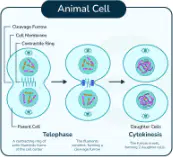
Which stage is characterized by the nuclear membrane reforming around DNA?
Telophase
Prophase
Metaphase
Anaphase
What are two functions for which cells need energy?
Making proteins and transporting substances
Making seeds and growing
Photosynthesis and respiration
Making food and breaking down sugar
Which organisms make their own food through photosynthesis?
Heterotrophs
Autotrophs
Consumers
Animals
Heterotrophs obtain energy from eating other organisms.
True
False
Where does photosynthesis take place in plants?
Mitochondria
Chloroplasts
Nucleus
Cell wall
Which of the following is NOT a factor that affects the rate of photosynthesis?
A) Sunlight
B) Water
C) Carbon dioxide
D) Oxygen
Fill in the blank: The photosynthesis equation is ______ + 6H₂O + Light → C₆H₁₂O₆ + 6O₂.
6CO₂
6O₂
C₆H₁₂O₆
6N₂
Plants use glucose for food. Name one other function for which energy from glucose is used in plants.
Growth and repair of tissues
Absorption of water from soil
Production of chlorophyll
Movement of roots towards light
Cellular respiration is the process by which plants break down sugar.
True
False
What do chloroplasts contain that allows them to absorb energy from sunlight?
Mitochondria
Chlorophyll
Glucose
Oxygen
What happens to water molecules during photosynthesis?
They are split into hydrogen and oxygen
They are converted into glucose
They are absorbed by roots
They evaporate
During photosynthesis, ______ is released as a result of splitting water molecules.
Oxygen
Carbon dioxide
Glucose
Nitrogen
What combines with carbon dioxide to create glucose (chemical energy) during photosynthesis?
Oxygen
Hydrogen
Nitrogen
Water
Breathing is the movement of ______ in and out of the lungs.
air
water
glucose
energy
What is the process cells use to convert glucose into energy called?
Photosynthesis
Respiration
Digestion
Fermentation
Respiration is used by both plants and animals to obtain energy.
True
False
Which stage of cellular respiration occurs in the cytoplasm?
Stage 1
Stage 2
Both stages
Neither stage
In which stage of cellular respiration is oxygen NOT involved?
Stage 1
Stage 2
Both stages
Neither stage
Where does Stage 2 of cellular respiration occur?
Cytoplasm
Mitochondria
Nucleus
Ribosome
The organelle in cells which creates large amounts of energy is called the _________.
mitochondria
nucleus
ribosome
chloroplast
Alcoholic fermentation produces carbon dioxide, which creates pockets of air in bread.
True
False
Muscle cells can release energy from food without using oxygen through ________ fermentation.
lactic acid
alcoholic
acetic
butyric
Which of the following is NOT a product of cellular respiration?
Carbon Dioxide
Water
Oxygen
Energy (ATP)
A student organizes a chart describing examples of different types of cellular transport that occurs in cells.
Move the correct answer to each box. Not all answers will be used.

Cells can use (a) to bring in ions or molecules when there is already a higher concentration of the ions or molecules inside the cell than outside the cell. An Example of this would be (b)

