
 Worksheets
Sens & Perc Exam 4
Total questions: 119
Worksheet time: 1hrs 1mins
Our otolith organs sense both _____ and _____.
Angular acceleration; gravity
Linear acceleration; angular acceleration
Linear acceleration; gravity
If you shake your head "no" what kind of rotation is that?
Yaw
Roll
Pitch
Where each semicircular canal joins the vestibule, there is a swelling called the _____ that contains a(n) _____, which detects angular motion in the semicircular canals.
Crista; ampulla
Ampulla; crista
Ampulla; otolith
Otolith; crista
During head rotations, the spike rate of neurons in the semicircular canals _____, with the degree of change in firing rate signaling the amplitude of the rotation.
Increases in both motion directions
Increases in one motion direction and decreases in the other direction
Decreases in both motion directions
The otolith organs consist of the _____ which allow us to detect _____.
Ampulla and crista; gravity and linear acceleration
Ampulla and crista; rotation
Utricle and saccule; gravity and linear acceleration
Utricle and saccule; rotation
In what part of the brain is the vestibular cortex located?
Vestibular cortex is in the frontal lobe
Vestibular cortex is in the parietal lobe
Vestibular cortex is in the temporal lobe
Vestibular information is represented in several areas of the brain
What is the implication of brain pathways that send signals from cortex back to the vestibular nuclei?
Knowledge can influence how we perceive motion
Knowledge cannot influence how we perceive motion
Knowledge only increases our sense of vertigo from self-motion
Knowledge can override all vestibular sensations
The reason that videos shot with handheld camera seem so shaky and hard to follow is because when we see something with our own eyes, out _____ allows us to compensate for our own motion and maintain a steady image on the retina.
vection
vestibular-autonomic integration
vestibular-ocular reflex
sense of gravity
sense of linear acceleration
The term for rotation around the x-axis is _____, rotation around the y-axis is _____, and rotation around the z-axis is _____.
pitch; roll; yaw
pitch; yaw; roll
roll; yaw; pitch
roll; pitch; yaw
yaw; pitch; roll
If you close your eyes and rotate your head from side to side, as if to say "no," you are experiencing _____, which is registered by your _____.
angular motion; otolith organs
angular motion; semicircular canals
linear motion; otolith organs
linear motion; semicircular canals
tilt; otolith organs
When participants stand on a tilted platform and then indicate which direction is "up" using a handheld haptic indicator, how do they do at this task?
They drastically underestimate the tilt
They slightly underestimate the tilt
The estimate the tilt quite accurately
They slightly overestimate the tilt
They drastically overestimate the tilt
Which brain area processes vestibular information?
Parietal lobe
Frontal lobe
Occipital lobe
Temporal lobe
When you drive forward in a car, the motion you experience is called _____ translation.
positive x-axis
positive y-axis
positive z-axis
negative x-axis
negative z-axis
Suppose you are wearing virtual reality goggles and there is a delay between when you turn your head and when the computer updates the display in the goggles. This creates a(n) _____ that might result in motion sickness.
angular acceleration
sensory integration
sensory conflict
linear acceleration
tilt sensation
Semicircular-canal neurons respond to _____ and _____, but not _____.
acceleration; deceleration; constant velocity
acceleration; constant velocity; deceleration
deceleration; constant velocity; acceleration
roll; pitch; yaw
pitch; yaw; roll
Which five organs make up the vestibular system?
One semicircular canal and four otolith organs
Two semicircular canals and three otolith organs
Three semicircular canals and two otolith organs
Four semicircular canals and one otolith organ
Five semicircular canals
_____ typically result(s) from a disagreement between the motion and orientation signals provided by the semicircular canals, otolith organs, and vision.
Exhaustion
The tilt aftereffect
The vestibulo-ocular reflex
Motion sickness
Hallucinations
Which mechanoreceptors have large receptive fields and fast adaptation rates?
Merkel discs
Pacinian corpuscles
Meissner corpuscles
Ruffini endings
_____ fibers carry information from proprioceptive receptors in muscles and tendons and have the fastest neural conduction rate
C
A-delta
A-beta
A-alpha
Which touch pathway from skin to brain carries information about skin temperature and pain?
Spinothalamic pathway
Dorsal column-medical lemniscal (DCML) pathway
According to gate control theory, the _____ pain signals from _____ can be blocked via a circuit located in the spinal cord.
Bottom-up; thermoreceptors
Bottom-up; nociceptors
Top-down; thermoreceptors
Top-down; nociceptors
The areas on your body that have small two-point touch thresholds are the ones that have _____ receptive fields.
small
medium
large
extra large
Which tactile cue is important for determining the fine texture of objects via touch?
the sound the fingers make when running over the surface
the weight of the surface when held in the hand
the magnitudes of vibrations when running fingers over the surface
the frequencies of vibrations when running fingers over the surface
Which of the following has been established as the frame of reference for touch, also known as the haptic egocenter?
Near the bridge of the nose, between the two eyes
In the middle of the head
The shoulder of the left arm
There is no single, fixed haptic egocenter on the body
Which functionality would be most affected if you lost your FA II (Pacinian) touch receptors?
Texture perception and pattern/form perception, like for reading Braille
Sensitivity to finger position and downward skin pressure, as when holding an object
The ability to detect stable grasp and whether an object is slipping
The ability to feel when an object you are holding contacts another object, or a mosquito landing on your arm
The ability to sense cold and warmth of objects touching the skin
If you pick up a novel object that you've never seen before and run your fingers along it to get a better sense of its shape, you are engaging in
proprioceptive feedback
two-point touch
a haptic exploratory procedure
nociception
increased touch sensitivity
If you stick your hand in a bucket of ice water for a few moments you will most likely feel both cold and pain sensations. Which pathway, from the spinal cord to the brain, carries this information?
Dorsal column-medial lemniscal
Primary somatosensory
Dorsolateral
Spinothalamic
Ventricular
Which functionality would be most affected if you lost your FA I (Meissner) touch receptors?
Texture perception and pattern/form perception, like for reading Braille
Sensitivity to finger position and downward skin pressure, as when holding an object
The ability to detect stable grasp and whether an object is slipping
The ability to feel when an object you are holding contacts another object, or a mosquito landing on your arm
The ability to sense cold and warmth of objects touching the skin
Nociceptors transmit information about
skin stretch and downward pressure
noxious or painful stimuli
muscular pain
high frequency vibrations on the skin
body position
The term for rotation around the x-axis is _____, rotation around the y-axis is _____, and rotation around the z-axis is _____.
pitch; roll; yaw
pitch; yaw; roll
roll; yaw; pitch
roll; pitch; yaw
yaw; pitch; roll
The story of soldiers in battle who did not feel painful wounds until the stress was over describes a reduction of pain sensations know as
analgesia
blocked pain
delayed pain perception
phantom limb phenomenon
battle frenzy
Suppose you hit your shin on a piece of furniture and it starts to hurt. Which theory explains why rubbing your shin might make it hurt less?
Theory of vestibulation
Pain sensitization theory
Theory of kinesthetics
Two-point threshold
Gate control theory
Which sensation would you become insensitive to if you lost your thermoTRP receptors?
The burn of chili peppers
The cooling sensation from mint
Pain associated with touching an extremely cold surface
Pain associated with touching an extremely hot surface
Suppose you reach into the depth of your backpack without looking and find a pencil using your sense of touch alone. You have just engaged in _____ perception.
comprehensive body
active
external
somatosensory
haptic
When you walk into the kitchen and smell an apple pie cooking, you are using _____ olfaction.
orthonasal
retronasal
lateralized
anterior
While you are chewing a bite of apple pie, the flavor you experience is largely due to _____ olfaction.
orthonasal
retronasal
lateralized
anterior
When we smell menthol and it feels cool, that "feeling" information is carried by the _____.
trigeminal nerve
olfactory sensory neurons
cribriform plate
mitral cells
The small, voliaile, hydrophobic molecules that we smell are called _____.
tastants
odors
flavorants
odorants
When we inhale through our nose, odorants land of the _____, where they are first sensed by _____.
olfactory epithelium; olfactory bulb
olfactory sensory neurons; olfactory bulb
olfactory epithelium; olfactory sensory neurons
olfactory bulb; olfactory sensory neurons
olfactory bulb; olfactory epithelium
Olfactory sensory neurons (OSNs) pass through tiny holes in the bony _____, which is why a sharp blow to the head could potentially sever the axons of the OSNs, causing anosmia.
glomerulus
cribriform plate
cilium
olfactory cleft
Which answer lists the pathway from odorant to odor perception in the correct order?
Olfactory sensory neurons, olfactory bulb, primary olfactory cortex
Olfactory sensory neurons, primary olfactory cortex, olfactory bulb
Primary olfactory cortex, olfactory bulb, olfactory sensory neurons
Primary olfactory cortex, olfactory sensory neurons, olfactory bulb
Olfactory bulb, olfactory sensory neurons, primary olfactory cortex
_____ is the idea that different scents activate different arrays of olfactory receptors, and that the firing pattern of olfactory bulb neurons determines the particular scent we perceive.
Vibration theory
Shape-pattern theory
Specific anosmia theory
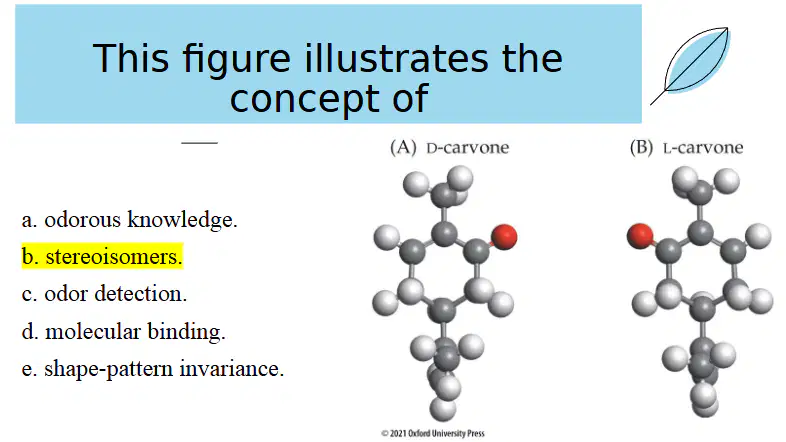
Stereoisomer theory
An example of the method of limits, the _____ uses increasing concentrations of an odorant until the participant can "smell something" and then decreasing concentrations until the participant reports no detection. Concentrations at which the participant's perception revers are averaged to determine the threshold.
Sensory discrimination method
Staircase method
Triangle test
Odor recognition method
In the _____, the participant is given two odorants that are the same and one that is different, and the participant must determine which odorant is different than the other two.
Odor recognition method
Staircase method
Sensory discrimination method
Triangle test
Which of the following age groups would we expect to have the poorest sense of smell, on average?
5-9 year olds
20-29 year olds
40-49 year olds
60-69 year olds
80-89 year olds
Walking into a hair salon and no longer smelling the chemicals after a few minutes is an example of _____ while not noticing the smell of your house unless you've been out of town for a few weeks is an example of _____.
receptor adaptation; cognitive habituation
receptor adaptation; cross adaptation
cross adaptation; cognitive habituation
cognitive habituation; receptor adaptation
Why is olfaction unique among all of the senses in terms of its neural wiring?
It has a direct connection to the limbic system
It has a direct connection to the thalamus
Each olfactory bulb is processed by the contralateral hemisphere, unlike the other senses
It has a direct connection to the cerebellum
The olfactory bulbs connect directly to the orbitofrontal cortex
If you taste the fruit characteristics of a fine wine, what kind of olfaction are you engaging in?
Retronasal
Allonasal
Pseudonasal
Orthonasal
Ipsinasal
Suppose a person's olfactory system is "rewired" such that olfactory signals pass through the thalamus and are processed more in the left hemisphere of the brain. What might be a consequence?
It would be harder for them to verbally label smells
Smell would be more isolated from the other senses
The emotional aspects of the smell would increase for them
It would be easier for them to verbally label smells
There would be no difference between the typical and rewired systems
If your friend is wearing a new perfume and you decide you really like it, you have just made a _____ judgement.
gustatory
value
fashion
logical
hedonic
Specific anosmia and the study of stereoisomers provide evidence against the _____ theory of olfactory perception.
regulated odor
shape pattern
vibration
odor activation
olfactory nerve
Suppose you enter a hair salon and the smell of the hair dyes and other chemicals is very strong and distinctive at first. However, after a few minutes you no longer smell those chemicals. What process is responsible for this phenomenon?
Anosmia
Receptor adaptation
Cognitive habituation
Cross-adaptation
Odor repression
Sometimes odorants can stimulate the somatosensory system through polymodal nociceptors. These sensations are mediated by the _____, which transmits information about the "feel" of an odorant.
prefrontal cortex
ciliary nerve
maxillary nerve
trigeminal nerve
endocrine system
_____ form part of the deepest layer of cells in the olfactory bulb. They comprise an extensive network of inhibitory neurons, integrate input from all the earlier projections, and are thought to be the basis of specific odorant identification.
Mitral cells
Juxtaglomerular neurons
Basal cells
Tufted cells
Granule cells
Meet John. All food tastes pretty bland to him, he can only sense the sweetness, saltiness, bitterness, or sourness of food, but none of the other complexities. What is the best diagnosis for John?
Prosopagnosia
Olfactory blindness
Anosmia
Insomnia
Agnosia
The cilia are
the last structures in the biochemical chain of events involved in odor perception
the first structures involved in olfactory signal transduction
the most important type of epithelial cells
the axons involved in the firing of action potentials in the olfactory process
the cells that carry olfactory information to the thalamus
The liking dimension of odor perception is called _____.
Odor preference
Smell preference
Smell hedonics
Odor hedonics
The fact that California ground squirrels exhibit an instinctive defense response the very first time they are exposed to the odor of the Pacific rattlesnake, a natural predator, is evidence that some odor preferences may be ______.
Innate
Learned
Developed
Acquired
Which of the following elements defines the difference between taste and flavor?
Cognitive associations
Orthonasal olfaction
Retronasal olfaction
Visual perception
If you had a cold, which of the following symptoms would make food seem to be rather flavorless?
Headache
Stuffy nose
Body aches
Fever
Chills
Which type of papillae have no taste function?
Filiform papillae
Fungiform papillae
Foliate papillae
Circumvallate papillae
Which part of the brain is known as the gustatory cortex?
Insular cortex
Orbitofrontal cortex
Medial temporal cortex
Superior frontal cortex
In terms of the four basic tastes, _____ are mediated by ion channels, whereas _____ are mediated by protein receptors.
Salty and bitter; sweet and sour
Salty and sweet; bitter and sour
Salty and sour; bitter and sweet
Bitter and sweet; salty and sour
Which of the four taste sensations evolved to make sure we have enough sodium in our bodies to keep cells functioning?
Sweet
Salty
Sour
Bitter
Which of the four taste sensations evolved to allow us to sense any acids that we ingest?
Sweet
Salty
Sour
Bitter
Which of the four taste sensations evolved to allow us to sense any toxic chemicals that we might have ingested?
Sweet
Salty
Sour
Bitter
Which of the four taste sensations evolved to allow us to sense glucose, the principle source of energy in humans?
Sweet
Salty
Sour
Bitter
One of the major reasons that people do not consider umami one of the basic tastes is that _____?
Protein molecules are too small to stimulate taste or olfaction.
Protein molecules are too large to stimulate taste or olfaction.
People cannot taste MSG.
One of the major reasons that people do not consider fat one of the basic tastes is that _____?
Fat molecules are too small to stimulate taste or olfaction.
Fat is sensed in the mouth but not the digestive tract.
Fat is sensed in the digestive tract but not the mouth.
People who are supertasters tend to eat _____ leafy green vegetables than average.
fewer
the same amount
more
If you accidentally consume a poisonous food, what will it probably taste like?
Salty
Sour
Umami
Sweet
Bitter
Chewing and swallowing force an odorant emitted by the mouth up behind the palate into the nose, which causes one to experience _____ sensation of the odor perceived.
orthonasal olfactory
flavor
retronasal olfactiory
nasal
smell
Which of the following is not considered to be basic taste?
Spicy
Salty
Bitter
Sweet
Sour
The gustatory system is responsible for
differentiating between smells and tastes
integrating smells and tastes
detecting nutrients and "antinutrients" before we ingest them
protecting our olfactory system from approaching harmful foods
all of these are correct
Which of the following is evidence that taste preferences are genetically determined?
Families in Mexico encourage young children to eat spicy chili peppers
Orange juice tastes strange if you drink it after brushing your teeth
Newborn infants are insensitive to sweet, salty, sour, and bitter and must be taught positive and negative associations with foods
Newborn infants respond with stereotyped facial expressions the first time they taste sweet, salty, sour, and bitter solutions
People tend to have an aversion to foods that have made them sick in the past
If you take a bland food like tofu and add some acid to it, it will taste
saltier
more sour
sweeter
more bitter
spicier
If a glass of water undergoes a chemical reaction, such that it has more hydrogen ions in it, it will taste
salty
sour
sweet
bitter
spicy
Which papillae could be completely removed from the tongue (hypothetically) with no impact on taste?
Filiform
Fungiform at the tip of the tongue
Circumvallate
Foliate
Fungiform in the middle of the tongue
If you are stung by a honeybee, many other bees nearby may be cued to sting you because the first bee emitted a(n)
chemosignal
odorant
pheromone
olfactant
tastant
Which taste receptors do fat molecules stimulate?
Sweet
Sour
Salty
Umami
None of these
What is the role of the dorsal horn in our sensation and perception of pain?
Gustatory signals arrive at the dorsal horn in the spinal cord and, there, receive information from the thalamus and the orbitofrontal cortex
Olfactory signals arrive at the dorsal horn in the thalamus and send information to the piriform cortex
Nociceptive signals arrive at the dorsal horn in the spinal cord and, there, receive information from the brain AND from synapses with other neurons that convey sensory info from the nociceptors to the brain
Nociceptive signals arrive at the dorsal horn in the thalamus and, there, receive information from the brain AND form
The sense of _____ registers motion resulting from rotation.
orientation
tilt
balance
angular motion
linear motion
The sense of _____ registers head inclination with respect to gravity.
orientation
tilt
balance
angular motion
linear motion
The sense of _____ registers motion resulting from translation.
orientation
tilt
balance
angular motion
linear motion
Anesthesia of the chorda tympani causes
impaired olfaction
damaged taste
flavor enhancement of foods
a delayed reaction of flavors
foods to taste salty
Which of the following is not a type of papillae?
Filiform
Fungiform
Foliate
Circumvallate
Circular
_____ are mushroom-shaped structures distributed most densely on the edges of the tongue, especially the tip.
Filiform papillae
Fungiform papillae
Foliate papillae
Circumvallate papillae
Microvilli
_____ are the small structures on the tongue that have no taste function and are responsible for its bumpy appearance.
Filiform papillae
Fungiform papillae
Foliate papillae
Circumvallate papillae
Microvilli
Nature, responding to temperature, touch, smell, and taste, and is critical for assigning affective value to stimuli.
Prefrontal cortex
Occipital lobe
Insular cortex
Thalamus
Orbitofrontal cortex
_____ is the taste quality produced by the hydrogen ion in foods
bitter
salty
sour
spicy
sweet
If you adjust the brightness of a light until it matches the intensity of sourness of that taste of a lemon, you are engaging in
variety matching
scaling
sensory integration
cross-adaptation
cross-modality matching
The _____ is a narrow space at the back of the nose into which air flows and where the main olfactory epithelium is located
olfactory sensory neuron (ONR)
odorant receptor (OR)
olfactory mucosa
olfactory bulb
olfactory cleft
The cilia are
the last structures in the biochemical chain of events involved in odor perception
the first structures involved in olfactory signal transduction
the most important type of epithelial cells
the axons involved in the firing of action potentials in the olfactory process
the cells that carry olfactory information to the thalamus
The _____ is a bony structure riddled with tiny holes, at the level of the eyebrows, which separates the nose from the brain
glomerulus
olfactory mucosa
olfactory bulb
olfactory epithelium
cribriform plate
Each olfactory sensory neuron (OSN) converges onto two
olfactory bulbs
tufted cells
olfactory cilia
glomeruli
supporting cells
While all mammals appear to have plenty much the same set of olfactory receptor genes, some genes in each species are _____ and are not expressed.
dominant
pseduogenes
missing
hybrid
active
Cutting onions makes you cry because chemicals in the onions
create a burning sensation via the ciliary nerve
create a burning sensation via the inferior alveolar nerve
create a burning sensation via the trigeminal nerve
dry out the eyes, causing them to tear up
irritate the eyes directly, causing them to tear up
The vibration theory of olfaction contends that
trigeminal nerve vibrations transmit odor sensations
vibrations cause odorous molecules to spread through the air
vibrations mediate the transfer of neural signals in the brain
there is a different vibrational frequency for every perceived smell
maxillary nerve vibrations transmit odor sensations
A
B
C
D
E
The processing of components in an odorant mixture is completed by using
analysis and synthesis
detection and regulation
olfactory digestion
olfactory separation
the anterior cingulate cortex (ACC)
Equal intensity that span olfactory physiochemical and psychological (perceptual) space are mixed. The resultant odor percept is the same as every other mixture of 30 odorants meeting the span and equivalent intensity criteria, even though the various mixtures do not share any common odorants
Olfactory white
Olfactory yellow
Olfactory red
Olfactory green
Olfactory blue
_____ is the biochemical phenomenon, occurring after continual exposure to an odorant, whereby receptors stop responding to an odorant and detection ceases.
Receptor adaptation
Cognitive habituation
Anosmia
Odor repression
Cross-adaptation
The _____ reflex is the term for eye movements that compensate for rotations of the head to maintain fixation on an object.
translational motion
angular motion
balance fixation
torsional motion
vestibulo-ocular
The neural processes of posture control by which weight is evenly distributed, enabling us to remain upright and stable, is called
the active sense
the vestibulo-ocular reflex
kinesthesis
balance
the passive sense
_____ are the mechanical structures in the vestibular system that sense both linear acceleration and gravity.
Otolith organs
Ossicles
Semicircular canals
Cochlea
Saccules
_____ is an illusory sense of self motion produced when one is not, in fact, moving.
Vection
Yaw
Roll
Pitch
Tilt
When you switch from lying down to standing up, which system or structures(s) is/are responsible for regulating the blood pressure in your head so that you don't faint?
Cranial nerves
Otolith organs
Inferior rectus
Autonomic nervous system
Vestibular nerve
Which brain area processes vestibular information?
Parietal lobe
Frontal lobe
Occipital lobe
Temporal lobe
If you spend the day at the ocean playing in the waves, you might experience an illusory sense of rocking motion while you are falling asleep at night. This is known as
Ménière’s syndrome
mal de debarquement syndrome
vection
motion sickness
vestibular flux
Which term describes the perception of the position and movement of our limbs in space?
Homunculus
Thermoception
Nociception
Neural plasticity
Kinesthesis
Mechanoreceptors that have a fast adaptation rate and large receptive field size are called
Meissner cirpuscles
Ruffini endings
Pacinian corpuscles
Merkel cell neurite complexes
Muscle spindles
Low-frequency vibrations from about 5 to 50 Hz, such as are produced when an object slips from one's grasp, and they terminate in Meissner corpuscles.
SA I
SA II
FA I
FA II
Extrafusal muscle
The figure demonstrates the locations of four types of
skin layers
muscle spindles
mechanoreceptors
neuronal axons
neurotransmitters
The _____ pathway is the route from the spinal cord to the brain that carries signals from skin, muscles, tendons, and joints
dorsal column-medial lemniscal
primary somatosensory
dorsalateral
spinothalmic
ventricular
In the brain, the _____ is associated with the perceived unpleasantness of pain sensation
primary somatosensory cortex (S1)
secondary somatosensory cortex (S2)
extrastriate body area (EBA)
prefrontal cortex
anterior cingulate cortex (ACC)
The A-delta and C fibers are types of
photoreceptors
thermoreceptors
nociceptors
mechanoreceptors
_____ are narrow-diameter, unmyelinated sensory nerve fibers that transmit signals from pleasant touch.
PT nerves
P tactile efferents
C tactile efferents
P tactile afferents
C tactile afferents
_____ perception is knowledge of the world that is derived from sensory receptors in skin, muscles, tendons, and joints, and usually involves active exploration.
Comprehensive body
Haptic
Active
External
Reactive
Frame of reference is used to _____ while _____ describes the center of a reference frame
perceive touch; egocenter
define locations in space; egocenter
identify objects; haptic center
refer to specific objects; haptic center
envelop objects with the hand; somatosensory

