
 Worksheets
Tissue and tissue culture
Total questions: 117
Worksheet time: 1hrs 4mins
) In plant tissue culture technique surface sterilization of explant is made by…………
Hydrochloric acid
Sulphuric acid
Mercury chloride
Nitric acid
The two strand of double helix model of DNA are holdind together by……..
Sugar & nitrogen base
Sugar &phosphate group
Phosphate &nitrogen base
Phosphate &phosphate group
..……….proposed definite model of molecular structure
Watson
Crick
Watson &crick
Daniel
Agrobacterium cell consist of ………..as independent replication circular DNA
Cosmid
Plasmid
Ti-Plasmid
L-Plasmid
Restriction Endonucleases are ……………enzyme
Bacterial
Viral
Fungal
Algal
The term ‘Totipotency’ was given by _____________.
T.H. Morgan
Haberlandt
Schwann
De Robertis
In PCR reaction .....enyme is used.
Taq polymerase
Reductase
Phosphatse
Dehydrogenase
The method of producing thousands of plants through tissue culture is called
somatic hybridiastion
totipotency
micro-propagation
The capacity to generate a whole plant from any cell/explant
micropropagation
Tissue culture
Totipotency
somatic hybridisation
In plant tissue culture, what is the term ORGANOGENESIS means?
Formation of callus culture
Formation of root & shoot from callus culture
Genesis of organ
None of the above
Ability of a plant to endure extreme conditions by changing growth and development of plant organs
Petiole
Micropropagation
Pathogenic
Plasticity
Plant tissue culture is a practice used to propagate plants under sterile conditions, often to produce ________ of a plant.
DNA
Bacteria
Cloning
Chromosome
What is the name of naturally occurring Auxin in plant?
1-napthaleneacetic acid (NAA)
2,4-Dichlorophenoxyacetic acid (2,4-D)
Indole 3-acetic acid (IAA)
1-napthoxyacetic acid (NOA)
In Plant Tissue Culture, Totipotency means
Flowering in culture medium
Development of Organ from Tissue under medium
Development of fruit
None
Micropropagation is widely used in ________ and in floriculture.
Wilderness
Deforestation
Sustainability
Forestry
Plant tissue culture is a practice used to propagate plants under sterile conditions, often to produce ________ of a plant.
DNA
Bacteria
Cloning
Chromosome
In palnt tissue Cultue, Which part shows maximum totipotency?
Xylem
Phloem
Meristem
Stem
In Plant Tissue Culture, the callus is grown in plantlet by altering the concentration of _______
Amino acid
Glucose
Hormone
Al of the above
Factors Associated in Somatic embryogenesis
Light intensities
particular wavelengths
photoperiods
gamma ray
BASIC MEDIA COMPONENTS FOR PLANT CELL CULTURE IN MS MEDIA FOR GLYCINE
2mg/l
12mg/ml
7mg/ml
190mg/ml
Disadvantages of Micropropagation
expensive and time consuming
expensive
time consuming
How to Propagate?
Induction of direct regeneration of shoots from organ cultures.
Induction of direct regeneration of roots from organ cultures.
Induction of direct regeneration of stomata from organ cultures.
Induction of direct regeneration of xilem from organ cultures.
Plant parts (cell, tissue, organ) used in tissue culture called as the
import
implant
explant
export
Scientist known as the father of tissue culture
Scleiden
Murashige
Gottlieb Haberlandt
Simon
Stages of Callus Culture
induction > proliferation > morphogenesis
proliferation > induction > morphogenesis
morphogenesis > induction > proliferation > mutation
induction > mutation > proliferation > morphogenesis
What does it means by micropropagation produces genetically identical plants. The production of
true to types plants
somaclones
somaclonal variation
false to types plants
Tissue culture technique is an efficient tool used in plant breeding for the following reasons EXCEPT
mass propagation of specific clones.
useful for plant reproduced by asexual.
production of high yield diseased plants.
production of healthy or diseased-free plants.
Healthy plants can be grown from diseased plant by
meristem culture
leaf culture
stem culture
root culture
Which of the following statements are the APPLICATIONS of plant tissue culture technique.
I Micropropagation
II Genetic improvement
III Germplasm preservation
IV Production of synthetic seed
I and II
II and III
I, II and III
All of the above.

Apical meristems can be found in
The leaves
The tips of the shoots and roots
The xylem cells
The epidermal cells
Apical meristems can be found in
The leaves
The tips of the shoots and roots
The xylem cells
The epidermal cells
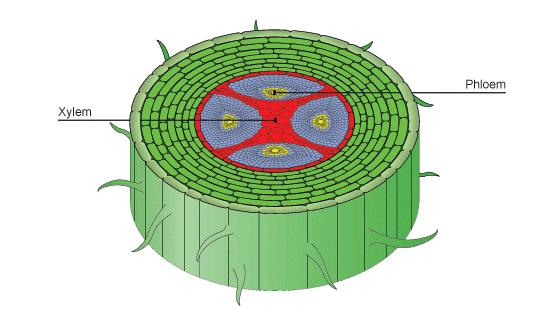
Specific type of plant tissue that transports water and minerals from the roots, through the stems, to leaves
vascular plant
nonvascular plant
xylem
phloem

Specific type of plant tissue that transports food (sugar) made in the leaves to the entire plant
vascular plant
nonvascular plant
xylem
phloem
Sieve tubes and companion cells are present in
xylem
phloem
cambium
cork
Other than transporting water, what is a function of xylem?
making food
transporting food
helping support the plant
catching light
A tissue whose cells are capable of dividing and re-dividing is called
complex tissue
permanent tissue
connective tissue
meristematic tissue
Xylem and phloem are examples of
epidermal tissue
connective tissue
protective tissue
vascular tissue
The size of the stem increases in the width due to
apical
intercalary
lateral
vascular bundle
Packaging tissue
parenchyma
collenchyma
xylem
phloem
The nuclei of meristematic cells are
small
large
medium sized
no nucleus
Which of the following is an undifferentiated embryonic tissue found in the active growth regions of plants such as tips of roots and stems?
Parenchyma tissue
Collenchyma tissue
Meristematic tissue
Permanent tissue

What type of ground tissue is this?
Parenchyma
Schlerenchyma
Collenchyma


What type of ground tissue is this?
Parenchyma
Collenchyma
Schlerenchyma

Both a plant and animal cells have a cell wall
True
False
Do meristematic tissues have vacuoles present in them?
Yes
No
It helps water Hyacinth to float on water. What type of parenchyma tissue is it?
Chlorenchyma
collenchyma
Aerenchyma
schlerenchyma
I am a kind of parenchymatous cell, and I perform photosynthesis. Who am I?
Collenchyma
Aerenchyma
Chlorenchyma
Sclerenchyma
There is more Intercellular space found in this tissue
Collenchyma
Sclerenchyma
Parenchyma
Epidermis

Which is not a function of epidermis?
protection from adverse condition
gaseous exchange
conduction of water
transpiration

Which muscles act involuntarily?
striated muscles
cardiac muscles
skeletal muscles
All the above

The muscular tissue which function throughout the life
continuously without fatigue is
skeletal muscle
cardiac muscle
smooth muscle
voluntary muscle

While doing work and running, you move your organs such as hands, legs, etc., which among the following is correct?
smooth muscles contract and pull the ligament to move the
bones
smooth muscles contract and pull the tendons to move the
bones
skeletal muscles contract and pull the ligament to move the
bones
skeletal muscles contract and pull the tendon to move the
bones

Voluntary muscles are found in
alimentary canal
limbs
iris of the eye
bronchi of lungs

A person met with an accident in which two long bones of
hand were dislocated. Which among the following may be the possible reason?
tendon break
break of skeletal muscles tissue
ligament break
areolar tissue break

Bone matrix is rich in
fluoride and calcium
calcium and phosphorus
phosphorus and potassium
calcium and potassium

Which of the following helps in repair of tissue and fills up the space inside the organ?
tendon
adipose tissue
areolar tissue
cartilage
Bone matrix is rich in
fluoride and calcium
calcium and phosphorus
phosphorus and potassium
calcium and potassium

Fats are stored in human body as
cuboidal epithelium
adipose tissue
bones
cartilage

Cartilage is not found in
nose
ear
kidney
larynx
These cells are small and flat
Cuboidal
Columnar
Squamous
Pseudostratified
Which of the following is NOT a function of epithelial tissues?
covering exposed surfaces
lining internal passageways
producing glandular secretions
contracting to produce movement

Name the tissue
Pseudostratified
Simple columnar
Transitional
Stratified Squamous
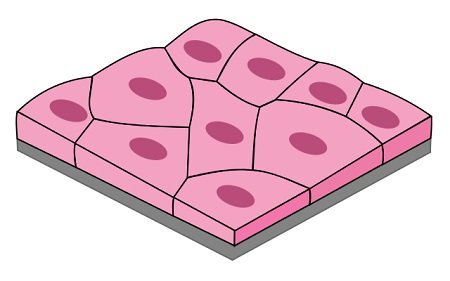
Name the type of epithelium
simple cuboidal
simple squamous
simple columnar
stratified squamous
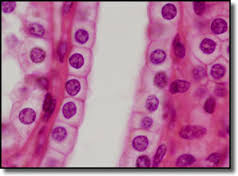
Which muscle type can contract rapidly with great force, BUT tires easily and must rest after short periods of activity.
skeletal
smooth
cardiac

Where are dogs worshipped? They have a festival!
India
China
Nepal

People of the Ancient Egypt considered ___________ as sacred and as an important deity because they kept an eye on storms, chaos, and darkness.
cats
dogs
pigs


For culturing, plasma from the adult chicken is preferred to mammalian plasma because
it forms a clear and solid coagulum even after dilution
it is too opaque
it doesn't produce solid clots
it forms a semi solid coagulum
Range of osmolarity tolerated/accepted in mOsm/Kg of H2O by mammalian cells is
150-300
280-360
300-325
360-400
Accumulation of lactate leads to
increase in pH
no change in pH
reduction in the pH of culture hence loss of cell viability
no loss of cell viability
What is animal tissue culture?
Growth and maintenance of animal cells
Growth and selling of animal cells
Only maintenance of animal cells
All
Culture freshly prepared from isolated tissue is known as _____
Organ culture
Primary culture
Cell line
Histotypic culture
______________is the primary equipment required for animal tissue culture laboratories.
Glasswares
Laminar flow
Sterilizers
All
The material used in culture techniques is important because the surface of the vessel serves as a substrate for cells to grow.
True
False
_________________is one of the limitation of animal tissue culture.
Disposal of biohazards is not easy
Cultured cells are not easy to store
Both
None
The foundation for the development of cell culture technique was laid by
Roux
Arnold
Ross
Harrison
Who is regarded as the father of tissue culture
Harrison
Arnold
Ross
Roux
The limited replicative capacity of human cells in culture is called
Brownian effect
Contact inhibition
None of the above
Hayflick effect
HAT medium used for the selection of fused hybrid cells in hybridoma culture was introduced by
Littlefield and Miller
Kohler and Milstein
Frish and Jentoft
Eagle and Karl
Which of the following is HGPRT+ and survives in HAT medium
B cells
Myeloma cells
Hybrid cells
Both a and c
Use of trypsin to free cells from tissue matrix for cell culture was described by
Jolly and Koch
Beebe and Ewing
Sims and Stillman
Gottieb Maberland
Vero cell line is obtained from Kidney cells of
African green monkey
Chinese hamster
Calf
Swine
Which of the following is easy and rapid method to interpret viability of cells in culture system
Trypan blue dye exclusion
Neutral red assay
Fluorescein dye assay
All of the following
Which of the following virus is used for cell fusion
Sendai virus
Herpes virus
Myxovirus(
All of the following
Which of the following is most commonly used cell fusing agent
PEG
NaNO3
Sendai virus
Polyvinyl alcohal
The ratio of CO2 : O2 used in cell culture system should be
1:5
1:13
1:19
1:25
Which cell line is used for production of recombinant sex hormones
BHK cell line
Vero cell line
Hela cell line
CHO cell line
Which of the following is the oldest cell line
Hela cell line
Vero cell line
CHO cell line
BHK cell line
Optimum pH required for the growth of mammalian cells is
5.3-7.0
6.5-7.0
7.2-7.4
8.1-8.9
For culture of avian cells the optimum temperature requirement is
37 ̊C
40 ̊C
42 ̊C
35 ̊C
The optimum temperature of any cell or organ is called
Critical temperature
Threshold temperature
Ceiling temperature
None of the above
Which of the following is the structural fibre in cell culture system
Collagen
Elastin
Fibronectin
Both a and b
Which of the following is true regarding animal cell culture technique
Lactic acid is source of carbon
Cells have high requirement of L-glutamine
Cholin is necessary for cell adhesion and cytoskeleton
All of the following
Cell culture technique became simpler only after advent of
Antibiotics
Trypsin
Cell culture media
All of the following
Cells used in feeder layer
Should have ability to divide
Have ability to metabolize
These properties are obtained by exposing cells to irradiation
All of the above

