wayground logo

Free Printable Worksheets

Font size

S
M
L
XL
Worksheets

Zoology-Botany Exam Review

Total questions: 120

Worksheet time: 1hrs 23mins

Name
Class
Date
1.

The idea that better adapted organisms survive to pass traits along to offspring is called ___.

a)

Evolution

b)

Natural Selection

c)

Extinction

d)

Artifical Selection

2.
The theory of evolution by natural selection means that what is changing over time?
a)
The inherited traits of a population.
b)
The acquired traits of a population.
c)
Hair color and eye color
d)
Attractive features.
3.
a bird that can easily outcompete other birds for food and that can produce many eggs has a high
a)
life expectancy
b)
mutation rate
c)
fitness
d)
adaptability
4.
Some organisms that share a common ancestor have features that have different functions, but similar structures.  These are known as
a)
vestigial structures
b)
analogous structures
c)
homologous structures
d)
fossil structures
5.
If an organism has a vestigial structure, that structure likely once had a function in a(n)
a)
close relative
b)
early ancestor
c)
unrelated organism
d)
embryological stage
6.
Two organisms that are closely related would have
a)
very similar DNA sequence
b)
exactly the same DNA sequences
c)
no proteins in common
d)
completely different DNA sequence
7.
What is speciation?
a)
combining of tow species to form one with different traits
b)
isolation that affects mating behaviors
c)
timing of mating that prevents normal sexual selection
d)
divergence of two or more species from an existing one
8.
two species are in different environments and look very similar.  However, that are not closely related (analogous).  Their resemblance is most likely an example of.
a)
sexual selection
b)
temporal isolation
c)
convergent evolution
d)
divergent evolution
9.

What is the term for a feature that allows an organism to survive better in its environemtn?

a)

variation

b)

adaptation

c)

homologous structure

d)

vestigial structure

10.

Which best describes the relationship between structure and function in organisms. For example, why do herbivores have flat molars?

a)

Herbivores eat plants because they have flat molars; what they eat will dictate whether they inherit flat or pointy teeth.

b)

Herbivores have flat molars because they eat plats; their teeth shape will affect how successful they are and how common that shape is in future populations.

11.
Which domain includes all animals and plants?
a)
Archaea
b)
Eukarya
c)
Bacteria
12.
Which kingdoms have some organisms that can make their own food (autotrophic)?
a)
Plantae and Animalia
b)
Fungi and Plantae
c)
Protista and Plantae
13.
Organisms whose cells have NO nucleus are classified as...
a)
Eukaryotic
b)
Prokaryotic
c)
Dead
14.
The scientific name for an organism is made from the:
a)
class and family name
b)
genus and species name
c)
domain and kingdom name
d)
kingdom and phylum name
15.
The 8 levels of classification, most broad to most specific.
a)
Domain, Genus, Family, Order, Class, Phylum, Kingdom, Species
b)
Domain, Species, Kingdom, Genus, Phylum, Family, Class, Order
c)
Domain, Kingdom, Phylum, Class, Order, Family, Genus, Species
d)
Order, Kingdom, Species, Domain, Phylum, Family, Class, Genus
16.
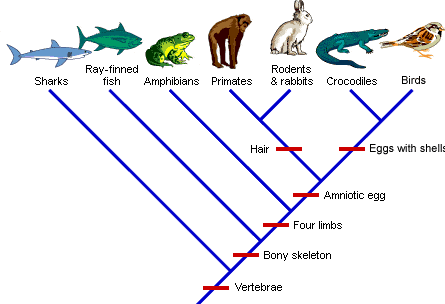
According to this cladogram, sharks are MOST closely related to which organism? 
a)
Amphibians
b)
Ray finned fish
c)
Crocodiles
d)
Birds
17.
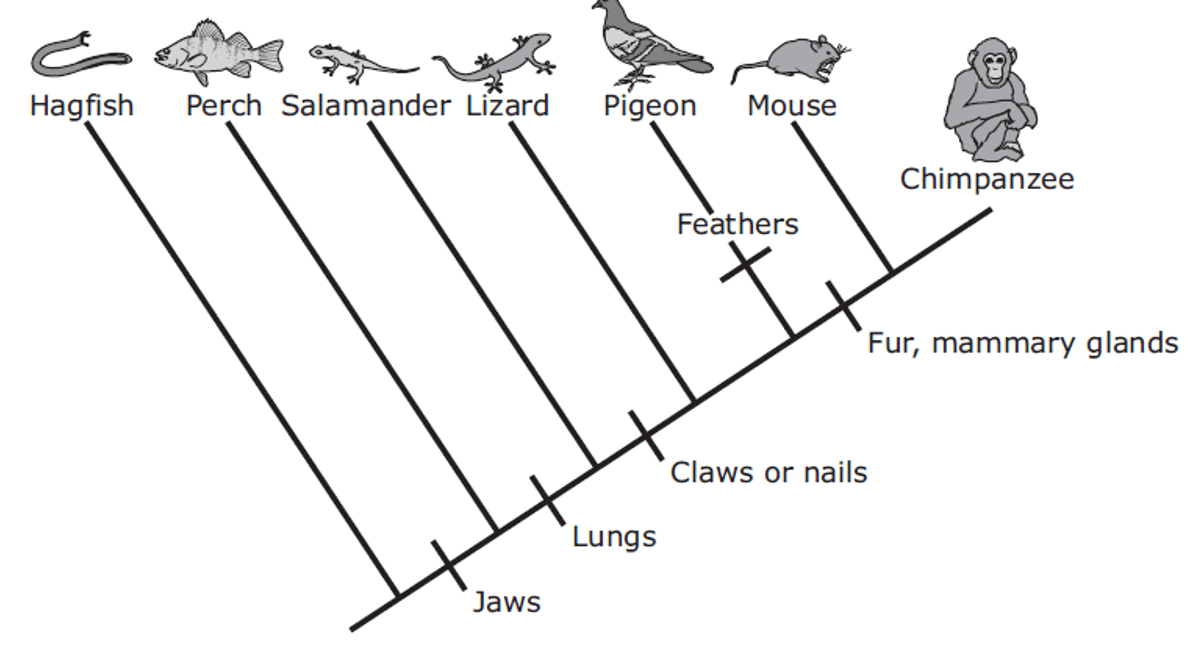
Which trait do only humans have, according to the cladogram?
a)
jaws
b)
mammary glands & hair
c)
terrestrial during all life stages
d)
bipedal & opposable thumbs
18.
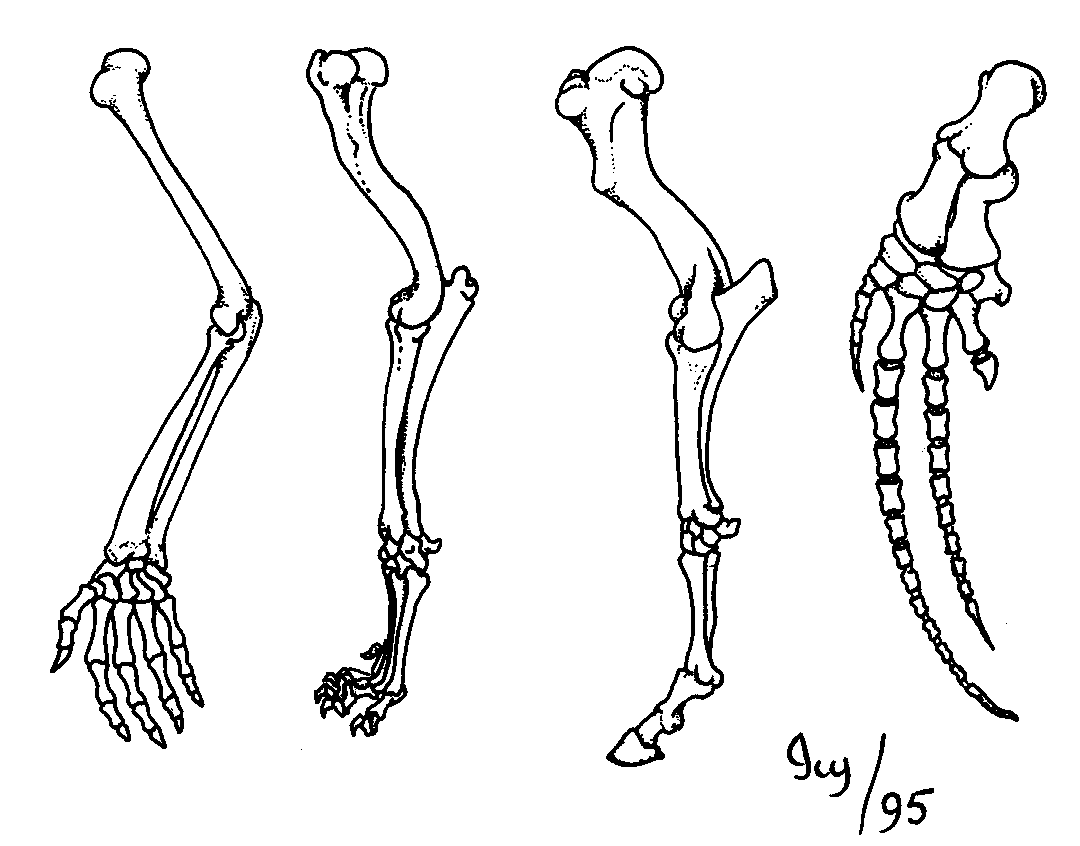
Structures with the same parts have different functions; suggests that organisms share a common ancestry
a)
vestigial structures
b)
homologous structures
c)
adaptive radiation
d)
fossil
19.
All the animals to the right of the hagfish would have the common characteristic of -
a)
Fur
b)
Claws or nails
c)
Lungs
d)
Jaws
20.
What type of evolution do homologous structures show?
a)
convergent
b)
divergent
c)
artificial selection
d)
disruptive selection
21.

What is the smallest clade that includes both species D and E?

a)

All of the species (A, B, C, D and E)

b)

C, D, and E

c)

D and E

d)

B, C, D and E

22.

What is necessary for speciation to occur (and not just natural selection within a population)?

a)

adaptations

b)

reproductive isolation

c)

development of homologous structures

d)

interbreeding

23.
All organisms that do not fit into plant, fungi, and animal kingdoms but have a nucleus are:
a)
archaebacteria
b)
eubacteria
c)
protists
d)
fungus
24.

This kingdom contains heterotrophic organisms that can be unicellular or multicellular and have a cell wall.

a)

Fungi

b)

Animalia

c)

Protista

d)

Archaebacteria

25.

What kingdom is made up of entirely decomposers

a)

Animalia

b)

Plantae

c)

Protista

d)

Fungi

26.
Which of the following is a cephalopod?
a)
snail
b)
slug
c)
oyster
d)
octopus
27.
The organism in the picture is a(n)
a)
echinoderm
b)
mollusk
c)
arthropod
d)
cnidarian
28.
soft-bodied; some have shell; muscular foot
a)
Mollusca
b)
Porifera
c)
birds
d)
Platyhelminthes
29.
spiny-skinned organisms; have plates with spines and a water vascular system
a)
Echinoderms
b)
Platyhelminthes
c)
Cnidarians
d)
Arthropoda
30.

Animal characteristics include:

a)

multicellular

b)

eukaryotic

c)

heterotrophic

d)

no cell walls

e)

all of the above

31.
Which of the following describes an open circulatory system?
a)
one that has two openings
b)
One in which blood is not enclosed in vessels
c)
One that has two openings
d)
One that has blood inside vessels
32.
A rapid change from the young to the adult form of an animal.
a)
metamorphosis
b)
budding
c)
diffentiation
d)
reproduction
33.
What am I?
a)
Mollusk
b)
Annelid
c)
Arthropod
d)
Cnidarian
34.
I have a digestive cavity with one opening, and have tentacles.  I am a hydra.
a)
Echinoderm
b)
Cnidarian
c)
Arthropod
d)
Mollusk
35.

A body plan where the animal has equal left and right sides

a)

radial symmetry

b)

bilateral symmetry

c)

asymmetry

d)

total symmetry

36.
An arthropod’s _______ protects it and keeps it from drying out. It is made of _______ and does not grow with the animal.
a)
exoskeleton, antennae
b)
exoskeleton, chitin
c)
abdomen, chitin
d)
antennae, exoskeleton
37.
What two characteristics do all Arthropods have?
a)
two legs per body segment
b)
jointed legs and a cephalothorax
c)
three body segments and metamorphosis
d)
jointed legs and segmented bodies
38.

Fishes mostly regulate bouyancy by precisely regulating the volume of gas in the

a)

stomach

b)

gills

c)

body tissues

d)

swim bladder

39.

Nitrogenous wastes such as urea, creatine, and creatinine are produced in the _______ of fishes

a)

spleen

b)

kidneys

c)

pancreas

d)

liver

40.

The activity by which birds maintain a clean plumage and rid the feather sand skin of parasites is referred to as

a)

combing

b)

grooming

c)

dusting

d)

anting

e)

preening

41.

The _______ of the bird (and annelid) is responsible for grinding up the food.

a)

crop

b)

gizzard

c)

stomach

d)

intestine

e)

heart

42.

The back surface of a bilateral animal is

a)

anterior

b)

posterior

c)

dorsal

d)

ventral

43.
Which of the following is NOT a characteristic of the phylum Arthropoda? 
a)
complete digestive system
b)
 closed circulatory system
c)
hard exoskeleton
d)
metamerism
44.
Which of the following is NOT a good reason why the arthropods are so diverse?a.  c. b.  d. 
a)
cephalization
b)
metamorphosis
c)
versatile exoskeleton
d)
highly developed sense organs
45.
The simplest animals to have achieved bilateral symmetry are the 
a)
 insects
b)
flat worms
c)
arthropods
d)
star fish
46.

Opossums belong to the group of mammals known as

a)

therapsids

b)

monotremes

c)

cynodonts

d)

marsupials

e)

placentals

47.
Organisms, like sponges, lacking body tissues and body symmetry belong to which of the following phyla?
a)
Cnidaria
b)
Mollusca
c)
Nematoda
d)
Porifera
48.

Gills are large sheets of thin tissue that

a)

absorb carbon dioxide

b)

assist in digesting food

c)

take in dissolved oxygen

d)

protect a fish's lungs

49.

The process of a blastula developing embryonic layers and folding inward to make the gut is called ________________.

a)

protostome

b)

blastulation

c)

gastrulation

d)

fertilization

50.
Cnidarians (hydra) have two germ layers so they are
a)
triploblastic
b)
diploblastic
c)
digerminal
d)
pseudocoelomate
51.
The specialization of a head region
a)
cephalization
b)
cephalopod
c)
celiac
d)
triploblastic
52.
Platyhelminthes (flatworms) have which type of body plan?
a)
acoelomate
b)
pseduocoelomate
c)
coelomate
53.
If the mouth develops first, then the organism is a 
a)
protostome
b)
deuterostome
54.
This body type is considered a false body cavity.
a)
Psuedocoelomate
b)
Coelomate
c)
Acoelomate
d)
Triploblast
55.

fluid filled space between the digestive tract and the body wall

a)

coelom

b)

radula

c)

frenulum

d)

glabella

56.
Cnidarians are predators which have tentacles possessing batteries of special cells called ______.
a)
Cnidocytes
b)
Choanocytes
c)
Amebocytes
d)
nematocysts
57.
An asexual form of reproduction found in females where growth and development of embryos or seeds occurs without fertilization by a male is called ______
a)
gonochoristic
b)
parthenogenetic
c)
budding
d)
regeneration
58.
Which structure is NOT associated with digestion?
a)
Gizzard
b)
pharynx
c)
nephridia
d)
crop
59.
If present, which type of skeleton is found in worms?
a)
Longitudinal
b)
Circular
c)
Exoskeleton
d)
Hydrostatic
60.
Which phylum of worms are pseudoceolomates?
a)
Platyhelminthes
b)
Nematoda
c)
Annelida
61.
Which of the following is the evolutionary advancement first found in annelids?
a)
Three germ layers
b)
A complete digestive system
c)
Cephalization
d)
Coelomates (tube within a tube)
62.
Which worm is a member of the clade ecdysozoa?
a)
Roundworm
b)
Flatworms
c)
Segmented worms 
d)
Bookworms
63.
As members of the clade ____, Arthropods, like roundworms, must molt to grow thanks to their protective outer covering.
a)
Deuterostomia
b)
Bilateria
c)
Lophotrochozoa
d)
Ecdysozoa
64.
The malpighian tubules are organs associated with which system?
a)
skeletal
b)
Digestive
c)
Reproductive
d)
Excretory
65.

Flatworms, rotifers, molluscs and annelids are members of the clade ____ and share larval structures.

a)

lophotrochozoa

b)

ecdysozoa

c)

craniata

d)

amniota

66.
Which two groups of fish have jaws?
a)
Agnatha and Chondrichthyes
b)
Agnatha and Osteichthyes
c)
Chondrichthyes and Osteichthyes
67.
What does the term ectothermic mean?
a)
The temperature of the organism is regulated by the organism.
b)
The temperature of the organism is regulated by the environment.
c)
The temperature of the organism stays constant.
68.
Fish like guppies that hatch eggs inside of their bodies and give "live birth" are called
a)
oviparous
b)
ovoviviparous
c)
viviparous
69.
Sac in the abdominal cavity of fish that contains different amounts of gases is the ___
a)
pancreas
b)
swim bladder
c)
gills
d)
liver
70.

Lampreys and Hagfish are examples of

a)

Jawless Fish

b)

Jawed Cartilage Fish

c)

Bony Fish

71.
Which of the following is not one of the characteristics of all chordates?
a)
notochord
b)
pharyngeal slits
c)
spinal cord
d)
post-anal tail
72.
All mammals give live birth.
a)
True
b)
False
73.

I breathe with lungs, lay eggs, am ectothermic (cold-blooded), and often have scaly skin which holds in the water. What am I?

a)

fish

b)

mammals

c)

birds

d)

reptile

74.

I breathe with lungs, lay eggs, and am endothermic (warm-blooded). What am I?

a)

birds

b)

fish

c)

mammals

d)

amphibians

75.
Which of the following is a structure that mammals share that enables them to feed their young?
a)
diphyodont
b)
mammary glands
c)
sebaceous glands
d)
aortic arch
76.
What is true about bird bones? 
a)
they are hollow 
b)
they are heavy 
c)
they aren't made of the same thing as mammal bones 
d)
they play no role in flight 
77.
Animals who regulate their body temperature internally with metabolism are ___
a)
endotherms 
b)
ectotherms 
78.
Which type of feathers give adult birds their streamlined shape and provide coloration? 
a)
down feathers
b)
contour feathers
c)
flight feathers 
79.

Which of the following characteristics is not common to both birds and living reptiles?

a)

scales

b)

amniotic egg

c)

endothermy

d)

being mostly viviparous

80.

What do all plants have in common?

a)

Chloroplasts

b)

Cell Walls

c)

Perform Photosynthesis

d)

All of the Above

81.
A seed is
a)
a plant embryo in a protective coating.
b)
produced by pollen.
c)
only found in fruit.
d)
all of these.
82.
Ferns, horsetail and club mosses are examples of
a)
.seedless non vacscular plants
b)
seed producing vascular plants
c)
seedless vascular plants
d)
seed producing nonvascular plants
83.
Gymnosperms produce
a)
flowers
b)
fruits
c)
cones
d)
all of these
84.
Angiosperms produce
a)
flowers
b)
fruits
c)
seeds
d)
all of these
85.
The function of stomata is 
a)
to diffuse oxygen into leaf
b)
diffuse carbon dioxide out of leaf
c)
allow light into leaf
d)
facilitate transpiration
86.
Which is true of bryophytes?
a)
They have Xylem
b)
They have vascular tissue
c)
They draw up water by osmosis
d)
They don't need water
87.
Plants with leaves and stems that die back to the ground each winter, then produce new shoots from the crown in spring are:
a)
herbaceous perenials
b)
woody pernenials
c)
annual flowers
d)
shrubs
88.
This is an example of 
a)
Phototropism
b)
Gravitropism
c)
Thigmotropism
d)
Iwantmoretropism
89.
This is an example of
a)
Phototropism
b)
Gravitropism
c)
Thigmotropism
d)
Allthetropisms
90.
The purpose of the cuticle is to 
a)
nourish the plant
b)
reduce evaporation of fluids
c)
aid in reproduction 
d)
allow it to live under water
91.
What is the main function of the Apical Meristem?
a)
Transportation of water and nutrients
b)
Protection of the root cap
c)
Location of the growth of cells using mitosis
d)
Allows gases to enter and leave the cell
92.

Besides absorbing water, what does this root do?

a)

Store Food

b)

Prevent Erosion

c)

Fibrous Root

d)

Tap Root

93.

What are the two red dots?

a)

Young Leaves

b)

Old Leaves

c)

Axillary Buds

d)

Apical Meristems

94.
A flowering plant with leaves that have parallel veins.
a)
gymnosperms
b)
angiosperms
c)
dicot
d)
monocot
95.
Small grains that contain a plant's male reproductive cells.
a)
stamen
b)
pollen
c)
anther
d)
stigma
96.
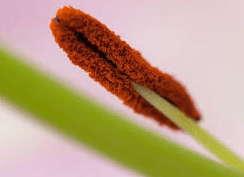
The part of a flower that produces the male reproductive cells.
a)
anther
b)
style
c)
stigma
d)
filament
97.
Plants that produce their seeds in wood-like cones.
a)
gymnosperms
b)
legumes
c)
deciduous 
d)
conifers
98.

The major function of leaves is to

a)

anchor the plant.

b)

perform photosynthesis.

c)

shade the tree.

d)

support the stem.

99.

Which are seedless nonvascular plants?

a)

conifers

b)

grasses

c)

mosses

d)

tulips

100.

Which is NOT a characteristic of all plants?

a)

They are multicellular.

b)

They have vascular tissue.

c)

They make their own food.

d)

They undergo photosynthesis.

101.

An unknown plant is a few centimeters tall when fully grown. It lives only in moist areas and reproduces with spores. How would you classify this plant?

a)

nonvascular seed plant

b)

nonvascular seedless plant

c)

vascular seedless plant

d)

vascular seed plant

102.

This is a layer of plant tissue that produces new vascular tissue and grows between the xylem and the phloem.

a)

cambium

b)

tissue

c)

stoma

d)

bark

103.

This is plant that completes its life cycle in one growing season

a)

triennial

b)

annual

c)

biennial

d)

perennial

104.

What two generations are seedless plants alternating between during their lifecycle?

a)

haploid; diploid

b)

angiosperm; gymnosperm

c)

non vascular; vascular

d)

seed; seedless

105.
The gametophyte makes eggs and sperm
a)
TRUE
b)
FALSE
106.
Which of the following is NOT a characteristic of a dicot?
a)
Two cotyledons
b)
Vascular tissue bundles arranged in a ring
c)
floral parts often in multiples of three
d)
one main root
107.

The haploid generation of plants is called the

a)

gametophyte.

b)

sporophyte.

c)

spore generation.

d)

ovary.

e)

flower.

108.

In gymnosperms, the gametophytes develop inside

a)

seeds.

b)

pollen grains.

c)

cones.

d)

lignin.

e)

vascular tissue.

109.

Bryophytes are unique land plants because

a)

they produce a sporophyte.

b)

they release spores.

c)

they undergo alternation of generations.

d)

the gametophyte is the dominant generation.

e)

they lack seeds.

110.
What is transpiration?
a)
Evaporation of leaves from the roots of plants.
b)
Evaporation of water from lakes, ponds, and streams.
c)
Evaporation of water from the leaves of plants.
d)
Exchange of carbon dioxide and oxygen from the leaves of plants.
111.
What tube transports water from the roots to the leaves?
a)
xylem
b)
phloem
c)
stems
d)
roots
112.

All events below occurs in sink tissue, except

a)

Water potential increases

b)

Water enters sieve elements from xylem

c)

Higher(+ve) solute potential

d)

Phloem turgor pressure decrease

113.

Movement of sugar from source to other parts of plant is assist by

a)

active transport

b)

diffusion

c)

endosmosis

d)

capillary action

114.

Process in which food substances are moved to the rest of plant by phloem is known as

a)

transpiration

b)

respiration

c)

photosynthesis

d)

translocation

115.
Venus Flytrap flower reacts to a bug. 
a)
Nastic Movement 
b)
Negative Gravitropism 
c)
Thigmotropism
d)
Hydrotropism
116.
A plant growing in response to the sunlight. 
a)
Gravitropism 
b)
Phototropism
c)
Thigmotropism
d)
Hydrotropism
117.
Helps fruit ripen
a)
Auxin
b)
Gibberellin
c)
Cytokinins
d)
Ethylene
118.
Breaks seed dormancy and promotes growth (can make fruit bigger)
a)
Auxin
b)
Gibberellin
c)
Cytokinins
d)
Ethylene
119.
Hormone related to the growth of the plant in response to tropisms
a)
Auxin
b)
Cytokinins
c)
Ethylene
d)
Absisic acid
120.

Which is correct?

a)

d- bones

b)

de - amniotic egg

c)

cde - live births

d)

ab - four limbs