
 Worksheets
Final Exam Review
Total questions: 123
Worksheet time: 31hrs 45mins
Cells need to be able to divide to...
Reproduce the next generation
Be able to grow
Replace old, dead, or inefficient cells
All of the above

In the image shown (see screen for larger image), what is A?
Nucleosome
Chromatin
Chromosome
Histone
Gene
In the image shown (see screen for larger image), what is B?
Nucleosome
Chromatin
Chromosome
Histone
Gene
In the image shown (see screen for larger image), what is C?
Nucleosome
Chromatin
Chromosome
Histone
Gene
In the image shown (see screen for larger image), what is D?
Nucleosome
Chromatin
Chromosome
Histone
Gene
In the image shown (see screen for larger image), what is F?
Nucleosome
Chromatin
Chromosome
Histone
Gene

In the image shown (see screen for larger view), what are the arrows pointing to for A and B? There are TWO correct answers.
Sister chromatids
Non-identical chromatids
1 chromosome total
2 chromosomes total
In the image shown (see screen for larger view), what are the arrows pointing to for C? There are TWO correct answers.
Sister chromatids
Non-identical chromatids
1 chromosome total
2 chromosomes total
In the image shown (see screen for larger view), could E and F be identified as the SAME thing?
Yes: they could each be called "1 homologous pair of chromosomes"
No: E is "1 homologous pair of chromosomes" but F is "2 homologous pairs of chromosomes"
Somatic cells...
Include our eggs or sperm
Include all our body cells except eggs or sperm
Include ALL cells: body cells and eggs or sperm
Sex cells...
Include our eggs or sperm
Include all our body cells except eggs or sperm
Include ALL cells: body cells and eggs or sperm
Sex cells have...
Half a genome
1 complete genome
2 complete genomes
Body cells have...
Half a genome
1 complete genome
2 complete genomes
Human somatic cells...
Have 23 pairs of chromosomes (46 total)
Have 24 pairs of chromosomes (48 total)
Have 46 pairs of chromosomes (92 total)
Have 13 pairs of chromosomes (26 total)
When will a cell have characteristic "X" shaped chromosomes?
All the time-- it is how chromosomes are normally stored.
Only when a cell is not expressing the genes on a chromosome.
Only when a cell is preparing to divide.
Only in sex cells.
During which phase of the cell cycle is DNA replicated?
M phase
S phase
G1 phase
G0 phase
During which phase of the cell cycle does mitosis occur?
M phase
S phase
G1 phase
G0 phase
During which phase of the cell cycle does the cell actually divide?
M phase
S phase
G1 phase
G0 phase
A cell will spend most of its lifetime in which two phases of the cell cycle?
G0 or Mitosis
G0 or Interphase
Mitosis or Interphase
The correct order of the steps of mitosis is:
Telophase, Anaphase, Prophase, Metaphase
Anaphase, Prophase, Metaphase, Telophase
Prophase, Metaphase, Anaphase, Telophase
Metaphase, Telophase, Prophase, Anaphase
During this step of mitosis, the chromosomes get pulled away to opposite poles of a cell.
Prophase
Metaphase
Anaphase
Telophase
What IS separated during mitosis, anyway?
Homologous pairs
Sister chromatids
During this step of mitosis, the chromosomes are condensing into the characteristic X shape we know (and love, right?)
Prophase
Metaphase
Anaphase
Telophase
During this step of mitosis, the chromosomes line up along the middle of the cell.
Prophase
Metaphase
Anaphase
Telophase
During this step of mitosis, new nuclear envelopes form.
Prophase
Metaphase
Anaphase
Telophase
True or False? The cell divides into two during the Telophase step of mitosis.
True
False
True or False? Just like us, prokaryotes (like bacteria) also undergo mitosis in order to divide.
True
False
What does a cell have that allows it to stop and "ask" itself if it is ready to divide?
Cell stop points
Cell division pause points
Cell genome review points
Cell cycle checkpoints
True or False? If a cell is undergoing apoptosis, it is never a good thing.
True
False
What can result if a cell loses control of its cell cycle checkpoints? (The checkpoints no longer function as they should?)
Increased errors/mistakes, leading to cancer potential
Increased dwarfism due to increase in recessive alleles
Decreased cell growth
Decreased cell division
True or False? Sexual reproduction, compared to asexual reproduction, requires TWO cells in order to reproduce.
True
False
How many of our pairs of chromosomes are considered "autosomes"?
1 pair
All 23 pairs
11 pairs
22 pairs
Our body cells have TWO complete copies of the genome (one entire copy from mom, one entire copy from dad). What can we call these types of cells?
Diploid
Haploid
Monoploid
Triploid
We can think of haploid cells as having "half" the usual number of chromosomes. But, they do NOT have half a genome. Why not?
Haploid cells still have two full copies of the genome.
Haploid cells still have one full copy of the genome.
Haploid cells still have 46 total chromosomes.
An egg and sperm come together during fertilization to create a zygote. Which components of this process are diploid vs. haploid?
Egg, sperm, and zygote = diploid
Egg, sperm, and zygote = haploid
Egg and sperm = diploid, Zygote = haploid
Egg and sperm = haploid, Zygote = diploid
Unlike mitosis, each completed round of meiosis (including meiosis 1 AND meiosis 2) results in how many cells that are completely UNIQUE?
1
2
4
8
What gets separated during Meiosis 1 vs. Meiosis 2?
Meiosis 1: homologous pairs, Meiosis 2: homologous pairs again
Meiosis 1: sister chromatids, Meiosis 2: homologous pairs
Meiosis 1: homologous pairs, Meiosis 2: sister chromatids
Meiosis 1: sister chromatids, Meiosis 2: sister chromatids again
How many rounds of cell division does a cell undergo for mitosis? What about meiosis?
Mitosis: 1 round, Meiosis: 1 round
Mitosis: 1 round, Meiosis: 2 rounds
Mitosis: 2 rounds, Meiosis: 1 round
Mitosis: 2 rounds, Meiosis: 2 rounds
When homologous pairs closely associate in Meiosis, what unique event allows parts of the replicated chromosome from mom to exchange/swap information back and forth with the replicated chromosome from dad?
Independent assortment
Crossing over
Independent assortment describes...
A unique event in which homologous pairs swap information with one another during Meiosis
A common event in Meiosis where DNA is replicated and then separated equally into identical cells
A common event in which mom's chromosomes get copied a little more often than dad's chromosomes, just enough to be considered statistically significant.
A unique event in which mom's chromosome sometimes lines up on the left but sometimes dad's lines up on the left for all 23 pairs of chromosomes, resulting in random separation of all 23 homologous pairs during Meiosis.
True or False? Although we still refer to them as "sister" chromatids, they are no longer identical after Meiosis 1.
True
False
True or False? The events of meiosis allow for essentially limitless unique combinations within the resulting egg or sperm cells.
True
False
The genes encoded in your DNA, inherited from your parents, can be called your [what]?
Phenotypes
Genotypes
How genes encoded in your DNA are SEEN by others, or HOW your genes are expressed, can be called your [what]?
Phenotypes
Genotypes
I have a gene that encodes the ability to read people's minds!! It uses the "letter" designations R/r. What are the possible alleles for this gene?
RR, Rr, or rr
R or r
I have a gene that encodes the ability to read people's minds!! It uses the "letter" designations R/r. Reading people's minds is a recessive trait and the gene demonstrates complete dominance. Which genotype(s) will give you the ability to read minds?
RR
Rr
rr
RR or Rr
Rr or rr
I have a gene that encodes the ability to read people's minds!! It uses the "letter" designations R/r. Which genotype(s) is/are considered homozygous?
RR only
Rr only
rr only
RR or rr
RR or Rr
Complete a Punnett square for the following cross: A mother heterozygous for reading minds (Rr) has a child with a father who is homozygous recessive for reading minds (rr). What is the likelihood that they will have a child who also can read minds?
100%
75%
50%
25%
0%
Complete a Punnett square for the following cross: A mother and father, both heterozygous for reading minds (Rr), have a daughter. What is the likelihood that she will be able to read minds, unlike her parents?
100%
75%
50%
25%
0%
A dad has spiky hair and a mom has spiky hair. They have a son with straight hair. Which trait is dominant and which is recessive?
Dominant: Spiky hair, Recessive: Straight hair
Dominant: Straight hair, Recessive: Spiky hair
It depends on the individuals
Do you remember how to cross TWO traits at a time? Here's your reminder to make sure you do. Let's practice on the board really quick (if this is AFTER our review session, make sure you can still get the correct answer now on your OWN!!) Complete the following cross: BBYY x BbYy. How many possibilities, out of 16, will lead to a homozygous dominant B/b gene and a heterozygous Y/y gene?
BB = 16/16, Yy = 0/16
BB = 3/16, Yy = 8/16
BB = 8/16, Yy = 8/16
BB = 8/16, Yy = 3/16
When a trait is dominant...
You need to inherit BOTH copies (one from each parent) in order to express the trait.
You need to inherit at least ONE copy (one from either parent) in order to express the trait.
You cannot inherit ANY copies (from either parent) in order to express the trait.
For genes showing complete dominance, how many alleles will you have for each gene?
1
2
3
4
Purple flowers are dominant to white flowers, and flower color demonstrates complete dominance. A purple flower and a white flower are crossed and produce a purple flowering plant. What would be the genotype of the purple flowering plant based on its parent plants? (Flower color uses the alleles P/p.)
PP
Pp
pp
PP or Pp, we don't really know for sure
A herd of goats are preparing for the winter. They have nice thick coats that are either dark brown, white, or a light brown intermediate. Luckily, the color of the coat doesn't make the goats any less able to get warm. Brown coat goats have the genotype DD, light brown Dd, and white dd. What kind of inheritance pattern does the goat's coat color demonstrate?
Complete dominance
Incomplete dominance
Codominance
Pleiotropy
If the herd of goats is white, their eyes lack pigment as well. This means that we will not know what eye color genes the goats have because they are hidden by the lack of pigment. What is this an example of?
Complete dominance
Incomplete dominance
Codominance
Pleiotropy
Epistasis
If instead the herd of goats had brown fur (DD), white fur (dd), or fur that contains splotches of both brown AND white (Dd), what kind of inheritance would this demonstrate?
Complete dominance
Incomplete dominance
Codominance
Pleiotropy
Epistasis
If instead the herd of goats had brown fur (DD), white fur (dd), or fur that contains splotches of both brown AND white (Dd), what kind of inheritance would this demonstrate?
Complete dominance
Incomplete dominance
Codominance
Pleiotropy
Epistasis
Traits whose expression is determined by MORE than one gene are very common. What do we call this kind of trait?
Simple
Stereotypical
Classical
Complex

A is showing the [1] for a gene while B is showing the [2] for a gene.
(1) Chromosome; (2) Alleles
(1) Alleles; (2) Locus
(1) Locus; (2) Chromosome
(1) Chromosome; (2) Locus
What sex genotype do males and females have?
Males: XX, Females: XY
Males: XY, Females: XY
Males: XX, Females, XX
Males: XY, Females: XX
The sex determining region of the Y gene is also called what?
Male-development gene
Sex recognition of the Y gene
Male-determination gene
SRY gene
True or False? In each of a female's somatic cells, an entire X chromosome gets inactivated and only the genes on one of her X chromosomes are expressed.
True
False
When someone has an abnormal number of chromosomes, it is called:
Aneuploidy
Polyploidy
When someone has an abnormal number of genomes, it is called:
Aneuploidy
Polyploidy
True or False? We actually have a small number of genes encoded ELSEWHERE in our cells OTHER THAN the nucleus.
True
False
Which scientist(s) helped determine the STRUCTURE of DNA?
Griffin
Chargaff
Watson, Crick, Wilkins, Franklin
Which scientist(s) helped determine that DNA is the genetic material that gets passed down, NOT protein as previously thought?
Griffin
Chargaff
Watson, Crick, Wilkins, Franklin
Which scientist(s) helped determine that the number of guanines in DNA are about EQUAL to the number of cytosines, and the number of adenines are about EQUAL to the number of thymines?
Griffin
Chargaff
Watson, Crick, Wilkins, Franklin
When DNA gets replicated, what kind of replication is performed?
Conservative
Semi-conservative
Dispersive
None of the above
Where does DNA replication begin?
At the start codon
At origins of replication sites
At the promoter region
When DNA starts replicating itself with DNA polymerase, which direction does replication proceed at a replication bubble?
In one direction: downstream only
In both directions
In one direction: upstream only
At a replication fork, which enzymes are involved in the replication process? (Select ALL answers that apply.)
Helicase & Topoisomerase
Ligase
Polymerase
Binding proteins
Primase
At a replication fork, which enzymes are responsible for unzipping the DNA strands from one another and keeping the DNA from getting too super coiled?
Helicase & Topoisomerase
Ligase
Polymerase
Binding proteins
Primase
At a replication fork, which enzymes are responsible for gluing together any gaps that are present in the DNA?
Helicase & Topoisomerase
Ligase
Polymerase
Binding proteins
Primase
At a replication fork, which enzymes are responsible for KEEPING the two strands unzipped once they have been separated?
Helicase & Topoisomerase
Ligase
Polymerase
Binding proteins
Primase
At a replication fork, which enzymes are responsible for actually building the complimentary DNA strands?
Helicase & Topoisomerase
Ligase
Polymerase
Binding proteins
Primase
In DNA replication, the type of primers that get added are (1) and the type of polymerase used is (2).
(1) DNA primers; (2) DNA polymerase
(1) RNA primers; (2) DNA polymerase
(1) DNA primers; (2) RNA polymerase
(1) RNA primers; (2) RNA polymerase
Why must primers be laid down before DNA polymerase can begin copying the DNA?
Primers give DNA polymerase a place to bind and start
Primers give DNA polymerase its "stop" signal
Primers give helicase a place to bind and start unzipping the DNA
Primers give DNA binding proteins a place to bind
Okazaki fragments are named after the scientist who discovered them. Which strand in DNA replication creates Okazaki fragments?
The template strand
The leading strand
The lagging strand
All of the above
At a replication fork, THIS enzyme proofreads the DNA as it is being built.
Helicase & Topoisomerase
Ligase
Polymerase
Binding proteins
Primase
Which direction does DNA polymerase BUILD DNA?
3' --> 5'
3' --> 3'
5' --> 5'
5' --> 3'
Which of the following is the correct order for the central dogma of biology?
RNA --> DNA --> protein
Protein --> DNA --> RNA
DNA --> Protein --> RNA
DNA --> RNA --> Protein
The process of RNA --> protein is called:
Translation
Transcription
Replication
The process of DNA --> DNA is called:
Translation
Transcription
Replication
The process of DNA --> RNA is called:
Translation
Transcription
Replication
A DNA strand shows 3' GGCTAAT 5'
What would the resulting RNA sequence be?
5' GGCTAAT 3'
5' CCGATTA 3'
5' CCGAUUA 3'
3' CCGAUUA 5'
The monomer for DNA and RNA are:
Amino acids
Nucleotides
Both
Neither
The monomer for proteins are:
Amino acids
Nucleotides
Both
Neither
How many nucleotides are present in a single codon?
1
2
3
4
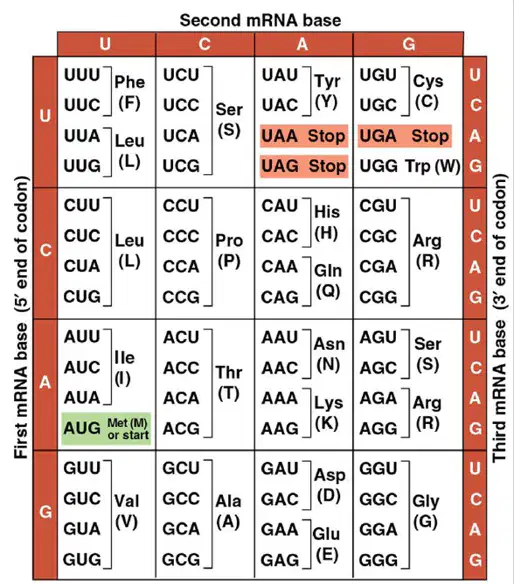
You have the mRNA sequence 5' AAG AUG GCG AAG UGA AAA 3'
What is the appropriate amino acid sequence?
Lys - Met - Ala - Lys
Lys - Met - Ala - Lys - Trp- Lys
Met - Ala - Lys
Lys - Met - Ala - Lys - Trp
When we say a gene is turned on or "expressed" what are we saying?
The protein encoded by that gene has been produced.
The protein encoded by that gene has been inhibited.
The RNA encoded by that gene has been produced.
The DNA encoding that gene has been replicated.
Which steps of the central dogma occur within the NUCLEUS of a cell?
Select ALL that apply.
Replication
Transcription
Translation
None of the above
In transcription, what polymerase is used to build an RNA transcript?
DNA polymerase
RNA polymerase
Which direction does RNA polymerase BUILD RNA?
3' --> 5'
3' --> 3'
5' --> 5'
5' --> 3'
In this part of the central dogma, a 5' cap is added, a polyA tail is added, and splicing occurs.
DNA processing
RNA processing
Protein processing
All of the above
Which part of a pre-mRNA transcript is considered the non-coding region?
Exons
Introns
Both
Neither
Which part of a pre-mRNA transcript is cut out and removed during splicing?
Exons
Introns
Both
Neither
Which end of a protein is the C-terminus?
The beginning of the protein
The end of the protein
It depends on the proteins
The RNA that carries the message interested in being expressed from the DNA is:
rRNA
tRNA
mRNA
All of the above
The RNA that helps form the peptide bonds during translation is:
rRNA
tRNA
mRNA
All of the above
The RNA that brings in the appropriate amino acids for the growing polypeptide chain during translation is:
rRNA
tRNA
mRNA
All of the above
Which type of RNA is MOST IMPORTANT for translation?
rRNA
tRNA
mRNA
All of the above
Which ribosomal subunit binds to the DNA first when translation is being initiated?
Small subunit
Large subunit
Both bind at the same time
The ribosome has three binding sites for tRNA molecules. Which order do tRNAs travel through these binding sites?
P --> E --> A
A --> E --> P
A --> P --> E
P --> A --> E
The start codon for translation is...
GGA
GUA
UAC
AUG
Which type of RNA contains an anticodon for translation purposes?
mRNA
tRNA
rRNA
All of the above
New peptide bonds are formed in the [what] site of the ribosome?
A site
P site
E site
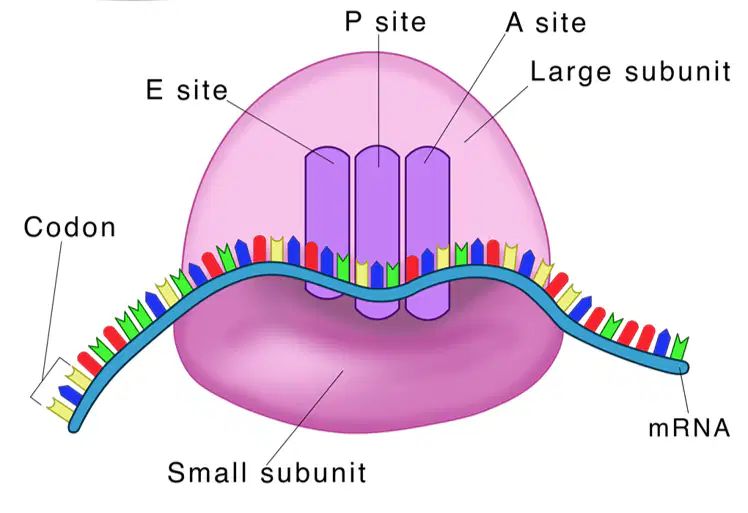
Based on the image provided, which direction will translation be going?
From left to right
From right to left
In both directions
It depends on where the ribosome starts
True or False? When a gene is expressed, the process only produces 1 mRNA transcript and 1 polypeptide chain.
True
False
When does a translated polypeptide chain begin to fold into a functional protein?
Immediately after translation completes and it is released from the ribosome
Immediately as it begins exiting the ribosome during translation
Immediately after post-translational modifications are completed
Free ribosomes will translate... (select all that apply)
Proteins that will function within the cytoplasm
Proteins that will function within a membrane
Proteins that will function outside of the cell
Ribosomes bound to the rough ER will translate... (select all that apply)
Proteins that will function within the cytoplasm
Proteins that will function within a membrane
Proteins that will function outside of the cell
How does the ribosome know where the correct "reading frame" is on the mRNA transcript?
Where the 5' cap is
Where the start codon (AUG) is
Where the first non-start codon is
True or False? A mutation in the DNA will always lead to an impairment for the individual.
True
False
Point mutations include... (Select all that apply.)
Substitutions
Insertions
Deletions
What type of mutation occurred if the following change occurred?
Met - Ala - Lys - Trp - Trp - Pro
Met - Ala - Lys - Trp - Gly - Pro
Silent
Missense
Nonsense
What type of mutation occurred if the following change occurred?
Met - Ala - Lys - Trp - Trp - Pro
Met - Ala - Lys - Trp - Trp - Pro
Silent
Missense
Nonsense
What type of mutation occurred if the following change occurred?
Met - Ala - Lys - Trp - Trp - Pro
Met - Ala - Lys
Silent
Missense
Nonsense
These types of mutations can be incredibly damaging because when they occur they can change ALL amino acids that get translated after that mutation during gene expression. (Select all that apply.)
Substitutions
Insertions
Deletions
At what levels can gene expression be regulated? Select ALL that apply.
At the transcription level
At the translation level
At the post-translation level
What type of regulatory molecule could bind to the DNA in order to block gene expression?
An inducer
A blocker
A repressor
An inhibitor
What type of regulatory molecule could bind to a repressor in order to make it fall off the DNA and no longer allow it to block gene expression?
An inducer
A blocker
A repressor
An inhibitor

