
 Worksheets
Neuron Functioning and Impulse Quiz
Total questions: 127
Worksheet time: 1hrs 13mins
What is an impulse in the context of neurons?
A force that excites the neuron
A message generated in response to a stimulus in a neuron and transmitted along it
A chemical released by the neuron
A physical movement of the neuron
What is the role of a stimulus in the functioning of a neuron?
It generates a message in the neuron
It excites the neuron
It inhibits the neuron
It destroys the neuron
What is the primary mechanism by which nerve impulses are transmitted in the body?
Electrical signals traveling through the axon
Ions carrying a signal in the form of a cascade of charge
Chemical reactions between neurons
Magnetic waves generated by the brain
Which ions are primarily involved in the transmission of nerve impulses?
Calcium (Ca²⁺), Magnesium (Mg²⁺), and Phosphate (PO₄³⁻)
Sodium (Na⁺), Potassium (K⁺), and Chloride (Cl⁻)
Iron (Fe²⁺), Zinc (Zn²⁺), and Sulfate (SO₄²⁻)
Hydrogen (H⁺), Oxygen (O²⁻), and Nitrogen (N³⁻)
Why are salts important in the human diet according to the text?
They provide energy for the body
They regulate nerve impulses and are essential for survival
They help in digestion and absorption of nutrients
They increase muscle strength and endurance
What happens if the body does not have sufficient salts?
The body becomes dehydrated
Death occurs quickly
The immune system weakens
The body loses its ability to produce hormones
What is the primary reason sodium ions (+) stay outside the nerve cell at rest?
The membrane is permeable to sodium ions.
The membrane is impermeable to sodium ions.
Sodium ions are actively pumped into the cell.
Sodium ions are neutral and do not affect the charge.
What happens to potassium ions (+) in a nerve cell at rest?
All potassium ions leave the cell.
All potassium ions stay inside the cell.
Half of the potassium ions leave the cell, and half stay inside.
Potassium ions are impermeable to the membrane.
What is the approximate resting potential of most neurons?
+70mV
-70mV
0mV
-30mV
Why is the overall charge of the nerve cell negative at rest?
Sodium ions are pumped into the cell.
Potassium ions are impermeable to the membrane.
The cell contains negatively charged proteins and chloride ions.
The cell contains positively charged proteins and sodium ions.
What ions are predominantly found inside the membrane at rest?
Sodium (+) and half potassium (+)
Chloride (-), Protein (-), and half potassium (+)
All sodium (+) and chloride (-)
Potassium (+) and Protein (-)
What is the primary composition of ions outside the membrane at rest?
All sodium (+) and half potassium (+)
Chloride (-) and Protein (-)
High potassium (+) and low sodium (+)
Negative organic ions and chloride (-)
What is the role of the Na⁺/K⁺ pump in maintaining the resting membrane potential?
It allows passive diffusion of ions across the membrane.
It actively transports sodium out and potassium into the cell.
It blocks the movement of chloride ions.
It equalizes the concentration of ions inside and outside the membrane.
Why is the membrane described as polarized at rest?
Because the inside of the membrane is positively charged.
Because the outside of the membrane is negatively charged.
Because there is a charge difference across the membrane.
Because sodium and potassium ions are equally distributed.
What happens to the cell membrane when a nerve receives a stimulus?
It becomes impermeable to sodium ions
It changes and some protein channels open
It releases potassium ions into the extracellular space
It remains unchanged
What is the threshold potential required to trigger an action potential in a nerve cell?
-70mV
-55mV
0mV
-40mV
What is the process called when sodium ions flood into the cell, raising the charge towards 0mV?
Repolarisation
Hyperpolarisation
Depolarisation
Polarisation
How do sodium ions enter the cell during the generation of a nerve impulse?
By active transport
By osmosis
By diffusion
By facilitated transport
What happens during depolarisation in a neuron?
Sodium ions exit the neuron, increasing the negative charge inside.
Sodium ions enter the neuron, neutralising the negative charge inside.
Potassium ions enter the neuron, neutralising the positive charge inside.
Calcium ions enter the neuron, increasing the positive charge inside.
What triggers the depolarisation process in a neuron?
The release of potassium ions from the neuron.
The application of a stimulus to the neuron.
The removal of sodium ions from the neuron.
The increase in calcium ion concentration outside the neuron.
Which part of the neuron becomes excited during depolarisation?
The dendrites.
The axon.
The synapse.
The cell body.
What happens when the stimulus is great enough to generate an action potential?
Sodium ions leave the cell.
Sodium ions continue to enter the cell.
The cell resets by pumping sodium ions back out.
The action potential decreases in size.
What occurs if the stimulus is not strong enough to generate an action potential?
Sodium ions continue to enter the cell.
The cell resets by pumping sodium ions back out.
The nerve fires partially.
The action potential is generated but smaller in size.
Why do nerves either fire or not fire?
Because action potentials vary in size.
Because the stimulus strength determines the firing.
Because action potentials are all the same size if triggered.
Because sodium ions leave the cell.
At what voltage does sodium continue to enter the cell until the inside of the cell reaches this level in most neurons?
-70mV
+40mV
0mV
+100mV
What causes potassium channels to open in the cell membrane during repolarisation?
Negative charge buildup
Positive charge buildup
Sodium ion movement
Hyperpolarisation
What happens to potassium ions during repolarisation?
They move into the cell
They remain stationary
They move out of the cell
They are converted into sodium ions
Why does hyperpolarisation occur during repolarisation?
Potassium channels open/shut slower than sodium channels
Sodium channels open/shut slower than potassium channels
Sodium ions overshoot the membrane potential
Potassium ions remain stationary
What mechanism resets the cell after repolarisation?
Sodium channels closing permanently
Potassium channels remaining open
Na+/K+ protein exchange pumps using energy
Hyperpolarisation maintaining the charge
What is the process of repolarisation in an axon?
The movement of Na+ ions into the axon and K+ ions out of the axon.
The movement of K+ ions into the axon and Na+ ions out of the axon.
The movement of Na+ ions out of the axon and K+ ions into the axon.
The movement of K+ ions out of the axon and Na+ ions into the axon.
What happens to the charges inside and outside the axon during repolarisation?
The inside becomes positively charged while the outside becomes negatively charged.
The inside becomes negatively charged while the outside becomes positively charged.
Both inside and outside remain positively charged.
Both inside and outside remain negatively charged.
Which ions are primarily involved in the repolarisation process of an axon?
Calcium (Ca2+) and Sodium (Na+).
Potassium (K+) and Sodium (Na+).
Magnesium (Mg2+) and Potassium (K+).
Chloride (Cl-) and Sodium (Na+).
What is the significance of the note stating "Charges on bottom are same as top" in the diagram?
It indicates that the axon is uniformly charged throughout.
It highlights that the charges on the axon membrane are symmetrical.
It shows that the charges inside the axon are identical to the outside.
It suggests that the charges are irrelevant to the repolarisation process.
What is the primary function of the Na⁺-K⁺ pump in the resting axon?
To maintain a high concentration of Na⁺ inside the axon and K⁺ outside the axon.
To actively transport Na⁺ out of the axon and K⁺ into the axon.
To allow passive diffusion of Na⁺ and K⁺ across the axon membrane.
To depolarize the axon membrane during nerve impulse transmission.
What happens to the axon membrane during depolarization?
The inside of the axon becomes more negative compared to the outside.
The inside of the axon becomes more positive compared to the outside.
The Na⁺-K⁺ pump stops functioning.
The axon membrane becomes impermeable to ions.
Which ion primarily moves into the axon during depolarization?
K⁺
Na⁺
Cl⁻
Ca²⁺
What is the significance of repolarization in the axon membrane?
It restores the resting potential of the axon.
It initiates the depolarization process.
It allows the axon to remain in an excited state.
It prevents the movement of ions across the membrane.
What is the sequence of events in the nerve impulse process starting from the resting membrane?
Resting membrane → Depolarization → Repolarization → Hyperpolarization → Resting membrane potential
Depolarization → Resting membrane → Hyperpolarization → Repolarization → Resting membrane potential
Resting membrane → Hyperpolarization → Depolarization → Repolarization → Resting membrane potential
Resting membrane → Repolarization → Depolarization → Hyperpolarization → Resting membrane potential
During the depolarization phase of a nerve impulse, which ion moves into the cell?
Potassium (K+)
Sodium (Na+)
Calcium (Ca2+)
Chloride (Cl-)
What happens during the repolarization phase of a nerve impulse?
Sodium ions move into the cell
Potassium ions move out of the cell
Calcium ions move into the cell
Chloride ions move out of the cell
What is the term used to describe the overshoot of ions during the nerve impulse process?
Depolarization
Hyperpolarization
Repolarization
Resting membrane potential
What is the final phase of the nerve impulse process that restores the original state of the membrane?
Depolarization
Hyperpolarization
Resting membrane potential
Repolarization
What causes the impulse to move down the axon during the conduction of nerve impulses?
The ions themselves move down the axon.
Sodium channels open in the next part of the membrane.
The wave of repolarisation pushes the impulse forward.
Diffusion of ions down the axon.
Why is the conduction of nerve impulses faster than diffusion?
Because ions move rapidly down the axon.
Because the charge moves, similar to electricity.
Because sodium channels open instantly.
Because repolarisation occurs faster than diffusion.
What happens after the wave of repolarisation during nerve impulse conduction?
The nerve impulse stops completely.
The ions move to the next part of the axon.
The entire nerve resets back to rest.
Sodium channels remain open permanently.
Analyze the nerve impulse graph and explain the role of sodium and potassium gates during depolarization and repolarization phases.
Sodium gates open during depolarization, allowing sodium ions to enter the cell, while potassium gates open during repolarization, allowing potassium ions to exit the cell.
Sodium gates open during repolarization, allowing sodium ions to exit the cell, while potassium gates open during depolarization, allowing potassium ions to enter the cell.
Both sodium and potassium gates remain closed during depolarization and repolarization phases.
Sodium gates open during repolarization, allowing potassium ions to enter the cell, while potassium gates open during depolarization, allowing sodium ions to exit the cell.
What is the significance of the refractory period in the nerve impulse graph?
It ensures that the nerve impulse travels in one direction only.
It allows the nerve impulse to travel faster.
It prevents the sodium/potassium pump from functioning.
It increases the strength of the nerve impulse.
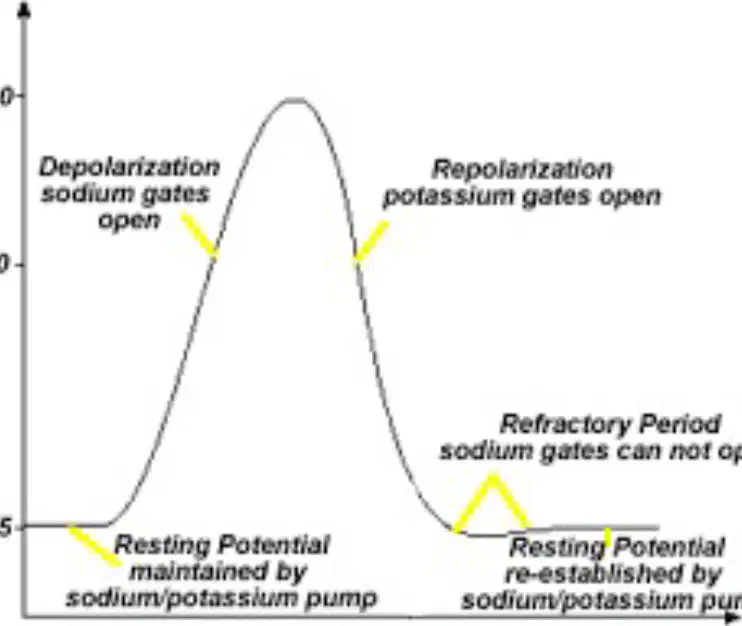
During the resting potential phase, what mechanism maintains the membrane potential at -65 millivolts?
Sodium/potassium pump actively transports sodium out and potassium into the cell.
Sodium gates remain open, allowing sodium ions to enter the cell.
Potassium gates remain open, allowing potassium ions to exit the cell.
Both sodium and potassium gates remain closed.
What is the primary function of neuro-muscular junctions?
To connect nerve cells to other nerve cells
To trigger muscle cells for contraction
To transmit sensory information to the brain
To regulate blood flow in muscles
How do neuro-muscular junctions differ from regular nerve junctions?
They transmit signals to another nerve cell
They work differently from regular nerve junctions
They trigger muscle cells instead of another nerve cell
They are located in the brain only
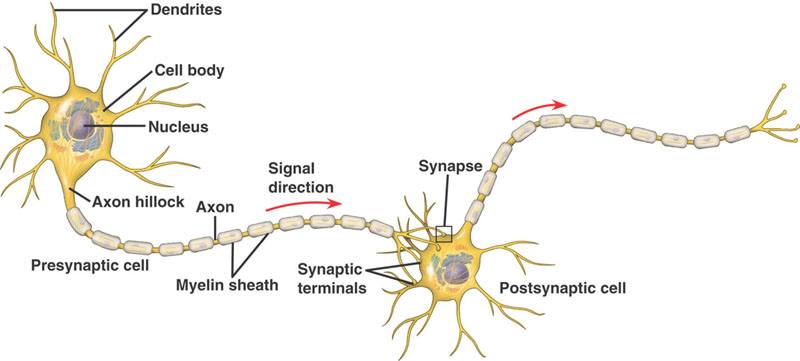
What is the term used to describe the connection between the end of an axon and the dendrites of the next neurone?
Synapse
Axon terminal
Neurotransmitter
Myelin sheath
Which neurone is responsible for sending the impulse in a synapse?
Post-synaptic neurone
Pre-synaptic neurone
Axon neurone
Dendritic neurone
What happens when the impulse reaches the end of the axon?
The action potential stops completely
The action potential is sent to the next neurone to continue the signal
The dendrites absorb the impulse directly
The axon releases neurotransmitters into the bloodstream
What is the name of the neurone that receives the impulse in a synapse?
Pre-synaptic neurone
Post-synaptic neurone
Axon neurone
Synaptic neurone
What is the name of the narrow gap between the axon and dendrites where diffusion occurs very quickly?
Synaptic Vesicle
Synaptic Cleft
Axon Terminal
Neurotransmitter Gap
Why is the synaptic cleft only about 20 nanometres wide?
To allow neurotransmitters to bind to receptors
To allow diffusion to occur very quickly
To prevent the axon and dendrites from touching
To store neurotransmitters for later use
What is the axon filled with to support its function?
Synaptic clefts and neurotransmitters
Mitochondria and vesicles
Dendrites and axon terminals
Soma and synaptic vesicles
What are vesicles in the axon filled with?
Synaptic clefts
Neurotransmitters
Axon terminals
Mitochondria
Which neurotransmitter is one of the main ones found in humans?
Dopamine
Acetylcholine
Serotonin
GABA
Which diagram best illustrates the structure of a synapse, including the synaptic cleft, axon, vesicles, and neurotransmitters?
A diagram showing the synaptic cleft, axon, vesicles, and neurotransmitters.
A diagram showing only the axon and dendrite without vesicles or neurotransmitters.
A diagram showing a neuron without any synaptic structures.
A diagram showing only vesicles and no other synaptic components.
What is the role of calcium ions in triggering signal transmission at the axon tip?
They open sodium channels in the end membrane.
They activate proteins on vesicles, enabling them to bind to the axon membrane.
They directly release neurotransmitters into the synaptic cleft.
They diffuse across the synaptic cleft to the next neuron.
What process occurs when vesicles fuse with the axon membrane during signal transmission?
Endocytosis of neurotransmitters.
Diffusion of calcium ions.
Exocytosis of neurotransmitters.
Activation of sodium channels.
What happens to neurotransmitters after they are released into the synaptic cleft?
They bind to calcium ions.
They diffuse across the synaptic cleft to the next neuron.
They are absorbed back into the vesicles.
They activate sodium channels in the axon membrane.
What happens when neurotransmitters bind to receptor proteins in the post-synaptic dendrite membrane?
Sodium channels open, allowing sodium ions into the post-synaptic dendrite.
Potassium channels open, allowing potassium ions into the post-synaptic dendrite.
Calcium channels open, allowing calcium ions into the post-synaptic dendrite.
Chloride channels open, allowing chloride ions into the post-synaptic dendrite.
What is the result of sodium ions entering the post-synaptic dendrite?
Formation of a new action potential.
Inhibition of signal transmission.
Decrease in membrane potential.
Release of neurotransmitters.
Which part of the neuron is involved in signal transmission when neurotransmitters bind to receptors?
Post-synaptic dendrite membrane.
Axon terminal.
Myelin sheath.
Cell body.
The operation of the sodium-potassium "pump" moves:
sodium & potassium ions into the cell
sodium & potassium ions out of the cell
sodium ions out of the cell & potassium ions into the cell
sodium ions into the cell & potassium ions out of the cell
After depolarization what happens to restore resting potential?
Sodium channels open & sodium ions diffuse out of the neuron.
Potassium channels open and potassium ions diffuse into the neuron.
Potassium channels open and potassium ions diffuse out of the neuron.
Sodium channels open and sodium ions diffuse into the neuron.


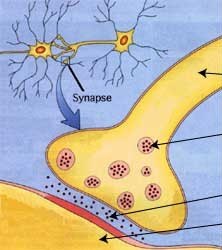
The location of neurotransmitters
axon terminals
dendrites
Schwann cells
cell body
Which of the following best describes a neuron?
Specialized cells that protects the body from any foreign particles
Specialized cell that transports oxygen throughout the cardiovascular system
Specialized cell that functions to transmit electrical impulses within the nervous system
Specialized cells that receive and read signals sent from the body
What are the 3 stages in action potential? Select all that apply.
Depolarization
Repolarization
Refractory period
Resting potential

When a neuron is at REST,
the inside of the neuron is negatively charged compared to the outside.
the inside of the neuron is positively charged compared to the outside.
there is no charge difference established
none of these is true
Depolarization occurs when
sodium channels open
potassium channels open
sodium channels close
potassium channels close

when does the stimuli cause an action potential?
when it reaches threshold
just below the threshold
just above threshold
Which is true for repolarisation?
sodium channels open, potassium channels close
sodium channels open, potassium channels open
sodium channels close, potassium channels open
sodium channels close, potassium channels close


The resting membrane potential is:
+40mV
-70mV
-20mV
0 mV
The sodium potassium pump...
is energy (ATP) free as sodium and potassium move in and out by diffusion as needed
moves 3 sodium ions into the neuron and 3 potassium out only if ATP is present
moves 3 sodium in to the neuron and 2 potassium without energy from ATP
moves 3 sodium out of the neuron and 2 potassium into the neuron only if there is energy from ATP
What number(s) on the graph represents the THRESHOLD level of stimulus?
1 and 5
2
3
6
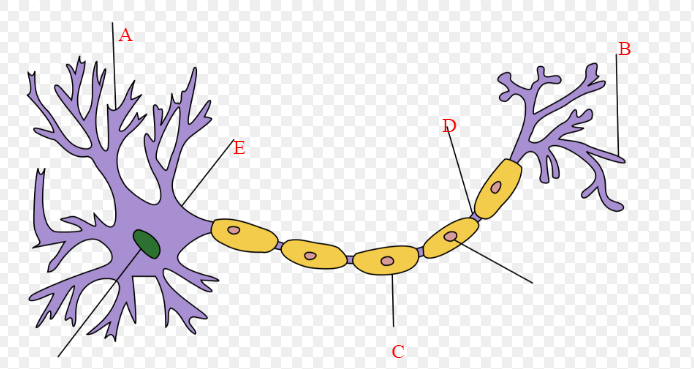
What structure is labeled B
Dendrite
Axon
Axon Terminal
Cell Body

Which of the following can be observed during the 2nd period of the graph?
K+ gates open
Na+ gates open
Na+/K+ pump opens
Na+ and K+ gates open
Which statement about neurotransmitters is true?
Neurotransmitters are produced by glands and they are transported to nerve cells through the bloodstream.
Neurotransmitters transmit nerve impulses from one neurone to another neurone.
Neurotransmitters are produced and released by dendrites.
Neurotransmitters are produced only at the motor neurone.

What do the nodes of Ranvier do?
help speed up impulse
help slow down impulse
protecting the axon
insulating the axon
What is a nerve cell called?
axon
neuron
dendrite
myelin
Which 2 are parts of the central nervous system?
brain
nose
spinal cord
left big toe

Which ions are MAINLY implicated in the potential of the membrane?
Na and Ca
Ca and Fe
K and Cl
Na and K
Part of a neuron that receives information from other neurons is called...
A signal molecule that transmits nerve impulses across synapses is called...

Axon Terminal
Nerve impulse transmission refers to the ability of the neuron to...
reproduce
receive an chemical signal
produce sodium or potassium
send an electrochemical signal
The sodium potassium pump...
is energy (ATP) free as sodium and potassium move in and out by diffusion as needed
moves 3 sodium ions into the neuron and 3 potassium out only if ATP is present
moves 3 sodium in to the neuron and 2 potassium without energy from ATP
moves 3 sodium out of the neuron and 2 potassium into the neuron only if there is energy from ATP


A reflex reaction is an .....
involuntary response
voluntary response
conscious response
response
Which of these are the correct pathway for the reflex arc?
Stimulus-receptor- motor neuron -interneuron-sensory neuron-response
Stimulus-receptor-sensory neuron-interneuron- motor neuron -response
Stimulus-interneuron-sensory neuron- motor neuron- receptor-response
Stimulus-receptor-sensory neuron-response- interneuron - motor neuron

Look at the reflex arc shown in the diagram. Which neurone is marked by the letter X?
Sensory neuron
Interneuron
Motor neuron
CNS

Look at the reflex arc shown in the diagram. Which neurone is marked by the letter Y?
Sensory Neuron
Interneuron
Motor neuron
CNS

