
 Worksheets
Field Trip Science Review
Total questions: 123
Worksheet time: 2hrs 5mins

Solid
Liquid
Gas

Which state of matter has no definite shape and no definite volume?
Gas
Solid
Liquids and Gases
Liquid
Liquids have the ability to flow because
There are strong forces of attraction between the particles
Their particles are arranged in a regular pattern
Their particles can slide over each other
Their particles are very far apart
Evaporation is the change in state of a
gas to a liquid
gas to a solid
solid to a liquid
liquid to a gas
Which one of the following is not a property of a solid?
Definite color
Definite mass
Definite volume
Definite shape

The boiling point of a substance is the temperature at which it changes from
a liquid to a gas
a liquid to a solid
a gas to a solid
a solid to a liquid

Which one of the following is not a property of gases?
They have a definite mass
They have no definite shape
They have a definite volume
They can diffuse

In which state are the distances between the particles greatest?
Both gas and liquid
Liquid
Gas
Solid
Which one of the following is a state of matter?
Liquid
Creature
Particle
Air
The process of gathering information about our world is
data
observation
science
The ability to do work is
efficiency
energy
power
The study of matter and energy is not
Physical Science
Physics
Chemistry
Earth Science
Biology
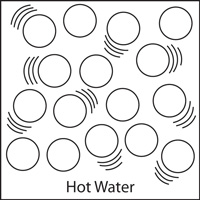
the smallest particle that still can be considered an element
proton
neutron
electron
atom
a series of models that developed from experimental evidence
atomic law
atomic theory
elemental law
elemental theory
negatively charged particles, discovered by Thomson
proton
neutron
electron
the dense center of an atom
proton
nuetron
nucleus
election
a positively-charged particle in the atoms nucleus
proton
neutron
electron
a particle with no charge in the nucleus of the atom
proton
neutron
electron
the number of protons in the nucleus of an atom
protons
atomic number
electron
nucleus
average mass of all the isotopes of that element
proton
atomic mass
electon
nucleus
a chart showing all of the elements arranged according to their properties
atomic mass
proton
neutron
periodic table
a one or two letter abbreviation for the element
chemical symbol
atomic number
atomic mass
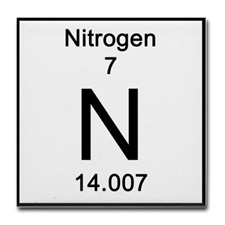


What period is this element in?
1
18
10
2
What group is this element in?
10
2
18
8

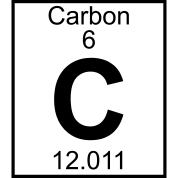
How many neutrons does Carbon have?
5
6
12
13
What is the atomic mass of an atom with 9 protons, 10 neutrons, and 9 electrons?
19
18
9
28


A bond between a metal and a nonmetal is called a(n)
covalent bond
ionic bond
metallic bond
transfer bond
A bond between a nonmetal and a nonmetal is called a(n)
covalent bond
ionic bond
metallic bond
transfer bond
What type of bond involves the sharing of electrons between atoms?
covalent bond
ionic bond
metallic bond
transfer bond
Identify the following compound as ionic or covalent: MgO
ionic
covalent
Identify the following compound as ionic or covalent: Na2SO4
ionic
covalent
Identify the following compound as ionic or covalent: CF4
ionic
covalent
Identify the following compound as ionic or covalent: SO2
ionic
covalent
Identify the following compound as ionic or covalent: CO
ionic
covalent
Identify the following compound as ionic or covalent: Ca(OH)2
ionic
covalent
This type of bonding can be described as "I give, I get"
ionic
covalent
metallic
This type of bonding can be described as a "cooperation"
ionic
covalent
metallic
Potassium is a
Metal
Nonmetal
Fe + S --> FeS
Example: H2
N2+O2--> _NO
(Check ALL answers)
H2O
Mg + __HCl ---> MgCl2 + H2
Al + O2 → 2Al2O3
A sample of Radium-228 decays from 100g to 12.5g. How many half lives did it experience?
1
2
3
4
How much of a 250g sample would be left after 5 half lives?
125g
62.5g
31.25g
7.81g
If the half life of Uranium-240 was 10 years, how long would it take for it to decay from 310g to 80g?
10 years
240 years
20 years
30 years

This image shows
nuclear fission
nuclear fusion

This image shows
Nuclear fission
Nuclear fusion

This equation shows
Nuclear fission
Nuclear fusion

This equation shows
Nuclear fission
Nuclear fusion
Which of these pH values represent an acid?
4
8
10
12

If I add more chicken soup to this setup, what will happen to the pH?
It will increase and get closer to 7
It will decrease and get closer to 0
It will stay the same and not change

If I add more water to this setup, what will happen to the pH?
It will increase and get closer to 7
It will decrease and get closert to 0
It will stay the same and not change

Milk is a very weak acid. What might its pH value be?
6.5
7.8
4.2
12.2
When acids react with metals, they produce hydrogen gas and salt.
True
False
When an acid is dissolved in water, it turns red litmus paper blue.
True
False
Which of the following are properties of acids?
They conduct electricity when dissolved in water
They taste sour
They react with metals to produce hydrogen gas
All of the answer choices are correct
Which of the following is an acid?
vinegar
bleach
sugar in water
starch in water
toothpaste in water
An acid is a solution that contains __________ ions dissolved in water.
positive
negative
The pH value of an acid represents its __________ of positive ions in the solution
amount
concentration
color
charge
Which of the following is a property of a base?
bitter taste
reacts with metals
salty
sour taste
Bases have many uses. They are mainly used to make
cleaning products
soaps
concrete
all of the answer choices
The higher the concentration of negative (hydroxide) ions in the solution, the stronger the base is.
True
False
All bases have a sour taste.
True
False
Which of the following pH values represents a base?
2.1
4.6
6.8
8.1
The strongest bases have pH values close to
0
14
7
5
Which of the following is a base?
baking soda in water
orange juice
vinegar
lemonade
Ocean water is only slightly basic. What might its pH value be?
5
8
12
2
Bases turn blue litmus paper red.
True
False
If the substance is neutral, what would the pH be?11
3
5
7
9
11
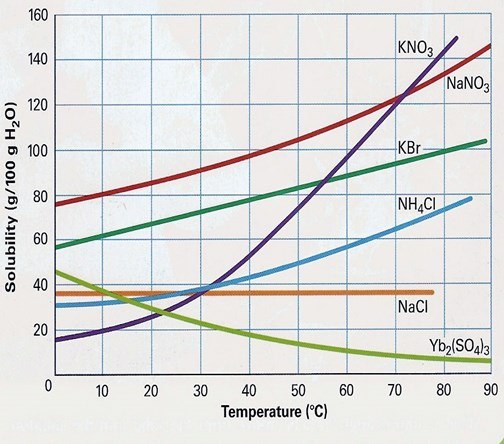
At 30'C, which substance has the lowest solubility?
KNO3
KBr
NaCl
Yb2(SO4)3
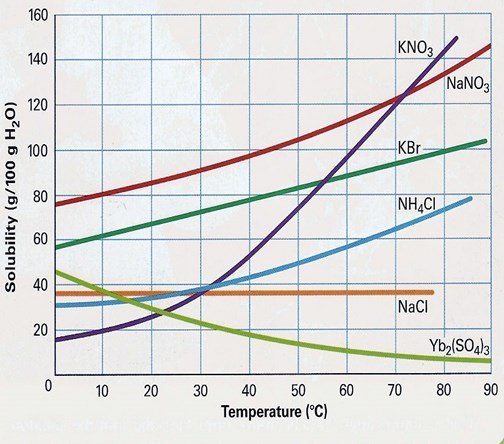
At which temperature do KBr and KNO3 have the same solubility?
60
55
50
Never
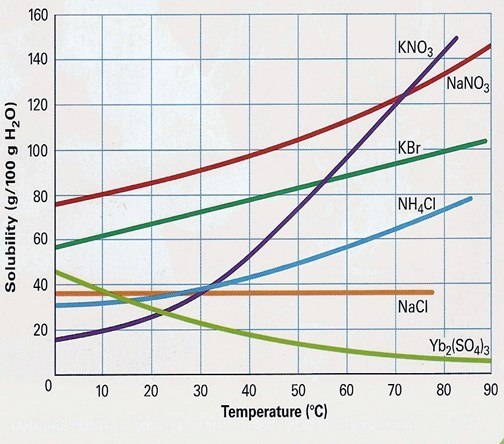
The solubility of Yb2(SO4)3 ________________ with added temperature.
increases
decreases
remains the same
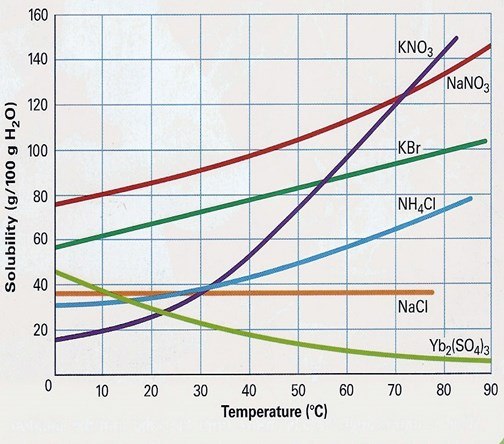
At 80'C, KBr's solubility is:
100
90
80
0
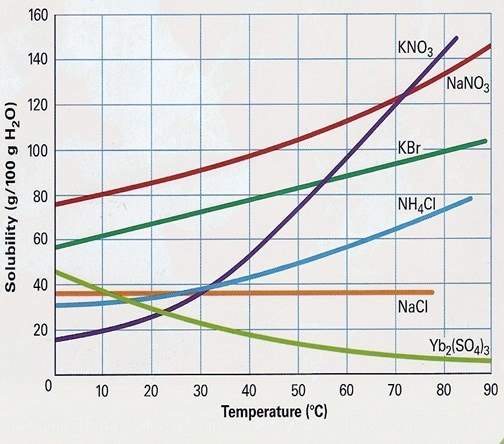
Determine the solubility for the substances at 55'C and arrange them in order from lowest to highest solubility.
NaCl, NH4Cl, KBr, NaNO3
NaCl, NH4Cl, NaNO3, KBr
NH4Cl, NaCl, NaNO3, KBr
NaNO3, KBr, NH4Cl, NaCl
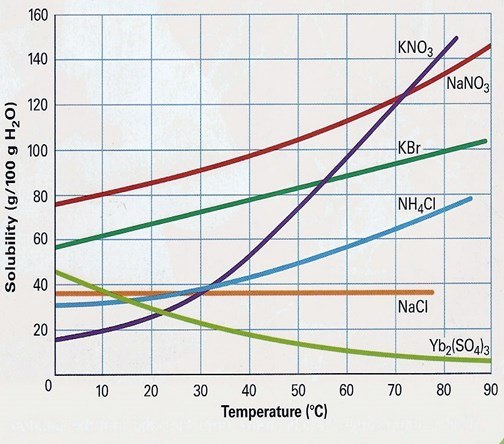
At 10'C, NaNO3's solubility is 80 g/100 g of H2O. Based on this information, what would the solubility be in 50 g of H2O.
40
80
160
16
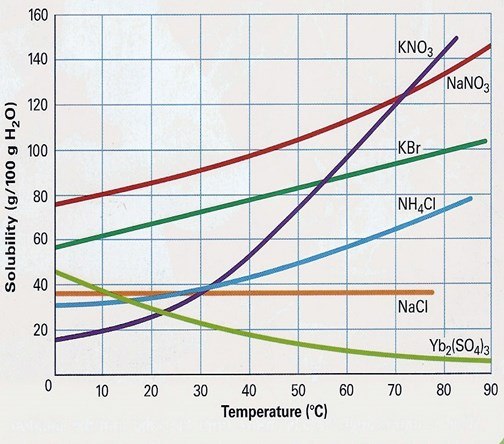
Identify if the following solution would be saturated, unsaturated, or supersaturated: 103 g KBr at 70'C.
Unsaturated
Saturated
Supersaturated
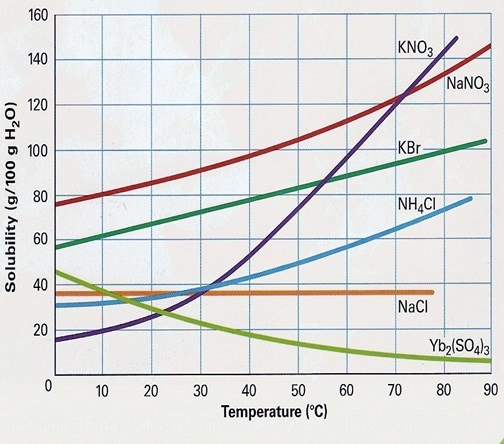
Identify how many grams of KNO3 is required to make a saturated solution at 40'C.
50 g
45 g
60 g
33 g
How could you change a saturated solution to an unsaturated solution?
Add solvent
Add solute
Water becomes __________ changing from a solid to a liquid
more dense & more kinetically chaged
less dense & less kinetically charged
more dense & less kinetically charged
less dense & more kinetically charged
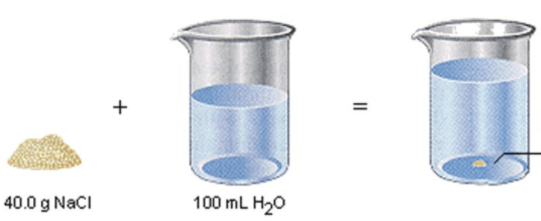
Identify the saturation associated with the product of this experiment.
Unsaturated
Saturated
Supersaturated
Identify a method to decrease the dissolving rate of a solution:
decrease the temperature
add KE
stir the solution
increase the temperature

