wayground logo

Free Printable Worksheets

Font size

S
M
L
XL
Worksheets

8th Grade Science Midterm Review

Total questions: 125

Worksheet time: 3hrs 10mins

Name
Class
Date
1.

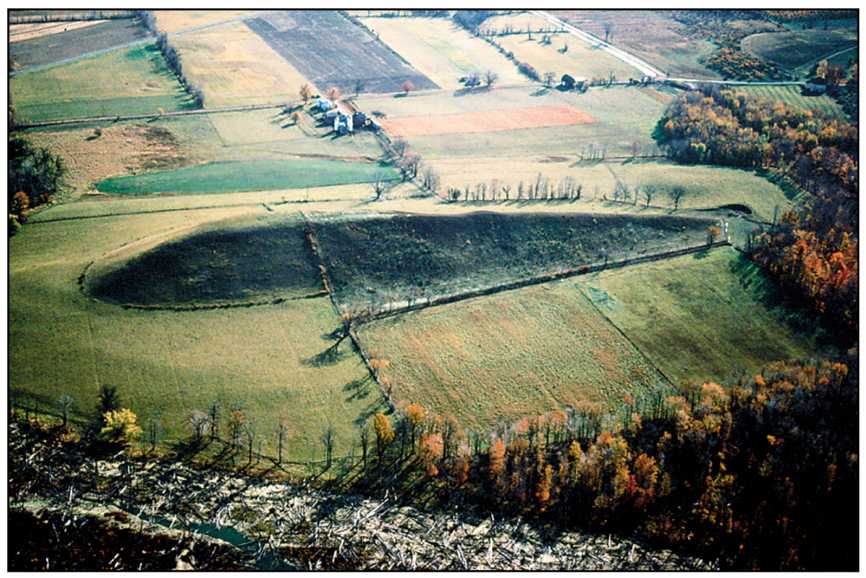
Where is a hilltop in this picture?

a)

Letter A

b)

Number 1

c)

Number 2

d)

Letter C

2.

Which of Newton's laws of motion is best described by inertia?

a)

1st

b)

2nd

c)

3rd

3.
A magician pulls a tablecloth out from under dishes and glasses on a table without disturbing them.
a)
Newton's 1st Law
b)
Newton's 2nd Law
c)
Newton's 3rd Law
4.

Rockets are launched into space using jet propulsion where exhaust accelerates out from the rocket and the rocket accelerates in an opposite direction.

a)

1st

b)

2nd

c)

3rd

5.
Pushing a child on a swing is easier than pushing an adult on the same swing, because the adult has more mass and requires more force to accelerate.
a)
Newton's 1st Law
b)
Newton's 2nd Law
c)
Newton's 3rd Law
6.

When two equal forces act in opposite directions on an object, they are called ______________________.

a)

frictional force

b)

balanced force

c)

centripetal force

d)

gravitational force

7.

Where is a gully in this picture?

a)

Just north of number 2

b)

Just south of number 1

c)

Just south of number 2

d)

Just south of letter A

8.

This kind of glacier once covered Ohio.

a)

Continental glacier

b)

Valley glacier

9.

When an unbalanced force acts on an object, the force ______________________.

a)

changes the motion of the object

b)

is cancelled by another force

c)

does not change the motion of an object

d)

is equal to the weight of the object

10.

What happens when two forces combine to act in the same direction?

a)

Their total force is the sum of the forces divided by two

b)

they cancel each other out

c)

the stronger force prevails

d)

they add together

11.

The resistance of an object to any change in its motion is called ______________________.

a)

inertia

b)

friction

c)

gravity

d)

weight

12.

According to Newton’s second law of motion, force is equal to mass times ______________________.

a)

inertia

b)

weight

c)

acceleration

d)

direction

13.

Any force that causes an object to change its motion is called a(n)

a)

unbalanced force

b)

gravitational force

c)

centripetal force

d)

balanced force

14.

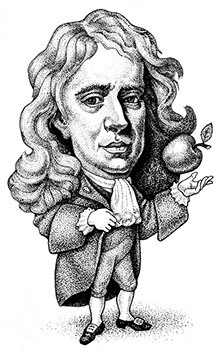
The picture is an example of Newton's...

a)

1st Law

b)

2nd Law

c)

3rd Law

15.
"For every action, there is an equal and opposite reaction."
a)
Newton's 1st Law
b)
Newton's 2nd Law
c)
Newton's 3rd Law
d)
Newton's 4th Law
16.

A person traveling in a car which stops suddenly will continue to move forward because of

a)

the person's mass

b)

the car's inertia

c)

the person's inertia

d)

the car's momentum

17.
Force = Mass x Acceleration
a)
Newton's 1st Law
b)
Newton's 2nd Law
c)
Newton's 3rd Law
d)
Newton's 4th Law
18.

"An object in motion (or at rest) will to stay in motion (or at rest) until an unbalanced force acts upon it."

a)

Newton's 1st Law

b)

Newton's 2nd Law

c)

Newton's 3rd Law

d)

Newton's 4th Law

19.
Any push or pull on an object.
a)
force
b)
velocity 
c)
inertia
d)
momentum
20.

Which of the following caused the formation of many of the hills in Strongsville, Brunswick, and Hinckley?

a)

glacial deposition

b)

glacial erosion

c)

water deposition

d)

water erosion

21.
The force that opposes motion between two surfaces in contact with each other.
a)
inertia
b)
friction
c)
momentum
d)
gravity
22.

The process by which natural forces move weathered rock from place to place is called

a)

erosion

b)

deposition

c)

till

d)

moraine

23.
The force of attraction between all matter.
a)
inertia
b)
friction
c)
net force
d)
gravity
24.

The difference in elevation between two contour lines on a topographic map is called its

a)

scale

b)

cliff

c)

hilltop

d)

contour interval

25.
A Newton is a unit of...
a)
force
b)
inertia
c)
acceleration
d)
velocity
26.
When all the forces on an object are equal and opposite, & the net force is zero, that's...
a)
balanced forces
b)
unbalanced forces
c)
terminal velocity
d)
reaction forces
27.

A channel along which water is continuously running down a slope is called a(n)

a)

rill

b)

till

c)

stream

d)

arete

28.
The combination of all the forces acting on an object is the...
a)
net force
b)
action force
c)
reaction force
d)
balance force
29.
Gravity is increased with...
a)
greater mass & shorter distance
b)
greater mass & farther distance
c)
lower mass & shorter distance
d)
lower mass & farther distance
30.
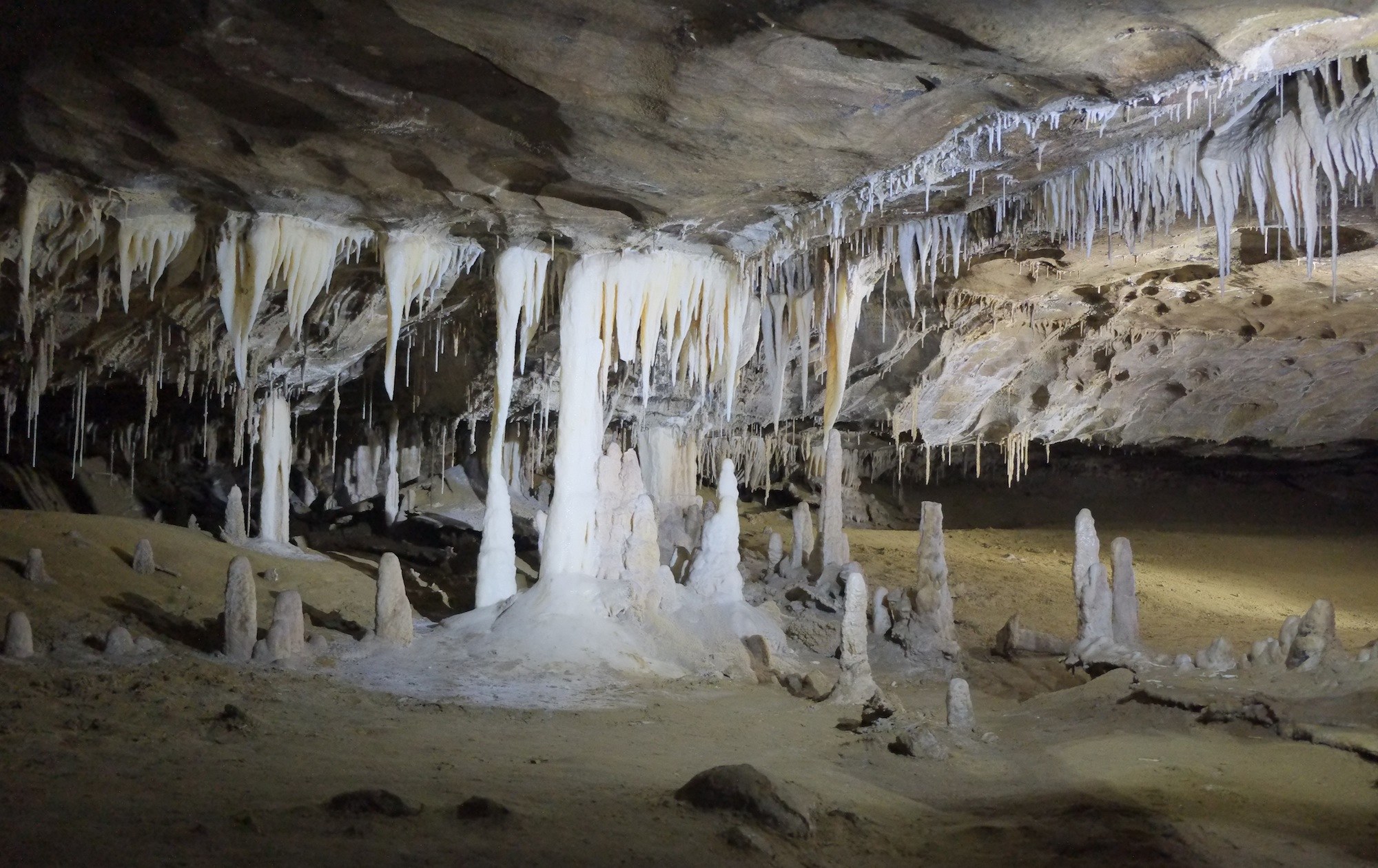
What landform can you see in the picture?
a)
Floodplain
b)
Delta
c)
Waterfall
d)
Oxbow lake
31.

An explanation of scientists' observations regarding how or why an observed phenomenon is occurring is a

a)

scientific question

b)

hypothesis

c)

scientific law

d)

scientific theory

32.
"I am a smaller river joining a larger river" What am I?
a)
Confluence
b)
Tributary 
c)
Drainage Basin
d)
Watershed
33.

What is the river landform seen in this picture?

a)

delta

b)

flood plain

c)

steep bank

d)

waterfall

34.

The till deposited at the edge of a glacier forms a ridge called a

a)

kettle

b)

moraine

c)

alluvial fan

d)

arete

35.
I am the land that gets flooded when the river overflows. What am I?
a)
Levee
b)
Delta
c)
Floodplain
d)
Meander
36.
In a meander (curve) where you can expect to have sediments deposited?
a)
Inside the curve
b)
Outside the curve
37.

What is the river landform seen in this picture?

a)

cliff

b)

delta

c)

meander

d)

oxbow lake

38.
A meander is best described as ...
a)
A straight section of the river.
b)
A winding section of a lake.
c)
A section of the river that joins another river.
d)
A winding section of a river.
39.

The force of gravity is stronger between two objects if they are __________________ each other

a)

closer to

b)

farther from

40.
What is a delta?
a)
Area of water
b)
fan shaped mass of material deposited at the mouth of a stream
c)
slope of land
d)
sediments deposited at a river
41.
When the bends of a Meander get close enough they can join, creating a new river path. What is left is called ...
a)
An oxback lake
b)
An oxen lake
c)
An oxcart lake
d)
An oxbow lake
42.
How is a floodplain formed ?
a)
When water floods on the flat area near it.
b)
When mud is deposited from the river to the flat land .
c)
When a flat area is formed near the river.
d)
When a river over flows.
43.
What is true of a river's upper course?
a)
It make a V-shaped valley
b)
It has an estuary
c)
It is slowing down
d)
The river is at its widest
44.

The gradual wearing down of land is called...

a)

Erosion

b)

Weathering

c)

Cataclysmic events

d)

Deposition

45.

What is the river landform seen in this picture?

a)

cliff

b)

delta

c)

meander

d)

waterfall

46.

The movement of sediment from one place to another is called...

a)

Deposition

b)

Cataclysmic events

c)

Erosion

d)

Wind

47.

Small pieces of the earth such as pebbles, rocks, and sand carried by water are called...

a)

Delta

b)

Sediment

c)

Mouth

d)

Water

48.

The gradual building up of land is called...

a)

Cataclysmic events

b)

Erosion

c)

Deposition

d)

Ice

49.
What is the process that picks up and moves weathered rocks?
a)
Deposition
b)
Landslide
c)
Weathering
d)
Erosion
50.
Deposition changes the Earth’s surface because bits of broken rock and soil _____.
a)
stop rivers from flowing.
b)
make rich farmlands.
c)
are dropped in new places.
d)
move very slowly.
51.

The tendency of an object to resist a change in motion is

a)

force

b)

momentum

c)

inertia

d)

mass

52.

The total momentum of two objects just before they collide is 60 kg * m/s. The total momentum of the objects after the collision will be

a)

20 kg * m/s

b)

60 kg * m/s

c)

30 kg * m/s

d)

120 kg * m/s

53.

What are the requirements for the formation of a waterfall?

a)

Horizontal rock layers of equal hardness

b)

Vertical rock layers of equal hardness

c)

Horizontal rock layers of unequal hardness

d)

Vertical rocks

54.

True or false? Waterfalls tend to move slowly downstream.

a)

True

b)

False

55.

The greater the mass of an object,

a)

the more space it takes up

b)

the easier it is for the object to start moving

c)

the more balanced it is

d)

the more momentum it has

56.

The large bead fell into the beaker more often than the puffball in our classroom activity because

a)

it had equal inertia with the puffball

b)

we had better aim when trying to get it into the beaker

c)

it had less inertia than the puffball

d)

it had more inertia than the puffball

57.

What is the river landform seen in this picture?

a)

beach

b)

cliff

c)

meander

d)

delta

58.

On a meandering river where does the water flow the fastest?

a)

On the inside of meanders

b)

In the middle of the stream

c)

On the outside of meanders

59.

According to Newton's second law of motion, acceleration increases as force increases if mass stays the same

a)

true

b)

false

60.
A river starts very small before getting larger. What is the name given to a small river that joins a larger river?
a)
Confluence
b)
Tribunal
c)
Tributary
d)
Joiner
61.
Deposition is when ...
a)
Objects are moved along the river.
b)
Objects are dropped along the river.
c)
Objects are suspended in the water.
d)
Objects are move into the ocean.
62.

A fan-shaped landform created by sediment being deposited at the mouth of a river.

a)

Delta

b)

Canyon

c)

U-Shaped Valley

d)

Sand Dunes

63.

The force of the gravity acting on a person or object at the surface of a planet is known as

a)

air resistance

b)

mass

c)

inertia

d)

weight

64.

Formed by a glacier that carved a deep valley as it slowly moved forward.

a)

Delta

b)

Canyon

c)

U-Shaped Valley

d)

Sand Dunes

65.

The flat, wide area of land along a river is called a(n)

a)

alluvial fan

b)

flood plain

c)

bank

d)

meander

66.
Which of the following actions causes the deposition of sand at a delta?
a)
river water slowing as it enters the ocean
b)
salt water & fresh water mixing together
c)
ocean waves transporting sand toward land
d)
ocean water slowing as it reaches the coast
67.

If you are standing on a skateboard when you throw a ball forward, Newton's laws of motion tell you that you will

a)

fall off your skateboard

b)

roll forward

c)

roll backward

d)

stay still

68.

Name two kinds of glaciers

a)

Continental Glaciers and valley glaciers

b)

Eroson Glaciers

c)

Mud slide

69.

What is a valley glacier

a)

Can move huge boulders

b)

Mixture of sediments that a glacier deposits

c)

A long, narrow glacier that forms when snow and ice builds up high in a mountain valley

70.

The till deposited at the edge of a glacier forms a rige called a _______________

a)

moraine

b)

drumline

c)

horn

d)

ice age

71.
An alpine/valley glacier generally forms in mountainous areas
a)
true
b)
false
72.
What is a bowl-shaped depression formed by glacial erosion?
a)
cirque
b)
arrete
c)
ice pack
d)
kettle
73.

A sharp, jagged ridge formed by a glacier is called a(n)...

a)

arete

b)

cirque

c)

erratic

d)

drumlin

74.

A description of many scientists' observations that is not explained is a

a)

scientific question

b)

scientific law

c)

scientific theory

d)

hypothesis

75.
What is an enormous mass of ice moving over land?
a)
glacier
b)
iceberg
c)
ice wedging
d)
dune
76.
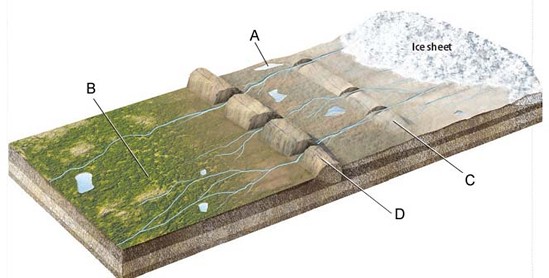
What glacial features are indicated by the labels C and D on the figure?
a)
moraines
b)
outwash plains
c)
kettle lakes
d)
ice sheets
77.

Which of the following can be used to find the elevation of a location on a topographic map?

a)

an index contour

b)

the scale

c)

a pixel

d)

a depression

78.
When a glacier retreats and large, partially buried, ice chunks are left behind to melt, these are formed:
a)
Moraine
b)
Prairie pothole
c)
Kettle Lake
d)
Fjord
79.
Poorly graded (unsorted) rock material deposited directly by a glacier.
a)
glacial drift
b)
stratified drift
c)
till
d)
glacier
80.
Forms when a flowing glacier scoops out an area between two mountains. 
a)
U-Shaped Valley
b)
Fjord
c)
Kettle
d)
Moraine
81.
Glaciers often form V shaped valleys
a)
true
b)
false
82.

The biggest threat to glacier health is

a)

earthquakes

b)

avalanches

c)

arctic animals

d)

global warming

83.
How do glaciers erode land?
a)
By picking up soil and rocks and depositing them in new location
b)
By picking up water from lakes and streams and carrying it to the ocean
c)
By causing rain and snow in an area
d)
By lowering the atmospheric pressure, causing intense windstorms
84.

Unless an object is acted upon by an unbalanced force, it stays at rest due to its

a)

friction

b)

inertia

c)

gravity

d)

matter

85.
A _____ is a tear-drop-shaped hill created by ice flow over and around till deposit.
a)
drumlin
b)
esker
c)
moraine
d)
erratic
86.

Which of the following is an example of rolling friction?

a)

a boat on the water as it sails

b)

your shoes on the sidewalk as you walk

c)

bike tires on the road as you ride

d)

two hands rubbing together

87.

An example of an action-reaction pair is

a)

waving your arms in a vacuum and not moving at all

b)

pushing your feet on the ground and having the ground push back equally on you causing you to lift into the air

c)

clapping your hands and making a sound

d)

throwing a ball and having no reaction at all on your body

88.
Glaciers form when _____.
a)
less snow falls than melts 
b)
more snow falls than melts 
c)
less rain falls than freezes 
d)
more rain falls than freezes 
89.
Glaciers only form near Earth’s poles.
a)
True
b)
False
90.

Where is the slope steepest in this picture?

a)

Letter C

b)

Number 1

c)

Just north of letter A

d)

Just south of letter A

91.
How were the Great Lakes formed?
a)
Canadians built a series of dams, making huge reservoirs
b)
Glaciers carving the land during the Ice Age, then melting
c)
Water flowing in from the Atlantic Ocean
d)
Underground springs
92.
Which law explains why when you put a book on a table the table pushes on the book
a)
3rd law
b)
4th law
c)
1st law
d)
2nd law
93.
Newton's third law states that any action will have a(n) _______ and ______ reaction
a)
Equal and similar
b)
Equal and opposite
c)
Equal and different
d)
Greater and opposite
94.
You hit a wall with a stick.  The equal but opposite reaction is _____
a)
the wall pushes against you
b)
the stick pushes against you
c)
you push against the stick
d)
the wall pushes against the stick
95.

An object with more mass has _________ than an object with less mass.

a)

more momentum

b)

less momentum

c)

more friction

d)

less friction

96.
A book rests on a table.  The force of gravity pulls down on the book with a force of 20 newtons. What prevents the books from accelerating downward ?   
a)
The table presses back up on the book with an equal and opposite force of 20 newtons.
b)
The table presses back up on the book with a force greater than 20 newtons.
c)
The table and the book together are accelerating downwards at  9.8 m/sec2
d)
The inertia of the book holds it up
97.
A person steps out of the boat and onto the dock.  As the person moves forward onto the dock, the boat moves backward.  Which statement best describes the backward motion of the boat as the person steps forward?
a)
For every action there is an equal and opposite reaction.
b)
Every mass exerts a force on every other mass.
c)
An object at rest tends to stay at rest.
d)
Friction opposes the motion of an object.
98.

On a topographic map, what connects points of equal elevation?

a)

contour intervals

b)

dashed lines

c)

contour lines

d)

longitude lines

99.
What is not an example of Newton's Third Law?
a)
Two people pushing against each other with the same force and in opposite directions
b)
You have to push a heavy ball harder to move as fast as a smaller one
c)
When you sit on a chair, your body acts as a force on the chair, and the chair acts as another force holding your body up
100.
Name the 2 factors that affect acceleration of an object
a)
velocity and time
b)
distance and time
c)
mass and force
d)
mass and time
101.

unit of measurement for force

a)

gram

b)

liter

c)

newton

d)

meter

102.

Football A has a greater mass than football B. Which football will have greater acceleration when both are thrown with the same force in the same direction?

a)

Football A

b)

Football B

c)

They will have the same acceleration

d)

Mass has no effect on acceleration

103.
True or false.  Mass resists acceleration.
a)
True
b)
False
104.
What are the appropriate units to describe acceleration?
a)
m/s
b)
m/s2
c)
cm
d)
there are no units associated with acceleration
105.

If the force on an object is doubled, to keep acceleration the same you must

a)

reduce the force to half of the original amount

b)

double the mass

c)

increase the mass by any amount

d)

reduce the force by any amount

106.
How can Newton's second law be represented  mathematically? 
a)
F=MA
b)
M= F/A
c)
A= F/M
d)
All are correct
107.
In an Unbalanced Force, which is true?
a)
There will be no movement
b)
One will move the other
108.

The law of universal gravitation states that any two objects in the universe

a)

repel each other

b)

combine to provide a balanced force

c)

attract each other

d)

create friction

109.
Why would one ball accelerate more than the other when pushed with the same amount of force?
a)
Different weights
b)
Different forces
c)
Different masses
d)
Different sizes
110.
Will it take more force to push an empty shopping cart or a shopping cart that is full?
a)
The empty shopping cart
b)
The full shopping cart
c)
They will take the same amount of force
111.
Which shopping cart will have more acceleration?  
a)
The empty shopping cart
b)
The shopping cart that's full
c)
They will be the same
112.

Which of these best states Newton's Second Law?

a)

The greater the mass of an object the greater the force needed to change its motion.

b)

The greater the mass of an object the less force needed to change its motion.

c)

The mass of an object does not effect the force needed to change its motion

113.

Your skateboard begins to slow down when you roll off the sidewalk and across gravel. What is at work?

a)

gravity

b)

friction

c)

balance

d)

all of the above

114.
An object at rest will _______ if no outside forces are applied.
a)
Stay at rest
b)
Increase Velocity
c)
Decrease Mass
115.

If you push the ping pong ball & the basketball with the same amount of force, which one will go a greater distance?

a)

The ping pong ball

b)

The basketball

c)

They will both travel the same distance

116.
One object has twice as much mass as another object. The first object also has also twice as much...
a)
velocity
b)
gracitational acceleration
c)
inertia
d)
all of these
117.
What is Newton's First Law
a)
F=ma
b)
Every action has an equal and opposite reaction
c)
An object at rest stays at rest, an object in motion stays in motion. 
d)
Friction 
118.
What Unit do we Measure Force in? 
a)
Newtons
b)
Joules
c)
Force
d)
Don't know
119.
The force that causes a ball to fall to the ground is ____________________________
a)
gravity
b)
lubricant
c)
friction
d)
motion
120.
A pull or push that acts on an object is called a
a)
force
b)
motion
c)
mass
d)
momentum 
121.
The tendency of an object to resist a change in its state of motion is called the object's ______.
a)
incline
b)
straight line
c)
friction 
d)
inertia 
122.
Without a force to stop or slow a coasting object, the object will coast forever in a ______ line. 
a)
blue
b)
red
c)
straight
d)
vertical 
123.
Objects at rest remain at rest and objects traveling at a steady rate in a straight line continue that way until a _________acts on them.  
a)
force
b)
velocity
c)
inertia
d)
acceleration 
124.
Forces that produce change in the motion of the object in the direction of the greatest force. 
a)
balanced forces 
b)
unbalance forces 
c)
incline
d)
Newton's 
125.
What is Newton's First Law known as? The Law of
a)
Friction
b)
Mass
c)
Inertia
d)
Gravity