
NEW
Font size
 Worksheets
Newton's Law Review
Total questions: 80
Worksheet time: 1hrs 21mins


What is another name for Newton’s 1st law?
Law of Inertia
Law of Acceleration
Law of Action/Reaction
What is another name for Newton’s 1st law?
Law of Inertia
Law of Acceleration
Law of Action/Reaction
What is the formula for the law of acceleration?
M = F x A
F = M x A
A = F x M
1st
Law of Motion
2nd
Law of Motion
3rd
Law of Motion
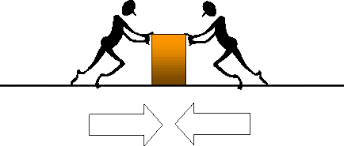

Which of Newton's laws is shown
1st law
3rd law
2nd law
What force slows objects down and keeps them from moving?
Acceleration
Gravity
Friction
Net Force

Letting go of a balloon full of air is demonstrating Newton's ______ _______ ________ _________ because the air comes out of the back and the balloon moves forward.
1st law of motion
2nd law of motion
3rd law of motion
13th law of motion
The more mass an object has, the _______ force it takes to accelerate it.
more
less
States that force equals mass x acceleration
Newtons 1st law
Newtons 2nd law
Newtons 3rd law
Claims if an object exerts a force on another object, the second object exerts a force of equal strenght in the opposite direction back towards the first object
Newtons 1st law
Newtons 2nd law
Newtons 3rd law
States an object at rest will remain at rest unless acted on by an unbalanced force
Newtons 1st law
Newtons 2nd law
Newtons 3rd law
An object moving at a constant velocity will continue moving at a constant velocity unless acted upon by an unbalanced force applies to this law
Newtons 1st law
Newtons 2nd law
Newtons 3rd law
The swing of a hammer drives a nail partially into a piece of lumber until it comes to a rest. The lumber exerts an opposite force of resistance.
Newtons 1st law
Newtons 2nd law
Newtons 3rd law
A squid ejects water backward, and the water pushes back, causing the squid to propel forward.
Newtons 1st law
Newtons 2nd law
Newtons 3rd law
A 1,000-kg truck barrels down a highway at 24 m/s2 with a force of 24,000 N.
Newtons 1st law
Newtons 2nd law
Newtons 3rd law
A tossed paper airplane glides forward until a gust of wind blows it sideways.
Newtons 1st law
Newtons 2nd law
Newtons 3rd law
A trampoline pad launches a child upwards with a force equal to the downward force of the landing the moment before.
Newtons 1st law
Newtons 2nd law
Newtons 3rd law
When the force of an object remains constant, then an increase in mass corresponds with a decrease in acceleration.
Newtons 1st law
Newtons 2nd law
Newtons 3rd law
The amount of matter in an object in the object's ________.
Inertia
Weight
Mass
Density
One Newton (N) equals ________.
1 kg ⋅ m/s2
1 lb ⋅ m/s2
1 kg ⋅ m/s
1 lb ⋅ m/s
The force needed to overcome ________ friction is more significant than that required to overcome the other two types of abrasion.
Rolling
Gliding
Fluid
Figure skaters A and B both apply the same amount of force to skate forward. If figure skater B has faster acceleration, is her mass less than that of figure skater A?
Yes
No
A white pool cue ball strikes a striped billiard ball at rest with a speed of 5 m/s. How fast does the striped billiards ball move, and in what direction?
5 m/s2 forward
5 m/s2 backward
5 m/s forward
5 m/s backward
The law of coservation of ______ states that the total momentum of the objects that interact ________ change.
mass, does not
Momentum, does
mass, does
Momentum, does not
Force equals...
mass x volume
mass x accelleration
change in direction
velocity x mass
What is the acceleration (a) of a 92 kg (m) downhill skier that skis with a force of 118 kg ⋅ m/s2 (F)?
.77 m/s2
1.3 m/s
1.3 m/s2
.77 m/s
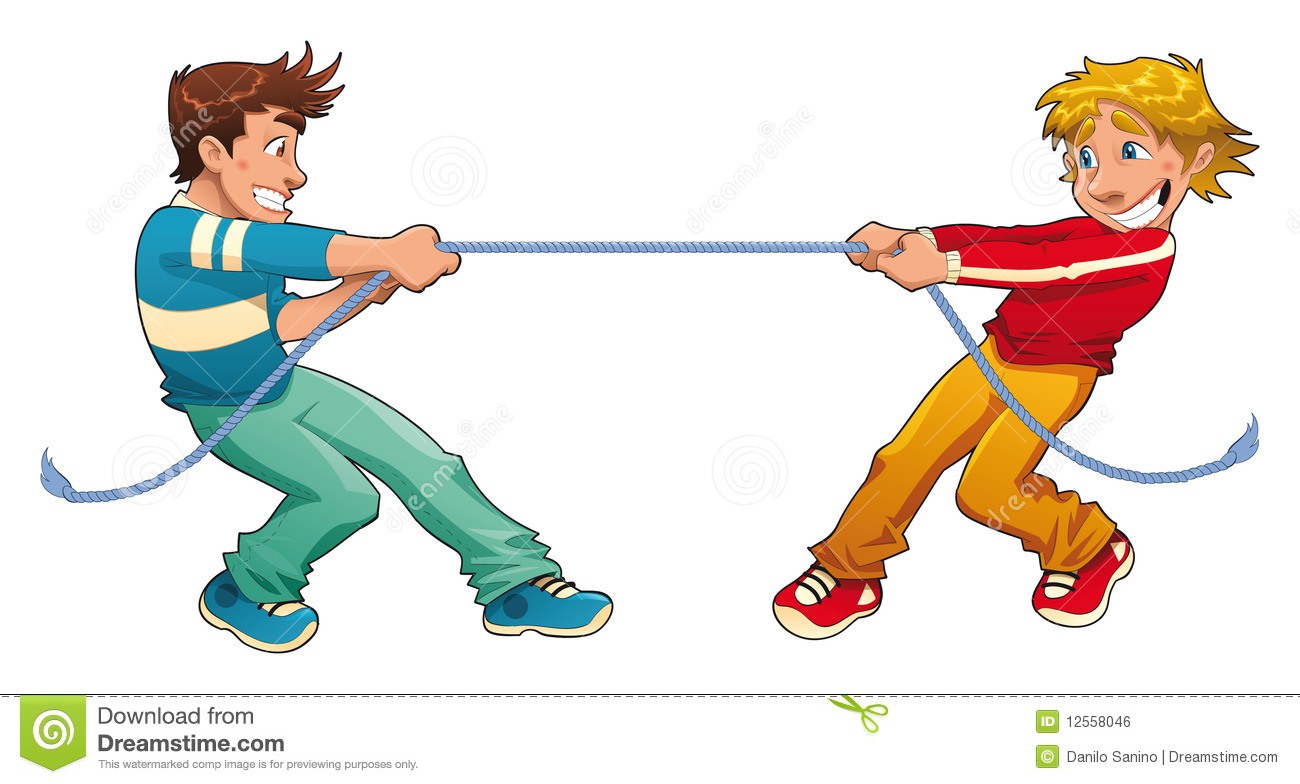
If these boys are pulling with the same amount of force. What will happen?
The boy in blue will win.
They will not move at all.
The boy in red will win.
Both will fall down.


The formula ? = mass x acceleration or ? = m x a is used to find
Force
Velocity
Momentum
Gravity
1st
Law of Motion
2nd
Law of Motion
3rd
Law of Motion


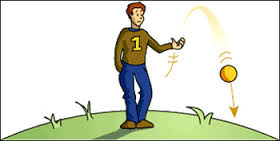
If an object is stationary (not moving), the forces acting upon it are _____________
unbalanced
weak
balanced
Hulk Smash!

A squirrel sits on the ground and eats a donut. We know the forces on him must be balanced because...
Forces are always balanced
the squirrel is not accelerating
squirrels are projectiles
he's eating a donut

Newton's third law states that any action will have an _______ and ______ reaction
Equal and similar
Equal and opposite
Equal and different
Greater and opposite

This equation goes with which law?
Newton's first law of motion
Newton's second law of motion
Newton's third law of motion

When the force on a car is doubled, the acceleration is doubled.
Newton's 1st Law
Newton's 2nd Law
Newton's 3rd Law

You push against a wall and the wall is pushing back on you.
Newton's 1st Law
Newton's 2nd Law
Newton's 3rd Law
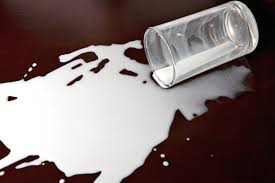
You are carrying a lunch tray when you bump into the edge of a table. Although the tray did not tip, your milk falls off the front of the tray.
Newton's 1st Law of Motion
Newton's 2nd Law of Motion
Newton's 3rd Law of Motion


If you calculate the magnitude of friction force on a car that is moving, which coefficient of friction would you use?
coefficient of static friction
coefficient of kinetic friction
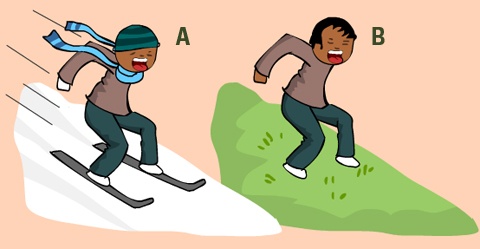
Why is it harder for the boy in Image B to get down the hill?
Motion
Friction
Work
Displacement
Which of the following shows the direction of the force of gravity (weight)?
A box is pushed with a force of 50N to the right and experiences a frictional force of 20N to the left. What is the net force acting on the box?
30N to the right
30N to the left
70N to the right
70N to the left
Which of the following is an opinion about friction?
It occurs any time two objects are in contact
It always acts in the opposite direction as motion
It slows objects down too much
It prevents objects on earth from staying in motion forever
Your skateboard begins to slow down when you roll off the sidewalk and across gravel. What is at work?
gravity
friction
balance
all of the above
What is the meaning of friction?

A force that opposes motion between two surfaces that are in contact.
cool as ice.
A 15 kg object is moving with a constant velocity on a horizontal surface. If the frictional force is 30 N, what is the applied force?
15 N
30 N
45 N
60 N
A 20 kg object is subjected to a force of 100 N. If the frictional force opposing the motion is 20 N, calculate the acceleration of the object.
2 m/s²
3 m/s²
4 m/s²
5 m/s²
A 50 kg object is at rest on a surface with a coefficient of static friction of 0.4. What is the maximum static frictional force that can act on the object?
100 N
150 N
200 N
250 N
A 10 kg object is moving at a constant velocity on a rough surface. What can be inferred about the forces acting on the object?
The net force is zero, and the frictional force equals the applied force.
The net force is non-zero, and the frictional force is greater than the applied force.
The net force is zero, and the frictional force is less than the applied force.
The net force is non-zero, and the frictional force equals the applied force.
A 10 kg object is at rest on a horizontal surface. A horizontal force of 30 N is applied, and the object accelerates at 2 m/s². Calculate the frictional force acting on the object.
10 N
20 N
30 N
50 N
Whenever a body is in motion, there is always ___ to oppose the motion
friction
inertia
gravity
acceleration
Which of the following shows the direction of the friction force?
A
B
C
D
Which of the following shows the direction of the normal force?
The force you have to overcome to start an object moving is ___.
rolling friction
static friction
sliding friction
air resistance

