
 Worksheets
Chapter 18: Renewable Energy Alternatives
Total questions: 76
Worksheet time: 39mins
Why do we need alternative energy sources for economic reasons? Fill in the blank: One reason is that fossil fuels are ___________.
increasing
not as efficient as alternatives
unlimited
limited
Why do we need alternative energy sources for economic reasons? Fill in the blank: Renewable energy sources can create new ______.
jobs
problems
taxes
pollution
Why do we need alternative energy sources for economic reasons? Fill in the blank: Our country will be less _________ on other countries for fuel.
dependent
reliable
focused
competitive
Another positive aspect of renewable energy sources is that they will help decrease air pollution and ________ gas emissions.
nitrogen
oxygen
greenhouse
argon
Which type/s of energy is/are the fastest growing sources in the U.S. and many other countries? Can be more than one.
Solar
OTEC
Hydrogen fuel
Wind
Hydro

What is biomass?
Material that makes up living organisms
A type of fossil fuel
A form of solar energy
A mineral resource
Biomass energy, called ________, is produced by burning biomass.
biopower
hydropower
geothermal energy
wind energy
Which of the following can biomass energy be used for?
Vehicle fuel
All of the above
Lighting
Cooking
Heating
Select the correct types of biomass from the list below:
Garbage
Wood
All of the above
Crops
Landfill Gas
Biomass energy can be used for vehicle fuel.
True
False
Fill in the blank: The main examples of solid biomass energy sources are ________, charcoal, manure, agricultural and timber waste, and switchgrass.
wood
coal
natural gas
petroleum
Fill in the blank: The main examples of liquid biomass energy sources (biofuels) are ________ and biodiesel.
ethanol
methanol
kerosene
propane
Fill in the blank: The main example of gaseous biomass energy source is methane, also known as '________' produced by breakdown of waste in landfills.
landfill gas
natural gas
biogas
propane
Biomass is used as a more primary energy source in which type of country?
Developing
Developed
Match the following types of biomass energy sources to their examples:
Solids
Wood, charcoal, manure, and agriculture
Liquids (biofuels)
Ethanol and biodiesel
Gases
Methane (landfill emissions)
Fill in the blank: One benefit of biomass energy is that there is no net change in atmospheric ________ ________.
carbon dioxide
oxygen levels
nitrogen oxides
sulfur dioxide
Fill in the blank: Biomass energy can be produced by ________ nations.
all
few
developed
rich
Which of the following is a cost of biomass energy?
No net change in atmospheric carbon dioxide
Takes away land from food crops or natural habitats
Can be produced by all nations
Reduces indoor air pollution
Fill in the blank: Deforestation, soil erosion, and ________ can result if plant biomass is harvested too rapidly.
desertification
urbanization
afforestation
glaciation
Burning biomass indoors can lead to indoor air pollution.
True
False
Geothermal energy is produced by ________ and breakdown of radioactive elements.
high pressures
low temperatures
solar radiation
wind movement
How is geothermal energy usually accessed?
By burning fossil fuels
By drilling deep below ground
By using solar panels
By wind turbines
Fill in the blank: Geothermal energy has low _______ emissions.
greenhouse gas
water vapor
sulfur dioxide
particulate matter
Fill in the blank: Some geothermal energy projects can trigger _______.
earthquakes
floods
tornadoes
wildfires
Fill in the blank: Geothermal power plants can only be built in places with easy access to _______ energy.
geothermal
solar
wind
hydroelectric
What is hydropower generated by?
Solar panels
Moving water
Windmills
Burning coal
Fill in the blank: Hydropower is generated by ______ turned by moving water.
turbines
generators
solar panels
engines
Which of the following is a basic approach to generating hydropower?
Water flows through a dam and pushes turbines
Water is heated to produce steam
Solar energy is converted to electricity
Wind is used to turn turbines
Fill in the blank: One benefit of hydropower is that it is __________ renewable.
completely
barely
rarely
never
Fill in the blank: Hydropower produces no __________ or greenhouse gas emissions.
air pollution
water pollution
noise pollution
thermal pollution
Fill in the blank: Hydropower yields relatively __________ electricity.
cheap
expensive
unstable
limited
Fill in the blank: One cost of hydropower is that dams alter __________ and affect organisms (especially fish).
ecosystems
weather
mountains
buildings
Fill in the blank: Dams trap soil-enriching __________, preventing it from reaching downstream.
silt
sand
clay
gravel
Costs and Benefits: Building dams and reservoirs can __________ people.
displace
entertain
employ
ignore
What generates electricity in tidal energy?
The flow of ocean water as tides go in and out
The movement of wind
Solar panels
Geothermal heat
Tidal waters push _______ in a dam.
turbines
pipes
valves
gates
The best places to harness tidal energy have big differences in the heights of high and low tides.
True
False
What does the ocean absorb and store as heat?
Wind energy
Solar energy
Chemical energy
Electrical energy
What does Ocean Thermal Energy Conversion (OTEC) convert into electricity?
Wind energy
Heat energy in the ocean
Solar energy
Chemical energy
With the process of OTEC warm ocean water is used to boil liquids with very low boiling points (ammonia), which generates vapors that can spin _________ to produce electricity.
turbines
wheels
generators
fans
T or F: OTEC technology is currently used in power plants today?
True
False
What is passive solar heating?
A process of generating electricity from wind energy.
Using electricity to heat a building regardless of sunlight.
A method of cooling buildings using solar panels.
Designing a building to efficiently capture, store, and distribute the sun’s energy
What is active solar heating?
Uses technology, such as solar panels, to capture, store, and distribute the sun’s energy.
Relies solely on passive materials like glass and concrete to absorb heat.
Uses wind turbines to generate electricity for heating.
Depends on fossil fuels to produce heat.
Which of the following is an example of a passive solar energy device?
Solar panels
Greenhouses
Wind turbines
Hydroelectric dams
What do photovoltaic cells (a.k.a. solar panels) do?
Convert wind energy into electricity
Convert solar energy directly into electricity
Store electricity for later use
Convert water energy into electricity
What does the process of concentrating solar power (CSP) create in order to generate electricity?
It creates steam to push turbines and generate electricity.
It creates wind to spin turbines and generate electricity.
It creates electricity directly from sunlight without any conversion.
It creates chemical energy to power batteries.
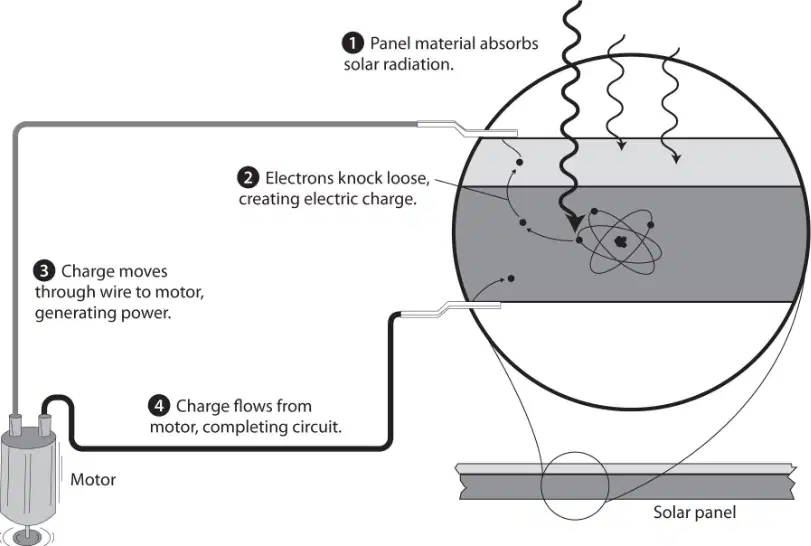
Refer to the diagram of the solar panel. What is the first step in the process of generating electricity from solar panels?
A) Electrons knock loose, creating electric charge
B) Panel material absorbs solar radiation
C) Charge moves through wire to motor
D) Charge flows from motor, completing circuit
Which of the following is NOT a benefit of solar power?
Inexhaustible
Clean—no air or water pollution produced during operation
Low maintenance devices
Devices are expensive
Solar power produces no air or water pollution during operation.
True
False
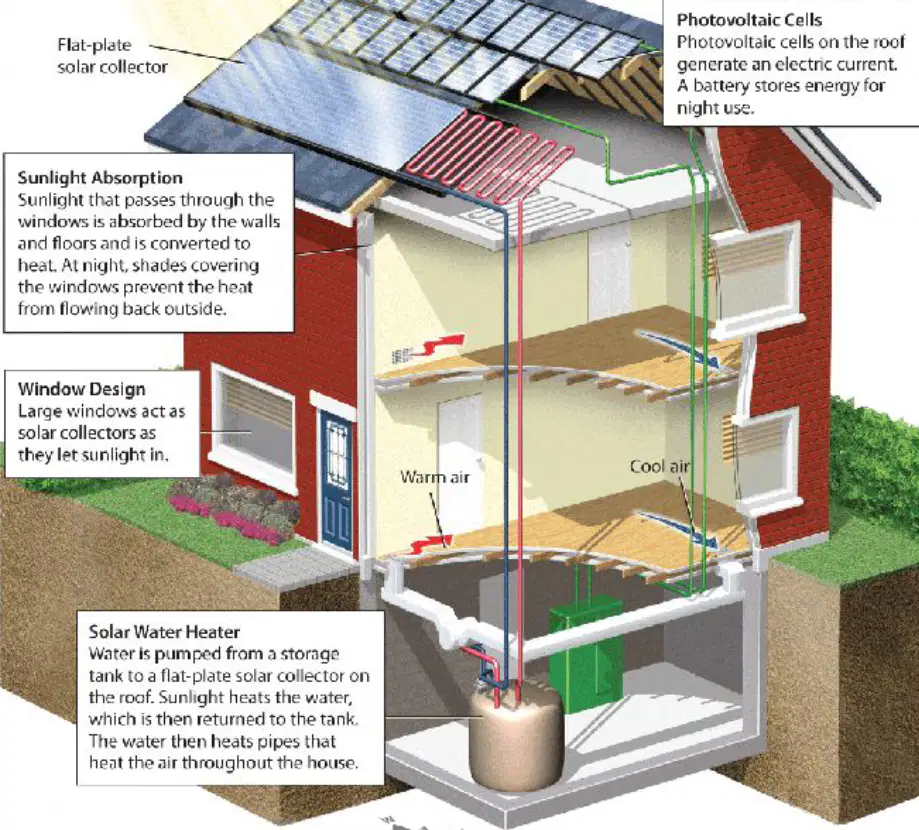
Water is pumped from a storage tank to a ________ solar collector on the roof.
flat-plate
parabolic
evacuated-tube
concentrated

What is the function of large windows in solar-powered houses?
They act as solar collectors as they let sunlight in.
They prevent heat from escaping.
They generate electricity directly.
They store water for heating.

Fill in the blank: Photovoltaic cells on the roof generate an ________ current.
electric
magnetic
thermal
mechanical

Match the following solar power features with their descriptions:
Sunlight Absorption
Large windows act as solar collectors as they let sunlight in.
Window Design
Sunlight passing through windows is absorbed by walls and floors and converted to heat.
Solar Water Heater
Water is pumped from a storage tank to a flat-plate solar collector on the roof.
Photovoltaic Cells
Cells on the roof generate an electric current.
Which of the following is a cost of solar power?
Some pollution during manufacture
Inexhaustible
Low maintenance devices
New jobs to make solar devices
Wind turbines (windmills) convert wind’s kinetic energy to what type of energy?
Thermal energy
Electrical energy
Chemical energy
Nuclear energy
Wind turbines can be placed on land or ________.
offshore
underground
in deserts
in forests
Turbines can be solitary or built in groups called ________.
wind farms
wind tunnels
wind mills
wind stations
Average wind speeds are 20% faster offshore than on land.
True
False
Which of the following is a benefit of wind power?
No pollution or greenhouse gases produced during operation
High startup costs
Winds can be unpredictable
Can be harmful to birds and bats
Which of the following is a cost of wind power?
Relatively cheap to operate
Under good wind conditions, produces far more energy than it uses
High startup costs
No pollution or greenhouse gases produced during operation
Fill in the blank: Wind power is ________ to operate compared to other energy sources.
relatively cheap
extremely expensive
rarely used
difficult
Under good wind conditions, wind power produces far more energy than it uses.
True
False
Communities complain about the looks and noise of wind farms.
True
False
Fill in the blank: Wind power can be harmful to ________ and ________.
birds and bats
fish and frogs
trees and flowers
clouds and rain
Fill in the blank: H₂ gas can be combusted to produce heat, with just ______ as a byproduct.
water
carbon dioxide
methane
sulfur dioxide
On Earth, H₂ is commonly found in compounds such as ______, though it is rare in its elemental form, H₂ gas.
water
carbon dioxide
methane
sodium chloride
H₂ can be produced by breaking down which of the following?
Water (H₂O)
Methane (CH₄)
Both A and B
Oxygen (O₂)
A new technology involves using ______ to produce H₂ from water.
green algae
solar panels
copper wires
plastic beads
Fill in the blank: One benefit of using hydrogen as a fuel source is its ________ supply.
inexhaustible
limited
expensive
unpredictable
Fill in the blank: Hydrogen can be ________ and transported.
stored
eaten
painted
ignored
Which of the following is a cost of using hydrogen as a fuel source?
It is inexhaustible
Hydrolysis is expensive and breaking down methane yields carbon dioxide
Few greenhouse gases are produced
It can be stored and transported
Which gases react to form water and produce electricity in a fuel cell's electrodes? (Hint: what makes up water?)
Hydrogen and Nitrogen
Hydrogen and Oxygen
Oxygen and Carbon Dioxide
Hydrogen and Carbon Dioxide
What are the only byproducts of a fuel cell?
Water vapor and heat
Carbon dioxide and heat
Water and oxygen
Nitrogen and water vapor
Fill in the blank: Fuel cells can power ________ or power plants.
vehicles
computers
books
televisions
Fuel cells can provide electricity to places 'off-grid' or unreachable by conventional power companies.
True
False
Fill in the blank: The reactions in a fuel cell produce ________.
electricity
heat
light
sound

