
 Worksheets
Unit 6 Stars Test Review
Total questions: 76
Worksheet time: 48mins
What is a star?
A sphere of burning gas
A sphere of plasma attracted to a solid iron core
A sphere of plasma held together by its own gravity undergoing nuclear fusion
A very large planet that can perform nuclear fusion
What causes stars to perform nuclear fusion?
Random chance
Extreme heat in the core
Chemical reactions between gases
Extreme gravitational force
What is our Sun’s name?
Billy
Luna
Sirius
Sol
What is a binary star system?
A star system with one star
A star system with only one planet
A star system with two stars
A star system more than 100 light-years away
Which is not required for stars to form?
Heat
Gravity
Hydrogen
Millions of years
What is the heaviest element that stars can fuse?
Helium
Oxygen
Gold
Iron
How do low mass stars die?
They cool slowly as red dwarfs
They become white dwarfs
They undergo a supernova
They become black holes
Which layer of a star do we see?
Corona
Photosphere
Radiative zone
The core
Which layer of the Sun can only be seen during a total solar eclipse?
Corona
Photosphere
Convective zone
Sunspots
How do high mass stars die?
They become neutron stars
They become blackholes
They become a white dwarf
They become neutron stars OR They become blackholes
How do average mass stars die?
They become a planetary nebula
They become blackholes
They become a white dwarf
They become a planetary nebula with a White Dwarf at their center
Which stars live the longest?
High Mass Stars
Low Mass Stars
Average Mass Stars
All stars live the same amount
What part of a star is dense and hot?
Corona
Core
Photosphere
Convective Zone
What part of a star is made of low-density plasma?
Corona
Core
Photosphere
Convective Zone
What part of a star is where currents transport heat away from the center and toward the outer layers?
Corona
Core
Photosphere
Convective Zone
What part of a star is where nuclear fusion occurs?
Corona
Core
Photosphere
Convective Zone
What part of a star is where energy from nuclear fusion is radiated out from the core?
Covective Zone
Core
Photosphere
Radiative Zone
What are two reasons that stars in the night sky could appear brighter than other stars?
The distance of the star and the power of the star
The distance of the star and the color of the star
The power of the star and the size of the star
Why does our sun look larger than other stars we see in the sky?
it is bigger
it is closer in distance
it is further in distance
it has a brighter color
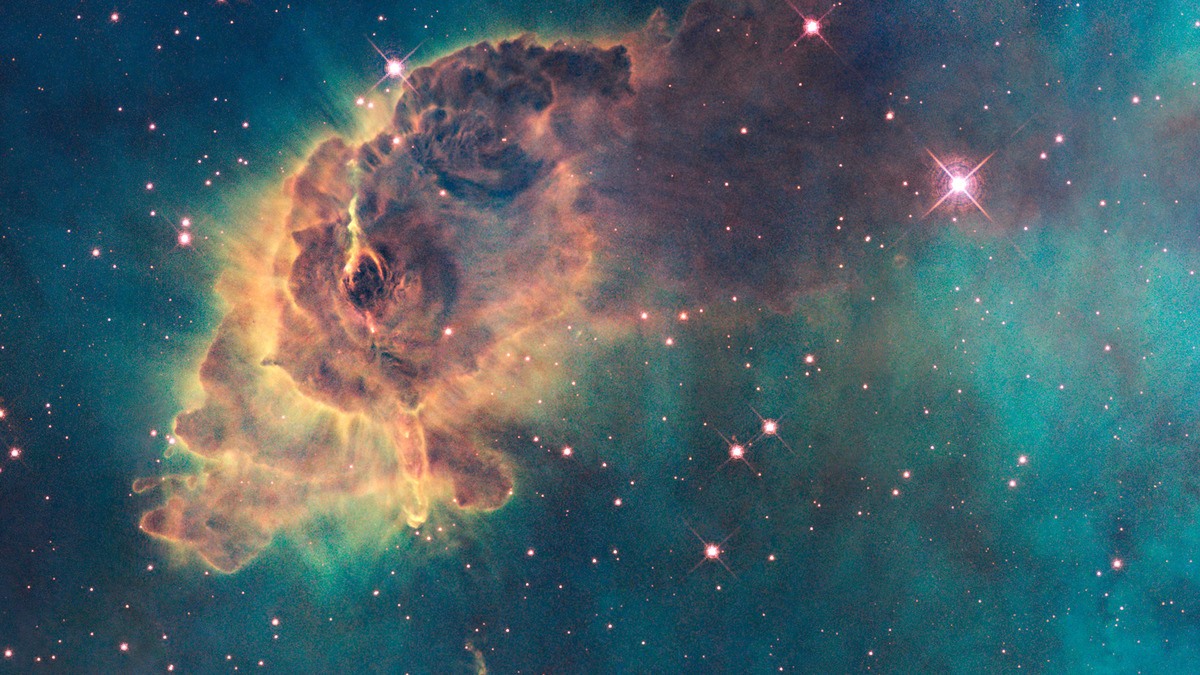


All stars begin their life in a
Main Sequence
Nebula
Protostar
Black Dwarf

The Hertzsprung-Russell diagram graphs stars' luminosity and ....
color
size
temperature
distance
The Sun is a ___________ star.
red giant
main sequence
protostar
white dwarf

Aldebaran is a ____________
red giant
white dwarf
main sequence star
supergiant

Compared to the Sun, Spica is .......
hotter and brighter
cooler and brighter
hotter and dimmer
cooler and dimmer
The process by which a star changes over its lifetime is its ____________.
birth
age
life cycle
growth

Ninety percent of all stars are ______ .
white dwarfs
supergiants
red giants
main sequence stars

A star with a temperature of 10,000 K and a luminosity of 5000 times greater than the Sun would be a ____________.
supergiant
red giant
white dwarf
main sequence star

The ______ of a star determines its life cycle.
gravity
mass
age
color
For main sequence stars, the _________ the luminosity, the ___________ the temperature.
greater, lower
greater, higher
lower, higher
How many stars are in our Solar System?
Hundreds
Billions
One
Eight
A star's temperature determines its ________.
size
color
name
health

White Dwarfs are ________ than the Sun.
cooler
dimmer
brighter
larger

What color indicates that a star is relatively hot, compared to the others?
red
orange
yellow
blue


Which of these observations of Barnard’s Star is most likely accurate?
Barnard's star is less bright than sun and cooler
Barnard's star is brighter than the sun but hotter
Barnard's star is less bright than our sun but hotter
Barnard's star is equal in brightness and temperature to the sun


sort of cool, dim (not too much light), and red?


Which best describes stars located in area A
Bright and Hot
Cooler and bright
Dim and hot
Dim and colder

Which description best describes area B
Brighter and Hotter
Brighter and Cooler
Dimmer and cooler
Dimmer and Hotter

Which best describes stars in area C
Brighter and Hotter
Brighter an Cooler
Dim and Hotter
Dim and Cooler

Which best describes area D?
Brighter and Cooler
Brighter and Hotter
Dimer and Cooler
Dimmer and Hotter
In Nuclear Fusion....
Hydrogen is converted into Helium
Protons are converted into Electrons
Gas is converted into Dust
White Dwarves are converted into Red Giants
What is the heaviest element that can be created inside a star?
Silver
Iron
Carbon
Gold
What does a star use to start nuclear fusion?
Hydrogen
Helium
Electrons
Neutrons

In comparison to other stars in the sky, the Sun appears brighter because it is–
Bigger
Smaller
Nearer
Further

As the _________ of a star increases, luminosity increases.
size
distance
age
composition
The luminosity of a star describes its ______________.
brightness
temperature
age
color
Which statement is true about the sun?
It is a star
It is a planet close to Earth
It is the largest star
It is a moon
What is one thing that makes the sun different from the other stars?
It is the largest star
It is the farthest star
It gives off the most heat energy
It is the closest star to Earth
Which of the following is true about the Sun?
The Sun is the main source of energy for Earth.
The Sun is a ball of gas.
The Sun is a star.
All of the above.



