
Font size
 Worksheets
MBI
Total questions: 100
Worksheet time: 50mins
In RNA, nucleotides are attached with which bonds?
H-bonds
Phosphodiester bonds
Ionic bonds
Salt linkages
RNA contains which of the following base in place of Thymine of DNA?
Thymine
Uracil
Adenine
Cytosine
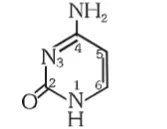
Identify the following structure:
Cytosine
Guanine
Uracil
Thymine
Substance common in DNA and RNA is:
Hexose sugar
Histamine
Thymine
Phosphate group
Which of the following sugar is present in nucleic acids?
Pentose
Trioses
Tetroses
Hexoses
Which type of charge is present on DNA?
Positive
Negative
Neutral
Depends on the types of DNA
Wilkins X-ray diffraction showed the diameter of the DNA helix is:
10 Å
20 Å
30 Å
40 Å
How many bonds are present between Adenine and Thymine in double-stranded DNA of humans?
Two hydrogen bonds
Three hydrogen bonds
Five hydrogen bonds
Four hydrogen bonds
DNA is acidic due to:
Sugar
Purine
Phosphoric acid
Pyrimidine
Which one of the following nitrogen bases is not found in DNA?
Cytosine
Guanine
Uracil
Adenine
Angle present between two steps of DNA is:
94°
34°
84°
36°
The diameter of DNA double helix is:
3.4 Å
34 Å
20 Å
16 Å
A single stranded DNA is present in:
TMV
Salmonella
Φ x 174
Bacteria
What is the nature of the two strands of a DNA duplex?
Identical & Complimentary
Antiparallel & complimentary
Dissimilar & non-complimentary
Antiparallel & non-complimentary
Pyrimidine base that has conferred additional stability to DNA over RNA is:
Adenine
Cytosine
Guanine
Thymine
Prokaryotic DNA is:
Double stranded circular
Single stranded circular
Double stranded linear
Double stranded RNA as nucleic acid
Choose the correct statement:
B DNA shows clockwise twisting
Z DNA shows clockwise twisting
B DNA helix length is 3.4Å
B DNA shows anti-clockwise twisting
Chargaff's rule represents:
Purines ≠ Pyrimidines
A + G = T + C
A + U = G + C
A + T / G + C = Constant
In the DNA of an animal, percentage of Adenine is 30 then percentage of Guanine will be:
40
30
20
70
In sea urchin DNA, which is double stranded, 17% of the bases were shown to be cytosine. The percentages of the other three bases expected to be present in this DNA are:
G 17%, A 16.5%, T 32.5%
G 17%, A 33%, T 33%
G 8.5%, A 50%, T 24.5%
G 34%, A 24.5%, T 24.5%
A typical nucleosome contains:
100 bp of DNA helix
200 bp of DNA helix
300 bp of DNA helix
480 bp of DNA helix
Total number of base pairs present in *Escherichia coli* is:
4.6 x 10⁶
4.6 x 10⁵
4.5 x 10⁶
4.4 x 10⁵
Distance between two nucleotide pairs of DNA is:
0.34 nm
34 Å
3.4 m
34 nm
The thread-like stained structure present in the nucleus is known as:
Mesosome
Chromatin
Chromatid
Chromosome
Histone proteins are rich in:
Histidine and arginine
Histidine and lysine
Histidine, arginine, and lysine
Arginine and lysine
What would be the sequence of mRNA from 3’ AGCT 5’ DNA strand?
5’ TACA 3’
5’ UCGA 3’
5’ TCGA 3’
5’ AGUC 3’
Which of the following rRNA in bacteria acts as a ribozyme as well as structural RNA?
23S rRNA
18S rRNA
5.8S rRNA
5S rRNA
Which of the following RNA is the most abundant in an animal cell?
mRNA
tRNA
miRNA
rRNA
Anticodon is present in
DNA
tRNA
rRNA
mRNA
Choose the correct statement:
mRNA form structure of ribosome
mRNA has message for protein synthesis
tRNA form structure of ribosome
tRNA is double stranded
Reverse transcription is discovered by:
Garrod
Temin and Baltimore
Hugo de Vries
Crick
DNA is synthesized from RNA with the help of which enzyme?
DNA ligase
DNA polymerase-1
DNA polymerase-2
Reverse transcriptase
Wobble hypothesis is given by:
Crick
Temin
Baltimore
Hugo de Vries
Wobbling normally occurs for:
Third nucleotide of codon
Second nucleotide of codon
First nucleotide of codon
Position not fixed
Polycistronic mRNA is present in:
Prokaryotes
Eukaryotes
Both (1) and (2)
Saccharomyces cerevisiae
In Griffith experiment which of the following cells of pneumococci were isolated from dead mice?
Live rough cells
Dead rough cells
Live smooth cells
Dead smooth cells
Choose the correct statement:
Capsulated bacteria are virulent and cause pneumonia
Capsulated bacteria are non-virulent and not cause pneumonia
Capsulated bacteria are non-virulent and cause pneumonia
Non-capsulated bacteria are virulent and cause pneumonia
Which of the following strain is non-virulent?
Capsulated – S-III
Non-capsulated – R-II
Both are virulent
None
Which of the following strains were used by Griffith?
S-III and R-II
S-IV and R-IV
S-II and R-III
S-III and R-I
Biochemical nature of genetic material was not defined from:
Transforming principle
Hershey and Chase experiment
Avery, Macleod and McCarty
None of the above
The final proof as DNA is genetic material came from the experiment of -
Griffith
Hershey and Chase
Avery and Macleod
McCarty
In the Hershey and Chase experiment, protein tagging was done by -
Radioactive sulphur
Radioactive phosphorus
Radioactive potassium chloride
Radioactive sodium chloride
Hershey and Chase experiment was based on the principle of -
Transformation
Translation
Transduction
Transcription
Choose the correct option -
DNA of the phage enters in the bacterium.
Protein of the phage enters in the bacterium.
Complete phage enters in the bacterium.
Phage never infected bacterium.
Bacteria phages are -
Viruses
Bacteria
Prions
Viroids
Which of the following statement is correct regarding Genetic material?
DNA is highly reactive
RNA is not catalytic
RNA cannot be easily degraded
DNA is a better genetic material than RNA
RNA mutates as compared to DNA:
Faster rate
Slower rate
Moderate rate
Depending on the medium
Which of the following is best for storage of genetic information?
DNA
RNA
Proteins
Lipid
RNA is less stable genetic material as compared to DNA. The reason for this is:
In RNA, 2' position has -OH group while DNA does not
RNA is also known to be catalytic
RNA has uracil while DNA has thymine
All of the above
Which of the following criterion cannot be fulfilled by protein?
Formation of polypeptide chains
Generation of its replica
Acts as an enzyme
Non-covalent bonds are present between amino acids
Select an incorrect statement regarding RNA molecule:
It has highly reactive 2'-OH group
It shows higher rate of mutation than DNA
It is genetic material in some viruses
It follows Chargaff’s rule
Which of the following is less stable genetic material?
RNA
DNA
Protein
Carbohydrate
RNA world hypothesis suggests that life on earth:
Begin with a simple RNA molecule
Begin with a simple DNA molecule
Begin with a simple protein molecule
Begin with a simple carbohydrate molecule
Which of the following is correct statement?
RNA is better material for transmission of genetic information
Protein is better material for transmission of genetic information
DNA is better material for transmission of genetic information
Enzymes is better material for transmission of genetic information
Which of the following enzyme is non-proteinaceous in nature?
Deoxy ribose nuclease
Ligases
Ribozymes
Lysozyme
Which of the following is true regarding RNA world?
Protein was first genetic materials
RNA was first genetic material
DNA was first genetic material
Carbohydrate was first genetic material
Semiconservative replication of DNA was first demonstrated in:
Escherichia coli
Neurospora
Drosophila
Saccharomyces cerevisiae
In Eukaryotes, DNA replication takes place in:
S-phase
A-phase
G₁-phase
G₂-phase
Which one of the following radio tracer was used by Taylor?
H³
N¹⁵
Cu¹⁵
CsCl
Newly synthesized DNA molecules contain:
Both new strands
Both old strands
One new and one old strand
Only one strand
Process used by Meselson and Stahl for studying semiconservative replication of DNA was:
Chromatography
Density gradient centrifugation
Normal centrifugation
Southern blotting
The strand of DNA, which does not code for anything is referred to as:
Template strand
Antisense strand
Coding strand
Noncoding strand
During DNA replication, discontinuously synthesized fragments are later joined by the enzyme:
Ligase
DNA polymerase
RNA primer
Primase
Replication fork is:
Large opening of the DNA helix
Small opening of the DNA helix
Tightly coiled part of DNA helix
Loosely coiled part of DNA helix
The DNA-dependent DNA polymerase catalyzes polymerization in:
3' → 5' direction
5' → 3' direction
Depend on the nature of template strand
Both (1) & (2)
Main enzyme of DNA replication is:
DNA-dependent RNA polymerase
DNA-dependent DNA polymerase
RNA-dependent RNA polymerase
RNA-dependent DNA polymerase
In the process of replication, deoxyribonucleoside triphosphate:
Acts as substrate
Provides energy for polymerization reaction
Acts as an enzyme
Both (1) & (2)
The process by which DNA of the nucleus passes genetic information to mRNA is called:
Transcription
Translocation
Translation
Transportation
The enzyme responsible for transcription is:
DNA polymerase-I
RNA polymerase
Reverse transcriptase
DNA polymerase-III
Choose the odd one:
RNA polymerase I – 28s rRNA, 18s rRNA, 5.8s rRNA
RNA polymerase II – hnRNA
RNA polymerase I – 28s rRNA, 5s rRNA, 18s rRNA, 5.8s rRNA
RNA polymerase III – tRNA, 5s rRNA
Which of the following subunits of RNA polymerase is required for initiation of transcription?
α (alpha)
σ (sigma)
ω (omega)
β (beta)
Sigma factor is a component of:
DNA ligase holoenzyme
DNA polymerase holoenzyme
Endonuclease holoenzyme
RNA polymerase holoenzyme
The process of copying genetic information from one strand of DNA into Y is termed as Z. What is Y and Z?
Transcription, RNA
RNA, Transcription
DNA, Translation
Replication, RNA
During transcription, the DNA site at which RNA polymerase binds is called:
Promoter
Regulator
Receptor
Enhancer
Which factor helps RNA polymerase enzyme to recognize the terminator site?
Rho factor
Beta factor
Sigma factor
Both (1) and (3)
Hogness box is present in:
Eukaryotes
Prokaryotes
E. coli
Bacteria
What is the sequence of the Pribnow box?
TATAAT
TATATAT
TATAAAA
TTTTATA
Non-functional part of DNA is known as:
Intron
Exon
hnRNA
Cistron
Functional part of DNA is known as:
Intron
Exon
hnRNA
Cistron
Which of the following is added in poly A tail at 3' end during post-transcriptional modifications?
7 Methyl guanosine
5 Methyl uracil
Guanine
Adenylic acid
Mostly prokaryotic genes are an example of:
Non-split genes
Split genes
Non-functional genes
Functional genes
Mostly eukaryotic genes are an example of:
Non-split genes
Split genes
Non-functional genes
Functional genes
Which one of the following triplet codes is correctly matched with its specificity for an amino acid in protein synthesis or as 'start' or 'stop' codon?
UCG – Start
UUU – Stop
UGU – Leusine
UAC – Tyrosine
Degeneration of a genetic code is attributed to the:
First member of a codon
Second member of a codon
Entire codon
Third member of a codon
A sequence of how many nucleotides in messenger RNA makes a codon for an amino acid?
Three
Four
One
Two
The first codon discovered by Nirenberg and Matthaei was:
CCC
GGG
UUU
AAA
Out of 64 codons, only 61 code for the 20 different amino acids. This character of genetic code is called:
Degeneracy
Unambiguous nature
Commaless
Overlapping
One gene-one enzyme hypothesis was proposed by:
Beadle and Tatum
Jacob and Monod
Lederberg
Watson and Crick
The "cri-du-chat" syndrome is caused by change in chromosome structure involving:
Deletion
Duplication
Inversion
Translocation
A class of mutation induced by addition or deletion of a nucleotide is called:
Missense
Non-sense
Substitution
Frame shift
Chromosome with genes abcdefg becoming abedcfg, this type of mutation is known as:
Duplication
Deletion
Translocation
Inversion
Gene mutation is:
Mutation in the number of chromosomes
Mutation in the ploidy of chromosomes
Mutation in the chromosomes structure
Change in the sequence of nitrogenous bases
Chromosome number 2n-1 is an example of:
Trisomy
Euploidy
Polyploidy
Monosomy
Which of the following can be called a mutation?
The halving of the chromosome number at meiosis
The doubling of the chromosome after syngamy
The possession of an additional chromosome
All the above
The function of non-sense codons is:
To release polypeptide chain from tRNA
To form an unspecified amino acid
To terminate the message of a gene-controlled protein synthesis
To convert a sense DNA into non-sense DNA
Which one of the following organelles is attached with mRNA during protein synthesis?
Endoplasmic Reticulum
Ribosome
Nucleus
Lysosome
Translation refers to the process of:
Polymerisation of nitrogen bases
Polymerisation of nucleotides
Polymerisation of nucleosides
Polymerisation of amino acids
Which one of the following statements is true for protein synthesis (translation)?
Amino acids are directly recognized by mRNA
The third base of the codon is less specific
Only one codon codes for an amino acid
Every tRNA molecule has more than one amino acid attachment site
Which codon gives signal for the start of polypeptide (protein) chain synthesis?
AUG
UGA
GUA
UAG
In protein synthesis, amino acid sequence is decided by the sequence of:
tRNA
mRNA
cDNA
rRNA

