
 Worksheets
Lesson Overview: Biomes, Energy Flow, and Biogeochemical Cycles
Total questions: 135
Worksheet time: 1hrs 8mins
Recall: Which abiotic factor directly influences the metabolic rates of organisms and varies with depth, latitude, and season in aquatic ecosystems?
Salinity
Temperature
Turbidity
Water density
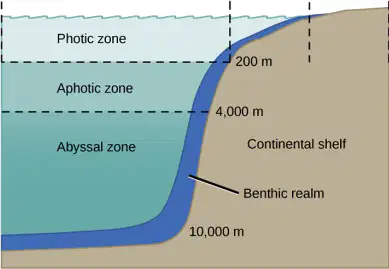
Recall: In marine zone classification, which region is defined as the open ocean divided into photic, aphotic, and abyssal zones and supports photosynthesis only in the photic layer?
Neritic zone
Pelagic realm
Intertidal zone
Benthic zone
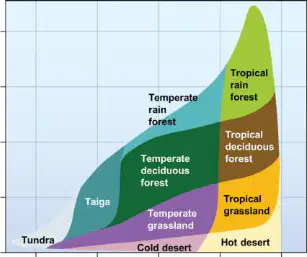
Skill/Concept: A biome table lists average temperature and precipitation. Which pairing best matches Tropical rain forest conditions based on the table?
27°C and 320 cm precipitation
25°C and 100 cm precipitation
8°C and 50 cm precipitation
−11°C and 17 cm precipitation
Skill/Concept: Which statement correctly distinguishes lentic from lotic freshwater habitats as described?
Lentic are flowing systems like rivers; lotic are standing waters like lakes.
Lentic are standing waters like lakes; lotic are flowing systems like rivers and streams.
Both lentic and lotic are marine regions over continental shelves.
Lotic systems have no oxygen stratification, unlike lentic systems.
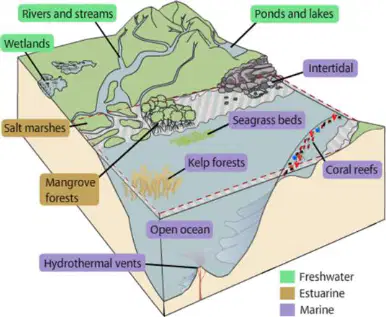
Strategic Thinking: A coastal region experiences periodic submersion and exposure with variable temperatures and salinity due to wave action. Which marine zone and ecosystem type would most directly describe this area, and why?
Neritic zone—shallow continental shelf edge offers high productivity due to nutrient-rich waters.
Intertidal zone—between high and low tide causes fluctuating conditions that select for adaptable species.
Pelagic realm—open ocean supports photosynthesis across depths, minimizing environmental variability.
Abyssal zone—beyond 4,000 m depth where organisms rely on chemosynthesis and stable conditions.
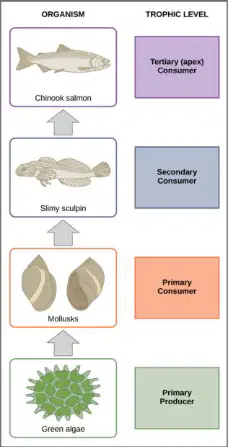
Recall: In a simple food chain described, which organism represents the primary consumer?
Green algae
Mollusks feeding on green algae
Slimy sculpin consuming mollusks
Chinook salmon (apex predator)
Skill/Concept: Trophic level transfer efficiency (TLTE) is defined mathematically as which ratio multiplied by 100?
Net consumer productivity divided by assimilation
Production at present trophic level divided by production at previous trophic level
Assimilation divided by net consumer productivity
Energy lost as waste divided by biomass generated
Strategic Thinking: A scientist measures net consumer productivity of zooplankton and the energy assimilated at that trophic level. To estimate how efficiently zooplankton incorporate received energy into biomass, which metric should be calculated and why?
TLTE—compares energy production between successive trophic levels, not within a level.
NPE—quantifies efficiency of converting assimilated energy into consumer biomass at the present level.
Assimilation—measures total energy generated per unit area after accounting for losses to respiration.
Gross primary productivity—evaluates plant energy fixation, not consumer energy use.
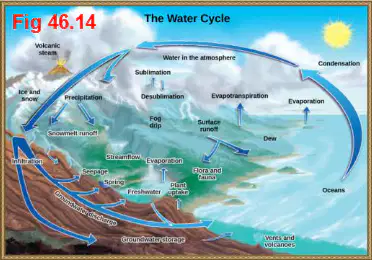
Recall: Which biogeochemical cycle description specifically involves processes such as evaporation, condensation, precipitation, infiltration, and runoff to distribute water resources and regulate climate?
Carbon cycle
Nitrogen cycle
Water cycle
Phosphorus cycle
Which abiotic factors are emphasized as the two major drivers determining the distribution and characteristics of terrestrial biomes?
Light availability and salinity
Temperature and precipitation
Wind speed and soil pH
Altitude and ocean currents
In the context of aquatic biomes, which set lists major abiotic factors highlighted as influencing them, including large-scale water movements?
Nutrient cycling, animal behavior, predation
Light availability, water density, temperature, and large-scale water movements
Soil texture, humidity, and pollination rates
Earth’s tilt, lunar phases, and volcanic activity
Which marine zone includes the deepest parts of the ocean and is characterized by extreme pressure and absence of sunlight?
Intertidal zone
Neritic zone
Abyssal zone
Pelagic realm
Which term refers to the sunlit upper layer of aquatic environments where photosynthesis is possible?
Photic zone
Aphotic zone
Benthic realm
Lentic habitat
Which pair correctly matches habitat type with water movement?
Lentic habitat—flowing water; lotic habitat—standing water
Lotic habitat—flowing water; lentic habitat—standing water
Oceanic zone—standing freshwater; neritic zone—flowing freshwater
Intertidal zone—deep ocean; pelagic realm—shoreline only
According to the lesson focus, which concept tracks element movement through biological, geological, and chemical processes across ecosystems?
Food web
Carbon cycle
Microcosm
Primary producer
Which statement best distinguishes a food chain from a food web?
A food chain shows linear energy transfer among trophic levels; a food web maps multiple interconnected feeding relationships.
A food chain is only aquatic; a food web is only terrestrial.
A food chain includes decomposers; a food web excludes them.
A food chain represents nutrient cycles; a food web represents abiotic factors.
Which term identifies organisms that produce organic matter from inorganic sources and form the base of trophic structures?
Primary producer
Primary consumer
Secondary consumer
Apex consumer
Which objective focuses on comparing zones such as intertidal, neritic, pelagic, benthic, and abyssal to understand their unique properties?
Recognize and compare major terrestrial biomes
Identify major abiotic factors in aquatic biomes
Compare distinct zones within marine biomes
Understand ecosystem equilibrium
Trophic level transfer efficiency (TLTE) most directly quantifies which process in ecosystems?
The rate of nutrient fixation by microbes
The proportion of energy passed from one trophic level to the next
The speed of ocean upwelling events
The resilience of ecosystems after disturbance
Net production efficiency (NPE) is described in the objectives. Which option best captures its focus?
Efficiency of photosynthesis under high light
Fraction of assimilated energy converted to biomass
Rate of nitrogen fixation in soils
Percentage of precipitation retained in watersheds
Which biome term refers to a large community characterized by climate, biodiversity, and predominant vegetation?
Microcosm
Biome
Ecosystem resilience
Forest only
Which term relates to a process where toxic substances concentrate at higher trophic levels through consumption?
Biomagnification
Biomass
Productivity
Ecosystem equilibrium
Which ecosystem model type is identified alongside conceptual and analytical models for predicting ecosystem dynamics?
Empirical model
Simulation model
Taxonomic model
Behavioral model
Which option correctly identifies the realm associated with the ocean floor and sediments?
Pelagic realm
Benthic realm
Neritic zone
Oceanic zone
Which cycle, listed among key terms, primarily describes movement of nitrogen through fixation, assimilation, and denitrification?
Water cycle
Carbon cycle
Nitrogen cycle
Sulfur cycle
Within the learning objectives, which focus describes ecosystems as communities interacting with their environment to understand energy flow and equilibrium?
Understand terrestrial biodiversity patterns
Understand ecosystems as communities interacting with their environment, focusing on energy flow and equilibrium
Identify ocean upwelling mechanisms
Compare temperate and tropical forests
Which term denotes the total rate of energy capture and conversion by producers in an ecosystem?
Productivity
Ecosystem resistance
Net production
Efficiency
Which description best fits ocean upwelling as listed in the key terms?
Sinking of warm surface water due to evaporation
Vertical movement bringing nutrient-rich deep water to the surface
Horizontal drift of water along coasts due to tides
Formation of lentic habitats from glacial melt
Which objective emphasizes illustrating the water, carbon, nitrogen, phosphorus, and sulfur cycles to highlight their importance in sustainability?
Recognize roles of producers, consumers, and decomposers
Examine ecosystem models to predict changes
Describe TLTE and NPE
Illustrate major biogeochemical cycles and their importance
Which statement best defines a biome as introduced in this section?
A small habitat with a single species adapted to uniform conditions
A large ecological area on Earth’s surface with distinct plant and animal groups adapted to unique climate and geographical features
Any ecosystem located in water regardless of climate
A climatic region defined solely by latitude without reference to organisms
Terrestrial biomes, as categorized in this section, are primarily defined by which pair of abiotic factors?
Salinity and light availability
Temperature and precipitation levels
Water flow and depth
pH and nutrient concentration
Aquatic biomes in this overview are classified based on multiple factors. Which option correctly lists factors emphasized for aquatic classification?
Temperature and precipitation only
Latitude and altitude
Salinity, depth, water flow, temperature, and light availability
Soil type and wind speed
Applying the classification criteria provided, which scenario would most likely shift an aquatic ecosystem from a freshwater to a marine biome?
A decrease in annual precipitation around the watershed
An increase in salinity beyond freshwater ranges due to tidal intrusion
A reduction in light availability from seasonal shading
A change from slow to fast water flow in the main channel
Strategic classification: A land region exhibits low precipitation and high temperature variability across seasons. Based on the terrestrial criteria presented, which reasoning best supports assigning it to a specific terrestrial biome category?
Temperature and precipitation jointly determine terrestrial biome types; low precipitation with high temperature variability aligns with arid biomes such as deserts
Classification depends mostly on salinity; low salinity indicates grassland categories
Light availability alone determines terrestrial biomes; high insolation makes it a tropical rainforest
Water flow and depth are the key terrestrial metrics; shallow soils indicate tundra
According to the classification presented, terrestrial biomes are primarily distinguished by which pair of physical factors?
Soil pH and sunlight intensity
Average annual precipitation and temperature
Altitude and wind speed
Latitude and day length
Which list best represents the major biomes found in regions with very low precipitation and high daytime temperatures?
Temperate deciduous forest
Tropical rain forest
Hot desert
Taiga (temperate coniferous forest)
From the classification list, which biome is explicitly associated with prairies?
Temperate grassland
Shrubland
Mountain ranges
Tropical deciduous forest
Which biome category is noted in the classification as occurring at high elevations rather than being defined by temperature and rainfall bands alone?
Tundra
Mountain ranges
Temperate rain forest
Tropical grassland (savanna)
In the table of characteristics, which temperature range and rainfall pattern most accurately describes grasslands?
Freezing temperatures with little precipitation
Warm (20–30°C) with seasonal droughts and medium moisture
Hot (>30°C) with less than 30 cm per year
Cold (0–15°C) with small precipitation and wet conditions
Which vegetation type is characteristic of deserts as described in the table?
Epiphytes, tall trees, and dense undergrowth
Coniferous trees densely packed with little species variation
Xerophytes adapted to water conservation, such as succulent bushes
Small, close-to-the-ground plants like mosses that grow perennially
Based on the table, which biome is associated with rainy winters, dry summers, and dry, woody shrubs that regrow quickly due to frequent fires?
Shrubland
Temperate deciduous forest
Taiga (coniferous forest)
Tropical rainforest
Which combination of temperature and precipitation best matches the tropical rainforest entry in the characteristics table?
Hot (25–30°C) with very high precipitation (>250 cm per year)
Moderate (15–25°C) with rainy winters and dry summers
Cold (0–15°C) with small precipitation and low evaporation
Hot (>30°C in day, <0°C at night) with <30 cm per year
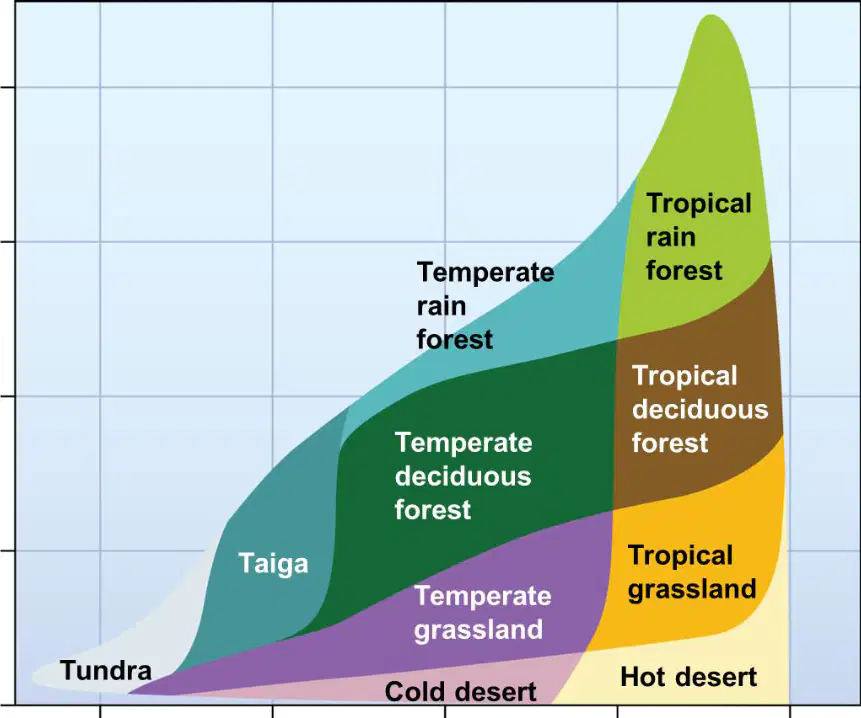
In the Whittaker diagram (refer to the figure), which biome occupies the highest annual precipitation zone at warm average temperatures?
Temperate deciduous forest
Tropical rain forest
Temperate grassland
Cold desert
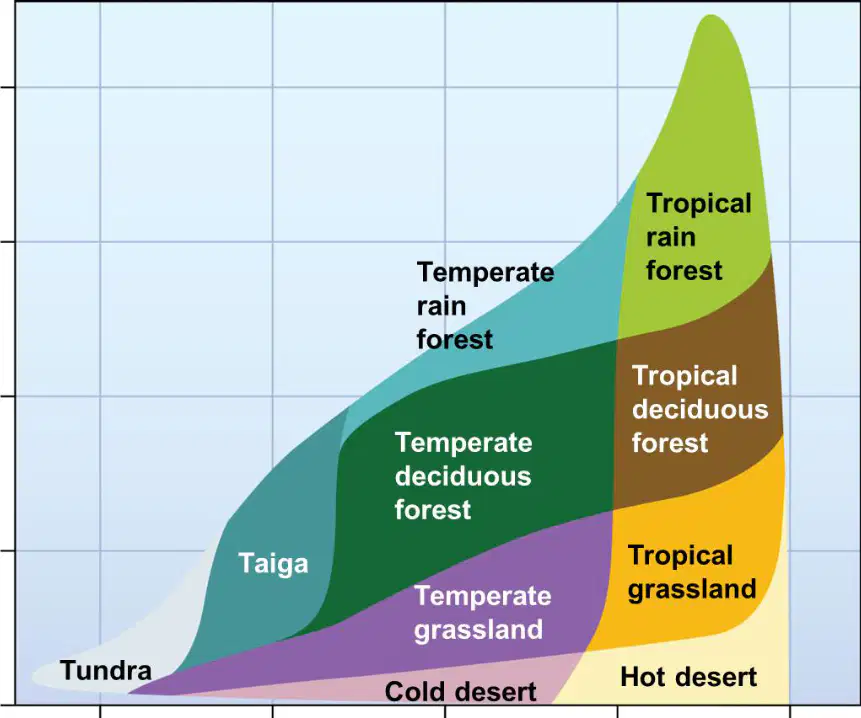
According to the Whittaker diagram, which biome is positioned at low average temperatures and minimal precipitation?
Tundra
Temperate rain forest
Tropical deciduous forest
Hot desert
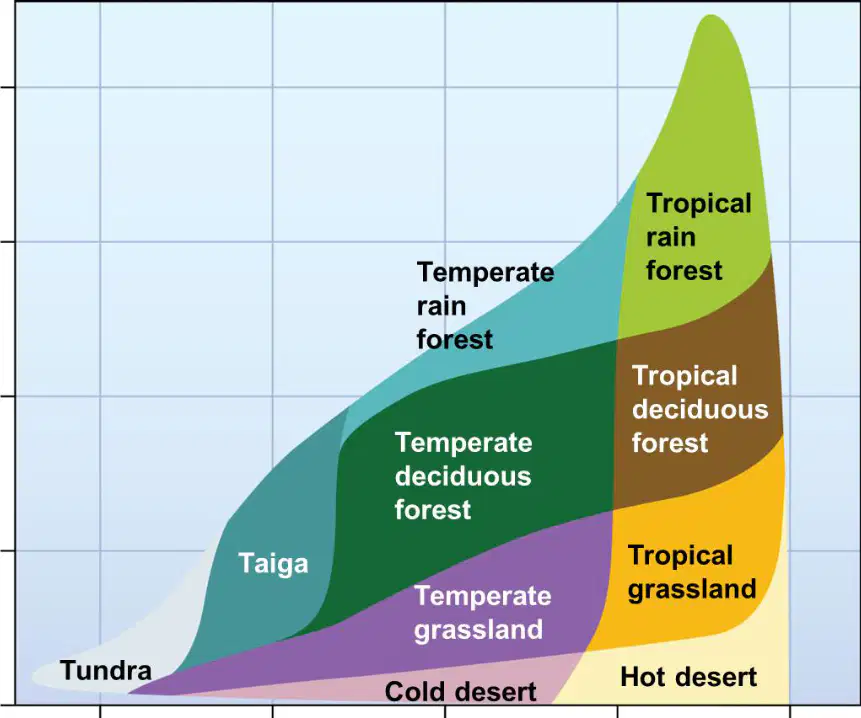
Using the Whittaker relationship figure, which biome transitions into temperate deciduous forest as both temperature and precipitation increase from temperate grassland conditions?
Cold desert
Taiga
Temperate rain forest
Temperate deciduous forest

From the Whittaker diagram, which pair of biomes share similar average temperatures around 20–30°C but differ markedly in precipitation?
Hot desert and tropical rain forest
Taiga and tundra
Temperate rain forest and cold desert
Temperate deciduous forest and tundra
Which biome is characterized by hot, humid conditions and typically receives over 2000 mm of rain annually, resulting in a dense canopy of broad‑leaved evergreen trees with many epiphytes and lianas?
Tropical rain forest
Temperate deciduous forest
Temperate coniferous forest (taiga)
Temperate grassland (prairie)
Which forest biome is noted for the highest terrestrial biodiversity, hosting millions of species of plants, animals, and insects, and serving as a significant carbon sink?
Temperate rain forest
Tropical deciduous forest
Tropical rain forest
Cold desert
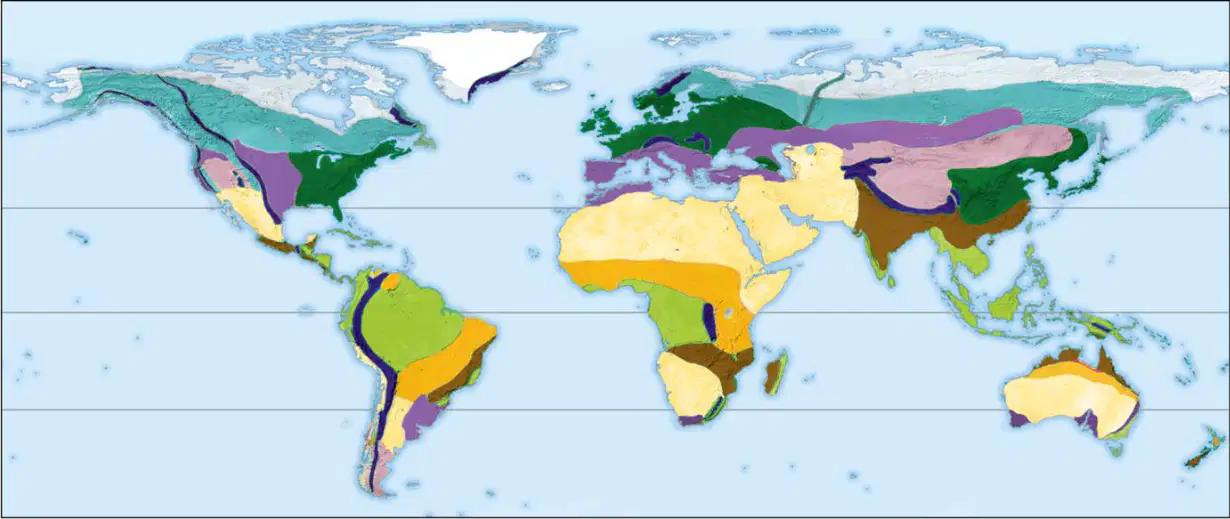
The primary reason taiga and temperate rain forest are combined in the provided global biome map is:
They share identical rainfall totals across latitudes
Similarity in tree species and the temperate rain forest occupies a very small area
Both occur exclusively in the Southern Hemisphere
They lack any significant ecosystem services
Which statement best distinguishes tropical deciduous forest from temperate deciduous forest?
Tropical deciduous forests are hot and humid with high rainfall; temperate deciduous forests experience temperate climates with seasonal temperature variation
Both have identical rainfall patterns exceeding 2000 mm annually
Temperate deciduous forests are dominated by conifers while tropical deciduous forests lack epiphytes
Tropical deciduous forests occur mainly near 60°N while temperate deciduous forests occur near the equator
In the tropical rain forest, which ecosystem service is emphasized in the material?
Provision of cold-desert mineral resources
Regulation of global climate and water cycles and functioning as a significant carbon sink
Prevention of mountain erosion only
Exclusive habitat for large herbivores with low plant diversity
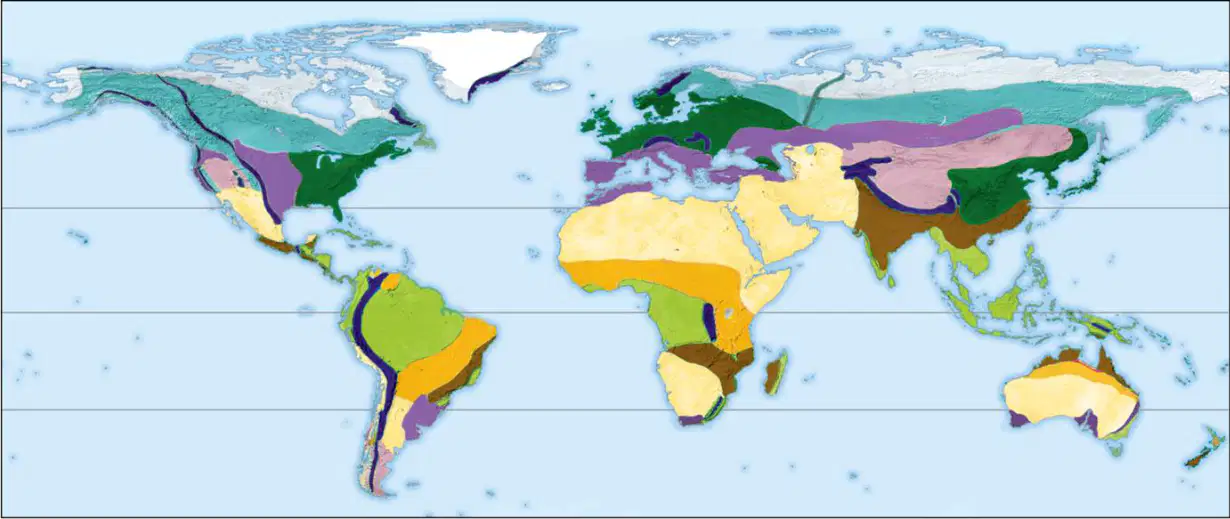
Which biome in the map is most extensive across high northern latitudes and is associated with coniferous vegetation?
Temperate coniferous forest (taiga)
Tropical grassland (savanna)
Hot desert
Temperate rain forest
A student claims that tropical deciduous forests have sparse vegetation and low biodiversity. Based on the material, what is the best evaluation of this claim?
Accurate: they host few species due to seasonal drought
Partly accurate: vegetation is sparse but biodiversity is high
Inaccurate: they have dense broad‑leaved evergreen canopies with numerous epiphytes and high biodiversity
Uncertain: there is insufficient information to assess
Which pairing correctly matches a biome with predominant vegetation described in the material?
Temperate deciduous forest — broad‑leaved evergreen canopy with many epiphytes
Tropical rain forest — dense canopy of broad‑leaved evergreen trees and lianas
Taiga — grass‑dominated with few trees
Temperate rain forest — cactus and succulents
Considering ecosystem services, which forest biomes in the material are explicitly noted as crucial in regulating global climate and water cycles and as significant carbon sinks?
Only temperate deciduous forest
Tropical rain forest and tropical deciduous forest
Taiga and hot desert
Temperate grassland and cold desert
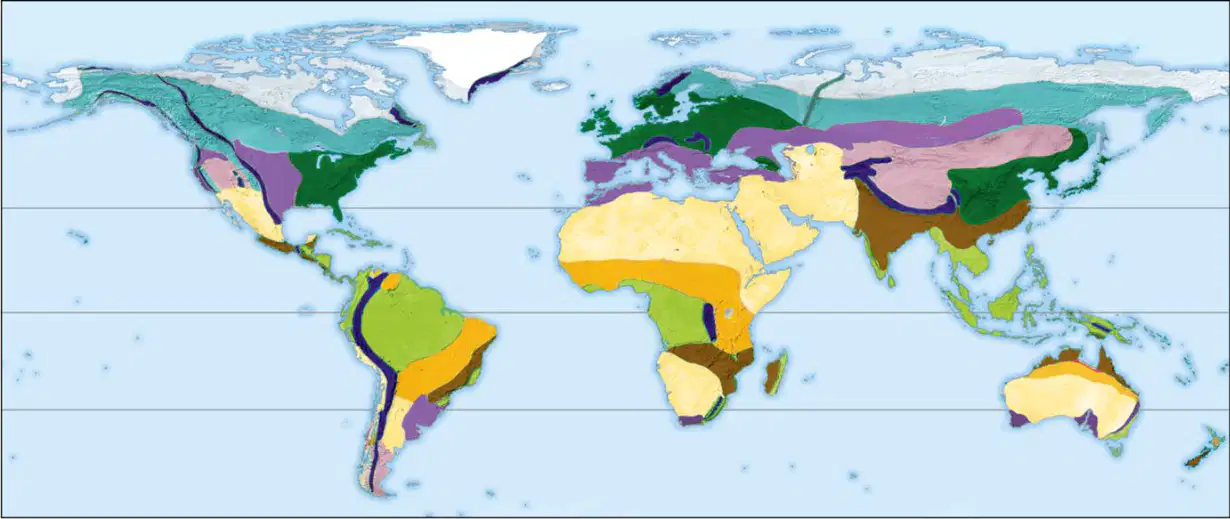
Which statement about the geographic location of tropical rain forests is supported by the map?
They occur primarily at high latitudes near the Arctic Circle
They are concentrated near the equator in parts of South America, Africa, and Southeast Asia
They are limited to interior continental regions far from coasts
They occur only on islands
If a conservation plan targets biomes that maximize protection of terrestrial biodiversity, which choice aligns best with the material’s evidence?
Prioritize hot deserts due to unique succulents
Prioritize tropical rain forests because they host the highest biodiversity and act as major carbon sinks
Prioritize temperate grasslands for forest-dependent species
Prioritize tundra because it has the densest tree canopy
Which climate description most accurately fits tropical deciduous forests as presented?
Cool summers and cold winters with moderate rainfall
Hot and humid with high rainfall, typically over 2000 mm annually
Arid with rainfall below 250 mm annually
Subpolar with persistent permafrost
Which biome is defined by warm year-round temperatures with pronounced wet and dry seasons, scattered trees, and large herbivore populations such as zebras and antelope?
Tropical grassland (savanna)
Temperate grassland (prairie)
Hot desert
Tundra
Temperate grasslands (prairies) are best characterized by which combination of climate and vegetation?
Low precipitation and dominance of cacti
Cold winters, warm summers, and dominance of grasses with few trees
Year-round high rainfall and dense evergreen canopy
Permafrost soils with dwarf shrubs
In hot deserts, which adaptation is most typical of plants to minimize water loss?
Broad, thin leaves with high surface area
Deep roots and succulent tissues that store water
Shallow roots and deciduous leaves
Large canopy with epiphytes
Cold deserts differ from hot deserts primarily in which climatic feature?
Higher annual rainfall and tropical temperatures
Lower temperatures with precipitation mainly as snow
Year-round humidity with frequent monsoons
Constant warm nights with high dew formation
Which biome has permanently frozen subsoil (permafrost), short growing seasons, and vegetation dominated by mosses, lichens, and dwarf shrubs?
Savanna
Temperate grassland
Tundra
Hot desert
Mountain ranges as biomes are distinct because they exhibit which pattern along elevation gradients?
Uniform climate and single vegetation type from base to summit
Rapid changes in temperature and moisture creating distinct ecological zones
Constant warm temperatures with high rainfall throughout
High biodiversity only at the highest peaks
Which ecosystem service is most strongly associated with tropical grasslands (savannas)?
Carbon storage in peatlands
Support for large herbivore migrations and grazing services
Temperature regulation via snow albedo
Salt marsh buffering against storm surge
Temperate grasslands (prairies) provide which key ecosystem service for agriculture?
Extensive timber production from conifer forests
Highly fertile soils that support cereal crops
Coastal fishery nurseries
High-altitude medicinal plant diversity
Which statement correctly contrasts biodiversity in hot deserts versus savannas?
Hot deserts have higher plant diversity than savannas due to constant water availability.
Savannas support larger mammal biomass, while hot deserts have sparse, specialized species.
Both have identical species richness but different soil profiles.
Savannas lack predators, whereas hot deserts host apex predators only.
A region experiences cold winters, low annual precipitation mostly as snow, and sparse vegetation of saltbush and sagebrush. Which biome is most likely?
Tundra
Cold desert
Temperate grassland
Savanna
Which vegetation feature helps tundra soils remain waterlogged during summer thaw?
Tall canopy that intercepts rainfall
Permafrost layer preventing deep drainage
Extensive taproots reaching aquifers
Sandy soils with high permeability
Which factor most strongly drives the formation of multiple life zones on mountains?
Changes in latitude over short distances
Gradual increase in soil salinity with elevation
Steep altitudinal gradients affecting temperature and precipitation
Uniform wind speeds across slopes
A management plan aims to conserve a biome that regulates regional water supplies, provides grazing lands, and supports fire-adapted grasses. Which biome is being prioritized?
Temperate grassland (prairie)
Hot desert
Tundra
Mountain alpine zone
Which biome’s flora commonly includes succulents like cacti, CAM photosynthesis, and waxy cuticles?
Savanna
Temperate grassland
Hot desert
Tundra
Which statement best explains why biodiversity often increases from tundra to lower mountain slopes?
Lower slopes have milder temperatures and longer growing seasons, allowing more plant and animal niches.
Higher slopes have more oxygen and thus more species.
Biodiversity is uniform across elevations; slope aspect does not matter.
Glacial ice at summits provides most habitat diversity.
Hot deserts are characterized by which climate pattern? Choose the best description.
Mild temperatures year-round with high precipitation
Extreme temperatures with very hot days, cold nights, and very low precipitation
Cool summers and cold winters with moderate, seasonal precipitation
High humidity and heavy rainfall concentrated in a wet season
Which vegetation trait is most typical of hot desert biomes?
Dense forests with tall, broadleaf trees
Grasses with scattered trees maintained by periodic fires
Sparse plants such as cacti, succulents, and hardy shrubs that conserve water
Thick moss mats over permafrost
In hot deserts, biodiversity is best described as:
High species richness dominated by large herbivores and predators
Limited but specialized flora and fauna adapted to arid conditions
Uniform communities with little specialization due to abundant water
Primarily aquatic species supported by temporary wetlands
Which ecosystem service is highlighted for hot deserts?
Major global carbon sink via dense vegetation
Vital for cereal crop agriculture and soil formation
Provides unique habitats, supports diverse microbial life, and has significant mineral resources
Primary source of freshwater through frequent precipitation
Cold deserts differ from hot deserts primarily in which climatic aspect?
They receive heavy rainfall throughout the year
They have lower temperatures but remain arid with low precipitation
They experience high humidity and warm nights
They are defined by permafrost and year-round snow cover
Which adaptation would most likely enhance plant survival in both hot and cold deserts?
Broad, thin leaves to maximize transpiration
Shallow rooting and rapid water uptake after infrequent rains
Dependence on constant surface water availability
Deciduous habit timed to monsoon seasons
Tundra biomes are best defined by which combination of features?
High rainfall, dense coniferous forests, and mild winters
Permafrost, short growing season, and low-stature vegetation
Frequent fires, deep soils, and extensive grass cover
Hot days, cold nights, and sparse succulents
Permafrost in tundra primarily influences vegetation by:
Enhancing deep root penetration and tall tree growth
Restricting drainage and rooting depth, favoring low shrubs and mosses
Increasing soil temperature to support tropical species
Promoting frequent crown fires that maintain grass dominance
Which statement about mountain ranges as biomes is most accurate?
Elevation has little effect on climate compared to latitude
Climate and vegetation change rapidly with elevation due to temperature and moisture gradients
Mountain ecosystems are uniformly dry and warm across altitudes
Biodiversity is low because conditions do not vary
Why do mountain ranges often host multiple biome types along a single slope?
Uniform soil chemistry supports identical plant communities
Elevational changes cause shifts in temperature and precipitation, creating distinct ecological zones
Constant high rainfall at all elevations selects for the same vegetation
Wind patterns eliminate microclimates
Which of the following organisms is explicitly cited as adapted to arid hot deserts?
Bison
Cheetah
Lizards
Elephants
Identify the most plausible consequence of extremely low precipitation in hot deserts for ecosystem processes.
High rates of nutrient leaching and soil formation
Reduced primary productivity with specialization for water conservation
Rapid tree growth due to limited competition
Stable, year-round surface water availability
Which characteristic best distinguishes tundra from cold desert?
Presence of permafrost and a very short growing season
Higher annual precipitation than tropical forests
Dominance of tall coniferous trees
Frequent, high-intensity rainfall events
A plant with thick cuticles, reduced leaf surface area, and CAM photosynthesis is most likely found in which biome?
Temperate grassland
Hot desert
Tundra
Mountain cloud forest
Choose the best explanation for why nighttime temperatures in hot deserts can be cold.
High cloud cover traps heat, causing rapid nocturnal cooling
Low humidity and sparse vegetation reduce heat retention, leading to large diurnal temperature ranges
Intense microbial activity consumes atmospheric heat at night
Frequent rainfall removes latent heat from the air during evenings
Which climate characteristic best distinguishes cold deserts from hot deserts?
Colder winters with snowfall and relatively warmer summers
Year-round high temperatures with no precipitation
Monsoon-driven rainy seasons with tropical humidity
Persistent permafrost limiting root penetration
In cold deserts, biodiversity is primarily composed of species adapted to which combined conditions?
High humidity and dense forest canopy
Extreme cold and aridity
Warm, wet summers and mild winters
Frequent flooding and saturated soils
Cold desert vegetation is typically sparse and features which adaptive trait?
Broad leaves for maximum photosynthesis
Shallow roots to avoid saline soils
Deep root systems accessing underground water
Epiphytic growth on host trees
Which ecosystem service is highlighted for cold deserts?
Global carbon sequestration surpassing tropical forests
Maintaining local biodiversity and providing mineral resources
Continuous freshwater supply from glacial melt
High agricultural productivity due to fertile soils
Tundra climate is best described as:
Moderate temperatures with long growing seasons and frequent rainfall
Extremely cold with short summers, long harsh winters, and very little precipitation mostly as snow
Arid with hot days, cold nights, and occasional monsoons
Humid tropical with year-round warmth and heavy rainfall
Why are trees generally absent in the tundra biome?
Nutrient-rich soils favor grasses instead
Permafrost prevents deep root development
Frequent wildfires eliminate saplings
Excessive rainfall causes root rot
Which organisms are characteristic of tundra biodiversity?
Large tropical hardwoods and epiphytes
Mosses, lichens, and migratory birds adapted to cold and permafrost
Coral reef fish and marine algae
Savanna grazers and acacia shrubs
Which ecosystem service of the tundra directly influences global climate regulation?
Acting as a carbon sink
Providing intensive agricultural land
Producing geothermal energy
Filtering urban air pollution
Mountain range climates vary primarily with which factor?
Latitude alone
Proximity to oceans
Elevation, with alpine conditions at higher altitudes
Soil pH across slopes
At higher elevations in mountain ranges, climatic conditions typically include:
Warm temperatures and low snowfall
Cold temperatures and heavy snow typical of alpine conditions
High humidity and frequent tropical storms
Stable temperatures year-round without seasonal variation
How does vegetation change along mountain elevation gradients?
From mangrove forests at the base to coral reefs at the peak
From deciduous and coniferous forests at lower elevations to alpine tundra near the peaks
From grasslands at all elevations to deserts at the summit
Uniform shrubland from foothills to peaks
Which statement best explains the high biodiversity in mountain ranges?
Uniform climate creates widespread generalist species
Varied climates and isolated environments support unique flora and fauna adapted to specific altitudes
Frequent volcanic activity continually creates new species
High soil fertility eliminates competition
Which ecosystem service is especially vital in mountain ranges?
Regulating global carbon markets
Water regulation and supply, recreation, and habitat provision
Sustaining deep-sea fisheries
Large-scale wind energy production only
Which biome’s vegetation commonly includes drought-resistant shrubs and grasses with deep roots accessing underground water?
Tundra
Cold desert
Tropical rainforest
Temperate deciduous forest
Which biome most directly acts as a carbon sink affecting global climate regulation?
Cold desert
Tundra
Hot desert
Savanna
Recall: Which abiotic factor is explicitly listed as a criterion for classifying major aquatic biomes? Choose the best answer.
Nutrient recycling rate
Salinity
Species richness
Sediment grain size
Recall: According to the classification criteria provided, which pair correctly lists two factors used to classify aquatic biomes?
Depth and current strength
Fire frequency and wind speed
Volcanism and tectonics
Pollinator diversity and soil pH
Skill/Concept: A researcher compares two lakes—one shallow with intense light and another deep with limited light. Based on the listed classification factors, which difference most directly explains variation in photosynthetic productivity between the lakes?
Availability of light
Oxygen content
Current strength
Seasonal water changes
Skill/Concept: Which statement best distinguishes freshwater from saltwater in the context of abiotic factors that shape aquatic biomes?
Freshwater biomes have higher current strength by definition
Saltwater biomes are identified primarily by greater salinity
Freshwater biomes always have lower temperatures
Saltwater biomes lack dissolved oxygen compared to freshwater
Strategic Thinking: You are designing an experiment to test how energy inputs affect coastal productivity. Based on the listed energy sources, which two variables should you prioritize measuring to capture major energy inputs?
Sunlight intensity and occurrence of ocean upwelling
Wind speed and tidal amplitude
Fire frequency and volcanic ash deposition
Nutrient concentrations and species richness
Recall: Which item is explicitly listed under "Other Factors" affecting aquatic systems?
Soil texture
Tides
Pollination syndromes
Herbivore migration
Strategic Thinking: A coral reef experiences a seasonal drop in water temperature and a temporary reduction in light penetration due to increased turbidity. Using the provided framework of abiotic factors, which combined changes would most likely reduce primary production?
Lower temperature and decreased availability of light
Higher salinity and stronger currents
Increased oxygen content and ocean upwelling
Frozen water formation and tectonic uplift
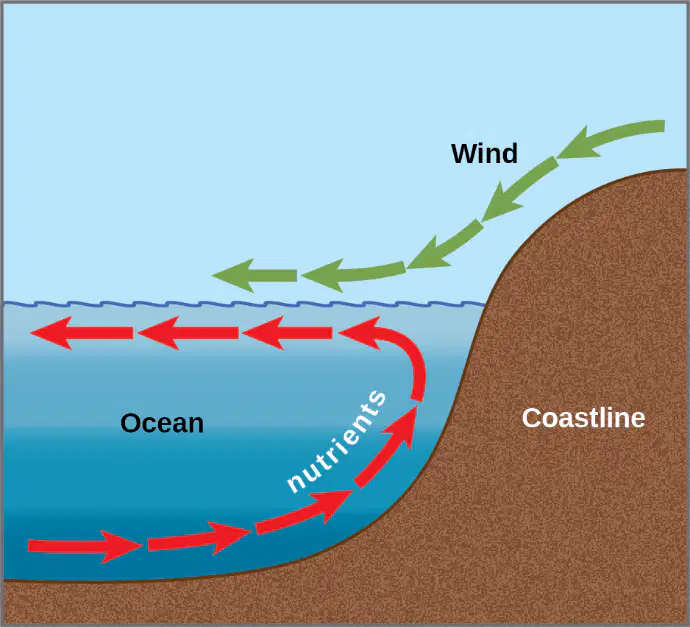
Refer to the ocean upwelling diagram. Which process directly brings nutrient-rich deep water to the surface along a coastline when winds push surface waters offshore?
Thermohaline circulation
Downwelling
Coastal upwelling
Internal tidal mixing
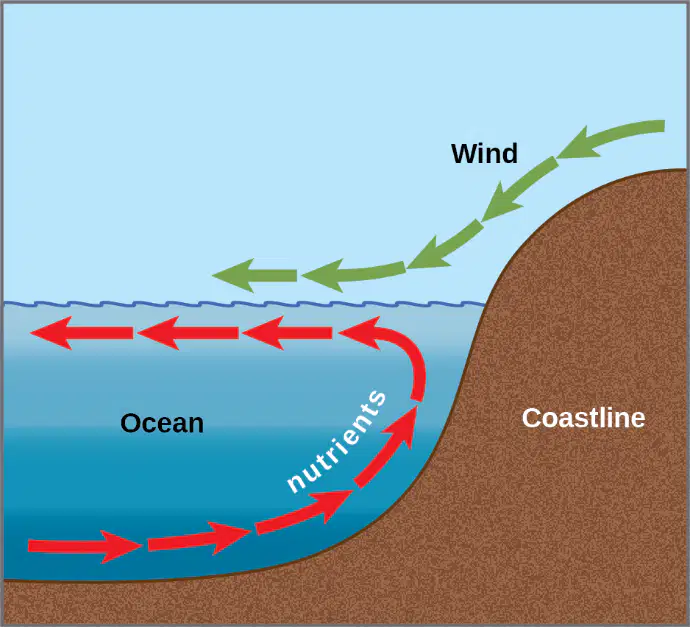
According to the upwelling diagram, what is the immediate driver that initiates the offshore movement of surface water, leading to the rise of deep water?
Temperature gradient
Wind pushing water away from shore
Seafloor spreading
Tidal bulges
Which marine zone is defined as the open ocean past the continental shelf and typically has scarce nutrients and fewer organisms?
Neritic zone
Oceanic zone
Intertidal zone
Photic zone
Which statement best distinguishes the photic zone from the aphotic zone in terms of depth and photosynthesis?
Photic zone is below 200 m and lacks light for photosynthesis; aphotic zone is above 200 m with abundant light.
Photic zone spans the top 200 m with enough sunlight for photosynthesis; aphotic zone lies below 200 m with insufficient light.
Both zones are confined to the continental shelf with equal light availability.
Aphotic zone is shallower than the photic zone due to higher nutrient levels.
Which realm encompasses all open ocean water, from the surface to the ocean floor?
Benthic realm
Pelagic realm
Neritic realm
Abyssal realm
Which zone is characterized by high pressure, low temperatures, complete darkness, and is located deeper than 4,000 meters?
Intertidal zone
Neritic zone
Abyssal zone
Photic zone
In the cross-section, which labeled region represents the ocean floor and supports fewer organisms as depth increases away from continents?
Pelagic realm
Benthic realm
Photic zone
Oceanic zone
Which zone lies over the continental shelf, is relatively shallow, and typically has plentiful nutrients and sunlight supporting many organisms?
Oceanic zone
Intertidal zone
Neritic zone
Aphotic zone
Which characteristic best describes water conditions in the intertidal zone?
Stable depth and salinity with minimal temperature variation
Fluctuations in water depth, salinity, and temperature due to tides
Consistently warm, clear water with high sunlight penetration
Uniformly cold, dark conditions across all depths
In the intertidal zone, which group primarily serves as producers capable of withstanding drying and submersion?
Sea urchins and barnacles
Crabs and sea stars
Algae and seaweeds
Phytoplankton and zooplankton
Which ecosystem service is specifically linked to intertidal zones?
Global carbon sequestration supporting climate regulation
Providing critical habitats and acting as a buffer protecting coastlines
Supporting most of the world’s fisheries through pelagic productivity
Tourism revenue from offshore pelagic species
Coral reefs rely on a symbiosis with which primary producers that photosynthesize within corals?
Phytoplankton
Zooxanthellae (coral algae)
Kelp forests
Cyanobacteria from deep waters
Which water condition is necessary for coral reefs to thrive?
Cold, turbid waters with limited light
Warm, clear, shallow waters with strong sunlight penetration
Deep, dark waters with low temperatures
Highly variable salinity due to tidal exposure
Which statement best distinguishes biodiversity patterns in the open ocean with increasing depth?
Species diversity increases steadily with depth due to cooler temperatures
Species diversity is uniform across all depths
Species diversity decreases with depth as conditions become colder and darker
Species diversity peaks only at the abyssal plain
What organism group forms the base of most marine food webs in the open ocean and is crucial to the ocean’s carbon cycle?
Zooplankton
Phytoplankton
Benthos (sea stars and crabs)
Marine mammals
A coastal region seeks natural protection from wave energy and erosion. Which marine ecosystem directly provides this buffering service according to the material?
Open ocean pelagic waters
Deep-sea hydrothermal vents
Intertidal zones
Offshore seamounts
Recall: Which statement best defines lentic habitats?
Aquatic systems characterized by still water that varies in depth, temperature, and oxygen levels
Aquatic systems dominated by rapid currents and continuous downstream flow
Coastal marine zones with tidal oscillations and saline conditions
Deep ocean basins with minimal primary productivity
Recall: Which group correctly lists primary producers typical of larger lentic water bodies?
Phytoplankton such as algae suspended in the water column
Rooted terrestrial shrubs colonizing exposed shorelines
Chemoautotrophic bacteria from hydrothermal vents
Salt-tolerant mangroves forming intertidal forests
Skill/Concept: A shallow lake is most likely dominated by which primary producers, and why?
Rooted aquatic plants, because light reaches the bottom enabling macrophyte growth
Phytoplankton, because deeper mixed layers prevent plant rooting
Coral polyps, because carbonate substrates favor reef building
Sphagnum moss, because saline influx raises osmotic stress
Recall: Which set best represents the biodiversity supported by lentic habitats?
Plankton, fish, amphibians, aquatic insects, and plant life
Only marine mammals and pelagic fish
Exclusively terrestrial vertebrates and decomposers
Deep-sea invertebrates adapted to high pressure
Skill/Concept: Which ecosystem service of lentic habitats directly supports human needs and recreation?
Provision of freshwater resources and recreational opportunities
Generation of tidal energy in coastal zones
Maintenance of ocean salinity through evaporation
Formation of barrier islands that protect coasts
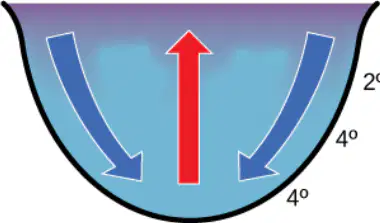
Strategic Thinking: A lake experiences spring turnover. Based on water’s density properties, which temperature profile and movement best explains this process?
Water at 4 °C becomes most dense, sinks, and drives mixing that brings nutrients and oxygen from bottom to surface
Surface water at 21 °C rises as it is denser, causing stratification to collapse
Ice at 0 °C sinks to the bottom, forcing warm water upward
Cold bottom water at 2 °C is least dense and remains unmixed
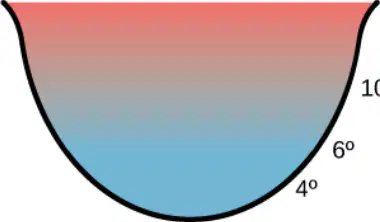
Recall: During summer stratification in deep lakes, which temperature gradient is typical?
Warm surface (around 21 °C) over cooler layers down to ~4 °C
Uniform 4 °C from surface to bottom
Surface near 0 °C with bottom at 10 °C
Bottom warmer than the surface throughout the season
Skill/Concept: Which statement best contrasts lentic and lotic habitats in terms of water movement?
Lentic are still water systems; lotic are flowing water systems
Both lentic and lotic are strictly marine environments
Lentic are tidal zones; lotic are stagnant wetlands
Lentic feature continuous downstream currents; lotic are isolated ponds
Strategic Thinking: Wetlands are valued for ecosystem services. Which scenario most directly illustrates flood protection by wetlands?
A river overflows during heavy rains, but adjacent marshes absorb and slow water, reducing peak downstream discharge
Open-ocean waves break on coral reefs, enhancing saltwater intrusion into coastal aquifers
A deep lake stratifies in summer, limiting nutrient upwelling to the surface
A groundwater spring increases flow velocity in a mountain stream

